
A central premise of the Antidote to Autocracy series is the knowledge that over recent decades our community has developed a wide array of capital innovations which if scaled could help address at least one of the forces driving the rise of American authoritarianism: citizens feeling left out of our economic future and lacking agency over their own economics at individual, family and community levels.
A central aspect of impact investing are strategies that expand economic agency through promotion of a robust asset-building policy in the United States. Accordingly, our nation has evolved from targeted savings interventions to universal child investment accounts and, more recently, to proposals that explicitly confront structural wealth inequality.
This essay examines three prominent individual asset building models
Individual Development Accounts (IDAs),
the Trump Administration’s universal child investment accounts, and
Senator Cory Booker’s Baby Bonds proposal
Before outlining an emerging hybrid approach that seeks to integrate lessons from each.
IDAs, pioneered in the 1990s, were designed as targeted, behaviorally informed interventions that combined matched savings, restricted asset uses, and financial coaching. Their purpose was not simply to increase savings balances but to alter life trajectories by making first-time asset ownership feasible for low- and moderate-income households.
By contrast, the Trump Accounts emphasize universal participation in capital markets, offering seed funding and tax-advantaged growth while relying on families and employers to contribute over time. This approach frames wealth-building primarily as normalized market participation rather than as structural correction.
Booker’s Baby Bonds represent a further conceptual shift, treating unequal starting wealth as the central barrier to long-term equity. Under this model, every child receives an account, but public deposits are progressive—larger for those born into households with less wealth. The focus moves from access to capital markets to public capitalization as a tool for narrowing wealth gaps at the outset of life.
In this post, I argue these models reflect distinct theories of change: feasibility (IDAs), normalization (universal accounts), and structural correction (Baby Bonds). In contrast, an emerging hybrid approach seeks to engage in systems change—combining universal infrastructure, progressive public capitalization, and modular institutional supports—which adds up to not simply positioning accounts merely as programs, but as efforts to create meaningful systems change with durable infrastructure for multi-sector capital coordination across the course of a life.
When I first heard of the “Trump Accounts” I was sincerely confused.
Here was Dear Leader on yet one more stage announcing how the government was going to open savings accounts for every child (one would assume, citizen child) in the United States, getting them off to a fresh start and process surely to guarantee financial independence by 30—and if not that, perhaps greater possibilities for saving and investing enough to help replace what will no doubt be a significantly crippled social security and retirement system in coming decades.
And who could be against such an initiative?
It sounded great—thoughtful, evidence-based, privately funded (at least, in large part).
My challenge was simply that for perhaps 25 years I had heard Robert Friedman of CfED (apparently rebranded in 2017 as Prosperity Now, which gives you a sense of how old I’m becoming!) promote what were called at the time Individual Development Accounts.
The new Trump Accounts sounded suspiciously like a marketing rip off—taking yet one more innovation within the progressive, nonprofit/community development sector and taking it over to take credit for a notion that had been pioneered by others for years.
A core premise of this series is that one of our best responses to the rise of American authoritarianism will be capital innovations of impact investing that promise to increase real wealth at the family level and decrease resentment and anger of being cut out of the American Dream.
Who is “right” and which approach should we champion?
Am I actually a closeted MAGA Man or a Friend of Bob?
I realized I had to go back to school and catch up on the conversation—and maybe you feel the same?!
It is important we understand how the three “new” initiatives presently before us—Trump Accounts, Individual Development Accounts and Booker’s Baby Bonds—compare, what their core assumptions are and—most importantly—do they simply continue on a “business as usual” basis or do they seek to use financial innovation to advance greater equity, justice and impact toward creating a more equitable economic order, capable of taking some of the wind out of our authoritarian drift?
Across the past three decades, the idea that people need assets—not just income—has moved from academic argument to mainstream policy terrain. What began in the 1990s as a relatively niche conversation among scholars and practitioners about matched savings accounts now shows up in federal legislation, presidential proposals, and major debates about inequality.
Today, at least three distinct approaches sit side by side. They look similar on the surface—each creates an account for a child, seeds it with some form of capital, and allows growth over time. But beneath that shared architecture lie very different answers to a deeper question:
What problem are we trying to solve when we give someone assets?
The contrast between the Trump administration’s child investment accounts, the long arc of Individual Development Accounts promoted by CfED (again, now Prosperity Now), and Sen. Cory Booker’s “Baby Bonds” proposal makes those differences unusually clear.
Seen together, they trace the evolution of the American asset-building imagination—from behavioral intervention, to universal participation, to structural correction and now forward to new, perhaps more sustainable hybrid options for future generations.
The Original Insight: Assets Change Trajectories
The intellectual starting point for much of this conversation sits with Michael Sherraden’s argument that assets matter not simply because they provide financial security, but because they reshape expectations, decision-making, and life planning. A household that owns something behaves differently from one that does not. The question became how to make first asset ownership plausible for people who lacked inherited wealth.
Individual Development Accounts emerged as a practical answer.
They were intentionally designed as “thick” interventions: matched savings, restricted uses, and financial coaching woven together to help households accumulate a first transformative asset—education, a home, a small business. The match mattered because income volatility made saving strategies on their own difficult. The restrictions mattered because the goal was not savings alone but asset acquisition. The coaching mattered because capability is institutional, not merely individual.
Child Development Accounts and experiments like SEED extended this logic earlier in the life course. If expectations shape trajectories, then starting at birth or early childhood could shift not only balances but horizons.
In this framework, the account is not the policy. The scaffolding around it is.
The Universal Turn: Normalize Participation in Capital
The newer federal child investment accounts associated with the Trump administration reflect a different move:
They retain the symbolic power of giving every child an account and seed capital, but they thin out the surrounding intervention. The emphasis shifts from targeted mobility to universal participation.
The program’s architecture is straightforward: a federal seed contribution during a defined birth window, tax-advantaged growth, and an open invitation for families and employers to contribute over time. The narrative is less about overcoming structural barriers to saving and more about ensuring every child has a stake in market growth.
This is an “ownership society” logic translated into childhood policy. Compounding, exposure to capital markets, and habit formation do the conceptual work. Equity effects are expected to emerge indirectly through universality and time.
Critics from the asset-building field note the obvious tension:
When private contribution capacity varies widely, universal vehicles can amplify gaps even while broadening participation. Proponents counter that simplicity scales, reduces stigma, and builds political durability in ways targeted programs often cannot.
The disagreement is not technical. It is philosophical as well as strategic. The central question to be addressed is whether one believes the primary barrier to family and individual level sustainability to be lack of access, or unequal capacity?
We will go into deeper discussion below, but just to make sure we are all more or less starting with the same understanding of what is under discussion, let’s start with a few areas of inquiry.
1) What are the Trump administration child savings accounts?
The program widely referred to as “Trump Accounts” (created in the 2025 tax law) is essentially a universal, IRA-like investment account for children.
Core design features
Federal government seeds accounts with $1,000 for children born 2025–2028. (Wikipedia)
Families, employers, or others may contribute up to about $5,000 annually. (Brookings)
Funds are invested largely in index-style equity funds and grow tax-deferred. (Brookings)
Accounts convert to a retirement account structure at adulthood (roll into IRA). (Wikipedia)
Eligibility is near-universal (all children under 18) rather than income-targeted. (Vanguard)
Underlying policy rationale
Give every child an early stake in capital markets
Encourage private saving and employer matching
Frame wealth-building as an individual investment pathway
Conceptually, it sits closer to “ownership society” / market participation policy than to poverty-reduction policy.
2) What were CfED’s Individual Development Accounts (IDAs) designed to do?
The Corporation for Enterprise Development (Prosperity Now) promoted Individual Development Accounts (IDAs) beginning in the 1990s as a cornerstone of the U.S. asset-building movement.
Core design features
Accounts targeted primarily to low- and moderate-income households
Matched savings (often 1:1 to 3:1) funded by philanthropy or government
Funds restricted to specific asset uses:
Education
Homeownership
Small business
Integrated with financial coaching / capability building
Programs like SEED extended the model to children with initial deposits and progressive matching that increased for lower-income families. (Wikipedia)
Underlying policy rationale
Address structural wealth inequality
Create first-time asset ownership
Use savings as a behavioral and developmental intervention
Again, this tradition is grounded in Michael Sherraden’s theory that assets change life trajectories, not just balance sheets.
3) What are the core conceptual differences between the two approaches?
Trump Accounts = universal investment account
Primary lens:
Market participation and long-term saving
Mechanism:
Seed capital + voluntary contributions + compounding
Equity strategy:
Indirect — everyone gets the same baseline
IDAs (CfED tradition) = targeted asset-building intervention
Primary lens:
Economic mobility and inequality reduction
Mechanism:
Progressive matching + restricted asset uses + coaching
Equity strategy:
Explicit — larger subsidies for those with fewer resources
4) How do we best understand the policy differences between the two approaches?
As our starting place is a comparison between the Trump Accounts and the original IDA approach, a classic, no doubt overly simple table easily illustrates the differences:
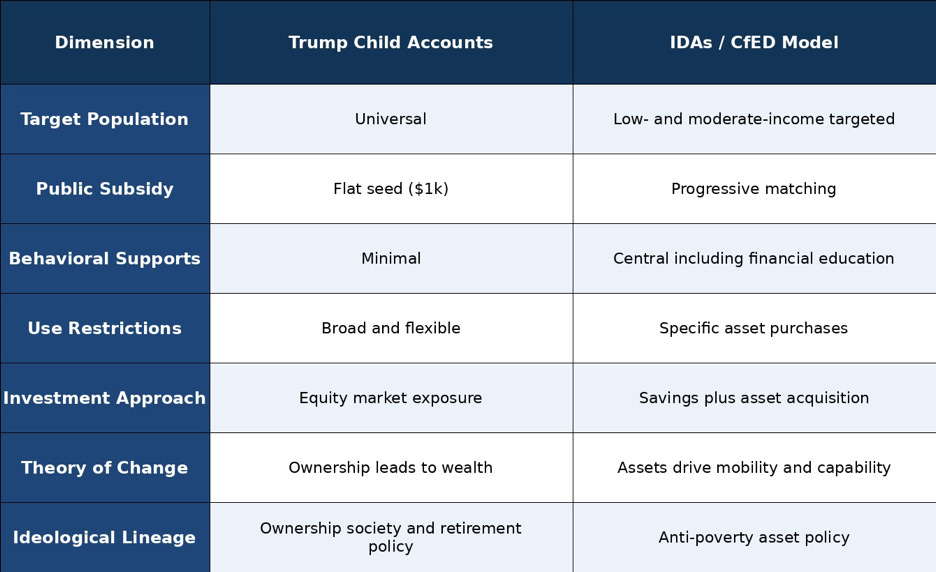
5) What are the deeper, philosophical differences—the understood purpose of these approaches?
Differences between the two approaches is not simply a question of program design but rather reflects two competing frameworks of wealth building.
A. Capital access vs. capital correction
Trump accounts: Expand access to capital markets
IDAs: Correct unequal starting positions
B. Individual saving vs. institutional scaffolding
Trump model assumes households will contribute if given a vehicle
IDA model assumes many cannot without subsidy and coaching
C. Financialization vs. asset transformation
Trump accounts emphasize portfolio growth
IDAs emphasize life-stage asset acquisition (home, business, education)
These distinctions mirror debates the field has explored for years:
Do we emphasize market participation or/over capital orchestration and structure
for advancing greater equity?
(We’ll come back to this topic, of course…)
6) Where do the two approaches overlap?
Interestingly, there are also real, complimentary elements to both approaches.
Both draw from the asset-building movement of the 1990s–2000s:
Early savings matter
Psychological effects of ownership
Child accounts shift expectations
The Trump program resembles a universalized, simplified descendant of SEED-style children’s accounts — but without progressive design features.
In policy taxonomy:
IDAs = targeted asset policy
Trump accounts = universal children’s savings account (CSA) with retirement framing
7) What do IDA advocates say about the Trump Administration approach?
Asset-building scholars typically argue the Trump approach risks:
Regressive effects
Wealthier families can maximize contributions
Weak mobility impact
$1k seed alone rarely changes trajectories
Missing capability layer
No coaching or structured asset purchase
Financial market risk exposure
Returns depend on equity performance
This critique is consistent with longstanding research in the SEED and IDA literature.
8) How do those designing the Trump approach view that of the IDA community?
They would argue IDAs…
Are administratively heavy
Scale poorly
Stigmatize recipients
Create fragmented programs
Their claim: Universal vehicles create political durability and normalization.
A single sentence, bottom-line analysis? How about this:
IDAs were designed to change inequality;
Trump child accounts are designed to normalize investment.
Same tool category — radically different policy intent.
And only one may be viewed as intentionally focused on advancing meaningful change.
Booker’s Baby Bonds proposal reframes the question yet again. It accepts the insight that early assets matter and the practicality of universal accounts, but rejects the assumption that equal vehicles produce equitable outcomes. Instead, it treats unequal starting wealth as the core problem and designs the public contribution schedule accordingly.
Under this logic, every child receives an account, but deposits are progressive—larger for those born into households with less wealth. The account becomes a mechanism for public capitalization rather than primarily a container for private saving. Access in young adulthood is typically tied to asset-building uses, but the defining feature is the front-loaded redistribution.
Where the Administration’s Trump Accounts focus on the universal participation model (emphasizing exposure to markets), Baby Bonds emphasize starting endowments. The policy does not wait for compounding to close gaps; it attempts to narrow them at the outset.
In intellectual lineage, this approach draws from the same asset theory as IDAs but shifts the locus of intervention from household behavior to public balance sheets.
Placed side by side, the differences clarify themselves:
First, the IDA tradition assumes the binding constraint is feasibility. People want to save but cannot without subsidy, structure, and support. The intervention therefore builds institutional scaffolding around individual effort.
Second, the Administration’s universal investment account approach assumes the binding constraint is access and normalization. Provide a simple vehicle early, and participation plus time will generate outcomes.
And third, whereas the Baby Bonds framework assumes the binding constraint is unequal starting wealth. Adjust the public contribution schedule, and trajectories shift even before private behavior enters the picture.
Each model answers a different question, which is why debates about them often talk past one another. They are not merely competing program designs; they are competing diagnoses.
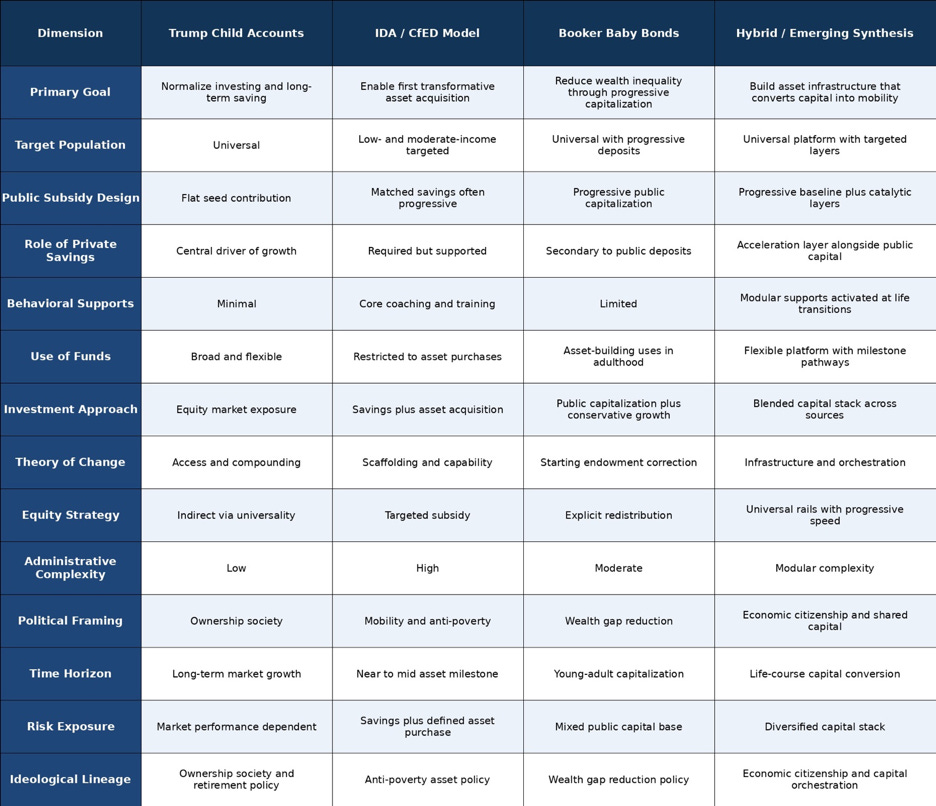
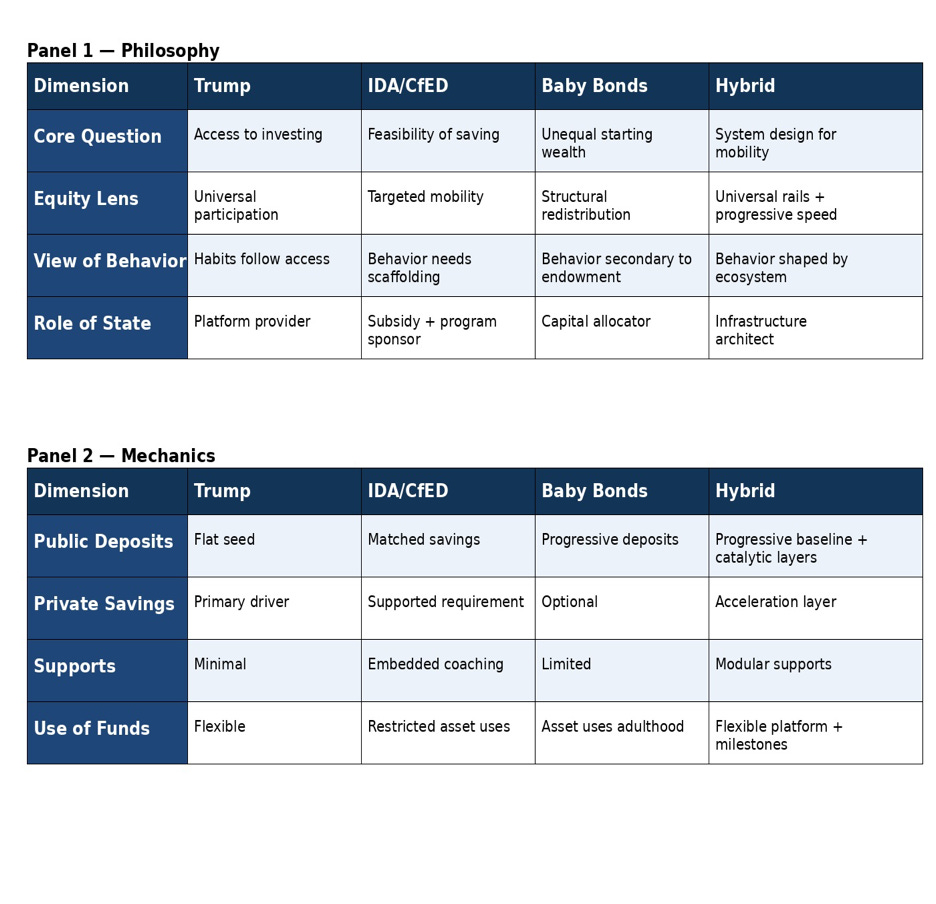
In addition to doing a side-by-side analysis of issues such as Theory of Change and Political Framing, it also helps to enunciate the underlying philosophy underscoring each approach, its intellectual assumptions and, therefore, its structural or, if you will, mechanical implications for how a program might then be created.
As illustrated below, a different starting place leads to program design and execution that is similar in type but not kind.
To my mind, this and the previous chart outlines the central questions we need to consider in assessing the Trump Accounts as compared with other initiatives and the degree to which they may be viewed as useful in our efforts to make use of capital innovation to advance impact or greater economic equity—which in turn we argue is necessary to act then as a possible antidote to autocracy.
Viewed historically, these approaches do not replace one another so much as layer one upon the next. The IDA movement demonstrated assets matter and targeted subsidy can change behavior. The universal account movement translated that insight into politically scalable infrastructure. Baby Bonds push the conversation further by asking whether infrastructure without progressive capitalization can meaningfully address wealth inequality.
This progression mirrors a broader shift across social policy and philanthropic strategy: from behavioral interventions, to participation frameworks, to structural balance-sheet thinking.
It is also why the distinctions matter for practitioners working in blended finance, philanthropy, and market-shaping. The question is not whether accounts are good policy tools. It is what role public, private, and institutional capital should play in determining who accumulates assets and when.
An account can be a nudge, a platform, or an endowment. The policy choice is deciding which.
There remains a durable tension between universality and progressivity (if that is even a word…excuse me if not!!), simplicity and intentionality, scale and precision. Universal vehicles build constituencies and normalize ownership. Targeted or progressive capitalization addresses distribution more directly but often raises political and administrative complexity.
The history of asset-building policy suggests durable systems may ultimately blend these approaches: universal infrastructure, progressive public deposits, and optional layers of support that make asset acquisition realistic across income volatility.
That synthesis is still emerging. But the conversation has clearly moved beyond whether assets matter to how society chooses to allocate starting capital across generations.
Which, in the end, is less a technical question than a moral and political one:
Whether giving every child an account is enough, or whether giving them different amounts is the point. Either way, the three approaches outlined so far focus more on the individual as opposed to the systems of economics and inequity that must be navigated over the course of a life…
Perhaps its time for a different perspective and approach?
If the past thirty years of asset-building policy trace a movement from targeted intervention to universal participation to structural capitalization, a fourth approach is beginning to take shape in practice—even if it is not yet fully codified in federal policy.
This emerging synthesis does not choose between the three existing logic models as much as combine them. It starts with the recognition that each approach solved a real problem while leaving another insufficiently addressed. IDAs demonstrated that behavior changes when institutions make asset accumulation feasible. Universal child accounts appear to demonstrate scale and normalization require simple infrastructure. Baby Bonds clarified that unequal starting capital must be confronted directly if wealth gaps are too narrow across generations.
The hybrid direction attempts to hold all three insights simultaneously.
At its core is the idea of universal account infrastructure paired with progressive public deposits and layered supports that households can draw on when needed rather than as a condition of participation. The account exists automatically. The public contribution schedule adjusts based on household wealth or income. Coaching, matching incentives, or asset-specific supports sit as optional layers that can be activated around key life transitions—education, housing, entrepreneurship—rather than embedded permanently in the account structure.
This represents a shift from programmatic intervention to system design.
In this model, the account is the platform. Progressive capitalization establishes a baseline distribution. Institutional actors—schools, financial institutions, philanthropy, employers, community organizations—provide episodic scaffolding that helps translate accumulated capital into real asset acquisition. The emphasis moves from whether households save to whether systems coordinate around moments when assets become actionable.
Strategically, the hybrid approach also reframes political trade-offs that previously appeared binary. Universality remains because it builds legitimacy and durability. A progressive vision remains because equal vehicles do not produce equal outcomes. Administrative complexity becomes modular rather than universal: the full weight of coaching and matching does not apply to every participant all the time, but it is available where it changes trajectories.
This modularity is one of the most important conceptual shifts. IDAs embedded supports within the account. Universal investment accounts removed them. The synthesis externalizes them—creating a surrounding ecosystem that can plug into a common asset platform.
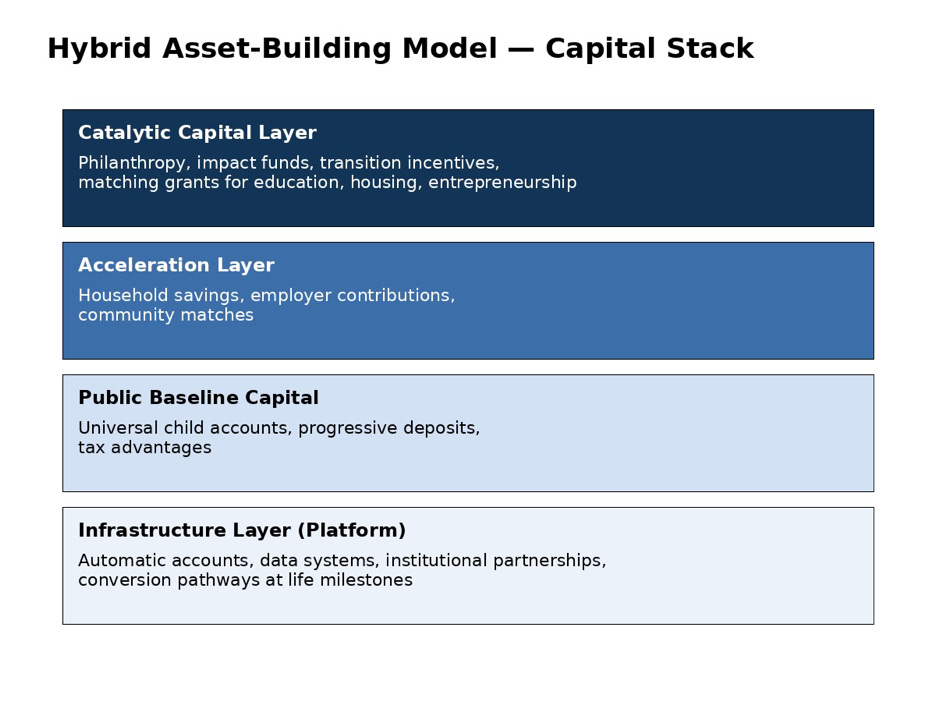
From a capital perspective, the hybrid direction also blurs traditional sector boundaries. Public deposits provide the floor. Private savings and employer contributions provide acceleration. Philanthropic and impact capital function as catalytic layers that target specific transitions or populations. What emerges begins to resemble the kind of capital orchestration framework more commonly discussed in place-based investing than in household finance.
The account becomes a node in a broader capital stack.
Seen this way, the trajectory of asset-building policy mirrors a broader evolution in social policy design: from discrete programs to infrastructure that coordinates multiple capital sources across time. The goal is no longer simply helping individuals save or even redistributing starting balances, but creating a durable architecture through which different forms of capital may then accumulate, interact, and convert into opportunity at predictable moments in the life course.
The tension between simplicity and intentionality does not disappear in this model, but it becomes a design parameter rather than a choice between competing philosophies. Universality provides the rails. Progressivity shapes the distribution of starting speed. Institutional scaffolding influences how effectively momentum translates into outcomes.
If earlier phases of the movement asked whether assets matter and how to provide them, this emerging phase asks how to build systems in which asset accumulation is not episodic policy but a persistent feature of economic citizenship.
The answer is still unfolding. But the direction is increasingly clear: less emphasis on accounts as programs, more emphasis on accounts as infrastructure through which society decides how to allocate starting capital, support its growth, and ensure that it converts into real mobility across generations.
(If you get the point and don’t want to go deeper, simply scroll down to the closing section!)
A Quick Dip in the Weeds: The Hybrid Approach, Explored
The emerging fourth, integrated approach to asset-building reflects a quiet shift from thinking about accounts as programs to thinking about them as infrastructure. Earlier models clarified different truths: that assets shape life trajectories, that universal participation creates legitimacy and scale, and that unequal starting wealth must be addressed directly if gaps are to narrow.
The hybrid perspective accepts all three. It assumes no single intervention—behavioral support, universal access, or progressive capitalization—can on its own produce durable mobility. Instead, the focus moves to building a platform through which different forms of capital accumulate over time and can be converted into opportunity at predictable life transitions.
In practice, this means combining universal account architecture with progressive public deposits while surrounding the account with modular supports that activate when they matter most. Rather than embedding coaching, matching, and restrictions permanently within the account—as in the IDA era—or removing them entirely in the name of simplicity—as some universal designs have done—the hybrid model externalizes these functions into an ecosystem. Schools, financial institutions, employers, philanthropy, and public agencies become episodic partners in asset conversion. The account establishes continuity; the surrounding system shapes outcomes. Equity becomes a question not only of who receives deposits but of how effectively accumulated capital can be translated into education, housing, entrepreneurship, and resilience.
The Hybrid Capital Stack
This approach also reframes the role of different capital sources. Public funding provides the baseline distribution and signals collective commitment. Private savings and employer contributions accelerate growth for those able to add resources. Philanthropic and impact capital act as catalytic layers that target transitions, populations, or market failures that public systems cannot easily reach. The resulting architecture resembles capital orchestration more than traditional social policy: a coordinated stack in which timing, alignment, and institutional roles matter as much as dollar amounts. What emerges is less a single program than a life-course infrastructure for asset formation.
Case study 1: Maine’s Harold Alfond College Challenge
Maine’s statewide children’s savings program illustrates an early version of the hybrid logic. Every child receives an automatic seed deposit for college savings, establishing universal infrastructure and signaling that post secondary education is expected. Over time, the program has layered targeted matching incentives, outreach partnerships with schools and community organizations, and philanthropic funding that increases support for families with lower incomes.
What makes this model hybrid is not the seed itself but the coordination around it. The account is universal and simple, yet the surrounding ecosystem introduces progressive features and behavioral supports without making participation conditional on them. The program demonstrates how philanthropy can function as a catalytic layer atop public infrastructure, helping translate a symbolic starting balance into real educational pathways.
Case study 2: SEED and its successors in integrated child account design
The SEED initiative—while originally framed within the IDA/CDA tradition—became influential precisely because it experimented with combinations that now define the hybrid direction: automatic account opening, initial deposits, progressive incentives, financial education, and institutional partnerships spanning schools, financial providers, and community organizations.
Its legacy is methodological rather than programmatic. SEED showed that universal architecture and targeted supports need not be mutually exclusive, and that developmental effects arise from the interaction between balances, expectations, and institutional engagement. Many contemporary statewide CSA programs draw directly from this insight, effectively turning what began as demonstration projects into infrastructure that can support layered capital over time.
Case study 3: Place-based capital orchestration models linking household assets to community investment
A more recent frontier extends hybrid logic beyond individual accounts into place-based capital systems that connect household asset building with broader investment flows. Initiatives that combine guaranteed income pilots, children’s savings accounts, housing equity programs, and mission-driven investment funds illustrate this shift. In these models, the child or household account is one node in a wider ecosystem that includes community development finance institutions, philanthropic funds, municipal programs, and employer participation.
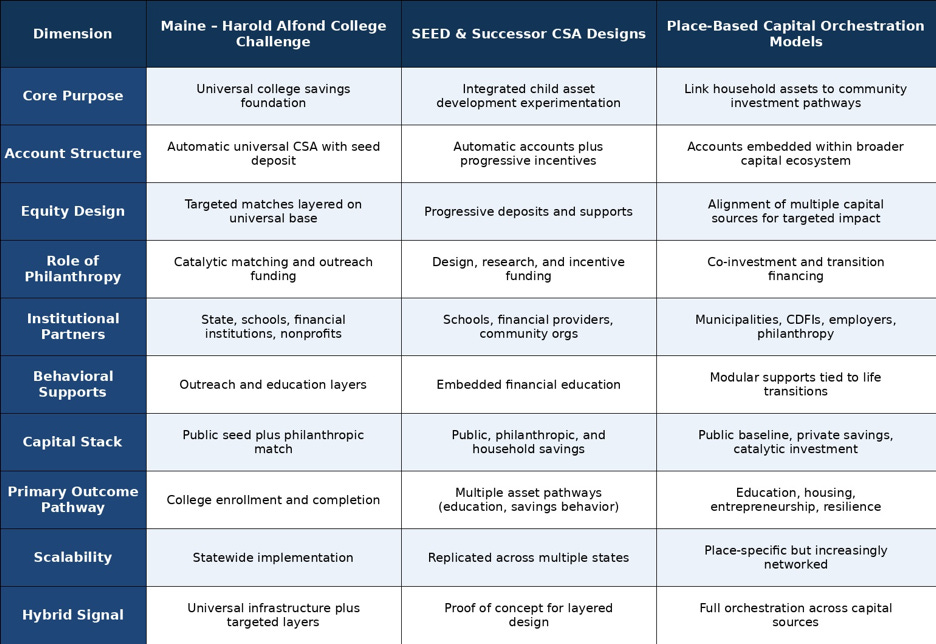
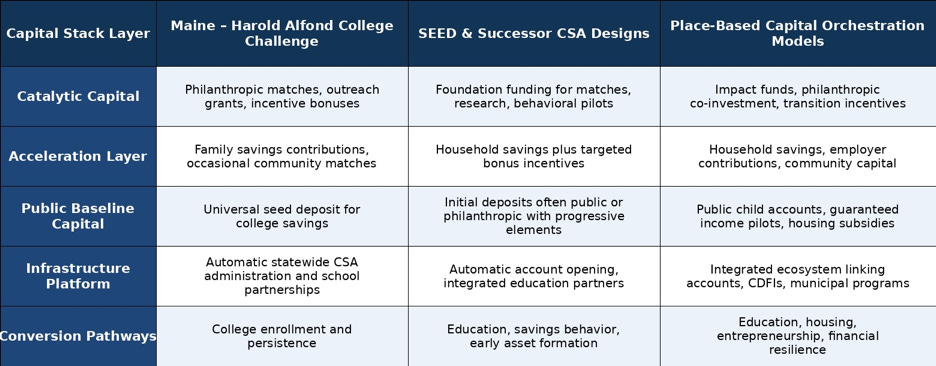
What distinguishes these efforts is their emphasis on conversion pathways. The goal is not simply that families hold assets, but that those assets interact with available financing, education pipelines, and local investment strategies. The hybrid approach becomes visible when public deposits, private savings, and catalytic capital are intentionally aligned so that households encounter coordinated opportunities rather than isolated programs.
This fourth approach represents a convergence between household asset policy and the broader field of capital orchestration—an alignment that suggests the next phase of asset-building will be less about designing accounts and more about designing systems in which assets meaningfully circulate.
Taken together, the three primary asset-building models explored in this essay illuminate a deeper debate about the future of economic justice in the United States.
IDAs sought to make asset acquisition feasible for those historically excluded from wealth formation. Universal child investment accounts seek to normalize early participation in capital markets at scale. Baby Bonds directly confront inherited inequality by altering starting endowments through progressive public deposits. Each approach identifies a different binding constraint within American capitalism—capacity, access, or structural imbalance.
Yet none alone fully addresses the systemic dynamics that generate and perpetuate wealth inequality across generations. Modern financial capitalism concentrates gains through compounding returns, preferential tax treatment, and capital-market access that disproportionately benefits those already holding assets. If policy interventions simply plug individuals into this system without adjusting its distributional mechanics, they risk amplifying disparities even while broadening participation. Conversely, purely re-distributive approaches that fail to build durable political and institutional infrastructure may struggle to scale or persist.
The emerging hybrid model points toward a more coherent path: universal account infrastructure to ensure legitimacy and normalization; progressive public capitalization to correct unequal starting positions; and coordinated, modular supports that help accumulated capital translate into education, housing, entrepreneurship, and resilience at key life transitions.
Such a design reframes asset policy not as episodic intervention but as generational infrastructure. It acknowledges that markets are powerful engines of growth, but that justice requires intentional structuring of who receives starting capital, how compounding operates, and how value converts into opportunity.
Advancing positive systems change within modern financial capitalism demands more than new accounts. It requires policy architecture that embeds equity into the distribution of capital from birth, aligns public and private capital flows toward broad-based asset ownership, and treats wealth-building as a dimension of economic citizenship rather than individual luck.
The central moral question is not whether children should have accounts, but whether American policy will intentionally design capital systems that expand dignity, reduce inter-generational inequity, and strengthen democratic stability.
If asset-building policy is to serve as an antidote to polarization and authoritarian drift, it must move beyond symbolic inclusion toward structural fairness—building a financial system in which compounding works for the many rather than the few.
1. Are we deploying capital in ways that merely expand participation in existing financial structures, or are we intentionally reshaping starting conditions to narrow structural wealth gaps across generations?
2. Does our investment strategy reinforce compounding advantages for those already well-capitalized, or does it help establish baseline endowments that allow broader segments of society to participate meaningfully in long-term wealth creation?
3. How might philanthropic, impact, or private capital serve as catalytic layers within a coordinated asset infrastructure—targeting life transitions where additional support changes trajectories rather than simply increasing balances?
4. If our goal is systemic change rather than programmatic success, what evidence would demonstrate that our capital is contributing to durable increases in economic mobility, democratic stability, and shared prosperity?
Thanks for reading Antidote to Autocracy! This post is public so feel free to share it.
Author’s Note: While the final writing and analysis are my own, please know I did make use of various AI tools in research and drafts conducted for this project. For a fuller discussion, please see the closing Note in the first post of the Antidote to Autocracy series. Thanks!
No posts
Comments
Nothing yet. Say the first thing.
Sign in to join the conversation.