
Summary Overview
In Part One of this post, I presented the dual questions of whether philanthropic foundations should exist and, if so, what an appropriate role for philanthropy might be in the context of responding to the rise of American autocracy today.
In this current post, Part Two, I take (for the time being!) the existence of philanthropy as a good thing, assume that with considered reflection philanthropy has a role to play in supporting democracy and The Rule of Law in our world today, and present areas of possible philanthropic action, presenting six archetypes of foundations I would argue are playing an important role in responding to today’s challenges and then discuss four areas in which we might raise the bar for our shared future.
Strategic Action by Philanthropy
The importance of foundations taking a leadership role in areas of critical interest not only to civil society organizations but broader, national and social questions of our time is key. In reflecting on the Rockefeller Brothers Fund efforts to advance a total portfolio approach—in their words, a systems approach—to its investment strategy and practices, Fund President Stephen Heintz said,
Should we lead or should we endure?
To which I say, if we do not lead we may not endure.
I would argue the same is true here, with regard to both the importance of foundations deploying ALL their assets on an integrated, total portfolio basis as well as the need to do so in a manner directly tied to voicing an alternative vision to the rising practices of American authoritarianism.
While there are various ways foundations are looking to step up, they may be loosely categorized in three strategic areas:
1. Collective Sector Advocacy and Legal Mobilization
2. Embracing Multi-year and Trust-Based Flexible Funding Models
3. Targeted Resilience: Climate, Impact Investing and Narrative Defense
One: Collective Sector Advocacy and Legal Mobilization
Organizations such as the Council on Foundations, Independent Sector, National Council of Nonprofits, and United Philanthropy Forum issued a joint statement condemning administrative threats to Harvard’s tax-exempt status and calling on the IRS to remain apolitical and independent.
The Council also led a bipartisan coalition opposing proposed legislation raising foundation excise taxes in H.R. 1 (“The Big Ugly Bill”), warning it would drain resources from community grants. At the same time, nonprofits and their allies have filed lawsuits that, for a time (and as of this writing!) successfully blocked attempts to freeze federal grants—litigation supported in part by foundation‑backed legal defense coalitions.
For additional examples please see 100 Liberal Philanthropies pushing back on Trump and Uniting in Advance of Coming Attacks. (See the full statement here).
Two: Embracing Multi-year and Trust‑Based, Flexible Funding Models
Under these current pressures, some foundations have also adopted or doubled down on trust‑based philanthropy—grant practices that reduce administrative burdens, offer unrestricted multi‑year funding, and center nonprofit autonomy. MacKenzie Scott’s approach to grantmaking, wherein she works with advisors to identify “proven” institutions and then makes multi-year gifts totaling hundreds of millions of dollars, is perhaps the best current example of this approach (not connected to an anti-autocracy strategy, however!) though there are certainly others operating in a similar vein at lesser monetary scale.
More specifically, over 70 foundations have signed commitments to “mobilize money, move in solidarity with nonprofits, and nurture possibility” through these practices. This may potentially enable grassroots and social justice organizations to pivot rapidly amid legal, operational, or ideological targeting by the Administration—essential in the disruptive landscape created by federal policy shifts.
Three: Targeted Resilience: Climate, Impact Investing and A Narrative Defense
Foundations are also pursuing targeted initiative responses.
For example, in 2025 as Trump rolled out Earth Day–timed climate grant freezes, philanthropic groups mobilized emergency funding for climate justice groups, backed legal challenges to block funding halts, and invested in advocacy campaigns to protect environmental nonprofits and international health programs. The Global Impact Investing Network (GIIN), Confluence Philanthropy (where I serve on the Board of Directors) and various other like-minded funders continue working to build resilient impact‑investment frameworks despite political headwinds, reinforcing ESG, sustainability and other values/priorities where federal policy wavers.
In a recent FT article by Sarah Murray, titled Philanthropists find new ways to give in the face of Trump’s opposition, it is reported philanthropists and foundations in the U.S. are continuing to adapt their strategies in response to increasing hostility from President Trump’s administration, including the legal threats, funding cuts, and political intimidation outlined above.
As that article reviews and as the above demonstrates, some in the foundation community are positively responding to current threats by:
Caution & Concealment: Foundations are auditing their communications, changing language to remove “red flag” equity and DEI language as well as shifting to donor-advised funds for anonymous giving.
Defensive Giving: Others are redirecting funds toward democracy, rule of law, and local/state initiatives, away from federal programs.
Increased Urgency: Foundations like MacArthur, McKnight, Gates, and Marguerite Casey are accelerating or increasing their grantmaking, citing the present urgency as a “rainy day.”
Coalition Building: There’s a growing trend toward collective action and public solidarity. Growing numbers of organizations have signed a statement defending philanthropic freedom, led in part by the MacArthur Foundation.
In a recent post, Victoria Rodarte offers some excellent ideas on how foundations might move toward funding “power building.” She proposes philanthropy take a “multi-entity systems approach,” and champions power structure analysis, cultivating an understanding of the true (and not simply perceived or understood) boundaries and limits of philanthropy, refinement of individual foundation strategy within that larger eco-system and moving from incremental, small project funding to investing in grantee organizations as if your life depends upon it—because it now does!
In these and other ways, some within the foundation community seek to protect critical thematic sectors such as climate, global health, racial equity, justice, and democracy through emergency grant programs. They are also positively positioning themselves as bulwarks for civil society and free expression as federal policy and resource support for such norms and values is not only in full retreat, but rather arrayed directly against the promotion of such values and vision.

Photo by Jon Tyson on Unsplash
Six Types of Philanthropic Action in Response to Democratic Erosion
As I noted in a previous post highlighting constructive responses to rising authoritarian pressures, a number of foundations have stepped forward publicly to articulate how they are adjusting their strategies in this moment.
In previous drafts of this post, I named specific actors and organizations. However, recently it has become clear the current Administration is developing and executing strategies targeting the social media platforms being used by those communicating regarding ICE and related actions as the DOJ also is investigating individual philanthropies, challenging those supporting what they deem to be “the opposition.”
I don’t want to make their research any easier, and so in this post have opted to share broader lessons from those taking action against policies of the present moment, but have “anonymized” the material. To readers of this post, what is important is less the individual or organizational names, but rather lessons and strategies we might learn from and advance.
I know you understand!
What follows are six examples of foundation action that, in different ways, have chosen not to retreat into quiet grantmaking, but instead to realign their voice, capital, and institutional posture in response to democratic strain.
1. A National Foundation Modeling Courageous Public Leadership
One large, nationally recognized foundation has demonstrated what it means to lead with clarity in moments of instability. Its president has publicly stated that crisis is not a time to shrink but a time to act with greater boldness. That sentiment has been matched with action.
Beyond encouraging peers to defend democratic norms, the foundation has embedded a pro-democracy lens across multiple program areas and examined how its endowment and financial assets may better aligned with its stated values. Rather than confining its stance to traditional grantmaking, it has used its institutional voice to articulate what an inclusive, non-authoritarian future requires.
Equally important, its chief executive has modeled a tone of principled firmness without rancor—speaking directly to threats facing civil society while maintaining professionalism and respect. If more philanthropic leaders chose to speak with similar clarity and composure, the sector’s collective voice would carry greater authenticity and weight.
2. A Community-Rooted Foundation Strengthening Local Voice
Leadership against authoritarian drift is not limited to the largest institutions. One smaller foundation with deep local roots offers an equally compelling model.
Rather than retreating from politically sensitive language, this foundation has maintained its commitment to diversity, equity and racial justice, signaling values are not seasonal. More significantly, it is funding the building blocks of social movements by channeling resources into community-based leaders—helping them organize, advocate, and raise the volume of their own voices.
This foundation’s strength lies not in scale but in proximity. By funding grassroots engagement and community organizing, it reinforces democratic participation at its most fundamental level. In doing so, it demonstrates that protecting democracy often begins not in national capitals, but in neighborhoods.
3. A Financial Institution Foundation Activating Internal Civic Capacity
Another example comes from a mission-driven financial institution’s affiliated foundation, which has approached the current moment through supporting internal civic activation of its employees.
In a recent initiative, the foundation encouraged staff to use a portion of staff time to engage in meaningful civic participation outside their regular professional roles. The approach was practical and structured. It included:
Curated resources and engagement pathways for lawful civic action
“Know Your Rights” trainings
Secure communication and digital resilience workshops
Paid volunteer time for activities consistent with nonprofit guidelines
Voluntary personal civic commitments supported through peer accountability
Regular internal communications to sustain momentum
In addition, the foundation began developing a digital archive documenting historical patterns of injustice within its sector and the ways communities resisted and reformed those systems. In a time when narratives can be erased or distorted, preserving historical truth becomes a form of institutional responsibility.
This approach expands the definition of philanthropy beyond grants alone. It treats employees not just as staff, but as citizens.
4. A Research Foundation Defending Democratic Infrastructure
A longstanding research and policy foundation has taken a comprehensive approach to democratic defense. In its most recent annual reporting, it spoke directly about executive overreach, censorship, and threats to civil and human rights—naming risks rather than alluding to them.
Its work spans multiple reinforcing strategies:
Raising awareness of democratic vulnerabilities
Providing the public with tools to recognize authoritarian patterns
Strengthening local civic participation
Integrating arts and culture into democracy work
Building international partnerships committed to democratic resilience
The foundation has also elevated respected leaders in democracy work through fellowships, board appointments, and recognition programs designed to support those working on the front lines of institutional integrity.
This model demonstrates how research institutions can pair analysis with active defense of democratic norms.
5. A Legacy Foundation Recommitting Resources and Voice
A large, well-established foundation recently published a presidential essay reaffirming its commitment to inclusion, rule of law, and free expression. In response to mounting democratic pressures, the foundation announced a temporary increase in its charitable payout rate.
While modest relative to the institution’s total assets, the increase signals recognition that “business as usual” is not sufficient in moments of democratic fragility. The foundation also engaged prominent scholars and thought leaders in public dialogue about belonging, identity, and authentic inclusion.
Importantly, its communications strike a tone that balances urgency with humility. Rather than claiming to have solved the moment, it frames its actions as part of an ongoing effort to realign philanthropy with foundational truths.
6. A Movement-Aligned Foundation Shifting Power and Resources
Finally, a national foundation rooted in movement-building has taken a more explicitly structural approach. Its mission centers on shifting power toward communities historically excluded from shaping public systems.
Its strategy includes:
Long-term, unrestricted funding for grassroots organizations
Support for community leaders and scholars engaged in systemic reform
Investment in independent and investigative journalism
Legal defense support for organizations facing political retaliation
Economic justice initiatives that link democratic participation to material conditions
In response to increased political pressure on the nonprofit sector, the foundation has significantly expanded grantmaking to strengthen organizational resilience and counter attempts to silence advocacy.
This model underscores a key insight: democracy is not only procedural. It is also economic.
Power shifts when resources shift.
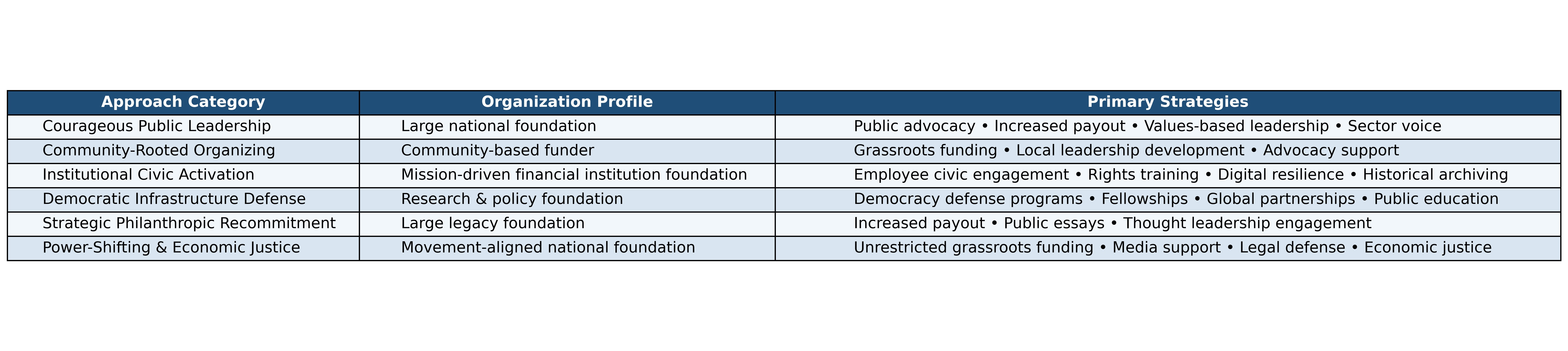
Emerging Categories of Approach
While each institution operates in its own context, their strategies cluster into identifiable categories:
Courageous Public Leadership
Using institutional voice and financial alignment to publicly defend democratic values
Community-Rooted Organizing
Funding and amplifying grassroots leadership and local civic participation
Institutional Civic Activation
Mobilizing internal staff and institutional culture toward civic engagement
Democratic Infrastructure Defense
Research, public education, partnerships, and fellowships aimed at strengthening democratic systems
Strategic Philanthropic Re-commitment
Increasing payout, issuing public essays, and re-centering mission during democratic stress
Power-Shifting & Economic Justice
Long-term movement funding and economic strategies to redistribute structural power
Each of these foundations has moved beyond simple grantmaking alone to realize their broader mission. Over the past year—often in anticipation of accelerating pressures—they have engaged internal and external stakeholders to reaffirm core values and translate those values into visible action.
The common thread is not ideology, but alignment: a willingness to step forward, clarify purpose, and adjust practice in defense of democratic dignity.
Raising the Bar: Four Strategic Areas to Explore
It can only be good that the foundation community is mobilizing in its own and some of its grantee’s defense. And as they and others do so, it is also time to explore and advance other ways in which philanthropy can take this opportunity to not simply respond to the present challenges via their grantmaking, but revisit traditional operating practices to better position our field as a whole to first challenge and then transcend the rise of American authoritarianism.
One: Institution Building—Not Program Funding
It would be one thing if the foundation community were deploying philanthropic capital at scale in support of grantees willing to step up and speak their truth to power. Yet, this post from Andrea Levere highlights a persistent strategic difference between conservative and liberal philanthropy in the United States.
Levere observes that conservative funders have, for decades, been giving more abundantly, patiently, and with greater trust than their liberal counterparts.
While liberal funders tend to support specific programs, conservative funders have consistently invested in institutions, providing multi-year (not three year or five year grants, but ten and twenty years of strategic grant support), in the form of unrestricted “Enterprise Capital” that strengthens nonprofits’ balance sheets and sustains movement-building over time.
The essay underscores that this institutional approach has been instrumental in building and maintaining political influence, with conservative philanthropy embracing it far more readily than funders viewed as liberal or progressive.
Levere cites recent research from Katherine Ponce at the National Committee for Responsive Philanthropy showing that 52% of funding to anti-democracy organizations—including election deniers and anti-voting rights groups—was long-term and flexible, compared to only 38% of such funding to social justice organizations, even during the peak progressive grantmaking years of 2020–2022.
This disparity, the author argues, reflects a broader lesson: philanthropy helps shape the world we live in, and those committed to a more just and democratic future should deploy such Enterprise Capital—aligned with their values—patiently, trustingly, and abundantly. Levere concludes with a call to action, linking to Capitalize Good LLC as a resource for funders seeking to adopt this approach.
For more on this topic, please see the NCRP report, Axis of Ideology. Pretty stunning stuff that should be of interest to us all.
Two: Move Assets From Foundations to Community and Issue Partners
As an extension of the previous point, other foundations are exploring options for executing spend downs that would see their assets transferred to either new vehicles to advance their work (e.g. Public Benefit Corporations) or place their philanthropic capital directly on to their nonprofit partners balance sheets to expand, develop and extend their work.
Regardless of the details, more foundations (all foundations?) now need to revisit, revise and renew their asset management and philanthropic investing strategies with the greatest of urgency—and stop managing like it was 1999 (i.e. all party and no meaningful provocation of the status quo!)—much less, Pre-Autocracy 2024!
Three: Intentional, Active Ownership.
All foundations—regardless of their mission or programmatic focus—should join the Shareholder Engagement Project and use their voting power to raise issues and challenge practices of corporations in which they are invested that run counter to or are not in alignment with their broader charitable mission.
As described below, the idea that 95% of foundation assets are managed to optimize financial returns alone, with no consideration of how best to leverage those assets in support of institutional mission or purpose, is a violation of organizational fiduciary duty. A first, basic step in managing all one’s assets to advance mission is proxy voting.
Foundations cannot grant their way out of this crisis.
They must step up now to leverage all of their resources to protect and promote the goals of civil society and the nonprofit sector.
In addition to innovative grantmaking strategy for the 5% payout, use Voice, Investment Assets and Proxy Vote to leverage mainstream investment capital!
Four: Deploy 100% of Foundation Assets For Strategic Impact…Now!
Fulfilling a foundation’s charitable purpose through deploying their total portfolios in pursuit of impact (using not only grant, but blended finance and a wide suite of market-rate impact investment strategies) is not a question of whether we know how to invest assets for multiple returns (meaning, various levels of financial return together with the generation of different types of social and environmental impact returns in pursuit of optimizing total, blended value) and the support/pursuit of systems change.
The strategies promoted largely in theory 30 or more years ago have been shown to work.
The experience of a growing community of foundations combined with the total performance of individual foundations demonstrates we know how to do the work.
What we now need is committed capital deployed through philanthropic institutions, which last year controlled approximately $1.5 trillion USD.
This article from Nonprofit Quarterly offers a great discussion of how these funds might be liberated to attain greater impact.
To understand the size of the investible opportunity upon which the foundation community could build—and from which today it is painfully absent—it should be noted that according to the Global Impact Investing Network’s 2024 research, over 3,907 organizations currently manage $1.571 trillion in impact investing assets worldwide, representing 21% compound annual growth since 2019 (GIIN Sizing Report 2024). When combined with blended finance vehicles, which Convergence reports have reached $231 billion across 1,233 transactions, the total potential impact investing marketplace of public, private and blended finance strategies approaches $1.8 trillion globally.
Therefore, while the market of impact-oriented capital now approaches $2 trillion, what impact capital managers lack is not expertise or skill, but rather broader GP/LP investor will, commitment and capital.
We are not here to protect charitable, philanthropic institutions for some future battle or the ever referenced and much lauded rainy day;
the battle front is right here and right now.
It is pouring rain on the troops in the trenches,
as the generals quietly await the outcome of the storm.
It is time we got off our assets and put our money where our mission statements are!
Moving Forward:
From Potential to Realized Philanthropic Transformation and Action in the Face of the new American Autocracy
To bring this back home to our topic of how foundations might act to counter the forces of American authoritarianism, in summary of the immediate, short-term steps outlined above and taken by some in the foundation world, in closing I would call on the foundation community to take the following four steps to re-position the entire sector as investors in long term, sustained impact and change as we seek to respond to the growing dictates of the Executive Branch and its allies:
First
For those in positions to do so and in alignment with other mission and organizational objectives, take direct and public stands against the practices of retribution, anti-democratic initiatives and top/down rule now being executed across virtually all branches of our government. These include ICE, the Department of Justice, the SEC and others implementing the paranoid and authoritarian passions of the current president to harm families, communities and eco-systems across the country.
I fully recognize many foundation executives have voiced a concern that to act in any public way would attract unwanted attention from the current Administration and its minions, potentially risking the charitable status of philanthropic institutions.
Well…
Guess what?
They are already coming for you so pack your bags and hit the charitable ATM, cuz we know from history that appeasement in the face of authoritarianism is barely even a successful short term, much less long term, strategic response.
Do whatever you feel you need do to position your assets for long term impact—but don’t kid yourself that by remaining quiet and unassuming they will leave you alone.
Bullies only back down when confronted, challenged and overcome.
Move your money and then move your mouth!
Join in with other funders working to challenge our current political environment by supporting and working with organizations such as the Democracy Funders Network and The Funders Network. Sitting this one out is a measure of power and privilege we can no longer afford.
Second
Follow the impressive and productive lead of some by moving from short term, program and project funding to long term capital institutional investments in nonprofit partners advancing meaningful, public policy, regulatory and practice change aimed at matching the proven success of their more “conservative” foundation colleagues over the next twenty years.
Third
Make critical and significant philanthropic investments in the expansion of social movement organizations.
This means providing financial and strategic support to grassroots efforts aimed at creating systemic social, political, or economic change. This type of grantmaking represents a shift from traditional charity models toward supporting organized collective action for structural transformation.
Here’s what this might involve:
Core Elements: Social movement funding supports organized groups of people working together to challenge existing power structures, advocate for policy changes, or shift cultural norms around issues like racial justice, economic inequality, climate change, or human rights.
Funding Approaches: Foundations may provide general operating support rather than restricting funds to specific projects, recognizing that movements need flexible resources. They often make multi-year commitments to allow for long-term organizing and relationship-building, which are essential to movement work.
Types of Support: Beyond direct grants, foundations might fund leadership development, coalition building, communications strategies, research and advocacy, and capacity building for grassroots organizations. Some also support movement infrastructure like training programs or convenings that bring activists together.
Strategic Considerations: This approach requires foundations be comfortable with more uncertain outcomes compared to direct service programs. Movements work toward long-term systemic change that may take years or decades to achieve. Foundations need to consider power dynamics, ensuring they’re not inadvertently co-opting or controlling the movements they fund.
Investing in social movement organizations could mean funding organizations working on criminal justice reform, immigrant rights, environmental justice, or economic democracy initiatives, particularly those led by directly affected communities. The goal is to support sustainable social change by strengthening the organized capacity of communities to advocate for their own interests.
Fourth
Take immediate action to liberate the 95% of your financial assets pursuing financial returns alone without consideration of possible negative social and environmental impacts and redeploy that capital in strategic pursuit of financial returns with measurable impact as a more effective approach to advancement—and attainment!—of philanthropic institutional mission and purpose.
While we all appreciate your “innovative grants program” the reality is clear:
Again and finally:
You can’t “grant” your way out of Autocracy, but maybe it helps to try!
In sum, the opportunities to mobilize private capital for public good are virtually limitless—ranging from market rate, to blended finance and more innovative philanthropic investments, across a capital investment continuum that literally did not exist 30 years ago.
Remember:
If your only tool is a grant, then the whole world looks like a charity case!
Not utilizing 100% of available philanthropic strategy and institutional capital to optimize total impact in the face of fascism is no longer defensible or debatable.
Free the 95 percent!!
Otherwise, what are any of us really doing here?

Photo by Delano Ramdas on Unsplash
Personal Challenge
What are your best examples of foundations stepping up in support of their grantees and the continued advancement of an agenda of justice and equity?
What can foundations do to most effectively promote an alternative vision and voice in response to the efforts of the Administration to roll back the work of these past decades?
What are the best resources you have found to guide your efforts to maximize the impact of your capital?
Thanks for reading Antidote to Autocracy! This post is public so feel free to share it.
Thanks for reading Antidote to Autocracy! Subscribe for free to receive new posts.
Author’s Note: While the final writing and analysis are my own, please know I did make use of various AI tools in research and drafts conducted for this project. For a fuller discussion, please see the closing Note in the first post of the Antidote to Autocracy series. Thanks!
Comments
Nothing yet. Say the first thing.
Sign in to join the conversation.