
Over the past year, many of us in the mainstream have wondered:
Where is the voice and grantmaking commitments of the philanthropic community during this time of turmoil in American politics and communities?
While there have been various responses from the philanthropic community (described in both this and the post to follow) and some foundations have played a critical role supporting community action in response to American autocracy, for the most part there has been an absence of strong, public challenge to the rise of American authoritarianism coming from the foundation community.
A growing number of voices both within and outside of traditional philanthropy have been calling for greater public voice and action, yet before we act we must, as argued in previous AtA Series posts, first reflect on questions of purpose and place.
This post explores the question of whether it is even appropriate for foundations to be engaged in defending democracy and presents seven areas of possible reflection for those within philanthropy (donors, executives and stakeholders) to consider prior to agreeing upon the best course of action to be taken by any individual institution.
The following post, then, delves more deeply into how a number of American foundations are acting to address this moment.
The Trump administration’s second term has unleashed sweeping executive orders and memos aimed at eliminating federal DEI and ESG programs, challenging the independence of private organizations and attacking many of the core, fundamental values upon which the nonprofit sector has been built over the past ninety years. And it has specifically targeted those providing financial support to such organizations.
Executive Order 14173 (“Ending Illegal Discrimination and Restoring Merit‑Based Opportunity”), signed Jan. 21, 2025, explicitly targets DEI initiatives and instructs agencies to identify nonprofits, foundations, universities and companies for investigation—including explicitly “up to nine” organizations with large endowments or ESG commitments.
Meanwhile, the freeze, claw back or suspension of hundreds of billions of dollars in federal grant funding now jeopardizes vital nonprofit programs and services in public health, education, climate, housing and justice. These actions raise real and meaningful alarms over threats to independence, nonprofit IRS tax‑exempt status, and civil society more broadly.
I am kind of sorry to say (sorry, because I would have wanted to see this kind of coverage and discussion come from media platforms in our own community) but one of the “best” summaries of the current Administration’s actions against foundations and nonprofits is to be found in this piece from The Free Press.
The piece (published in late October, 2025) offers a fairly comprehensive and clear discussion of what actions have been taken by the Administration, the rationale (from their perspective) for those actions, the effect those actions are having on our community and what potential next steps (in the form of legal and other actions) might be anticipated in coming months.
All in all, it makes for grim reading for those of us who support the work of the nonprofit sector and philanthropic communities in advancing positive impact in our communities, nation and world—and as potential actors challenging the rise of American autocracy.
The effect of these various aspects of administrative overreach is not only upon U.S.-based philanthropic institutions. Funders from around the world are pulling back, reassessing their strategies in response to the current Administration’s threats, chaotic implementation of destructive policies and challenges of both charitable nonprofit and philanthropic institutions.
Before we may discuss how foundations are responding (and should respond!) to our current crisis in democracy, it is first important to step back and ask two questions:
Should philanthropy even exist?
And if so,
What is the appropriate role for foundations to play
as they seek to defend democracy and the rule of law?
Let’s take each of these in turn:
First, should foundations exist?
Given the size and central role of the U.S. charitable sector and philanthropy, this may seem like an absurd question to ask, yet it deserves our serious consideration. Various folks have explored this question over the years, from differing perspectives.
Most recently it was interesting to see a smart and heartfelt piece by Jennifer Thuy Vi Nguyen. Ms. Nguyen who oversees a $100 million grant portfolio, argues institutional philanthropy in the U.S. functions primarily as a $1.5 trillion tax-sheltering mechanism that hoards wealth and undermines public systems rather than solving structural inequities. She believes efforts to make philanthropy “better” are insufficient and instead advocates dismantling the current philanthropic sector entirely, drawing inspiration from abolitionist frameworks. Her proposed strategy includes popularizing abolition as a concept, pursuing reforms that weaken philanthropic power, and building collective power outside of wealthy donors’ control.
Taking that question one step further, the various contributing authors in the collection The Revolution Will Not Be Funded, explore how philanthropy, as an embedded part of the nonprofit industrial complex, will never be fit for purpose if our purpose is meaningful, systemic change.
In this volume, various authors critique how the non-profit system can co-opt and neutralize social movements by managing dissent and shifting focus from systemic change to individual aid. The book features essays from activists and scholars who argue that the “non-profit industrial complex” (NPIC) integrates social justice work into the state and capitalist system, ultimately limiting transformative change and creating a “buffer zone” that manages rather than dismantles oppression. It calls for accountability to grassroots struggles and explores strategies for working outside or transforming the non-profit model.
Key themes and arguments include
Critique of the NPIC:
The book argues the non-profit system, while appearing to help, actually manages and contains social movements, making them less radical and more palatable to the state and corporations.
Co-optation of radicalism:
It suggests that funding often forces groups to adopt a “service-based” model (e.g., helping individuals get ahead) rather than a “movement-based” model (e.g., ending the systems that create the problems).
Historical context:
Contributors trace the history of non-profits and their relationship to social movements, from the Civil Rights era to the present.
Accountability:
The book emphasizes the need for accountability to the most marginalized communities and grassroots struggles, rather than to foundations and funders.
Strategies for change:
It offers visionary strategies for activists to work outside or transform the non-profit structure to achieve fundamental social change.
The best strategies all begin from a very simple place of inquiry:
What are we trying to do and how do our present structures inhibit or advance our interests and goals?
While a comprehensive discussion of whether foundations should exist at all is perhaps beyond the scope of this post, most foundations reflect upon this question in moments of transition (a president leaves or arrives, a board encounters significant turnover) or on some semi-regular basis (annual retreats or very five or ten years). These types of activity are important to affirming the “North Star” of the foundation, its programming and the mindsets of its stakeholders.
Assuming, for the time being, foundations will be with us and important actors in our effort to address the rise of American authoritarianism, we must then ask a second, related question:
What is the appropriate role of foundations in promoting and advancing democratic principles and the Rule of Law?
The current debate over philanthropy’s role in democracy is not a simple contest between action and inaction. It is a deeper dispute regarding the legitimacy, power, and institutional boundaries of philanthropic organizations in a moment of democratic fragility.
Many foundations and the sector as a whole operate with a level and degree of opaque management and lack of accountability that may easily be viewed as anti-democratic—the deliberations of foundation boards that make decisions on funding priorities and the power wielded by individual foundation executives both call into question foundations’ commitment to democratic, stakeholder aligned values.
Proponents of an active philanthropic role argue democracy is facing structural threats (polarization, disinformation, disengagement, and so on) that governments alone are proving unable or unwilling to address. From this view, philanthropy’s potential flexibility and long-term horizon uniquely position foundations to support civic participation, strengthen local institutions, and help rebuild democratic trust. To abstain, they suggest, is to allow erosion to proceed unchecked.
Yet even among philanthropy’s advocates, unease is evident.
Calls to “do no harm” acknowledge philanthropy’s very strengths of (possible!) speed, scale, and independence may serve to undermine democratic norms if exercised without restraint. Funding choices can shape political narratives, elevate certain voices over others, and create perceptions of elite management of public life.
In this framing, philanthropy’s challenge is not merely effectiveness but epistemic humility, by which I mean having confidence in what we believe we may know to be true, but promoting that knowledge from a posture of humility and mutuality. In various settings, I have referred to this idea as “humbition,” a term with various originators and by which I mean the pursuit of great, ambitious goals from a posture of humility, co-creation and awe.
In the case of foundations acting to affirm our democratic processes, knowing where philanthropy oversteps and support becomes substitution is important to understand.
More skeptical perspectives reject the premise that philanthropy should work to “save” democracy at all. From this angle, democratic renewal is a civic obligation, not a philanthropic mandate. When foundations assume quasi-governmental roles, they risk blurring lines of accountability and weakening the moral authority of democratic institutions themselves. Philanthropy, these critics argue, best serves democracy indirectly—by supporting innovation, research, and institutional competence without claiming democratic stewardship.
Underlying many positions of critique is a structural concern that no amount of good intention may erase: philanthropy concentrates private power in a domain that ideally rests on political equality. Even when aligned with democratic aims, large-scale philanthropy operates through decisions made by governing boards that are neither elected nor publicly deliberative.
The question is not simply whether philanthropy helps democracy, but whether democracy can absorb philanthropic power without being reshaped by it.
To help us explore this question, I identified a number of writers who approached the debate of philanthropy’s appropriate role in defending democracy from diverse perspectives. I then used Claude-AI to outline their differences and draft questions I felt important for foundation stakeholders to reflect on to come to their own conclusion regarding the best role their institution might play in responding to the rise of American Authoritarianism and, by extension, the rise of fascism today.
I reviewed various writings, from More Conservative to More Progressive, to frame a discussion regarding the “right” role of philanthropy in addressing the present moment. These included the following:
Want better government? Philanthropy can and should help! Daniel Stid in a newsletter of the American Enterprise Institute
It’s not philanthropy’s job to ‘save democracy!’ By James Piererson and Naomi Shaefer Riley, writing in National Review
Can Money Help Save Democracy? Celestin Bohlin, writing in the New York Times
Is Philanthropy bad for democracy? Gara LaMarche, writing in The Atlantic
What to do now? How can philanthropy help win the fight for America’s future, David Callahan writing for Inside Philanthropy, and
First, Do No Harm! Five Steps Philanthropy should take to bolster liberal Democracy, Daniel Stid (again) writing for the NYU Law Democracy Project.
This is an ongoing debate because it reflects a real tension rather than a conceptual confusion. Democracy needs resources, imagination, and resilience. Philanthropy can provide these—but only imperfectly, and never without risk. The unresolved task is to determine where philanthropic support strengthens democratic agency, and where it may quietly displace it.
What all perspectives quietly acknowledge is this:
Philanthropy’s potential power is not marginal.
Whether treated as remedy, risk, or reflection of deeper imbalance, philanthropy sits unavoidably inside democratic life. The disagreement is not about intent. It is about where authority should live when money, urgency, and democracy collide.
Another way to understand the various “camps” within which different foundation stakeholders may sit is in comparing how other elements of the approaches are positioned, one to another. Please see the following chart for yet more to mull over!
Therefore…
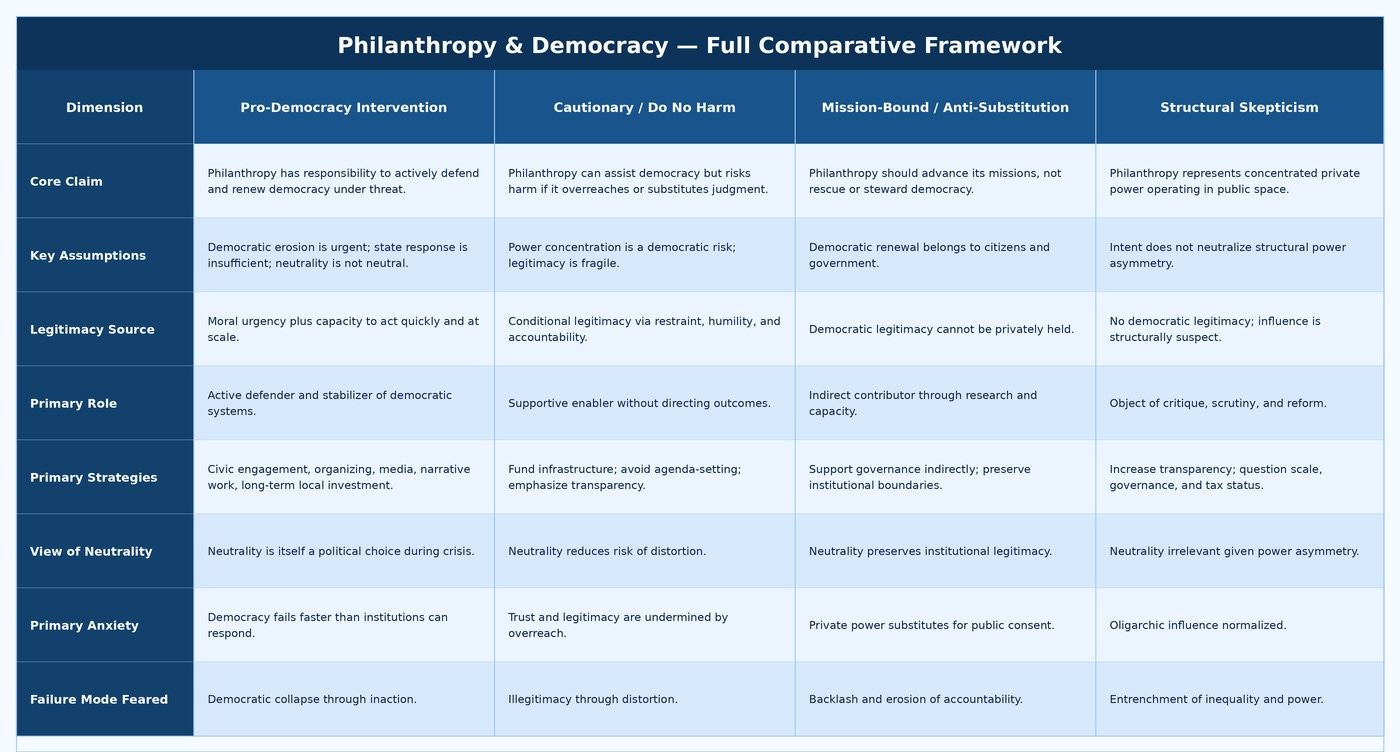
Foundations should seek to shape an institutional response to the challenge of autocracy by sitting deeply with the questions most relevant to agreeing upon the most promising strategies and tactics to best engage with autocracy
Which then leads us to…
What, then, are the questions foundation leaders and stakeholders should be asking themselves as they reflect and decide upon the most appropriate role their institution should play in this moment?
We might begin with the following areas of reflection:
Legitimacy and accountability
Risk, courage, and “obedience in advance”
Strategy: Guardrails vs Power vs Rebuilding
Money: Payout vs Seed vs Moral Seriousness
Communication as civic infrastructure
Equity and Predictability of Harm
Subsidiarity and citizen agency
This is not a definitive list of questions, but rather a starting place.
Let’s frame each of these in turn:
1. Legitimacy and accountability
A. Who are we accountable to, really—our boards, our donors, our reputations, or the communities living with the consequences of our choices?
B. If we claim to defend democracy, what democratic practices govern our own power (transparency, participation, contestability)?
2. Risk, courage, and “obedience in advance”
A. Where are we already self-censoring to avoid becoming a target—and what does that teach authoritarians about how to control civil society?
B. Are we optimizing for institutional safety or for civic durability—and which “scar” are we willing to own?
3. Strategy: guardrails vs power vs rebuilding
A. Are we only funding guardrails (litigation, institutions), or also funding the “breakthrough” work that builds civic power—and the reconstruction work that offers a credible alternative future?
B. Do our grant structures match democracy’s timelines, or are we forcing democracy work into philanthropic convenience? (Johnson Center for Philanthropy)
4. Money: payout, speed, and moral seriousness
A. If government funding is being cut and repression is rising, what justifies maintaining business-as-usual payout levels? (Chronicle of Philanthropy)
B. Are we moving money like an emergency is real—or like our perpetuity is the highest good?
5. Communication as civic infrastructure
A. Do our words make democracy human, or do they anesthetize it with euphemism? (Chronicle of Philanthropy)
B. Can we speak plainly about harm and dignity without turning civic work into propaganda?
6. Equity and predictability of harm
A. If authoritarian playbooks target marginalized groups first, are our budgets aligned to that predictive reality—or still spread in ways that protect our comfort? (Chronicle of Philanthropy)
7. Subsidiarity and citizen agency
A. Are we resourcing local civic culture and citizen agency—or treating communities as delivery channels for national strategies? (Chronicle of Philanthropy)
B. Does our funding expand the public’s agency, or does it subtly replace it with philanthropic agency?
These question are central for foundation executives and stakeholders to consider and grapple with before developing and executing responses to the present moment and executing strategies in support democracy, whether in the United States or other nations around the world.
Personal Challenge
What is your own perspective regarding the seven questions above?
How does your organization reflect or not reflect these considerations and practices?
Given there are probably not hard and fast rules one way or the other regarding how and in what ways foundations should be engaged in this moment, what considerations do you feel are most central to this discussion?
Thanks for reading Antidote to Autocracy! This post is public so feel free to share it.
Thanks for reading Antidote to Autocracy! Subscribe for free to receive new posts.
Author’s Note: While the final writing and analysis are my own, please know I did make use of various AI tools in research and drafts conducted for this project. For a fuller discussion, please see the closing Note in the first post of the Antidote to Autocracy series. Thanks!
No posts
Comments
Nothing yet. Say the first thing.
Sign in to join the conversation.