
This is a gross oversimplification for the sake of brevity, but AI models pattern match to the most statistically likely solution, and fill in the gaps with more of the same. AI models don’t “know things” exactly, but they do a passable facsimile of knowledge by effectively guessing the next word in a string based on the averages of their training data. And now, thanks to all these heavily-venture capital subsidized AI companies (a post for another day), anyone can make passable looking and functioning things using those patterns.
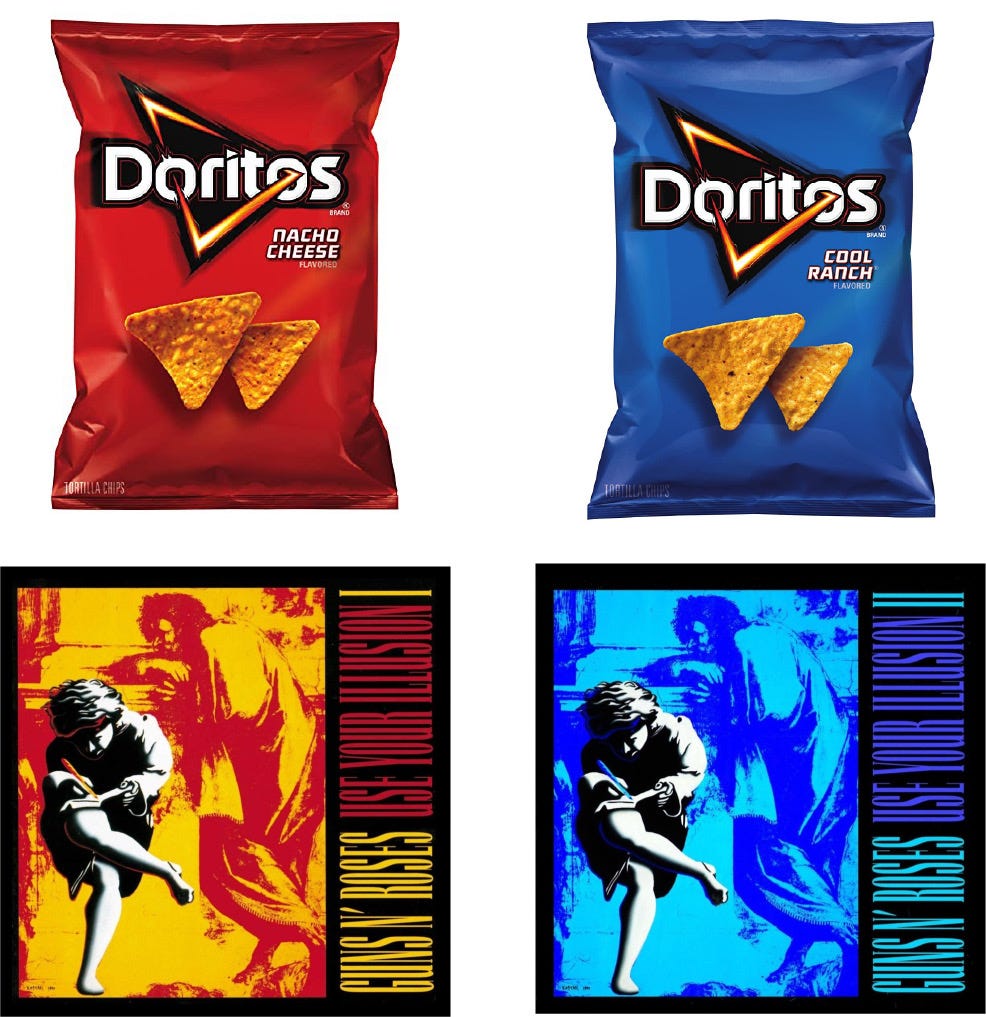
So a big question in this new normal where you can prompt a machine to create statistically likely versions of things, how does anything rise above the mean? How does anything stand out? Designer Diana Mounter says, “The bar for something that looks decent has never been lower.”
Welcome to the new world where everything looks ~fine~ and no one cares.
What goes in affects what goes out. More importantly, our inputs directly lead to outputs. To get a little agrarian about it, we grow what we sow. This is good news, right?Just put in better inputs and you’ll get better outputs, right? Here’s my issue with this — even if your inputs are all amazing, if they’re the same as my inputs, our outputs are more likely to be similar. And if branding is about differentiation, like I tell my clients, similar outputs are bad for business (yours and mine).
This isn’t just about AI. It’s not even a modern problem. Cultural trends, market forces, and popularity all influence what is deemed as good and acceptable. In the brand design industry where I work, UI pattern library websites, homogenized moodboard cultures, tool limitations and constraints, and even well-meaning industry standards all lead to similar outputs because the inputs are drawing from the same well. We must diversify our inputs to create differentiated outputs. Which means our input choices become an even bigger part of the work.
If you want to rise above the crowd, you must broaden your interests and inspirations. Actively go looking for sparks in uncommon places. Places computers wouldn’t think to look. But places weird and delightful humans might.
I call this collect the dots connect the dots. The more dots I can meaningfully connect, the greater chance I’m creating anything worth talking about.
Let’s try an example. If the brief for a web design project is Stripe + Perplexity w/ a side of Vercel, and I handed it to five designers, they’d have their own take and potentially weigh them in different ways, but their outputs would look fairly similar. But what if the brief was Christopher Alexander’s A Pattern Language + a thrift store print of traditional nautical knots + the way moss only grows on the north side of trees in the Northern hemisphere? That combo is so bizarre and non-linear, but loose and open to human interpretation that it can contain whole worlds. What if there’s connective tissue between them that only you see because of your intuition, taste, and experience? Those five designers aren’t going to produce anything remotely similar to one another. Diversified inputs lead to diversified outputs.
Things that influence my design process: a blue collar upbringing, construction work, growing up lonely in a loving family that was cash poor and never went on vacations, the local library, reading and writing poetry, gardening and being in touch with the natural rhythms of the seasons, hiking every morning, science fiction and speculative fiction film, loving men’s and women’s fashion, fine art, playing music, and an obsession with hospitality and creating community. That collection of inputs in going to affect everything I make.
You have intuition, taste, and experiences that will influence your work, too, if you’ll let it. Your unique inputs will shape and direct your outputs. This is why you emotionally resonate with certain things out in the world, because a human did something unique from their point of view. If you try to copy it 1:1, it won’t work because it’s not you. And it certainly won’t work if AI is pattern matching to the most statistically likely output. You’re only copying the skin, not the bones or the DNA, the last visible step of a longer more complicated process.
Comedian Bill Hicks said, “If you can be yourself on stage nobody else can be you and you have the law of supply and demand covered.” The supply of decent looking design artifacts is bigger than ever. The demand for things that look fine is lower than ever. But specifically because of the onslaught (onslopt?) of outputs, the demand for unique, human, multifaceted things is higher than ever. And that’s good news.
No posts
Comments
Nothing yet. Say the first thing.
Sign in to join the conversation.