
I wrestle with many things related to my nearly dozen years on staff at a large (and, at times, nationally influential) multi-site evangelical megachurch. I probably left with more baggage than the average 9–5, but less drama than needing to go to therapy about it. Oddly enough, one of the parts of that season I lament most is how we followed cultural trends headlong into Black Box Theater style venues.
The black box shift was both resource and methodologically-driven. In an attempt to mitigate construction costs, organizations often up-fitted existing, empty big box storefronts instead of building new. But replacing pews and altars in rooms made for small crowds with chairs and stages in big rooms made for big crowds was about methodology more than financials. After all, even when given the opportunity to build new facilities from the ground up, most megachurches still built the exact same model — a big box with an open atrium and a smaller black box inside, surrounded by a sea of parking with as few trees as building codes allowed. Bye bye, narthex; hello, Starbucks in the lobby. This was the new way, out with the old timey religion.
These types of spaces are, ostensibly, more flexible. They can be digitally repainted week-to-week thanks to screens, smoke, and mirrors. They can hold a lot more people. They’re more comfortable and more familiar for a modern audience.
These kinds of architectural trends mostly coincide with other broad-sweeping methodology changes, trying to replace a perceived stale, dwindling religion with a new, shiny wrapper for a timeless message. But the medium is the message, and methodology has a sneaky way of not staying neatly compartmentalized from theology, humans being embodied and all.
When our places of worship have more in common with third spaces like malls than sacred halls, there are deep-rooted consequences from the exchange. And theologically-speaking, if everything about a space is designed to cater to my comfort and ease, it affects the story the space is telling me about both myself and the divine.
Have you ever walked into a building and gasped? Like literally had an involuntary physical response? It doesn’t have to be a church building. It happens to me in museums sometimes. Or a really well-designed hotel lobby. It’s usually in spaces that are naturally meant to welcome people in and inspire them to linger.
In The Timeless Way of Building Christopher Alexander says, “The more living patterns there are in a place — a room, a building, or a town — the more it comes to life as an entirety, the more it glows, the more it has that self-maintaining fire which is the quality without a name.” I want to be in more rooms, buildings, and towns like that. Spaces that feel like they’re alive, with traces they were crafted and designed by people who are alive, too. I’m guessing you do, as well.
Forgive the long quote, but Paul Rudolph is relevant here:
We desperately need to relearn the art of disposing our buildings to create different kinds of space: the quiet, enclosed, isolated, shaded space; the hustling, bustling space, pungent with vitality; the paved, dignified, vast, sumptuous, even awe-inspiring space; the mysterious space; the transition space which defines, separates, and yet joins juxtaposed spaces of contrasting character. We need sequences of space which arouse one’s curiosity, give a sense of anticipation, which beckon and impel us to rush forward to find that releasing space which dominates, which acts as a climax and magnet, and gives direction.
Our designed spaces do things. The built environment affects us, viscerally. And as embodied creatures, not externally acting upon our environments, but participating in them from within, we can and should demand things from those spaces. I want to feel something when I walk in a room. Which is admittedly difficult to do in a Target (unless we’re counting anxiety).
Alexander, again: “The specific patterns, out of which a building…is made may be alive or dead. To the extent they are alive, they let our inner forces loose, and, set us free; but when they are dead they keep us locked in inner conflict.”
I don’t want to feel locked up in a box. If I want more disembodied, formless caverns designed to process a crowd, I can find those things in any suburban retail corridor, which will happily welcome me in to disassociate and participate in commerce. But those spaces keep me prisoner, shackled to a car, or conditioned air, removed from the natural environments I love and the kinds of built environments that make me feel alive, when they’re built correctly.
Joshua Heath Scott is the founder and owner of JHS Pedals, a wonderful boutique guitar effects pedal company in Kansas City, Missouri (I’m currently (loudly) putting their new Coyote octave fuzz through the paces.) For those of you that might not geek out over boutique guitar pedals, vintage music gear, tube amps, and all that jazz, you might be surprised to learn it’s a pretty hands-on corner of making. These folks love to dig into the details and craft objects of startling complexity and utility, and I find a good bit of that “self-maintaining fire” when I engage in their world.
Scott is also an amateur film photographer, and I was struck by a series of reels he recently posted re: AI and specifically photography. He says, “Photography is not just an image…photography allows us to freeze our actual lives, history, and the moments that matter” and then goes on to contrast those frozen, real moments with AI-prompted and generated images — “AI cannot create a memory….it’s cosplay.” Paul Rudolph said, “we tend to build boxes and call them buildings” and I wonder if those two sentiments are nearly the same thing?
In a world of increasing image congestion, both captured and generated, when it’s becoming difficult to separate truth from fiction, and cultural homogenization leaves local, distinct cultures gradually becoming more similar, I want to put my hands on real objects, set my feet in real spaces that someone made with intention and the hope that someone like me would be there one day to experience it. I want my home to feel that way. And I certainly want a house of worship to feel a certain way, to have a different story to tell than the one I can find in a strip mall, or a manufactured mixed use building. I want rituals, implements, and objects to be supporting characters and guideposts in a story that stands in contrast to the rushed, congested, car-centric, me-centric stroads encroaching my community.
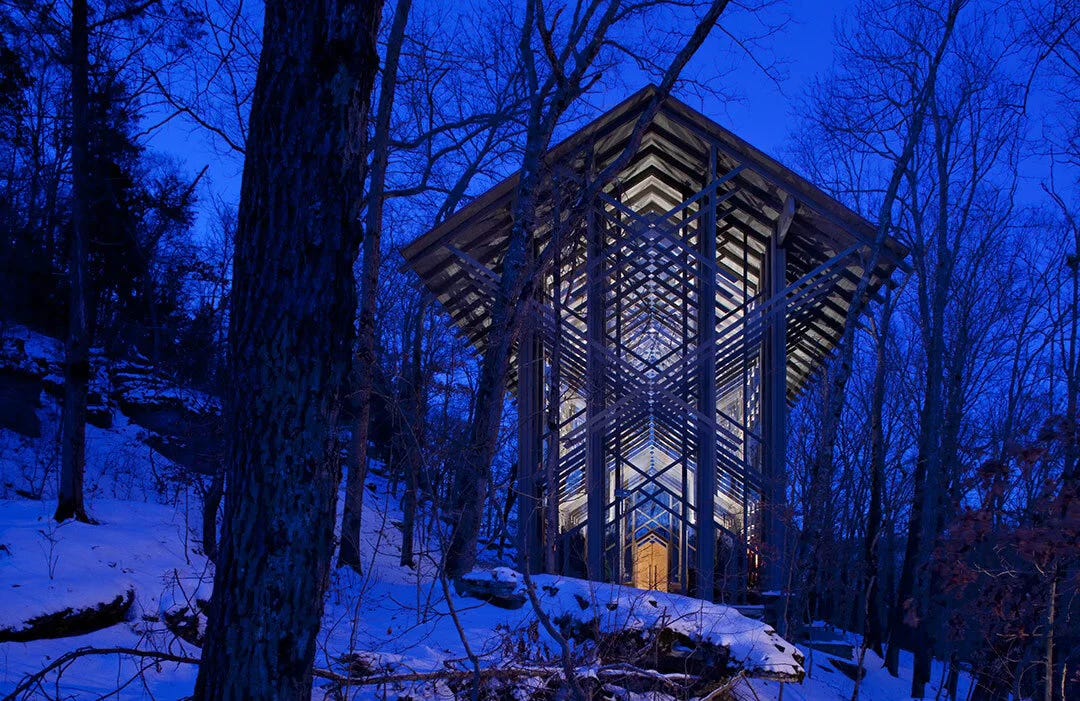
When architect E. Fay Jones was planning the Thorncrown Chapel in Eureka Springs, Arkansas, he gave the project a literal human-scaled constraint — “no structural element could be larger than what two men could carry through the woods.” Hell, yeah, Euine. Throughout the project they sourced organic materials indigenous to northwestern Arkansas, like Southern pine and flagstone, and, as a result of those material and logistical choices (and the wild amount of window glazing in the place), the chapel truly feels like a part of the environment.
Notably, Thorncrown only seats about 100 people. It feels intimate because it is intimate, by design. Saarinen’s North Christian Church seats nearly 500, but again, by design, is built as a theater-in-the-round so parishioners are “seated in the hands of God” facing both the communion table and one another. (Fun fact: Alexander Girard designed the liturgical objects for the communion table.) These are small-ish buildings made for small-ish gatherings, with every part considered and designed for specific purposes and experiences. Which is not to say black box theaters in old Best Buy storefronts aren’t considered and designed. They’re just increasingly not a set of considerations, purposes, or experiences I’m interested in.
I want human scale and God-sized awe. And I believe you should, too.
No posts
Comments
Nothing yet. Say the first thing.
Sign in to join the conversation.