
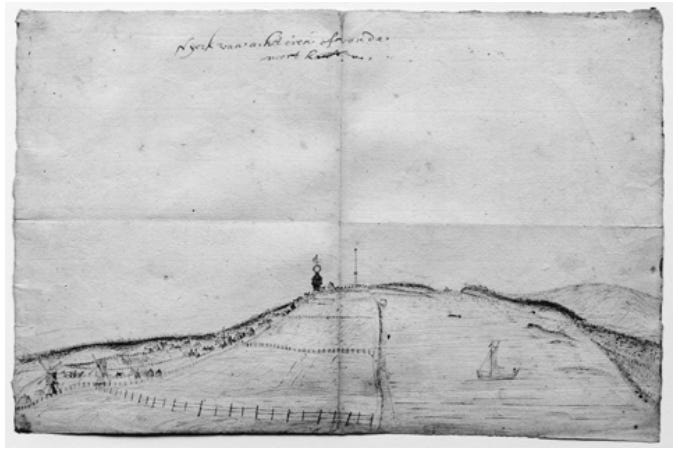
Over 119 years had passed since 1626, when the first eleven arrived in Manhattan after being trafficked from the kingdoms of Kongo and Loango. By 1703, New York City had a higher proportion of households that owned other people than any other city in the United States, save Charleston, South Carolina; forty-two percent of early-eighteenth century New York City households were slavers.
Those who died enslaved before 1745 were buried in the commons as well as the burial ground. While I’m sure this point was not lost on those who built the fence, one must surely draw the line somewhere.
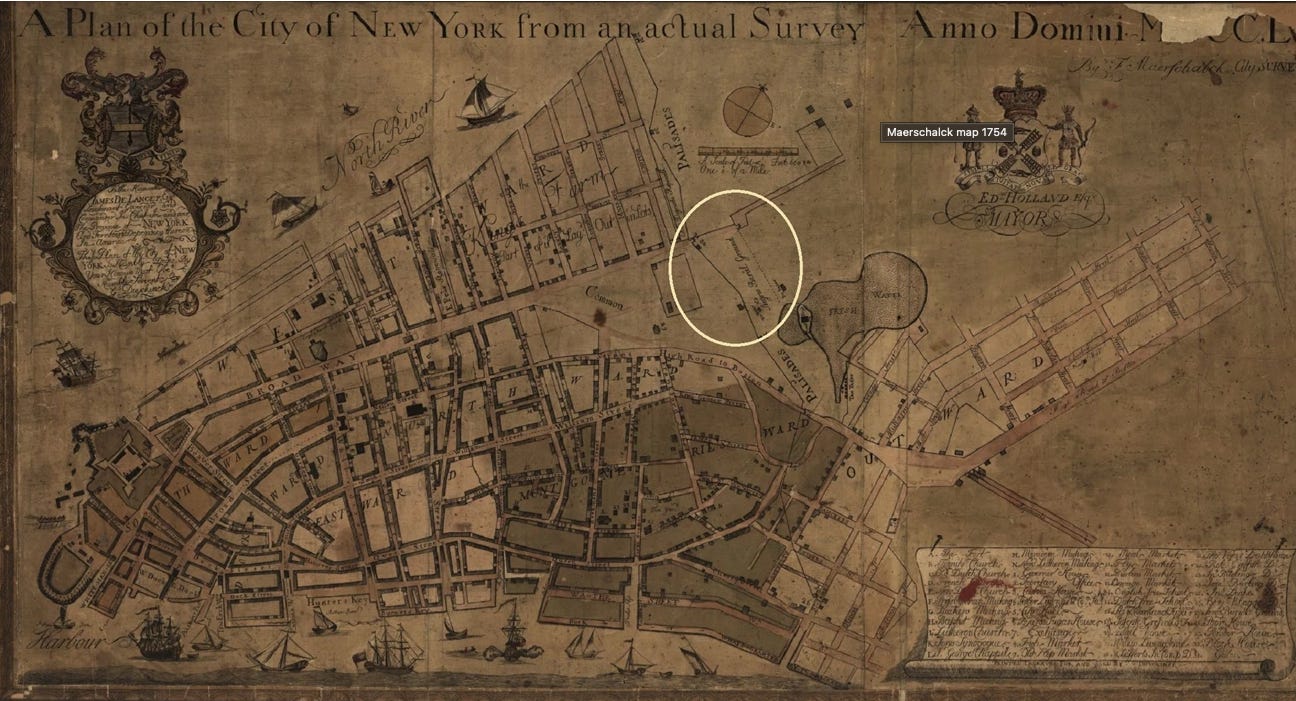
The motions of The City encroached on the Black sacred space of the African burial ground with or without a palisade, as did the city commons itself. Potters and leatherworkers, who relied on the water from Fresh Water Pond, began work up against the free and enslaved African communities that lived up against the burial ground.
“These industries,” Frohne writes, “marked a tension that surely existed between marginalized Africans striving to hold sacred funerals to honor the dead versus businesses who needed Fresh Water Pond water to produce and earn profit.
In so doing, the industries polluted Fresh Water Pond, which may have represented the line between the living and the dead to some Africans enslaved in New York. The desire for sacred space, and to define what such a term even meant for them, was the reason for and against the palisade and the line it represented in and of itself.
That the African Burial Ground got a formal line on the map of New York City at all is proof of Peter the Doctor’s conjuring power, as I wrote about in my last Substack entry.
According to Frohne, Francis W. Maerschalck, the surveyor of the 1744 map, had an ancestor who was killed by Peter the Porter (not to be confused with the Doctor) during the 1712 rebellion. “Since two members and one slave of the Maerschalck family were involved, this may have strongly impacted the reason why Francis Maerschalck would map the burial ground in his plan of the city,” Frohne notes (42).
Thanks for reading black medicine // black magic ! This post is public so feel free to share it.
Whenever I go to Pinkster, I feel it stronger. There’s some desire I see in the Black community, among scholars and practitioners alike, to force Hoodoo into the role of a Yoruba tradition. Nowhere have I seen it more than at Pinkster. Hoodoo, especially as it was practiced among the majority Kongo and Luongo communities of New York City, has a dominant Bakongo lineage. This is not to say there is no Yoruba lineage within Hoodoo—but the fact that folks would rather impose anything other than Kongo tradition upon it says a lot.
Some of this insistence feels self-serving and incidental—many authors and scholars of Hoodoo are themselves priests in Yoruba traditions. Some of this insistence accompanies the inexplicably inflated role of Nigerian ancestry that saliva tests issue.
This is similar to what I often see when some Hoodoos insist that Hoodoo is solely a Southern tradition. It’s an assumption born predominantly of the cynical research interests in “Black superstition” among white profiteers like Harry Middleton Hyatt; American mythmaking around Confederate defeat as is the case with the WPA Slave Narrative Project; as well as the genuine and understandable cultural interest in the South among Southern Black researchers, scholars, and writers like Zora Neale Hurston, Jason R. Young, and Dr. Katrina Hazzard-Donald.
The latter doesn’t bother me a bit, and is helpful to my own work in many ways—one must draw the line somewhere to constrain and complete one’s work. I would expect nothing less from the former two examples, since both parties were invested in pathologizing the South while hiding the rock in their own Northern hands.
I think history moves fast enough, especially as close as we are to when it happened, that we might benefit from thinking expansively. There’s so much about enslavement that we were not taught. There’s so much about enslavement that slavers intentionally hid from us.
In 1760, the palisade between the African burial grounds and the commons were disassembled. Once more there was no divide between the celebrations of the living and the city of the dead. Burials began in the commons once again.
Like the line between the living and the dead made solid by a palisade, the history of anti-Blackness in this country forces us to live in the messy middle, both north and south of the lines intended to divide us from one another.
While boundaries and borders can be helpful in conceptualizing our own work, we must be careful to work with lines that make historical sense rather than the ones that enforce historical erasure.
Comments
Nothing yet. Say the first thing.
Sign in to join the conversation.