
Take a dive into online communities like Quora or Reddit in search of discussions about Chinese pop music, and you might stumble upon questions like this:
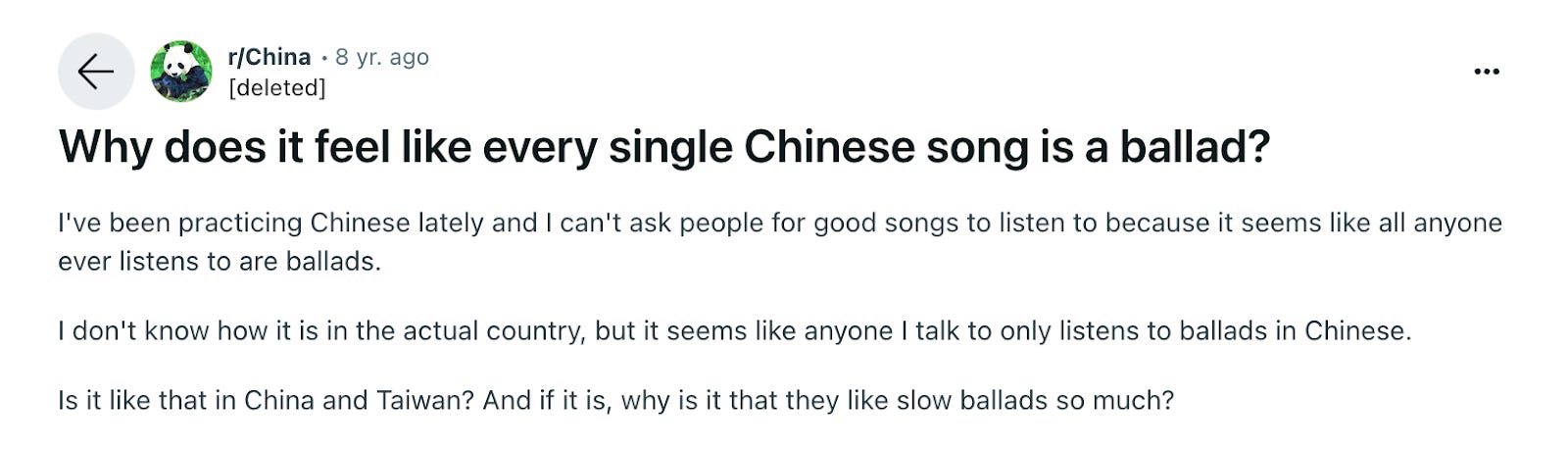
Some interesting responses include:

Don't get me wrong; there's a valid point being made here. There is no shortage of sappy love songs in the world of Cantopop and Mandopop. But is Chinese pop music really as bad as these questions make it out to be? Given how subjective the nature of this question is, context is going to be our best friend here. So let me play devil’s advocate for a moment, and introduce you to a little something known as “K-songs”—a term that may be our key to unlocking this ballad-induced enigma.
As someone who lived in Hong Kong as a teenager when these K-songs were the hottest thing, I was fortunate (or perhaps, in some ways, unfortunate) enough to witness the pinnacle of this phenomenon. And then later in life, as a full-grown adult working in the Hong Kong music industry, I came to experience its effects and fallout firsthand. I’ll mainly focus on Cantopop here, as that is what I’m most familiar with. But hopefully, it’s enough to shine a light on the question at hand and present a compelling case for reconsidering Chinese Pop music, especially if sentimental tunes aren't your thing.
Alright, let's set the scene: it's the late 1990s, and we were witnessing the tail end of Cantopop’s illustrious "Golden Age," a period etched in memory through music icons such as Leslie Cheung (張國榮), Anita Mui (梅艷芳), Beyond, and Faye Wong (王菲). There’s no question the '80s to mid '90s were the glory days for Hong Kong music, but let's dive into some numbers to illustrate just how booming the record business was back then: in 1986, Anita’s fourth and groundbreaking release Bad Girl (壞女孩) went a staggering 8x platinum (400,000 copies sold). Following suit, Leslie’s 1987 album Summer Romance achieved a remarkable 7x Platinum (350,000 copies sold). It's no wonder many industry folks likened the record business to a money-printing machine.
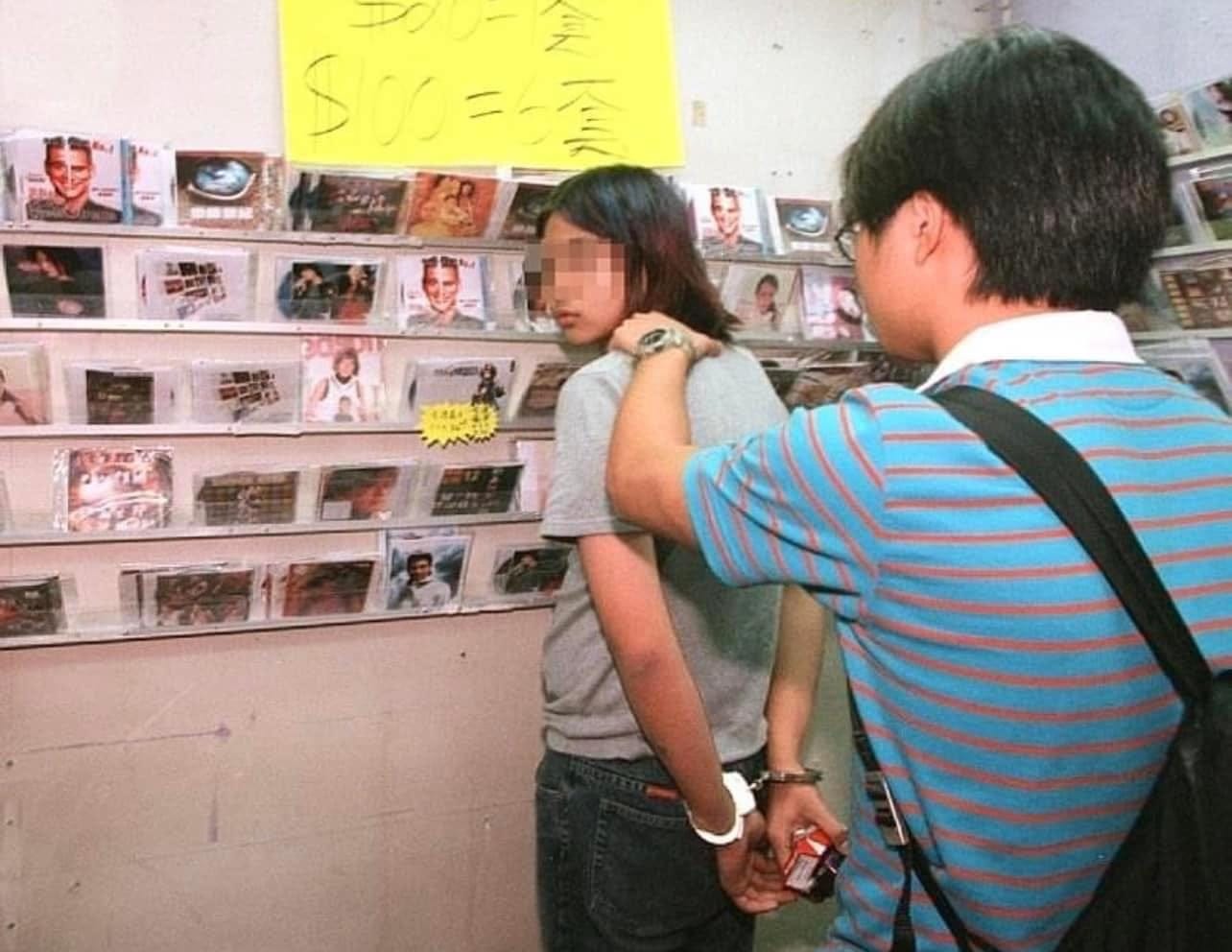
However, these sales figures didn't last forever. By the late '90s, things had taken a different turn. For example, take a look at one of the best-selling albums of 1999: Jacky Cheung’s (張學友) Someone (有個人) only managed to reach around 2x Platinum (80,000 - 100,000 copies sold). You might wonder, what changed? Were people losing interest in Cantopop? Not quite. Instead, what unfolded was the rise of the piracy industry during the '90s to mid-2000s—think CDRs and shoddy color-printed inserts wrapped in cheap plastic poly bags. So, even before Napster arrived to change the business of music, Hong Kong was rife with counterfeit copies of best-selling albums. This, of course, ate into the profits of local record companies, which led music executives at the time to scour for something to make up for lost revenue. Luckily for them, they didn’t have to look far for an answer.
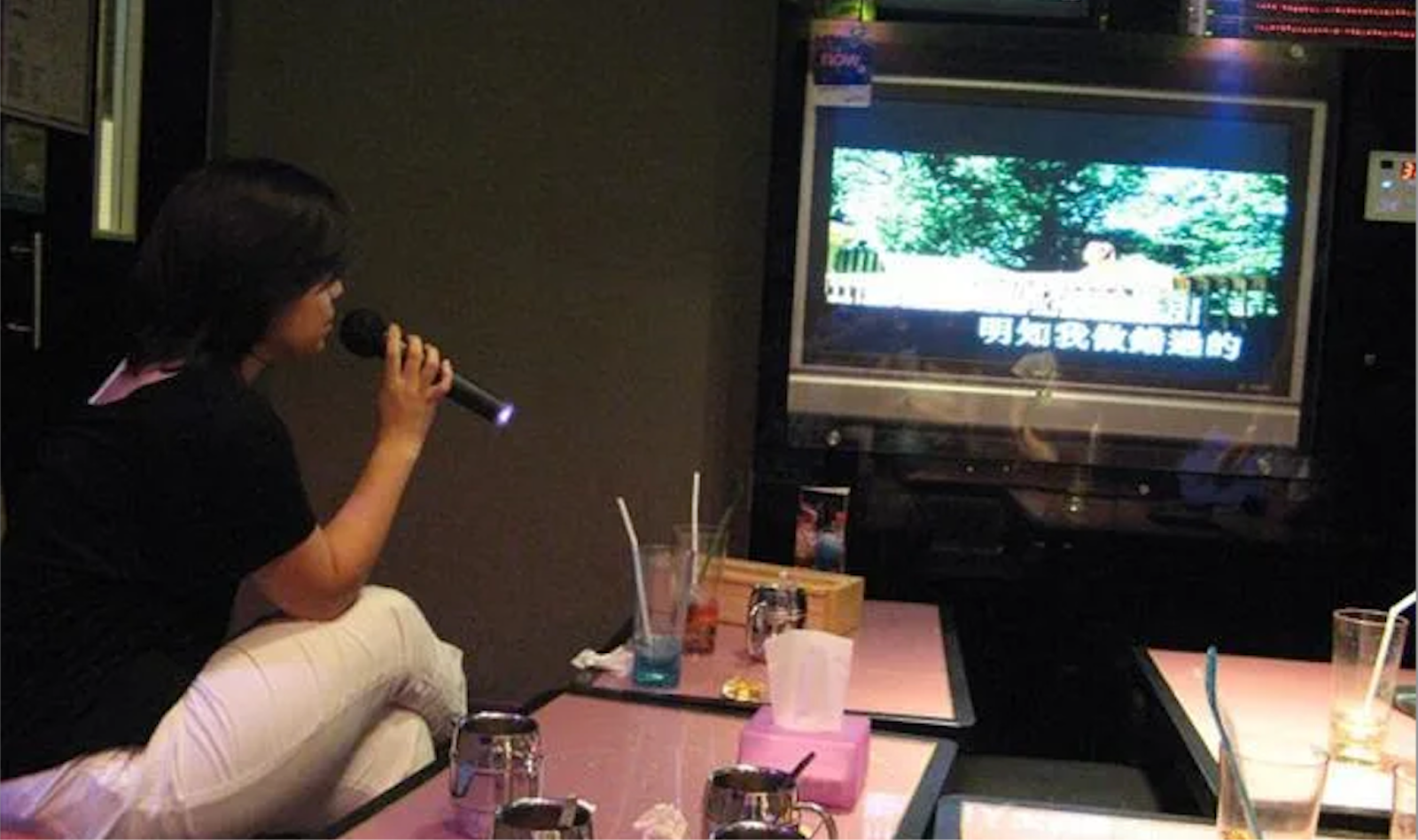
Enter karaoke, a revolutionary form of interactive entertainment born in Japan in the 1970s, where people could sing along to pre-recorded instrumental tracks. This cultural phenomenon quickly spread beyond Japan and landed in Hong Kong in the late '80s, with the opening of the first Hong Kong karaoke business, California Red (加州紅), in 1992. Business boomed, and by the early noughties, there were over 10 major karaoke chains like Neway, Top One, and Big Echo, all vying for attention.
As a result, karaoke became the go-to sanctuary for teenagers of the time, a refuge for heartbreak and teenage frustration. Finally, a place to go to vent when being told off for forgetting to turn off the TV set! I still recall those dimly lit rooms, pouring my heart out with friends to lyrics dripping with self-pity, yet naturally finding joy in having someone to share the experience with. Indeed, record companies weren't blind to this phenomenon either; they swiftly capitalized on it by ensuring their catalogs were licensed to these establishments, a strategic move to counter losses from piracy. This trend inevitably shaped the focus of record companies, giving rise to what locals affectionately dubbed K-Songs or karaoke songs. Aha!
Some popular tracks from this era, like Miriam Yeung’s (楊千嬅) “If You Let Me Continue” (假如讓我說下去) or Justin Lo’s (側田) “Die Hard” (命硬), were laden with lyrics delving deep into relationships and love, resonating with the masses, but lacking in terms of variety and artistry. These K-songs often seemed formulaic, emphasizing themes of heartbreak, with slow melodies designed to be easy to sing along to, accompanied by simple music arrangements and hook-laden choruses. While not all these tracks were bad per se, to be fair, ask any songwriter and they’ll tell you that writing a memorable pop hook is no easy feat. However, the issue here was the lack of variety and sincerity. For every good ballad written, there were an equal number of generic songs being released that were either overly engineered or, at worst, a quick copy-and-paste affair to launch a new artist's career.
This form-over-substance approach wasn’t only reflected in the songs at the time; another strategy employed by record companies was to elevate the packaging of their releases. Rather than simply offering a basic CD and jewel case, or even a digipak for that matter, they instead provided premium packaging complete with extras like posters, photo books, trinkets, product samples, and even facial discount coupons (no, I kid you not). While I'm uncertain whether this shift in focus meant that production costs that could have been allocated to song creation were redirected elsewhere, it certainly makes for some intriguing discussion points about what was going on during this time.

One particular song that offers insight into this culture is “King of Karaoke” (K歌之王) by Eason Chan (陳奕迅), with lyrics penned by famed Hong Kong lyricist Albert Leung (林夕). Originally intended as a critique of K-songs and karaoke culture, it ironically became one of the most-sung songs at the very places it criticized. The irony of this raises an interesting observation I’ve found with Chinese pop songs: they often place more emphasis on lyrics than Western music does. While this doesn't always mean the message is successfully conveyed as intended—case in point, “King of Karaoke”—this focus on lyrical quality may have shaped the perception of Chinese pop, where meaningful lyrics often take precedence over musical style.
This emphasis on lyrics also intersects with how Chinese pop music has been categorized and consumed over the years. Growing up I remember hearing Cantopop songs being classified simply as slow or fast (even today this classification system lives on), with slow songs (慢歌) typically being ballads and fast songs (快歌) encompassing everything else. While I can't pinpoint the exact reasons for this, I suspect it may have stemmed from how songs were presented by media outlets at the time. Genres, as an inherently Western popular music concept, may have been lost in translation or simply not applicable due to the smaller pool of artists or bands compared to the West. This lack of genres as a classification meant that the whole identity or culture that goes along with certain types of music styles, such as hip-hop, punk, or EDM culture, wasn’t quite understood in the same way it is in the West.
Looking ahead to the past decade, the heyday of karaoke culture has definitely passed. With only Neway left standing out of the early noughties karaoke chains I mentioned, it reflects the larger trend of young locals moving on to other forms of entertainment and a general disenchantment towards K-songs. And who’s surprised? Eventually even the most loyal Cantopop devotees got fed up with the repetitive nature of these songs. This in turn led to a increasingly shrinking local music business, where record label executives were once again looking for a money-making remedy. However, this time finding one wasn’t nearly as easy. Instead of taking this as a sign to change and innovate, for some of the more resource rich labels, this meant an even bigger reliance on the MVPs of the K-song era such as Eason Chan and Joey Yung (容祖兒) to help hit those annual targets. While for others, it led to an increasingly prudent and conservative approach towards cultivating new music talents. All this, combined with increased digital accessibility to competition in the form of J-pop, K-pop, and Western pop music, all contributed to an ongoing doom spiral for Cantopop. Perhaps one reason we perceive Chinese pop music, particularly Cantopop, as all about sappy love songs is that it reflects our last memory of it before it fell off our collective radar.
But hey, cheer up; it’s not all doom and gloom. I do want to say that there is a lot of great things about Chinese pop music beyond these K-songs, and I surely plan to delve deeper into it and be your guide to not only look back at some of C-pop’s most brightest moments, but some of its most recent developments as well. So, sign up for the newsletter if that sounds of interest to you, and if there are certain aspects of Chinese pop music you would like to know more about, please drop me a line. I’m always looking for interesting topics to explore.
In the meantime, check out this playlist on Spotify, which documents some of the most popular K-songs from that period. So far, I’ve only made one for Cantonese songs—if you’d like one for Mandarin tracks, just let me know!
Hope it gives you a feel for the era!
No posts
Comments
Nothing yet. Say the first thing.
Sign in to join the conversation.