
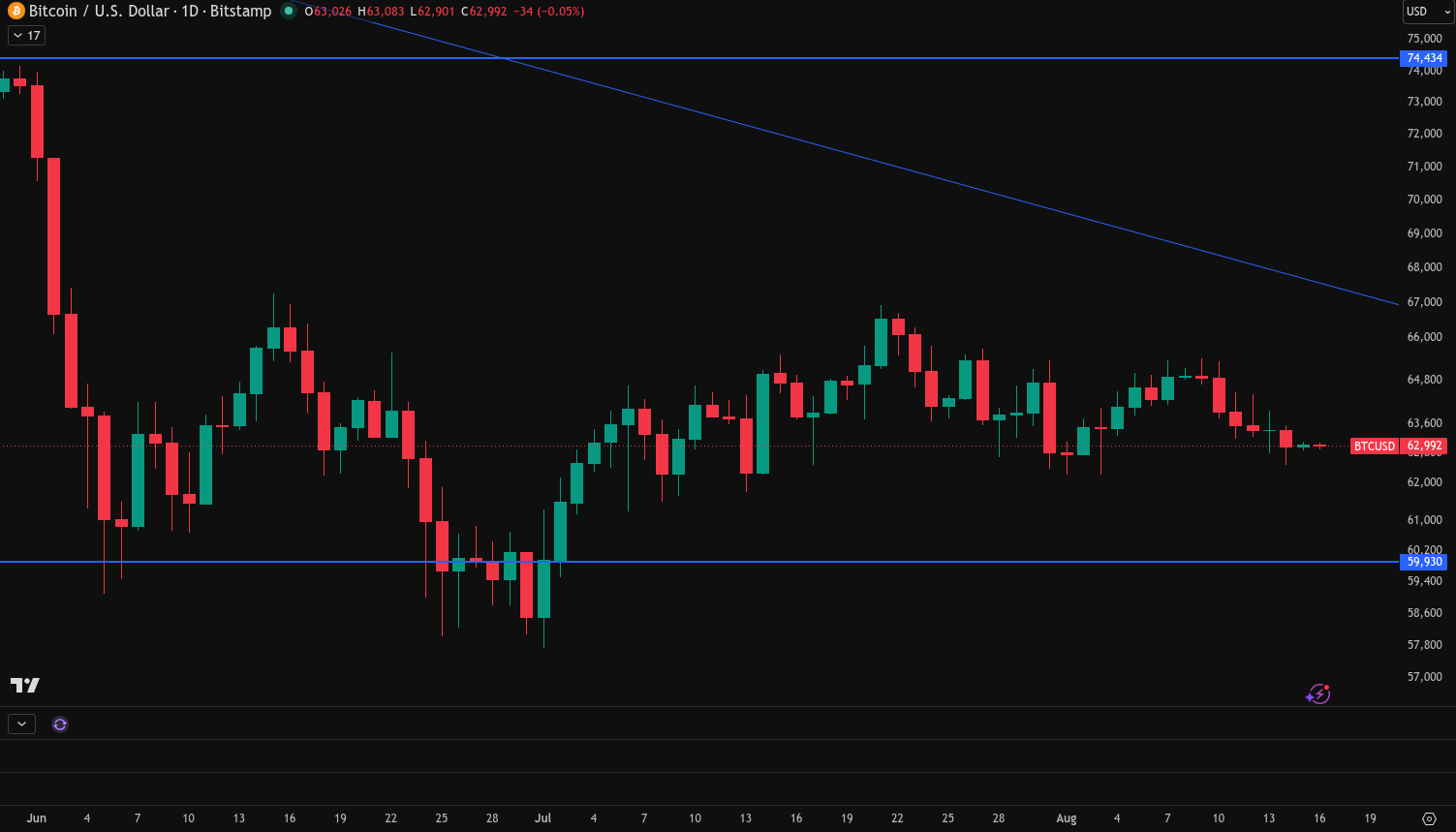
The Bitcoin spot market is in a state of directional exhaustion. Over the weekly cycle ending August 16, 2026, price action remained bound within a tight corridor. Bitcoin entered the week near $65,100, tested a peak of $65,180, and then experienced a series of liquidations that drove the price to a low of $62,470. By the morning of August 16, Bitcoin traded at $62,931, representing a net weekly decline of about 3%.
Underneath this quiet exterior, structural shifts point to a reduction in spot market liquidity. July 2026 trading data shows a sharp drop in transaction volume across primary fiat channels. Total spot volume across 14 leading exchange venues fell 21.7% compared to June, dropping from $547.9 billion to $429.0 billion. The contraction is pronounced on Western fiat gateways: spot volume on Bitfinex fell 59.7%, while Coinbase recorded a 26.4% decline. Binance maintained market dominance with a 45.8% market share, processing $196.5 billion in volume, followed by OKX and Bybit.
The compression in spot price volatility is a direct consequence of algorithmic market maker positioning and option dealer delta hedging. Options dealers, who hold net long options positions, trade spot against minor price fluctuations—buying into dips and selling into minor advances. This delta-hedging feedback loop dampens organic price breakout attempts and traps the asset in a mean-reverting range.
Short-duration prediction contracts on retail platforms highlight this volatility freeze. On-chain prediction contracts on platforms like Robinhood recorded massive volumes centered on strike thresholds between $62,800 and $63,100.
To offset these liquidity constraints and lower institutional friction, BlackRock filed an updated prospectus to alter the mechanics of the iShares Bitcoin Trust (IBIT). The manager reduced the minimum in-kind conversion threshold by 96%, lowering the limit from $25 million to $1 million.
Why it matters to investors: The drop in overall spot volume combined with high volume concentration leaves the spot price sensitive to sudden order flow imbalances. However, BlackRock’s mechanical upgrade democratizes arbitrage access for mid-tier quantitative desks. These desks can now execute Net Asset Value arbitrage, which will tighten bid-ask spreads during market stress and mitigate sudden flash crashes. Investors must view this low-volatility period as a structural transition where trading activity moves from raw spot execution to complex derivative structures.
While localized capital flows remain insulated within exchange-traded funds, a major threat to Bitcoin’s valuation model is unfolding in the Middle East. Deteriorating maritime security in the Strait of Hormuz has triggered a near-total collapse in commercial transit. The shipping channel, which handles 20% of the global petroleum and natural gas supply, is closed to transparent commercial shipping.
Following drone strikes on two ADNOC tankers and 65 vessel incidents reported by the International Maritime Organization, daily vessel transit plummeted from a pre-conflict baseline of 130 ships per day to fewer than 10. Many vessel operators now shut off transponders to evade detection.
A preliminary routing agreement between Oman and Iran, based on a June 18 memorandum of understanding, failed to restore confidence. Iranian authorities demand a complete halt to the United States naval blockade, compensation for war damages, and the unfreezing of sanctioned assets as non-negotiable conditions for a full reopening. The United States Pentagon states that the naval blockade can persist for an indefinite period, ensuring a prolonged shipping freeze.
This logistical block has caused immediate supply chain failures, including the suspension of Qatari liquefied natural gas deliveries to India. In response, West Texas Intermediate crude oil prices surged 5% over the week, reaching $82 per barrel.
Why it matters to investors: Bitcoin acts as an inflation hedge against currency expansion, not supply-driven cost inflation. A sustained energy shock spikes the headline Consumer Price Index, which strips away any incentive for the Federal Reserve to implement interest rate cuts. Higher interest rates maintain an expensive cost of capital and drain fiat liquidity from the global financial system. Because Bitcoin is a liquidity-sensitive asset, this macroeconomic tightening represents a major headwind that can override localized spot inflows and trap the price. Investors must monitor energy prices as the primary indicator of global monetary conditions.
The structural makeup of Bitcoin derivatives is undergoing a dramatic re-alignment. The popular institutional “basis trade”—a cash-and-carry strategy where traders buy spot ETFs and sell futures to capture the premium yield—is unwinding due to compressed basis margins.
CME Group Bitcoin futures open interest fell to 123,000 BTC, marking the lowest level of open contracts since February 2024. As basis yields compressed, institutional market makers pulled dual-sided liquidity from domestic regulated venues. As a result, Binance surpassed the CME in futures open interest for the first time since 2023, signaling a migration of derivative activity back to offshore platforms.
To counter this contraction, domestic exchanges are pushing for higher-leverage products to attract speculative capital. The Cboe BZX Exchange submitted regulatory filing SR-CboeBZX-2026-065 with the Securities and Exchange Commission. The filing proposes a rule change to list 3x leveraged Bitcoin and Ether ETFs managed by Volatility Shares LLC. These products will operate as commodity pools under Commodity Futures Trading Commission oversight. Because they utilize derivatives and hold no physical spot assets, they bypass standard SEC leverage restrictions.
At the same time, traditional asset managers are packaging Bitcoin’s volatility surface into income products. Goldman Sachs reached a definitive agreement to acquire NEOS Investments for up to $2.25 billion in cash and equity. The acquisition adds up to $32 billion in assets under management across 19 options-based income ETFs to Goldman’s portfolio. NEOS operates the BTCI ETF, a Bitcoin covered-call fund with over $1 billion in assets. The fund holds spot Bitcoin products and sells call options against them, generating monthly distributions in the mid-20% range.
Why it matters to investors: The unwind of the basis trade means that institutional market makers are reducing their dual-sided bid on regulated exchanges, which could lead to wider spreads and higher intraday volatility. However, Goldman’s massive $2.25 billion acquisition of NEOS demonstrates that major investment banks see long-term demand for yield-generating digital asset products. Instead of waiting for its own delayed prospectus, Goldman purchased an existing options engine to capture a slice of the $180 billion derivative-income market. This shifts the institutional narrative from simple spot accumulation to sophisticated yield-harvesting strategies.
Second-quarter 13F regulatory filings confirm that institutional allocators are restructuring their digital asset exposure, choosing concentration over diversification.
Swiss banking giant UBS disclosed a 24-fold quarterly increase in call option exposure tied to BlackRock’s IBIT ETF, holding options representing 1.95 million underlying shares. UBS also cut its put option exposure by 53% to 143,300 shares while expanding direct spot holdings by 12% to 407,890 shares. This asymmetrical deployment indicates that UBS is utilizing covered-call overwriting or structured yield products for private banking clients to monetize flat price action.
Other prominent allocators showed high conviction:
Tudor Investment Corporation: Paul Tudor Jones increased his IBIT spot holdings by 18.9% to 688,529 shares ($22.9 million), reversing a prior 91% divestment trend.
Edelman Financial Engines: The dominant registered investment advisor disclosed a new $34 million spot Bitcoin ETF position. Underlining this fiduciary shift, the firm’s Bitcoin position is larger in name than its $25 million equity holding in Amazon.
Mubadala: Abu Dhabi’s sovereign wealth fund expanded its exposure to close to $660 million, showing a direct contrast with cautious academic endowments.
Harvard Management Company: The university endowment halted its prior selling trend, maintaining a steady position of 3.04 million shares ($101.4 million).
Sovereign accumulation also accelerated via equity proxies. Norway’s Sovereign Wealth Fund, Norges Bank Investment Management, disclosed record indirect Bitcoin exposure of 11,549 BTC ($725 million) at the close of H1 2026. This represents a 60.5% year-over-year expansion. The fund holds 9,914 BTC through its 1.17% equity stake in Strategy, with remaining exposure distributed across Metaplanet, Marathon Digital, Coinbase, Block, and Tesla.
However, this proxy strategy faces an imminent index exclusion threat. Index provider MSCI initiated consultations on a new screen that excludes companies whose operating assets comprise less than 50% of total assets, alongside strict tests on operating cash flows and equity dilution. Backtests flag Strategy and Japan’s Metaplanet for potential exclusion during the November 2026 review. Metaplanet issued ¥200 million ($1.3 million) in unsecured 3-year BitBonds to fund its treasury after utilizing 83% of its $500 million credit line.
Why it matters to investors: Institutional capital is flowing toward regulated, liquid wrappers while divesting from alternative assets. Goldman Sachs, for example, liquidated its entire $154 million holding in Ripple and Solana products, concentrating capital on Bitcoin and Ethereum wrappers. This consolidation reinforces Bitcoin’s status as the primary macro asset of the sector. However, the proposed MSCI index change represents a structural risk. If Strategy and Metaplanet are excluded, passive index-tracking funds will be forced to liquidate billions of dollars in equity positions, creating a risk of a localized sell-off that could spill over into spot Bitcoin markets.
Bitcoin mining operations are locked in a physical confrontation with artificial intelligence hyperscalers for access to global electrical grids. Trillion-dollar tech giants possess a much higher revenue-per-megawatt generation capacity than ASIC mining operations, allowing them to outprice miners for power baseloads. Nvidia’s negotiation of a $3 billion investment in SB Energy to secure power for a proposed $100 billion OpenAI data center in Ohio highlights this trend.
In response to reduced mining profitability, public mining firms are pivoting to High-Performance Computing (HPC) and energy leasing:
Riot Platforms: The miner executed a 20-year, 191-megawatt lease with artificial intelligence laboratory Anthropic at its Rockdale, Texas campus. The contract projects $9.1 billion in revenue, with a ceiling of $16.1 billion if extension options are exercised through 2048. This agreement reframes Riot as an energy infrastructure landlord.
Keel Infrastructure: Keel’s Q2 earnings report disclosed a massive $140.8 million operating loss, driven by $63 million in depreciation from shutting down mining rigs in Moses Lake, Moses Lake, Scrubgrass, and Panther Creek. Keel liquidated 1,085 BTC for $75 million to retire debt and fund a new 96 MW data center in Quebec, and plans to sell its remaining 1,861 BTC by the end of 2026.
Soluna Holdings: Soluna secured ERCOT approval to begin energized commissioning on Project Kati 1, an 83 MW wind-powered site in South Texas, driving a 145% year-over-year revenue increase to $15.06 million.
Hyperscale Data: The firm liquidated 685 BTC for $43 million to finance a new high-performance computing facility in Michigan, leaving just 275 BTC in its treasury reserve.
Why it matters to investors: Public miners cannot rely on simple block reward accumulation to maintain equity valuations. Riot’s direct production cost rose to $49,912 per coin in Q2, squeezing margins. However, those miners with grandfathered grid connection queues hold a valuable economic moat. With Texas freezing 474 gigawatts of pending data center grid connection requests, Riot’s pre-approved grid queue positions are valuable assets. Investors must differentiate between miners executing successful HPC data landlord transitions and those forced to liquidate core Bitcoin reserves to cover operational cash burn.
While human-driven spot volumes are declining, machine-to-machine commerce is establishing a permanent floor for on-chain blockspace demand. Q2 earnings from Coinbase reveal the rapid emergence of Agentic Finance (AiFi), where autonomous artificial intelligence agents utilize cryptographic rails to settle transactions.
Traditional payment networks are uneconomical for the AI economy. A Keyrock research report shows that the average transaction size for an AI agent is $0.31. Because Visa’s minimum merchant fee threshold is about $0.30, 76% of all AI transactions are impossible under traditional card rails.
As a result, AI agents are migrating to Layer-2 networks. Coinbase confirmed that over 90% of all agentic stablecoin transaction volume is routed through its Base network using the x402 protocol, with 99% of this commerce settled in USDC. This has driven Base’s annualized transfer volume to $32 trillion, using sub-cent fees and sub-second settlement times.
At the same time, the Robinhood Chain—built on Arbitrum Orbit technology—recorded a massive expansion. The network’s Total Value Locked rose 32% in a single week to $473 million, processing 11.6 million daily transactions. The growth is concentrated in Ethena’s USDe stablecoin, which expanded from $17 million to $253 million, comprising 43% of the chain’s stablecoin supply. USDe uses a delta-neutral structure, backing spot collateral (ETH and BTC) with short perpetual positions on centralized exchanges to generate yield.
Why it matters to investors: The rise of agentic commerce shifts blockchain valuation models from speculative retail trading to utility-driven network bandwidth. AI agents do not hold physical bank accounts; they hold cryptographic keys. Layer-2 networks are becoming the primary clearinghouses for non-human capital. Investors must realize that base-layer assets like Bitcoin will capture value not as direct medium-of-exchange vehicles, but as the ultimate settlement assets and collateral backing the synthetic yields (like USDe) that feed these automated economies.
The institutionalization of Bitcoin is met with strict regulatory domestication and persistent operational security threats.
Sovereign states are moving to ring-fence capital and block access to offshore platforms:
Brazil: The Central Bank published Resolution 584, mandating a 24-hour precautionary hold on outbound virtual asset transfers exceeding $10,000 destined for foreign platforms or self-custody wallets. With stablecoins comprising 71.7% of Brazilian crypto activity, this hold destroys instant settlement finality.
South Korea: Regulators blocked 50% of the top 50 global overseas derivatives exchanges—including OKX and Bybit—from the domestic Google Play Store. At the same time, authorities softened domestic exchange ownership caps to 34%, enabling mega-banks like KB and Shinhan to acquire domestic platforms Upbit, Bithumb, and Coinone.
Russia: The Central Bank authorized retail trading of Bitcoin, Ethereum, and Tether on domestic exchanges. Russia is crowdsourcing domestic crypto liquidity to build a parallel foreign exchange reserve and facilitate cross-border trade to bypass Western sanctions.
At the same time, the physical and operational security of self-custody is under pressure. A critical vulnerability in BTCPay Server (versions prior to 2.4.2) using the Lightning Network Daemon allowed attackers to exfiltrate .macaroon credential files, close channels, and sweep merchant funds. Hardware wallet provider Trezor also reported a data breach at third-party logistics partner ShipMonk. An SQL injection exploit via Metabase exposed the names, emails, phone numbers, and physical delivery addresses of 13,689 customers across the US, UK, Brazil, and Europe who received units between May 10 and August 8, 2026.
However, traditional trust infrastructure is moving to absorb this risk. The Office of the Comptroller of the Currency granted preliminary conditional approval for World Liberty Trust Company to organize as a national trust bank. This charter allows World Liberty Financial to manage reserves, issuance, and redemption for its $4 billion USD1 stablecoin in-house. In addition, the FDIC approved deposit insurance for Dallas-based Augustus National Bank, allowing its Juno Moneta subsidiary to offer stablecoin issuance and custody under the GENIUS Act.
Why it matters to investors: The combination of strict transfer holds (Brazil), exchange blocks (South Korea), software exploits (BTCPay), and physical delivery database leaks (Trezor) creates friction for self-custody. This operational fragility is driving commercial operators and institutional investors away from sovereign, self-hosted architecture and toward regulated, custodial banking rails. The conditional approval of national trust bank charters for stablecoin operators (World Liberty) and insured deposit integrations (Augustus National Bank) signals that the future of digital asset banking is being built inside the regulatory perimeter.
Investors must position portfolios around several upcoming structural events that may dictate market direction over the coming quarter:
The CLARITY Act Senate Vote (September 15, 2026): Senate Majority Leader John Thune filed cloture on H.R. 3633, the Digital Asset Market Clarity Act. There are 14 legislative working days remaining before the October recess, and the bill requires 60 votes to overcome a filibuster. Current prediction markets price the probability of passage in 2026 at a mere 20%, as negotiations stall over ethics provisions and commercial banking opposition to stablecoin yields.
The SEC “Regulation Crypto” Rules: The SEC postponed its August 14 Sunshine Act open meeting that was scheduled to introduce tailored fundraising exemptions and safe-harbor rules for early-stage decentralized networks. Watch for the announcement of a rescheduled date, which will establish the formal public comment pipeline.
The November 2026 MSCI Index Review: Passive capital trackers face substantial rebalancing risk as MSCI concludes consultations on excluding companies with less than 50% operating assets. Backtests indicating the exclusion of Strategy and Metaplanet must be watched with care, as index removal will trigger forced selling of underlying equity proxies.
Traditional Finance M&A Closures (Q1 2027): Regulatory clearance updates on Goldman Sachs’ NEOS transaction and Bank Leumi’s native trading launch will serve as major validation milestones for institutional integration.
No posts
Comments
Nothing yet. Say the first thing.
Sign in to join the conversation.