

Bitcoin Market Brief here - your go-to crypto source.
What’s on the menu today:
Why Five-Minute Bitcoin Bets Created an Unexpected Risk
Aave Is Preparing for the Next Phase of Tokenized Finance
Trump to meet with senators over CLARITY Act on Thursday
A crypto trader tells his friend:
“I’ve stopped fighting the market.”
Friend:
“So you go with the trend now?”
Trader:
“No.
Now I just lose peacefully.” 📉😂

Prediction markets are supposed to tell us what people think will happen.
But sometimes...
They create incentives for people to make things happen.
A new study from Stanford University and Singapore Management University found that some of Polymarket’s short-term Bitcoin prediction markets may have done exactly that.
The issue wasn’t the predictions themselves.
It was the way they settled.
Here’s the simple version.
Polymarket offered contracts where users could bet on whether Bitcoin would finish above or below a certain price just five minutes later.
Sounds harmless enough.
But because the contract settled based on Bitcoin’s price at the exact end of that five-minute window...
Anyone with enough capital had a reason to try nudging the market right before settlement.
According to the researchers, that’s exactly what appeared to happen.
They found unusually large bursts of buying or selling activity just before contracts expired.
Then, almost immediately afterward, prices would reverse.
That’s important.
Because if traders were simply reacting to market news, you’d expect the price move to continue.
Instead, the move often disappeared once the contract settled.
The study estimates this behavior shifted roughly $1.3 million from ordinary participants to those taking advantage of the settlement mechanics.
And here’s the interesting part.
The problem largely disappeared when contract durations were extended from five minutes to fifteen minutes.
Why?
Because manipulating Bitcoin for a few seconds is one thing.
Influencing the market for fifteen straight minutes becomes a lot more expensive and a lot harder.
This doesn’t necessarily mean prediction markets are broken.
In fact, the researchers argue the opposite.
The issue isn’t prediction markets.
It’s how they’re designed.
A better settlement system could make this type of behavior much less profitable.
For example, instead of using a single price at a specific moment, platforms could use an average price over several minutes.
That makes it much harder for someone to game the outcome.
The takeaway:
Prediction markets are becoming a bigger part of finance.
Polymarket and Kalshi processed billions of dollars in volume recently, and the sector keeps growing.
But as these markets get larger, the details start to matter.
Because sometimes the biggest risk isn’t getting the prediction wrong.
It’s accidentally creating incentives for people to manipulate the result.
One of the biggest trends in crypto right now isn’t memecoins.
It’s not AI.
And it’s not another layer-2.
It’s the slow collision between traditional finance and blockchain infrastructure.
Aave just took another step in that direction.
The largest decentralized lending protocol in crypto has launched its new V4 infrastructure on Avalanche, and the really interesting part isn’t the blockchain itself.
It’s what the upgrade is designed to support.
Tokenized real-world assets.
Things like US Treasuries.
Money market funds.
Corporate bonds.
Private credit.
Assets that traditionally live inside the financial system are increasingly moving onchain.
And Aave wants to be one of the places where those assets can actually be used.
The new system introduces what’s called a “Hub & Spoke” architecture.
Sounds complicated.
But the idea is pretty simple.
Different lending markets can have their own rules, collateral requirements, and risk settings while still sharing liquidity across the broader Aave ecosystem.
Think of it like individual neighborhoods connected to the same city infrastructure.
Each neighborhood operates differently.
But everyone still benefits from the same underlying network.
That’s important because tokenized assets aren’t all the same.
A tokenized Treasury bill doesn’t carry the same risks as a tokenized corporate bond.
And a private credit fund doesn’t behave like a money market fund.
Aave’s new setup allows those differences to exist without forcing every asset into the same lending framework.
What’s really interesting is that this isn’t happening in isolation.
Over the past year, major financial institutions have been building infrastructure around tokenized collateral.
Franklin Templeton has been working on tokenized money market funds.
Nasdaq has been integrating tokenized collateral systems.
DTCC is building tokenized settlement infrastructure.
And now DeFi protocols are preparing to accept these assets as collateral.
That’s how financial adoption usually happens.
Not through one giant breakthrough.
But through dozens of separate pieces slowly connecting together.
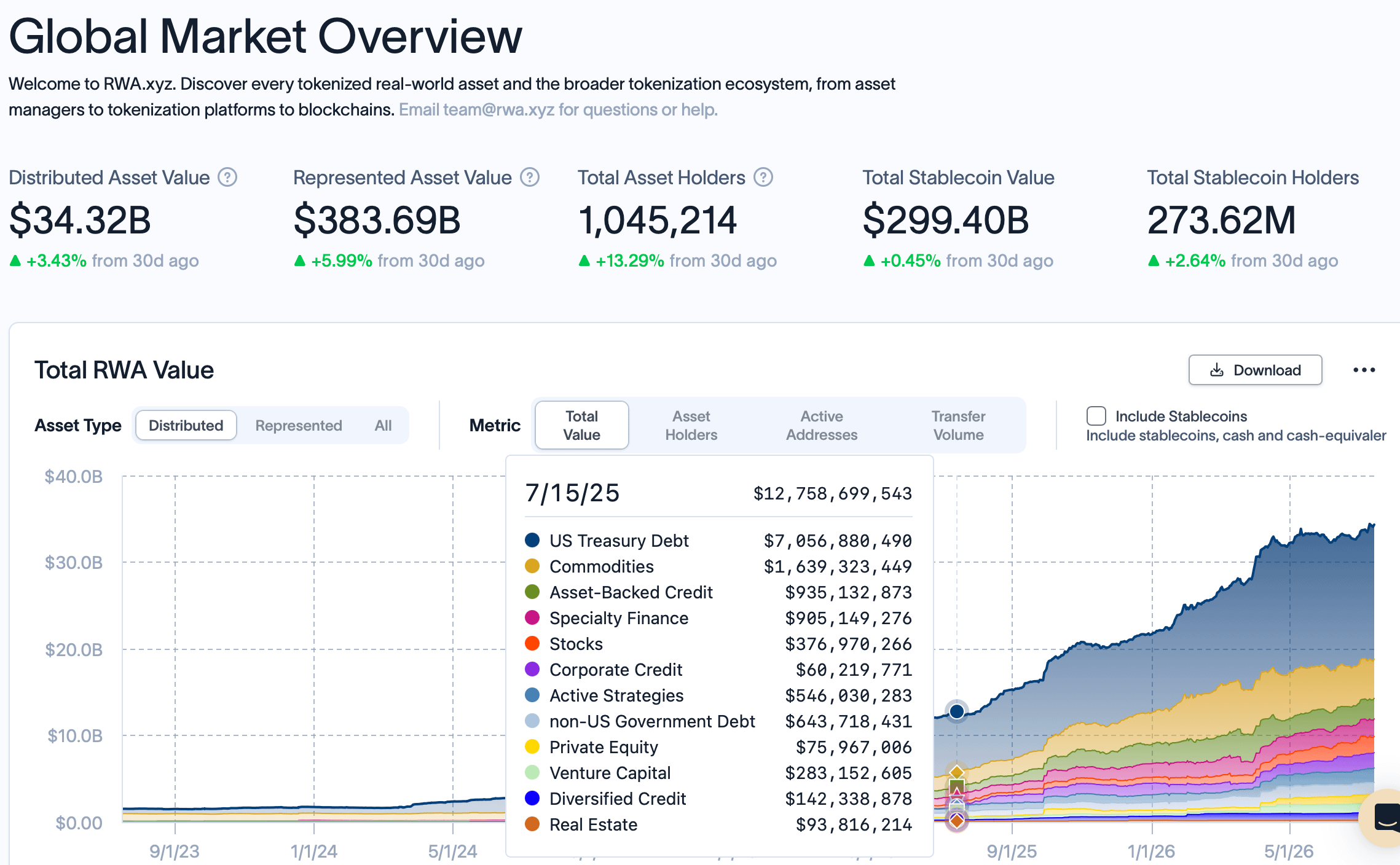
The numbers already show the trend.
A year ago, roughly $13 billion worth of real-world assets were tokenized on public blockchains.
Today, that figure has climbed to more than $34 billion.
And it’s still growing.
The takeaway:
For years, tokenization was mostly about creating digital versions of traditional assets.
Now the focus is shifting toward utility.
Because a tokenized Treasury becomes much more valuable when you can borrow against it, trade it, use it as collateral, and move it across financial platforms.
That’s the next stage of tokenization.
And protocols like Aave are positioning themselves to become part of that infrastructure.
Base’s social bet left it trailing in prediction markets and perps: Pollak
June PPI Misses Forecast by 0.7 Points, Boosting Rate Cut Expectations
Brian Armstrong Reveals Coinbase is 95% Vibe Coded By AI
Trump to meet with senators over CLARITY Act on Thursday: Politico
DISCLAIMER: None of this is financial advice. This newsletter is strictly educational and is not investment advice or a solicitation to buy or sell any assets or to make any financial decisions. Please be careful and do your own research.
No posts
Comments
Nothing yet. Say the first thing.
Sign in to join the conversation.