
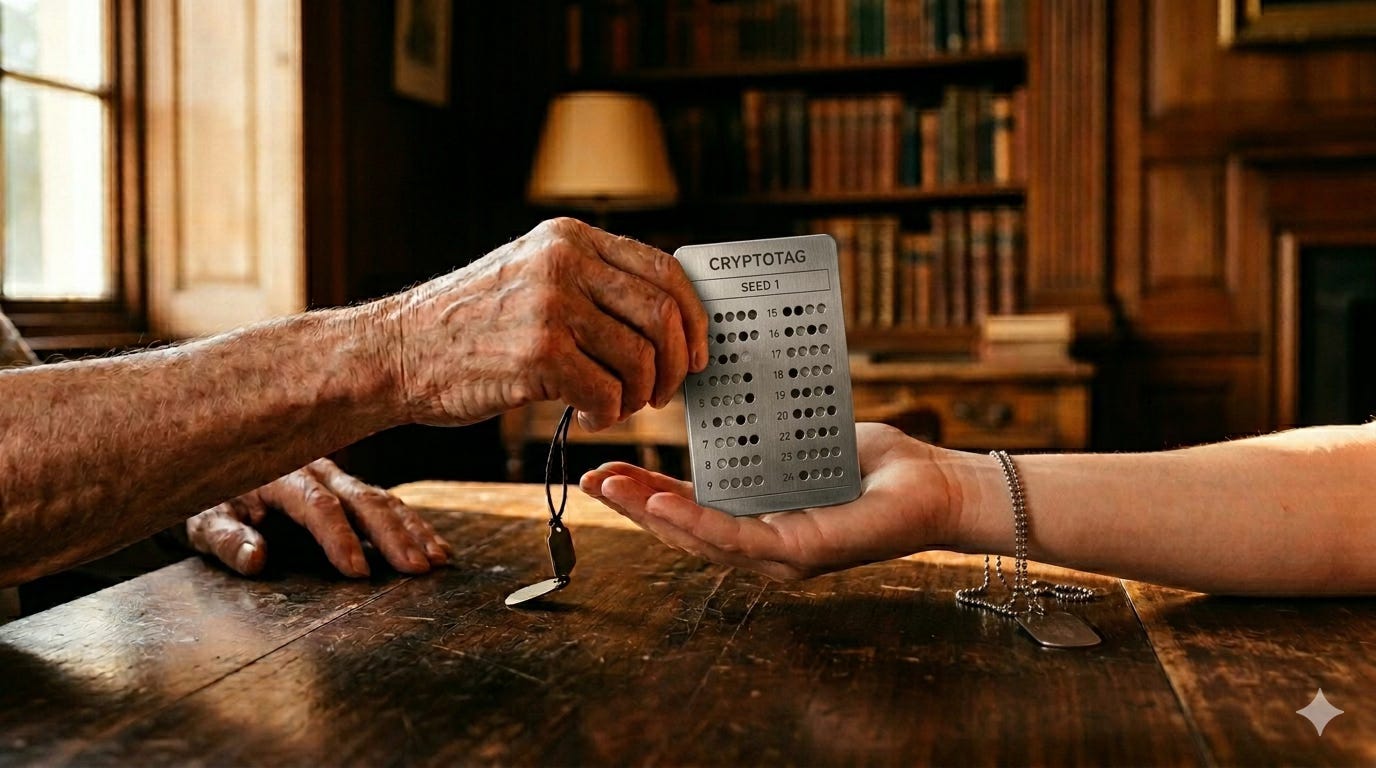
I had a conversation with a fellow Bitcoiner recently that has stayed with me. He’s in his late fifties, holds a stack he won’t discuss publicly, and his wife has no idea where any of it is. When I asked him why, he gave me an answer I’ve heard before: “I’ll sort it out properly one day.”
I think about him as I sit down to write about this topic.
He is not unusual. He is the rule.
Somewhere on the blockchain, around 3.7 million bitcoin sit in wallets that will never be opened again. That’s roughly 18% of the total supply, locked away forever.
The reasons are mostly quite mundane. Someone forgot a password, threw out a hard drive, or died without telling anyone how to access their stash.
If you’re of the Gen X or Boomer generations and holding a meaningful Bitcoin stack in self-custody, this article is written for you.
Even if you’re a younger Bitcoiner, you should still pay close attention, because morbidity and mortality can show up at the door - often when we least expect it.
For those of us in our forties and above, we are losing the advantage of youth. We are at a key inflection point where health outcomes are diverging rapidly.
Lifestyle diseases, strokes, dementia, sudden cardiac events, and other unwelcome health surprises start showing up at the door.
And as the saying goes, time is the only thing we spend without ever knowing what the balance is.
We simply don’t know when our number may be up, and as difficult as it may be to contemplate our own demise, we need to plan for this outcome because so far, nobody has ever avoided it.
In this article, I’ll cover:
Why this problem hits hardest after 40, and how it scales over the next 10-20 years
Why self-custody Bitcoin is uniquely difficult to inherit
Four real-world stories of fortunes lost to death, lockouts, and forgotten passwords
A self-custody inheritance plan matched to your family situation
The exact steps to take, starting today
People in their forties and older are more likely to hold meaningful Bitcoin stacks.
We reach the peak of our wealth between the ages of 45 and 65. Many people bought during the 2017 and 2020-21 cycles. Since then, our stacks have grown in value as we’ve aged another decade.
The same age group is moving toward the years when serious health events become more likely. Strokes, heart attacks, dementia, prolonged hospitalizations, and accidents all show up more frequently after 50, and any of them can take you offline before you’ve had a chance to organize your affairs.
After 50, the risk of a serious cardiac event roughly triples per decade. By age 65, it’s the leading cause of death for men.
Death is not the only possible outcome. In the aftermath of a serious health event, you could also become incapacitated at some level, affecting your physical or cognitive function.
In other words, you might still be breathing, but you may not be able to access your Bitcoin - or tell someone else how to.
For self-custodied Bitcoin specifically, the inheritance challenge is unlike any other asset class.
Compare it to property. Real estate ownership is recorded with a government registry. A title company, an estate attorney, a probate court, and a recording office all stand ready to transfer ownership when you die.
Shares are held by a brokerage on your behalf, with a clear paper trail to your beneficiaries. Bank accounts work the same way. Even the contents of a safety deposit box can be reached by an executor with the right paperwork.
Self-custodied Bitcoin exists outside this system of custodians and registries. There is no broker holding it for you, no land registry recording your ownership, no transfer agent who can rewrite your name to your spouse’s, and no probate court that can compel the blockchain to act.
The blockchain only knows that someone with the private key signed a transaction. Without that key, your ownership ends the moment you can no longer sign.
There is no bank to call. There is no customer service line.
This is the flip side of financial self-sovereignty. Unfortuantely, you can’t have it both ways. With freedom comes responsibility.
You, and only you, are responsible for ensuring your Bitcoin is not lost forever should you unexpectedly pass.
A serious cognitive event can lock you out of your own wallet, and the access information tends to go with the person who held it. By the time anyone realizes the keys are gone, they are gone for good.
Let me lay out the actuarial reality without sugarcoating it.
The early Bitcoin adopter cohort, the people who got in between 2013 and 2017, are now mostly in their 40s through their late 60s. Statistically speaking, within the next two decades, a meaningful percentage of them will be either deceased or cognitively impaired.
Several consequences follow from this:
Every Bitcoin price cycle increases the stakes of these losses. We are now at the point where a single mishandled wallet can permanently alter a family’s financial trajectory for generations.
Most heirs are wholly unprepared. Surviving spouses and adult children who have never touched a hardware wallet, who don’t know what BIP39 means, who don’t know the difference between an exchange account and a cold wallet, and who cannot tell whether they are looking at the real Ledger Live or a phishing clone.
The legal system will catch up slowly and imperfectly. The Revised Uniform Fiduciary Access to Digital Assets Act is now law in all 50 US states, and similar frameworks exist in the UK, Australia, and parts of Europe.
This means a court may be able to grant your heirs legal ownership of your Bitcoin, but it cannot grant access to a single satoshi. The technical knowledge required to recover a wallet is usually the purview of a single household member. When that person is gone, the knowledge usually goes with them.
We are heading into the first wave of mass Bitcoin inheritance failures, and the cycle will repeat itself with each successive generation unless people make conscious changes now.
These are stories of real and unexpected losses that left family members of the victims out in the cold, unable to access their Bitcoin or other crypto assets. The lessons apply across all custody models, but holders of self-custodied Bitcoin are by far the most exposed:
A banking heir from one of America’s most prominent financial dynasties. By 2018 he was estimated to be worth nearly $500 million, the vast majority of it in cryptocurrency. He held both XRP and Bitcoin.
Mellon was paranoid about hackers, which was fair enough at his net worth. So he stored his keys in cold wallets across the United States, hidden in bank vaults under other people’s names. He never told anyone where they were. Not his children. Not his ex-wives. Not his lawyers. Not the trustees managing his estate.
He died of a heart attack at 54, days before he was due to check into rehab.
His XRP holdings became the subject of a years-long recovery effort that I’ll cover in a separate article (the lessons around centralized cryptocurrencies deserve their own deep dive).
The short version: XRP is controlled by a centralized company, which gave Mellon’s lawyers a legal entity they could approach. Bitcoin has no such company. There is no business to negotiate with, no boardroom to subpoena.
More than three years after his death, his family still hadn’t located any of his Bitcoin holdings or the codes to access them. As far as anyone knows, his Bitcoin is gone forever.
The lesson: paranoia about theft can become the very thing that loses it all. When your security plan has no second copy, you have built a vault that will outlive you.
A man whose name has never been made public died unexpectedly in 2019. At the time of his death, his cryptocurrency holdings were worth roughly $190 million.
Days before he died, he had already locked himself out of his account. He had told friends he had forgotten the password and was trying to remember it. He never got the chance.
His family worked with the exchange afterward, but without the private keys, the fortune was unrecoverable. The lockout that started as forgetfulness became permanent the moment he was no longer around to keep guessing the password.
The lesson: if you haven’t secured your Bitcoin in a way that even you know how to access it, then your family certainly won’t in the event of your untimely demise.
This is the only “success” story in this section, and you’ll see why it barely qualifies.
Sandra is a widow whose husband had carefully prepared. He left a Trezor hardware wallet in a known location with a written seed phrase in a safe deposit box and a note explaining everything.
When he died, Sandra found the device and the seed phrase exactly where he’d said they would be. She had no idea what to do with either.
She called her bank. They had never heard of Trezor. She called her lawyer. He suggested she hire a “computer expert.” It took her three months and roughly $600 in consulting fees before her grandson finally helped her recover the Bitcoin.
She got there in the end. The case shows the limits of leaving the right physical objects behind without the knowledge to interpret them. Without someone who knows what the objects are and what to do with them, your heirs are facing an anxiety-soaked, multi-month treasure hunt during the worst weeks of their lives.
The lesson: a seed phrase or a device by itself, without any further instruction, is just a riddle for your heirs to solve.
Stefan Thomas is alive and well. He is also locked out of approximately $400 million worth of Bitcoin.
In 2011, Thomas made a video explaining how Bitcoin worked. He was paid 7,002 BTC for it. He stored those keys on an IronKey USB drive, a device that limits to 10 password attempts before permanently encrypting itself.
He forgot the password.
He has used eight of his ten attempts, leaving only two left. For all practical purposes, he is locked out for life.
The lesson, and this is the most important one: you do not have to die to lock your family out of your Bitcoin. A bad head injury, early-onset dementia, or a stroke can do it. So can a long enough stretch of forgetting a passphrase change.
You can still be alive and well (or not so well) and still lose the fortune that your heirs were set to inherit.
You may also like…
If you’ve made it this far, you’ve understood the problem. Now let’s talk about what you can actually do, using only self-custody tools.
Comments
Nothing yet. Say the first thing.
Sign in to join the conversation.