
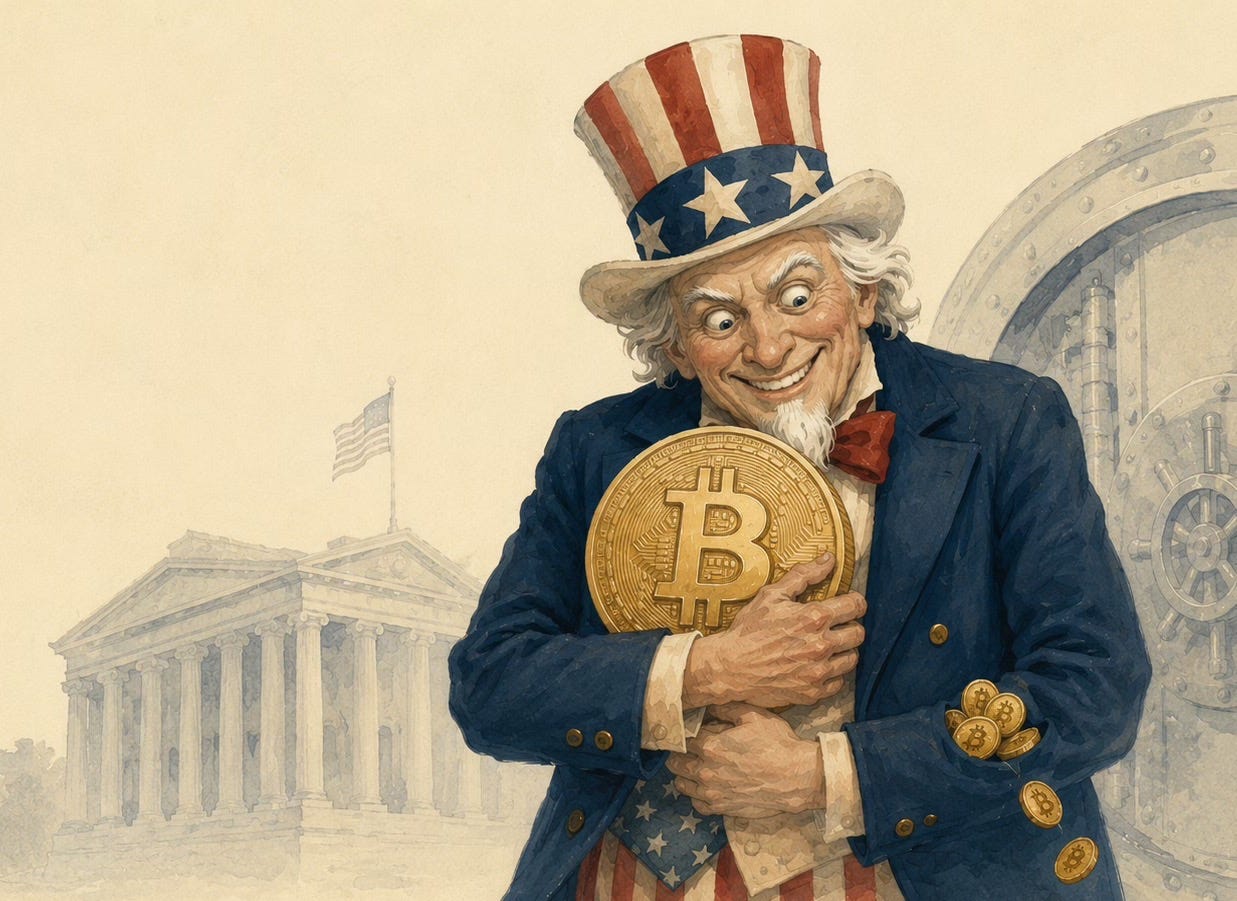
What would happen to Bitcoin if the US government, under the new bill now sitting in Congress, eventually bought up 5% of the entire supply?
This is the kind of math that would obliterate all previous assumptions about Bitcoin’s value and launch it into the stratosphere.
There will only ever be 21 million coins, making Bitcoin the most inelastic asset on Earth. And the moment the most powerful government on earth starts eyeing such a large slice of a fixed pie, something has to give.
And more than that. The second the rest of the world sits up and takes notice, all bets are off, and game theory is in play.
The bill I’m talking about is called the American Reserve Modernization Act of 2026, or ARMA, because Washington cannot resist a good acronym.
This is a bipartisan congressional bill, introduced to Congress by Rep. Nick Begich of Alaska on May 21st, 2026.
It is the successor to the stalled BITCOIN bill introduced by Senator Cynthia Lummis in 2025. It has been described as a ‘rebranded’ version of the original BITCOIN bill.
But both bills propose something particularly noteworthy: the revaluation of the US gold reserves to credit the profits to the Treasury’s balance sheet, allowing it to potentially use that ‘new’ money to purchase Bitcoin.
ARMA proposes that the US should hold 5% of the total Bitcoin supply to match its (alleged) gold holdings.
And this is where things get interesting. While 5% of the total supply doesn’t seem like much at first glance, it would actually make the US the largest single holder of Bitcoin on the planet - even possibly exceeding Strategy, which currently holds over 4% of the total Bitcoin supply.
So what would this mean for people who already hold Bitcoin? You might be thinking - I’m not American, why do I care about this proposed US legislation?
Well, strap in because regardless of whether you live in the US or not, things could get very wild indeed.
If a government buying spree ever does kick off, you'll want to be ready - and that means having your own ‘strategic reserve’ already in place. Subscribe for free to learn the essentials, or upgrade to paid for all my deep-dive articles and access to my complete Bitcoin Tool Vault
In this article I cover:
What the ARMA bill actually proposes
How the US could buy Bitcoin without spending a taxpayer dollar
The 1973 gold quirk that becomes a money-printing lever
What a US buying spree would do to Bitcoin’s price and supply
The game theory that pulls other nations into the race
The numbers: how a $37 billion buy could send Bitcoin from $100K to $1 million
What the bill proposes
Congressman Nick Begich introduced ARMA in May 2026, with Congressman Jared Golden as co-lead and a clutch of bipartisan co-sponsors. The bill essentially does four things.
It writes the reserve into law. Right now the Strategic Bitcoin Reserve exists only because of a 2025 executive order. The next president can undo an executive order with a single signature. Unwinding an actual law is far harder, because it requires the whole of Congress, which makes the reserve much harder to kill.
It gathers up the scattered coins. The Treasury takes custody of all the bitcoin and other crypto the government already holds, most of which it seized in criminal cases, with quarterly proof-of-reserve reports and independent audits to keep things honest.
It bolts the door for twenty years. Bitcoin in the reserve has to stay put for at least two decades, and the government can sell only to pay down national debt.
It protects your keys. The bill states plainly that the government may not stop individuals from owning and self-custodying their own coins.
The bill also directs a study into “budget-neutral” ways the government could buy more bitcoin without raising taxes or adding to the debt.
A study is not a directive. This means that these budget-neutral mechanisms must first undergo a process before they can be used to obtain Bitcoin. Nevertheless, even the possibility of one major government making it a stated strategic goal to hold x% of Bitcoin will potentially have an enormous impact on the market.
You may also like:
Could the US reprice gold reserves to buy Bitcoin?
Imagine a future administration decides to go the whole way. They want roughly 5% of all bitcoin in existence, to mirror, more or less, the slice of the world’s gold the US already sits on.
Paying for that without taxing anyone or borrowing a fortune sounds impossible at first. The most obvious lever here is gold revaluation.
To understand why that is even on the table, you need to acquaint yourself with a very unlikely number - one that has been hiding on the government’s books since before many of us could walk.
Why the US government’s gold is still priced like it’s 1973
The US Treasury values its gold at a very specific number. $42.22 a troy ounce.
That’s not a typo, and I have not dropped a couple of zeros. The Federal Reserve confirms that figure has not budged since 1973, even while gold now trades in the thousands.
The story goes back generations. For most of American history, US law defined the dollar in terms of gold, and the official price crept upward over the decades as the system strained.
It was set at $42.22 in 1973, just as the country was closing the book on the gold standard, after President Nixon suspended the dollar’s convertibility into gold in 1971 and the Bretton Woods system fell apart.
Under the Gold Reserve Act of 1934, the Federal Reserve handed its gold to the Treasury and took gold certificates in return. Each certificate carried a dollar value pegged to that statutory price, and nobody could walk in and redeem one for actual metal. Those dusty certificates are the lever a revaluation would pull.
Nobody has ever bothered to update a value that has sat there, untouched, for more than half a century. This is probably because:
Once gold stopped backing the dollar, the official price ceased to matter to the day-to-day workings of money. There was no pressing need to touch it.
The optics are ugly. If the government suddenly marked its gold up a hundredfold, markets might read it as an open admission that the dollar has lost a staggering amount of ground.
The lever is politically volatile. Pull it, and you create spendable capacity out of thin air, which is exactly why administrations treat it like a live grenade.
That last point is the whole ballgame, so let me walk you through it.
Comments
Nothing yet. Say the first thing.
Sign in to join the conversation.