

Picture this. You’re standing on a bathroom scale on the deck of a boat in a storm.
Every wave that lifts you up - temporarily defying gravity - sends the needle swinging wildly. For a brief moment in time, the number swears you’ve gained five kilos, and then lost ten.
Imagine that every time the scale shows a different number, your mood changes. If the number is too high, you feel anxious and defeated. When it suddenly drops, telling you that you’ve just lost weight, you feel elated.
The problem is, none of it is real. Your mass hasn’t changed one bit. You weigh exactly what you weighed when you stepped on the scale. Your emotions are on a wild rollercoaster - the result of nothing more than energy surging through the ocean.
The storm is shaking the instrument of measurement, while you stay exactly as you are.
This is more or less what happens when you watch Bitcoin’s dollar price. The market is the proverbial storm, and the scale priced in dollars has been swinging, and the reading on Bitcoin now sits more than 50% below the high we made back in October. Ah, those were heady days.
But the thing is that what I actually own, the Bitcoin in my own custody, hasn’t changed by a single satoshi since last October.
If you only want to be told that those lovely, elating green candles will be back soon, this won’t be your favorite read. I think we still have a sea of red ahead for the time being.
If you’d rather understand what you’re holding, enough so that you can sleep well at night, you’re in the right place.
And while I know that ultimately, the conclusion is that Bitcoin’s dollar price doesn’t matter any more than its price in pesos, pints of beer, or rolls of toilet paper, I would be remiss to imagine that all my readers are as blasé about it as I am.
So I want to walk through what’s happened in recent days, the likeliest reasons behind it, where we sit in the bigger cycle, and what a sovereign holder could potentially do with a stretch like this.
By the end, I hope that the red charts worry you a good deal less, because you’ll see the dollar price for what it really is, which is just about the least interesting thing about the Bitcoin that you hold.
Let me set the scene in dollars, because that’s exactly what we'll set aside later.
Bitcoin made its all-time high of around $126,200 on October 6, 2025. What followed wasn’t one dramatic crash so much as a long, grinding slide. A sharp leg down in early February took us under $70,000. A brief dip touched $60,000. Then came months of heavy chop that wore down even the more steely-nerved among us.
This past week finished off a lot of those nerves, but the important thing to understand is that the bulk of this latest move was already done before the doomsayer headlines started.
Over the ten days into last Friday, Bitcoin shed roughly $19,000 from its recent highs, and around $13,000 of that was gone from Monday morning to close on Thursday. The slide was well underway before Friday’s market bloodbath.
That leaves us more than 50% below the October high.
A drawdown like that is grim, especially if this is your first bear market. However, a 50% fall is not some freak event in Bitcoin’s history. It’s closer to a rite of passage.
We’ve been here more than once over the years, and on every previous occasion, it felt like the end of the world while we were living through it. (Spoiler alert: it wasn’t)
By the time last Friday arrived, Bitcoin had already taken most of its punishment. What Friday added was a broad, market-wide repricing, and it’s worth a quick look, because it shows you exactly what the dollar price is and isn’t.
Just before the US market open, the May jobs report was published. Payrolls came in at 172,000 against expectations of roughly 85,000, nearly double the forecast, with the prior two months revised up by a combined 93,000.
A hot labor market hands the Federal Reserve, now run by Kevin Warsh, every reason to keep rates high at exactly the moment traders were praying for cuts. A few desks have even started forecasting rate hikes before the year is out.
Watch what that single data point did:
The big tech and chip names took the worst of it. The Nasdaq fell around 4%, led down by semiconductor names, with some marquee chip stocks off by double digits and roughly a trillion dollars wiped off US equities in the session.
Investors dumped government bonds, sending prices down and yields up toward 4.5% on the 10-year.
Gold fell about 3.3% to roughly $4,340, its lowest of the year, and silver fell harder still.
The dollar powered higher against almost everything, with the Aussie and the Kiwi taking the worst of it.
Bitcoin slipped a little further, dipping under $60,000 to around $59,100. It did not crater the way the marquee tech stocks did, because it had already done most of its sliding in the days before.
Every asset on that list is priced in dollars, and every one of them takes its orders from the Fed’s next move. They lurched together because, underneath the labels, they’re the same kind of thing: claims and instruments denominated in a currency whose price just shifted. Every scale on the boat swung at once.
Now look at what was missing from the chaos. The Bitcoin protocol doesn’t hold meetings about economic data. It didn’t adjust its issuance. It produced blocks at the same steady pace it always does, and it’ll do the same on any day you read this. Your keys still hold your coins. Twenty-one million is still twenty-one million.
What moved that day was a price, the rate at which the market will swap your Bitcoin for dollars on a given afternoon. The thing standing behind that price was untouched.
There is no single tidy cause that we can pinpoint when the market undergoes a severe drawdown. What we can do is lay out the credible suspects, most of which occur all at once and feed off each other.
1. The four-year cycle. Lay this cycle over the last one, and we sit roughly where we did in the 2022 bear market, when Bitcoin ground through the low-to-mid $20K range and down to $16K, for months before it finally turned.
If the 4 year cycle thesis still holds and history rhymes, we could see fresh cycle lows form before the year is out, ahead of any real recovery. That would mean we are not yet at the bottom of the market.
2. AI is sucking oxygen out of the room. The AI giants are hoovering up the available capital, along with the wave of vast private names, the SpaceX, OpenAI, Anthropic, and xAI tier. Bitcoin is a mere tiddler next to all of that, and it takes only a modest rotation out of our small market and into those behemoths to drag the price a long way down. Remember, Bitcoin’s price is set at the margins.
3. Leverage getting flushed. As the price drops, leveraged long positions are liquidated. That forces more selling, which pushes the price lower, which triggers the next round of liquidations. The feedback loop is why the dips look so violent. It runs until the market has wrung out most of the leverage.
4. Sovereign currency defense. The war in the Middle East has left energy-import-dependent countries scrambling to prop up failing currencies. Turkey is the obvious example. Defending a currency means selling reserves, and while that’s usually gold and treasuries out in the open, behind the scenes it may well include Bitcoin, precisely because it sells instantly at any hour, 24/7.
5. The ETF exodus. The US spot Bitcoin ETFs have just endured a record multi-week run of net outflows totaling billions, led by hedge funds and brokerages heading for the door. That’s direct, mechanical selling. It’s also a live demonstration of a point I’ll come back to, the gulf between owning Bitcoin and owning a paper claim on it.
6. The price of money. Friday was the vivid example, but it’s been the backdrop all year. When rate-cut hopes die and the dollar firms up, the market sells off risk assets, yet it still classifies Bitcoin as high-octane risk. Global liquidity is the tide and right now the tide is going out.
7. The treasury companies. This week Michael Saylor’s Strategy disclosed its first Bitcoin sale since 2022, a small amount sold to help cover preferred dividend obligations, and the symbolism alone rattled people. Beyond Strategy, a whole flock of copycat treasury companies bought near the top and now sit under real financial strain, which throws off its own reflexive selling and a fair bit of sour sentiment.
8. Old coins waking up. A large Mt. Gox-linked wallet shifted coins this week. Long-dormant holders have been taking profit since October. And miners, squeezed by thin post-halving margins and steep energy bills, tend to sell into weakness rather than ride it out.
9. The narrative ‘cracking’. A lot of people hold Bitcoin on the strength of a story: that it's "digital gold," a safe haven that rises when everything else falls. In an actual sell-off, it usually does the opposite. It drops right alongside the tech-heavy Nasdaq, and because it's more volatile, it falls even harder, behaving like a turbo-charged tech stock rather than a safe harbor. So traders treat it as exactly that and dump it with the rest of their risky bets.
If your takeaway from all of that is that it’s messy, overlapping, and impossible to weight with any precision, you’ve understood the assignment. And that mess is the single best argument for the approach I’m laying out here.
It is wise to stop looking at daily candle charts, and zoom out to take a look at the bigger picture - the numbers that actually matter to a long-term holder.
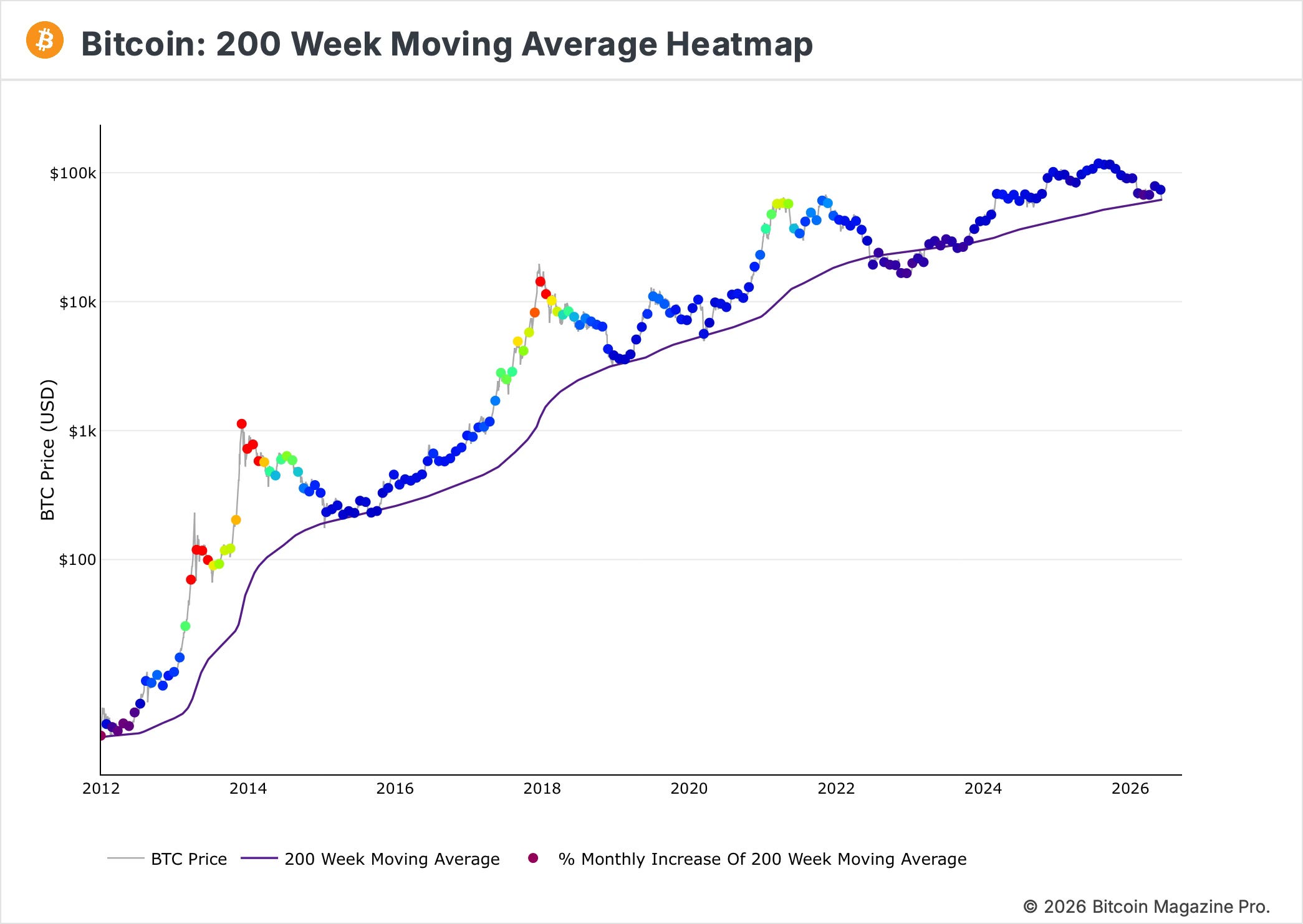
Start with the 200-week moving average. Think of it as Bitcoin’s center of gravity, the average price across almost four years of trading. It’s a slow, heavy line, and for most of Bitcoin’s lifespan it has marked the floor of essentially every major bear market.
On June 4, Bitcoin tagged the 200-week moving average near $61,300 for the first time this cycle. It’s the same line that the price climbed away from back in October 2023, and we’ve now traveled all the way back down to touch it again.
And in 2022, rather than bouncing off the 200-week line, Bitcoin spent well over a year dwelling below it - from the middle of 2022 until October 2023 - before it finally broke out. So a touch of this line has historically been a powerful signal, but it can take many months to resolve.
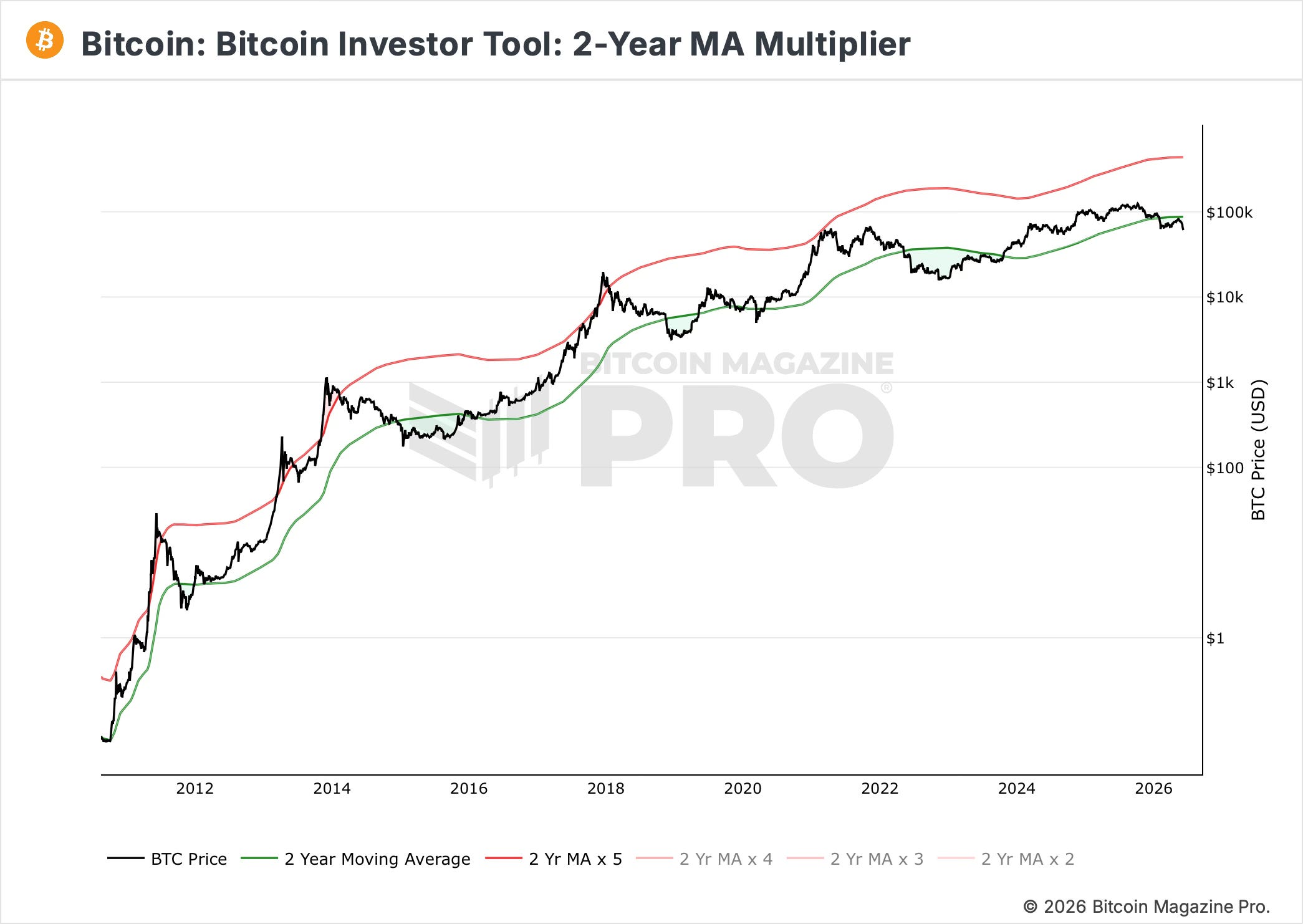
Then there’s the 2-year moving average multiplier, which simply stacks today’s price against its two-year average. When price slips below that two-year average, the multiplier drops under 1, and patient investors have long treated that zone as a value region.
You can see these periods highlighted in green on the chart. They normally come about every 4 years, and we have just entered into the green ‘value’ zone as of 2026.
The purpose of including the charts above is to provide the opportunity to zoom out and see the context of where Bitcoin is right now, with regard to market sentiment and thus the dollar price.
However, viewing Bitcoin solely through its current dollar price - even when zoomed right out - is a very one-dimensional way to understand it.
Most of the financial world looks at Bitcoin through what I’ve called the fiat lens. They see an investment, a trade to be timed, because that’s the only category their training encompasses.
And through that lens, there’s exactly one scoreboard that counts: did this thing get me more dollars?
That’s a perfectly fair question to ask about a stock or a bond. Those things exist solely to obtain more currency. Measuring them in dollars is the whole point.
Bitcoin doesn’t fit that mold, and forcing it in is like trying to jam a square peg into a round hole. I’ve written before about treating your Bitcoin as a personal strategic reserve, something closer to a productive piece of land than a tech stock.
You don’t hold land like that so you can flip it next quarter. You hold it because of what it does for you, the security it provides, and the way it sits outside a system you don’t control. Measuring that in dollars misses nearly everything that makes it worth holding.
Think of it the way you’d think about insurance. You can pay into a policy for years and never make a claim, and on a pure cash-flow basis it looks like dead money. Nobody sensible concludes their insurance is therefore worthless. Its value lives in the protection it gives against the day you finally need it.
Self-custodied Bitcoin works the same way. Its deepest properties, the fact that you can hold it directly without a counterparty, the censorship resistance, and the ability to move across a border with nothing but a memorized phrase, are dormant in calm weather. But they can be priceless the moment the storm hits.
Once that understanding clicks, the price chart ceases to be a verdict on whether you have made a ‘good’ investment. It turns into what it always was, the exchange rate between a fixed-supply asset you hold yourself and a currency that loses purchasing power a little more every year.
Trying to measure Bitcoin’s worth with that number is like measuring the height of your house using a ruler that shrinks a little each time you pick it up.
Holding Bitcoin through a cycle like this is not for the faint-hearted, and it’s certainly not for anyone who needs a green candle to feel reassured. People assume the hard part of Bitcoin is technical. I disagree.
For a long-term holder, the real difficulty is emotional, every single time. The whole game is refusing to let a real-time, endlessly liquid price feed convince you that something fundamental has changed, when nothing has.
Every bear market presents an opportunity, from building your stack to ensuring your Bitcoin is secure.
1. Ask yourself whether a rare oversold moment is sitting right in front of you. Bitcoin tagging its 200-week moving average for the first time since the last cycle is rare. Historically, the stretches of deepest fear near that line have been among the better windows to accumulate for the long haul.
If you do decide to buy, a steady dollar-cost-averaging approach takes the impossible job of calling the exact bottom off your plate.
2. Get your coins into self-custody, off the exchanges. The last bear market didn’t only take prices down. It took whole platforms down with it, customer funds and all. An exchange balance is really just a promise from someone else to give you your coins back when you ask.
Coins on your own hardware wallet, protected by a seed phrase only you know, doesn’t rely on anyone keeping their word. They’re simply yours. If you take one single action from this whole article, make it this one.
3. Make sure you own actual Bitcoin, not paper Bitcoin. This week’s record ETF outflows and Strategy’s first sale since 2022 are a timely nudge. An ETF share, an exchange IOU, a holding of MSTR, a stack of IBIT, none of these is actually Bitcoin.
They’re claims and wrappers that lean entirely on trust in multiple counterparties staying solvent and honest. The real asset is the one you can hold, move, spend, and verify without asking anyone’s permission.
4. Run your own node. This is the step that turns you from a customer of the Bitcoin network into a full participant in it. Your node enforces the rules on your behalf, confirms that the coins landing in your wallet are real, and means you’ve stopped trusting somebody else’s version of the truth.
It’s far more approachable than it sounds, and a slow market is a good time to set one up, while there’s less noise and excitement to distract you.
5. Whatever you do, don’t put your Bitcoin up as collateral. I can’t stress this strongly enough. Borrowing dollars against your stack might seem smart while the market’s rising, but can turn lethal in conditions exactly like these.
A further leg down triggers a margin call, the margin call forces a liquidation, and you hand over your Bitcoin at the worst imaginable price to settle a loan. These are precisely the conditions that have wrecked overconfident holders before.
6. Manage your UTXOs. This sounds so dull and boring but I promise you that learning coin control will not only help to protect your on-chain privacy, manage your Bitcoin more easily and give you insight into how the Bitcoin blockchain actually works. And it’s not complicated - anyone can do it.
Let me bring it back to where we started, out on the deck of that boat.
I’ve lived through enough of these drawdowns to know how convincing the fear feels from the inside. I’ve also lived through enough of them to know how the story tends to end for the people who keep their heads and keep their keys.
The market is built to shake out the jumpy and reward the patient. Your job this week is not to try to figure out where Bitcoin’s dollar price might be heading next, or to attempt to call the bottom.
The job is far duller than that: keep your head, keep your keys, and make sure that when the bear market turns - and the historical record says it will - you’re still holding the coins you set out to hold.
So when the screen flashes red, and your stomach lurches, step off the scales on that boat for a moment, and remember what didn’t change. Your coins are still your coins. The Bitcoin network is still operating as intended. That was always the entire point.
You may also like…
Just 0.3% of Global Wealth Could Send Bitcoin to $1 Million
·
Feb 24

Bitcoin is sitting around $76,000 today. Almost six months ago it was above $126,000. The Fear and Greed Index is at 29 out of 100, which is still in the ‘fear’ zone, but is a small improvement on the ‘extreme fear’ we languised in earlier this year. Google searches for “Bitcoin zero” in the US hit a record high in February.
Comments
Nothing yet. Say the first thing.
Sign in to join the conversation.