
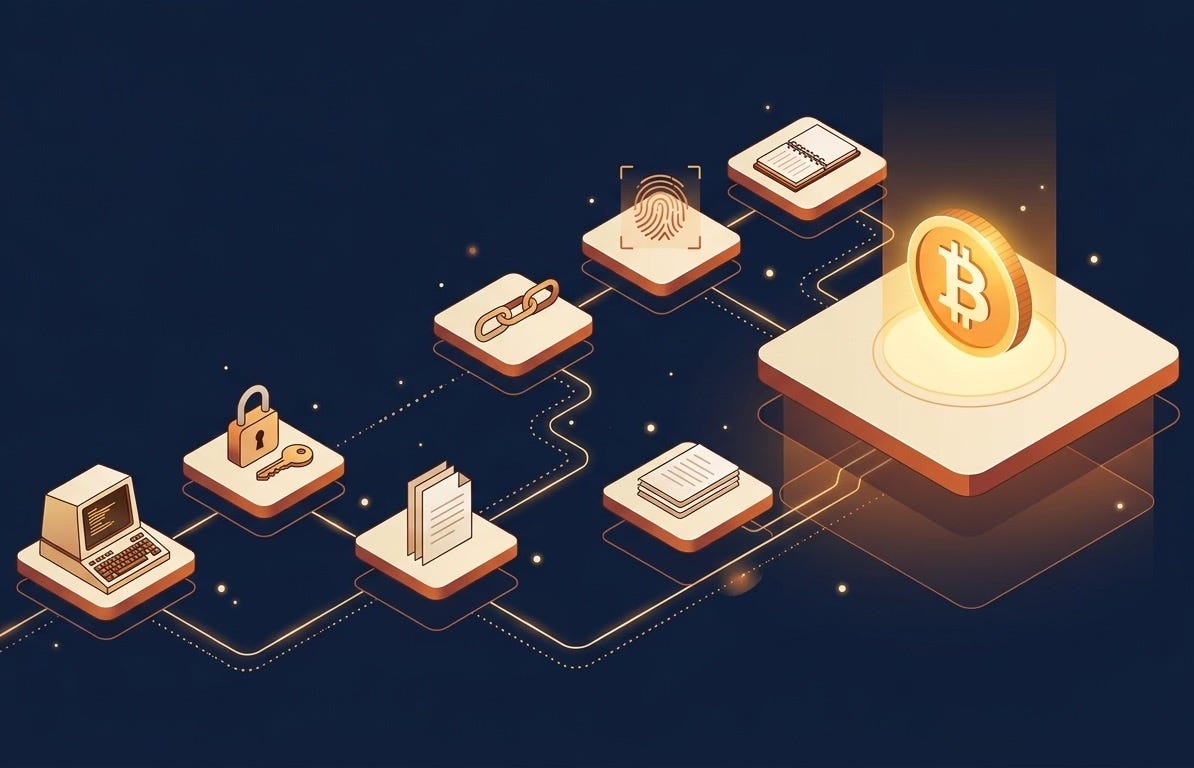
Forget what you’ve been told about Bitcoin suddenly appearing in 2008.
By the time Satoshi Nakamoto released the famous whitepaper, the project that would become the Bitcoin network had already been under construction for more than three decades.
The names may not ring a bell for you. Vint Cerf. Ralph Merkle. Wei Dai. Adam Back. Hal Finney. Nick Szabo. A cast of cryptographers, programmers, mathematicians, and stubborn idealists, scattered across decades, who each added a piece to a puzzle none of them could finish on their own.
What they built together was the scaffolding for Bitcoin. They just didn’t know that’s what they were building.
This is the short version of the long story. You don’t need to understand equations, code, cryptography, or what a hash function is in order to appreciate Bitcoin’s history.
By the end, you’ll see Bitcoin not as a sudden invention but as the culmination of roughly fifty years of work that finally clicked together to create an unstoppable force.
Don't miss my next post - subscribe free to get articles like this one straight to your inbox, or go paid to access my Bitcoin Tool Vault, where I keep my best practical Bitcoin resources.
It Started with the Internet (1974)
Before anyone could dream up digital money, the world needed digital plumbing.
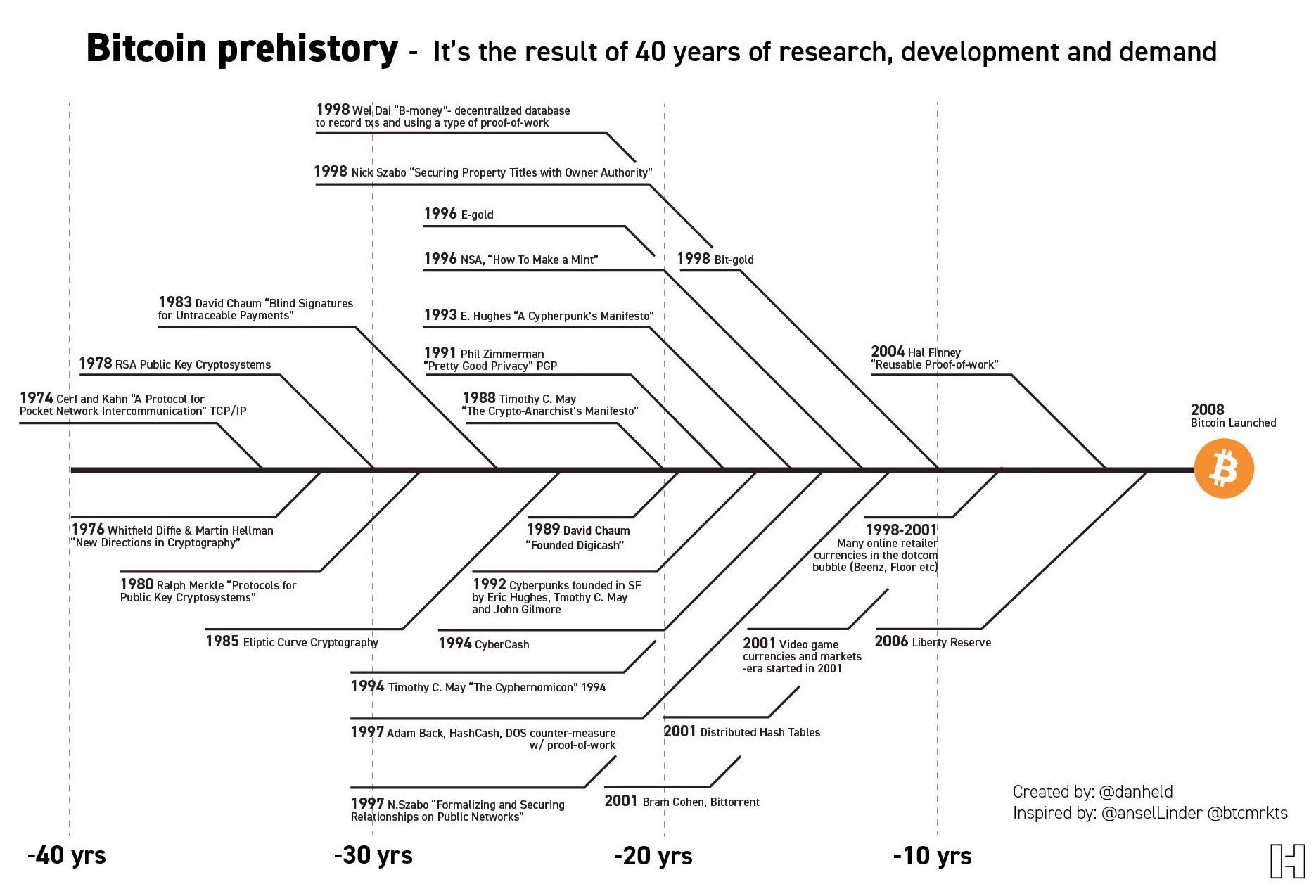
In 1974, two American researchers, Vint Cerf and Bob Kahn, published the protocol that enabled every computer on Earth to communicate with every other computer. We call it TCP/IP today. You’ll likely never think about it again after this article, but every email you’ve sent, every video you’ve streamed, every Bitcoin transaction ever made, all of it travels on the foundation Cerf and Kahn laid.
Bitcoin needs a global, permissionless network to live on. The internet is that network. So when we trace Bitcoin back to its origins, this is where we have to start. Not 2008. Not even the 1990s. In the early 1970s, two guys were figuring out how computers should talk.
The Math That Made It Possible (1976 to 1985)
The next twenty years saw a string of mathematical breakthroughs that, in retrospect, read like the design spec for a future cryptocurrency. None of these researchers had Bitcoin in mind. They were solving entirely different problems. Bitcoin would later borrow their tools.
Public-key cryptography (1976). Two researchers, Whitfield Diffie and Martin Hellman, tackled what sounded like an impossible problem: how to let two strangers communicate securely without first sharing a secret password.
Their solution was the padlock idea. Imagine handing out open padlocks to anyone who wants one. Anyone can lock something up with one of your padlocks, but only your unique key can open it. That’s public-key cryptography in plain English. Every Bitcoin wallet you’ll ever own works this way. Your wallet address is the open padlock. Your private key is the only thing that can unlock and spend the coins inside.
Without this single idea, Bitcoin doesn’t exist. (Two later refinements, called RSA in 1978 and elliptic curve cryptography in 1985, made the math more practical and more efficient. Bitcoin uses the elliptic curve version every time you spend a coin.)
Merkle trees (1980). A Stanford researcher named Ralph Merkle figured out how to take huge amounts of data and squash them into a single tiny code that proved nothing inside had been tampered with.
Picture every Bitcoin transaction with its own unique fingerprint, a small code that identifies it. Pair up all those fingerprints and create a new fingerprint for each pair. Then pair those new fingerprints and create larger fingerprints from them. Keep going until you end up with a single master fingerprint that represents thousands of transactions. Change even a single transaction at the bottom, and the master fingerprint at the top changes too.
This is what allows your phone to confirm a Bitcoin transaction without storing every Bitcoin transaction ever made. It just checks the master fingerprint. Bitcoin’s whole structure depends on Merkle’s work.
The Dreamers Who Wanted Digital Money (late 1980s to mid 1990s)
While the mathematicians were busy in their labs, another group was pursuing a different dream. They wanted to use this new cryptography to create digital money that no government or bank could control.
They called themselves the Cypherpunks. The word was coined in 1992 by a writer and hacker named Jude Milhon, better known by her handle St. Jude. She used it as a playful spin on "cyberpunk," the science fiction genre that was huge at the time. She fused "cipher" (the cryptography part) with "punk" (the rebellious, anti-establishment vibe of the cyberpunk movement) and the result stuck.
The cypherpunks were a loose collection of programmers, mathematicians, and privacy activists who started meeting and emailing each other in the late 1980s. Their motto, written by a man named Eric Hughes, captured the whole movement in two words: “Cypherpunks write code.” They believed ordinary people deserved the same cryptographic tools governments and corporations had. Building software was their preferred way of changing the world.
The Cypherpunks gave us the first serious attempt at digital cash. In 1990, a brilliant cryptographer named David Chaum founded a company called DigiCash. His idea was elegant. Customers could spend digital tokens that were mathematically untraceable, like cash, but online.
It didn’t catch on. A handful of banks partnered with Chaum, but consumer demand for online privacy was nonexistent in the mid-1990s, credit cards were eating up the online payments market, and Chaum reportedly turned down several major deals he believed would be bad for the company. DigiCash filed for bankruptcy in 1998.
The lesson everyone in the field absorbed was hard to ignore: a single company controlling the money was a fatal weakness. If the company died, the money died with it.
That was a lesson that would inform what emerged later.
The Decade of Almost (mid 1990s to mid 2000s)
After DigiCash came a wave of attempts at digital money. Each one grew, looked promising for a while, and then ran into the same regulatory wall.
E-gold, founded in 1996, was a digital currency backed by physical gold reserves. It grew to millions of users before US authorities shut it down for facilitating money laundering. Liberty Reserve launched in 2006 and met the same end in 2013. The dotcom era threw up retailer-backed digital currencies with names like Beenz and Flooz, which sound made-up but really existed, and which collapsed when the bubble burst.
The pattern was always the same. All of them drew users in droves. All of them also drew the attention of regulators, who found centralized issuers easy to subpoena and easy to switch off.
One bright spot stood out. In 2001, a programmer named Bram Cohen released BitTorrent, which allowed users to share files directly with each other through a peer-to-peer network without a central server. Hollywood and the recording industry threw everything they had at it. BitTorrent kept running. It was proof that a properly designed peer-to-peer network could survive even hostile attention on a global scale.
Meanwhile, the next group of inventors was starting to ask a dangerous question. What if money worked like BitTorrent?
The Direct Ancestors (1997 to 2004)
Now we get to the four people whose work shows up most directly inside Bitcoin. Some of these names may already be familiar to you.
Adam Back and HashCash (1997). Adam Back is a British cryptographer who was tired of email spam. His solution was simple and clever. He proposed making every email sender solve a small computational puzzle before the email could be delivered.
Think of it like requiring a one-cent stamp on every email. A normal person sending fifty emails a day would barely notice. A spammer trying to send fifty million emails a day would go broke. The puzzle had to be just hard enough to cost real money at scale.
This is called proof-of-work. It’s the same idea Bitcoin miners use today, applied to a ledger instead of an inbox. Miners burn real-world electricity solving puzzles, and the longest chain of solved puzzles is what the network agrees is the truth. Satoshi cited Adam Back’s HashCash directly in the Bitcoin whitepaper.
(Adam Back is still around, by the way. He runs a Bitcoin company called Blockstream and is one of the people most often suspected of being Satoshi himself. He denies it.)
Wei Dai and B-money (1998). Wei Dai is the very first reference in the Bitcoin whitepaper. His proposal was called B-money.
Wei Dai sketched a system in which every participant kept their own copy of every transaction, and proof-of-work generated new money. Anyone with internet access could join. No company sat in the middle. No bank held the ledger.
He never built it. He wrote up the idea on a Cypherpunk mailing list in 1998 and moved on. Bitcoin’s overall structure mirrors B-money so closely that Satoshi felt obligated to credit it first.
Nick Szabo and Bit-gold (1998). In the same year Wei Dai sketched B-money, an American computer scientist and lawyer named Nick Szabo proposed something called Bit-gold. People often call it the closest thing to Bitcoin before Bitcoin existed.
Szabo’s idea was to chain proof-of-work puzzles together. Each completed puzzle would feed into the next puzzle. The result would be a long, ordered string of solved problems that would be very hard to fake or alter. That’s a blockchain in everything but name.
Szabo never built it either. The resemblance between Bit-gold and Bitcoin is so striking that for years, people have suspected Nick Szabo of being Satoshi Nakamoto. He has always denied it. Whether he is or isn’t, his fingerprints are all over Bitcoin’s design.
Hal Finney and Reusable Proof-of-Work (2004). Hal Finney is the one whose name every Bitcoin holder should know.
Finney was a brilliant cryptographer who worked on Phil Zimmerman’s PGP encryption software in the 1990s. In 2004, he took Adam Back’s HashCash and tried to make the puzzle solutions actually spendable, like passing a coin from one person to another. He called it Reusable Proof-of-Work.
It still required a central server, the same flaw that had killed every attempt before it. But it was the closest anyone had come to digital cash that worked.
Five years later, in January 2009, Hal Finney downloaded the brand-new Bitcoin software within hours of Satoshi releasing it. He sent Satoshi bug reports, helped fix issues, ran one of the first nodes on the network, and received the first-ever Bitcoin transaction. Satoshi sent him ten coins as a test.
Many people suspected Hal was Satoshi. He denied it. He later developed ALS, the same disease that took Stephen Hawking, and lost the use of his hands while continuing to contribute to Bitcoin using assistive software. He died in 2014, still running a Bitcoin node from his hospice bed.
If you read one piece of writing from any of these four people, make it Hal Finney’s. I’ve linked it at the end.
2008 - Satoshi Pulls It All Together
Now you can see what really happened in 2008.
Satoshi didn’t invent the ideas in Bitcoin. Almost every component already existed somewhere in the academic and Cypherpunk literature. Satoshi’s real contribution was stitching the existing pieces together in a way nobody had managed before.
The internet, courtesy of Cerf and Kahn, became the network.
Diffie-Hellman’s public-key cryptography became the wallets.
Merkle’s trees became the way the network verified transactions efficiently.
Elliptic curve cryptography became the signature scheme.
Adam Back’s HashCash became the mining algorithm.
Wei Dai’s B-money and Nick Szabo’s Bit-gold provided the structural blueprint.
Hal Finney’s earlier attempts mapped the dead ends to avoid.
To all of that, Satoshi added one new idea: the rule that the longest valid chain of blocks always wins. That single rule solved the problem no one had cracked before: how to stop people spending the same digital coin twice without appointing a referee.
The whitepaper was posted to a Cryptography mailing list on October 31, 2008. Right in the middle of the global financial crisis. In January 2009, Satoshi mined the very first Bitcoin block. Hidden inside its code was a small message: “The Times 03/Jan/2009 Chancellor on brink of second bailout for banks.” It was a headline from that morning’s Times of London.
What This Means for You
Bitcoin represents the moment when half a century of research and ideological commitment finally clicked into place. The narrative that it’s a 17-year-old technology invented by an anonymous genius is only the last chapter of a much longer book.
A few things to take away from this:
When someone tells you Bitcoin is “magic internet money,” implying that it was somehow invented overnight, you now know the longer story. The core ideas are public and peer-reviewed, and some of them are older than the people using Bitcoin today.
Every digital money before Bitcoin had a central point of failure, and almost every one of them was shut down or collapsed. Decentralization is not just a buzzword. It’s the lesson written across fifty years of failed attempts.
Satoshi was a synthesizer, not a magician. A genuinely brilliant one, but the work being synthesized was not Satoshi’s alone.
The people who made Bitcoin possible were ordinary cryptographers, programmers, mathematicians, and curious thinkers. Many of them are still alive today, doing interviews and answering questions on social media. The history isn’t locked away in a vault. It’s sitting in old forum posts, free for anyone who wants to read it.
Where to Go Next
If this story has hooked you and you’d like to keep pulling threads, here are six places to start. I’ve ordered them roughly from “easy weekend read” to “deeper rabbit hole.”
A quick note on the links before you click. I’ve used neutral sources rather than pushing you toward a single retailer. The book links go to Goodreads, where you can read reviews and choose where to buy from, no matter which country you’re in.
The Antonopoulos book link goes to his own site, which is the most direct way to support the author.
The documentary link goes to JustWatch, which automatically detects your country and shows you every legal way to stream the film in your region.
Hal Finney’s essay link goes to the original Bitcointalk forum post he wrote himself in 2013.
Digital Gold by Nathaniel Popper. A New York Times journalist’s narrative history of Bitcoin’s early years. Reads like a thriller. The single best starting point for anyone who wants the human story.
The Internet of Money by Andreas Antonopoulos. A short collection of his talks, aimed at general readers. Skip his more technical book “Mastering Bitcoin” until later.
Andreas Antonopoulos on YouTube. Free and generous. His older talks like “Introduction to Bitcoin” and “Bitcoin: A New Species of Money” are gold for newcomers.
Banking on Bitcoin (2016 documentary). Covers the early developers and the regulatory battles. An easy weekend watch.
“Bitcoin and Me” by Hal Finney. A short forum post Finney wrote in 2013 about his involvement with Bitcoin from the very beginning. Free to read online, and one of the most personal documents in Bitcoin’s history.
The Book of Satoshi by Phil Champagne. A compilation of every public message Satoshi Nakamoto ever wrote. You don’t have to read it cover to cover. Dipping in is enough to get a feel for who Satoshi was.
If you only have time for one, make it Hal Finney’s “Bitcoin and Me.” It’s free, and the man who wrote it was, by then, dying, watching the thing he helped build start to take off in the world. There aren’t many documents in Bitcoin’s history more human than that one.
You may also like…
⛔️ FINANCIAL DISCLAIMER: This content is for informational and entertainment purposes only and should not be considered financial, investment, or legal advice. I am not a licensed financial advisor, accountant, or investment professional. The information shared in this post reflects my personal opinions and is based on publicly available data at the time of writing. All investment decisions—especially those involving Bitcoin or other digital assets—carry risk and should be made only after conducting your own due diligence and consulting with a qualified financial advisor. Never invest more than you can afford to lose. My views are my own and do not reflect those of any of my affiliate partners or sponsors.
Comments
Nothing yet. Say the first thing.
Sign in to join the conversation.