
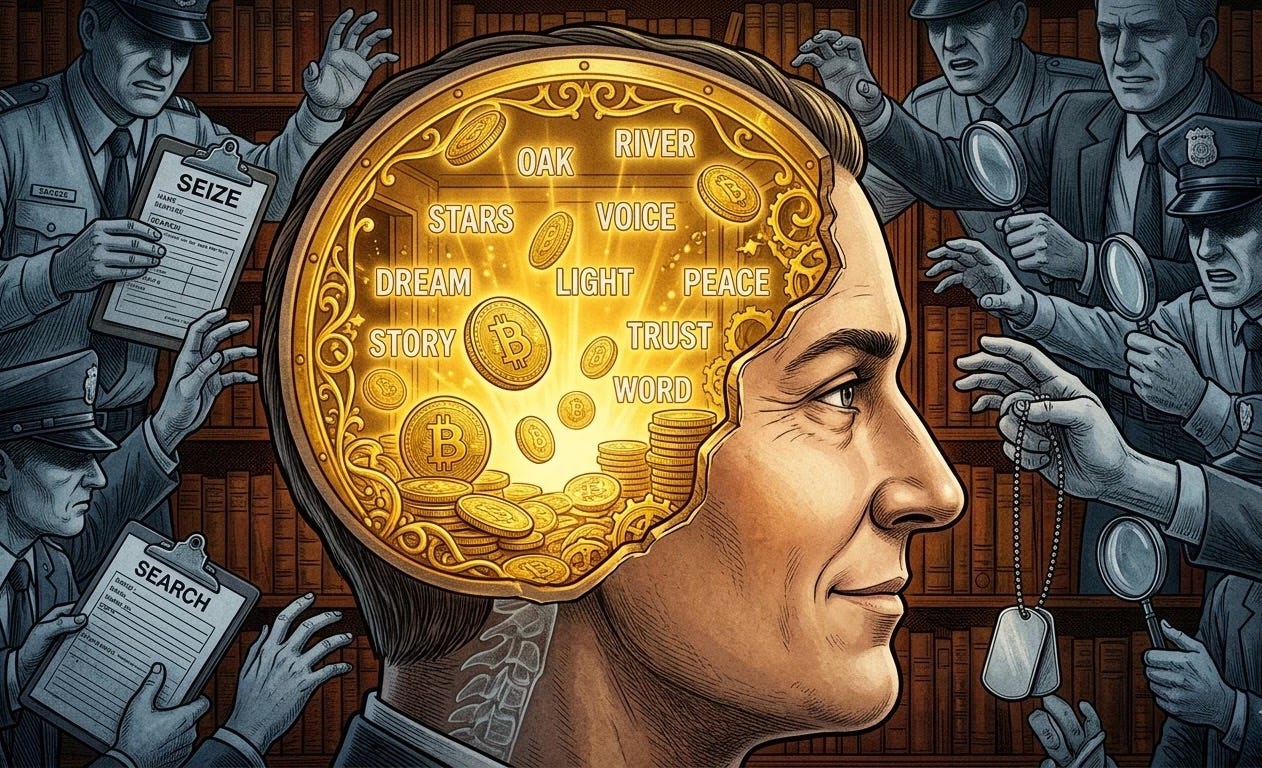
Imagine waking up tomorrow morning, scrolling through the news with your coffee, and seeing this headline: “Government Announces Plans for Total Ban on Bitcoin.”
What would you do? And could they actually pull it off?
Governments around the world have been wrestling with that question for over a decade, deploying everything from blunt-force prohibitions to slow regulatory squeezes.
None of them has succeeded as they hoped, and the reasons are worth understanding if you hold Bitcoin. Many Bitcoiners become nervous about the possibility of holding Bitcoin that they cannot legally hold or transact with in their country.
So in this post I cover:
The seven rungs of a bitcoin crackdown, from tax friction all the way to outright criminalization
What governments publicly say their reasons are, and what’s probably actually motivating the policy
Four real-world case studies where governments tried to ban bitcoin and were forced to reverse course
Why a true, effective ban is technologically impossible against anyone who self-custodies
Practical steps to take if your country starts really cracking down
Let’s begin with the ladder itself.
Subscribe for all my free posts direct to your inbox, or upgrade for the full picture. Paid subscribers get every deep-dive post in full plus access to my Bitcoin Tool Vault.
The Seven Rungs of a Bitcoin Crackdown
Governments don’t generally go from zero to total ban overnight. They usually climb a ladder, with each rung adding more friction. Recognizing where your country sits on this ladder tells you a lot about what might come next.
Rung 1: Tax friction. The simplest weapon is the tax code. Heavy capital gains rates, mandatory transaction reporting, and punitive structures designed to make trading unattractive. India is the textbook example, with a flat 30% tax on crypto gains plus a 1% tax deducted at source on every single transaction, regardless of profit. Trading volume on Indian exchanges collapsed by over 90% within months of those rules taking effect in 2022.
Rung 2: KYC and exchange regulation. Governments require any platform that touches the banking system to identify every customer, log every transaction, and report large transfers. The EU’s MiCA framework is the most comprehensive example. Variations exist almost everywhere, and the FATF Travel Rule extends this surveillance globally to transactions between exchanges. Usually, this goes hand in hand with tax friction.
Rung 3: Bitcoin ATM bans or restrictions. Crypto ATMs are easy targets because they’re physical devices in convenience stores. The UK’s Financial Conduct Authority effectively banned them in 2022 by refusing to license operators. Singapore followed in 2024. New Zealand banned them outright in July 2025 as part of an anti-money-laundering overhaul. Australia is currently giving its financial intelligence agency new powers to crack down on operators, with a $5,000 transaction cap already in place. Canada just banned them outright.
Rung 4: Banking blockades. This is the most common middle-tier tactic. Tell banks they cannot service crypto businesses or process crypto-related transactions. The user technically still has the right to own bitcoin, even though the on-ramps and off-ramps are severely restricted. Nigeria did this in 2021. India did it in 2018. The unofficial “Operation Choke Point 2.0” did something similar to crypto businesses in the US during 2022 and 2023.
Rung 5: Mining bans. Mining requires industrial-scale electricity, which makes it much easier to detect than someone holding a wallet. China’s 2021 ban is the most famous example. Kosovo banned mining during its 2022 energy crisis. Iceland and parts of Scandinavia have throttled new mining operations through energy permitting.
Rung 6: Payment bans. This rung lets you hold bitcoin while attempting to making it useless as money inside the country. Turkey banned crypto payments in April 2021 after a wave of exchange collapses. The official line was consumer protection, though the lira was also imploding at the time, making bitcoin an attractive escape valve for ordinary Turks.
Rung 7: Total prohibition. The big one. Owning, trading in, or using bitcoin in any form is a criminal offense. Algeria, Egypt, Bangladesh, Afghanistan, Nepal, Tunisia, and a small number of others sit at this rung. South Africa may join this dubious list soon. Notably, all of them have weak banking systems, capital control regimes, or governments concerned about citizens moving wealth abroad.
What Governments Say vs. What They Really Fear
What governments tell their citizens about why they’re cracking down rarely matches the deeper political logic.
You have the official stated reasons, and they usually revolve around crime prevention and consumer protection. The second set of reasons is not always explicitly stated, though more often than not, they are a driving factor.
The official reasons:
Preventing money laundering and terrorism financing
Protecting consumers from scams, volatility, and exchange collapses
Reducing energy consumption and environmental impact from mining
Maintaining financial stability
Other underlying reasons:
Preserving monetary control. Central banks lose their primary tool, the printing press, when citizens can opt out of the national currency.
Stopping capital flight. Bitcoin is a frictionless way for citizens to move savings out of a collapsing currency, which is exactly why so many of the strictest bans appear in countries with foreign exchange shortages.
Protecting tax revenue. A population that holds wealth on a public ledger they don’t control is harder to audit and harder to bleed dry through inflation.
Clearing the runway for a CBDC or regulated stablecoins. A central bank digital currency is far more useful as a tool of state if there’s no decentralized alternative competing with it for legitimacy.
Whenever you learn of a new bitcoin restriction, it’s worth asking which of the four pressures listed above might be driving the policy in that specific country.
You may also like…
When Governments Tried and Lost
History provides useful patterns. When a government pushes too hard against bitcoin, the policy tends to unravel in one of a couple of ways: it gets struck down in court, or it fails so badly in practice that the regulator has to retreat. Often, both occur at once.
India: The Supreme Court Strikes Back
In April 2018, the Reserve Bank of India ordered all banks to cut ties with cryptocurrency businesses. Indian crypto exchanges collapsed almost overnight. Trading simply moved to peer-to-peer channels.
Comments
Nothing yet. Say the first thing.
Sign in to join the conversation.