
“I feel as if someone put me through a pasta maker” - that’s what I said to my husband today after a rather overwhelming experience I had this morning. I couldn’t think of any better way to describe my state - kind of flattened, limp, devoid of any structural integrity that would keep me upright, emotionally. Turned into that state by the external circumstances of what happened this morning, as well as some of the underlying properties of my operating system. I do that a lot, liken my experience to ways I see objects, especially when I feel worn out. “Like a wrung out flannel” is another one I use. Or, when I was sick with a horrible cold, I felt like “one of those hot towels they give you on posh aeroplanes or at Indian restaurants after your meal”. Kind of steaming and very slightly damp. It works. It helps me make sense of how I feel when a single word is not enough to express it and it also helps my husband understand that how I’m feeling and behaving doesn’t have anything to do with him and everything to do with my current energy level. And it made me think - this is a practical application of emotional granularity.
Emotional granularity describes the specificity with which we are able to talk about our emotions. Essentially - a lot of people know very few emotion words. When asked how they feel, some people can only differentiate between “good” and “bad”, and some people use the same word to describe different emotions, whereas others have a bigger emotional vocabulary and use it with very high specificity. I talk about this all the time in my consultations and in webinars. Higher emotional granularity has been shown to be associated with better mental health. That means, the more words we know to accurately describe how we feel, the better we will be able to deal with those feelings. And there are plausible mechanisms behind that:
Putting a word to our experience makes it a lot less overwhelming. It’s a bit like experiencing different flavours: We don’t just want to be able to distinguish between sweet and salty, we probably also want to know whether the sweet thing is a strawberry or a piece of chocolate. Not being able to tell the difference would be confusing. Same goes for emotions.
Knowing how we feel with more accuracy that “good” or “bad” can also help us decide what to do about that feeling (if anything). It can help us decide, for example, if the anxiety we feel is a reason to stop doing something (avoid) or, instead, a reason to do something anyway (face a fear). It can also help us decide what a good regulation strategy might be - do we need to expend angry energy? Do we need some headphones and a minute alone to recover from overwhelm? Do we need to talk to a friend to get through grief?
The ability to be specific about how we feel can also help us get to the bottom of where our reactions might come from. In other words, which need might underlie how we feel.
It also helps us communicate our emotions to others - if we have shared emotion concepts then another person can imagine how we feel when we tell them we’re disappointed or content.
Therapists often refer to this as “name it to tame it” - the therapists I have collaborated with tell me that a lot of their work includes helping clients navigate their physiological experiences and turn them into useful maps by putting words to them.
An example of quite how granular our verbal emotional expression can be is the feelings wheel (if you find it useful, please consider going to the website and supporting it). It has the most commonly used emotion words in the middle and extends out to more and more specific terminology. This is a great tool if we want to improve our emotional granularity. Start in the middle and see which level you can get to.
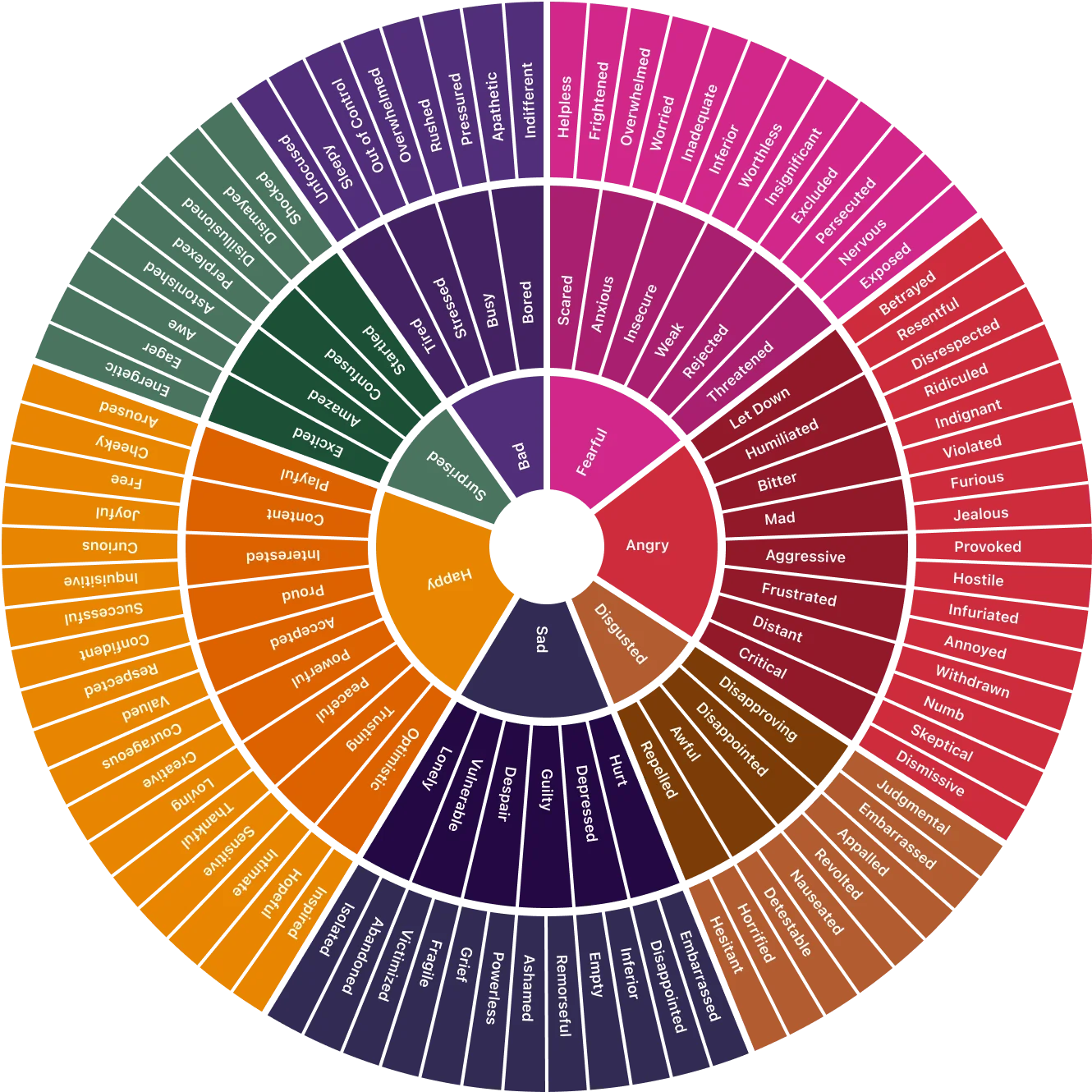
Our emotional granularity largely depends on the culture we grew up in. We learn emotion concepts and the accompanying words by linking how we feel to the words that are used to describe it to us as children. Or probably also by linking what we feel when we put ourselves into someone else’s shoes, be it a real person or a character from a book or movie, to how they talk about it. The richer our emotional experience and the more varied the words associated with it, the bigger our emotional granularity.
I’m fairly certain that in emotion research, emotional granularity is measured only with single words, i.e. when emotional granularity is assessed, people are probably asked to name as many emotion words as they can think of, or to mark which emotion words they recognise off a list. But when Lisa Feldman-Barrett, a pioneering emotion researcher talks about this concept (for example in her book “How Emotions Are Made”), she tends to reveal that a lot of emotions are culturally dependent. That means, people in different countries don’t just have different words for the exact same emotions that everyone feels, but entirely different concepts. One example she gives is a Japanese word that, apparently, describes the feeling you have when you’ve just been given a really bad haircut. And I recognise this, too - as a German person, I am (unfortunately) deeply familiar with the word “Schadenfreude”, the feeling of pleasure at someone else’s misfortune. There isn’t a word for that in English (other than saying the word “Schadenfreude” in an English accent). And these cultural variations in emotion concepts totally validate making up our own emotion words. My friend and I coined one when we went wild swimming in the river Thames in November - Sussudio, the tingling feeling in your legs, paired with the delight of just having done something physically and mentally difficult. Obviously, we can’t claim that we came up with the word, that was the one and only Phil Collins. But for us, the word matched the feeling perfectly and now we both know what we mean when we say - “Oh that delicious feeling of Sussudio makes braving the cold water totally worth it!”.
And that brings me back to my experience today - even though I don’t tend to go as far as turning my descriptions of how I feel into single term emotion concepts, finding the most accurate descriptions for my experiences serves the same purpose and has the same benefit for me - reclaiming some power in an otherwise confusing or overwhelming physical experience and communicating that to the people who need to be aware (“name it to tame it”). To avoid misunderstandings, give myself a little grace, and find ways to help myself feel better. Try it (if you don’t do it already)!
Feelings Wheel: www.feelingswheel.com
Read more about emotional granularity:
Barrett, L. F. (2017). How emotions are made: The secret life of the brain (pp. xv, 425). Houghton Mifflin Harcourt.
Erbas, Y., Gendron, M., & Fugate, J. M. B. (2022). Editorial: The role of emotional granularity in emotional regulation, mental disorders, and well-being. Frontiers in Psychology, 13. https://doi.org/10.3389/fpsyg.2022.1080713
Kalokerinos, E. K., Erbas, Y., Ceulemans, E., & Kuppens, P. (2019). Differentiate to Regulate: Low Negative Emotion Differentiation Is Associated With Ineffective Use but Not Selection of Emotion-Regulation Strategies. Psychological Science, 30(6), 863–879. https://doi.org/10.1177/0956797619838763
Tan, T. Y., Wachsmuth, L., & Tugade, M. M. (2022). Emotional Nuance: Examining Positive Emotional Granularity and Well-Being. Frontiers in Psychology, 13. https://doi.org/10.3389/fpsyg.2022.715966
No posts
Comments
Nothing yet. Say the first thing.
Sign in to join the conversation.