
When I wrote From 33rd Street to Camden Yards, my oral history of the Orioles, more than a quarter-century ago, I interviewed nearly 100 former players, managers, executives, broadcasters, scouts and others. Brooks Robinson was the only one I interviewed twice, once in the fall of 1999 and again in the spring of 2000.
I wound up with two hours on tape — two hours of Brooks talking about his “controversial” signing with Baltimore, his development as a player, his approach to playing the game, his reflections on the team’s highs and lows in his era, his relationship with the city … pretty much anything you’d want to hear Brooks discuss.
When I launched the Bird Tapes on Substack in 2024, my interview with Brooks was the first one I published. Where else could I start an Orioles history project?
A lot has changed since then. I’ve published more than 60 others interviews and more than 200 other posts about Orioles history, accrued thousands of subscribers and watched the Bird Tapes become a Substack bestseller.
But a few things haven’t changed. My interview with Brooke remains one of the truly rare gems of the Bird Tapes archive.
To show my appreciation for more than two years of growth on Substack, I’m making a chunk of my interview with Brooks available to all subscribers, free as well as paid.
The fourth of July seems like the right time to do it. Brooks was nothing if not quintessentially American, literally the subject of a Norman Rockwell painting.
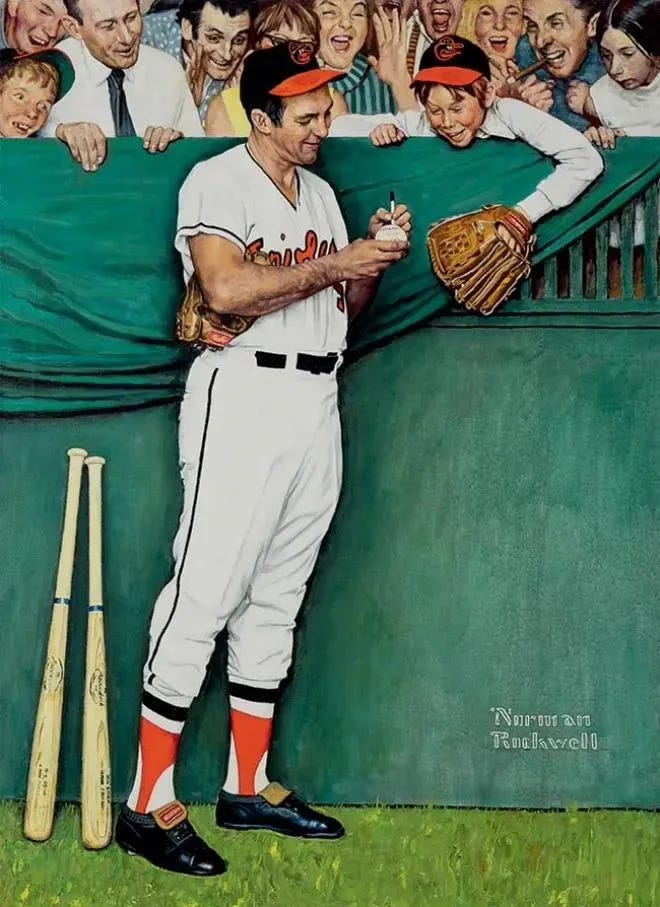
In the conversation you’re about to hear, Brooks is in his early sixties, a little more than two decades removed from the end of his playing career. He is no longer a broadcaster, and in fact, doesn’t have any role with the Orioles, to his chagrin.
He begins with the story of how and why he signed with the Orioles — as a second baseman. Some helpful background: When he signed in 1955, baseball was still a decade away from instituting a draft, meaning anyone could sign with any team. The sport sought a semblance of control with a “Bonus Baby” rule. If you signed for more than $4,000, you had to be on the major league roster for two years. It was a terrible rule that forced young players into the majors far too soon, ruining many careers. Paul Richards, the Orioles’ general manager (and manager) in the ‘50s, signed young players such as Wayne Causey and Jim Pyburn to bonus-baby deals. Brooks wisely elected not to go that route, enabling him to start his career in York, Pennsylvania, before joining the Orioles late in the 1955 season. But he still got into hot water, as he relates in a little-known story.
He then discusses getting demoted to the minors and playing winter ball at age 18, and he continues with his praise for Paul Richards. He recalls his memories from the Orioles’ first winning season in 1960, on a team that was known as the “Baby Birds” because it featured talented young pitchers. Then the conversation turns to Steve Dalkowski, a legendary figure in Orioles history even though he never threw a pitch in the majors. Widely regarded as one of the hardest throwers in organized baseball history, Dalkowski compiled huge totals of walks and strikeouts in the minors. Sadly, after Earl Weaver, as a minor league manager, helped him get his act together, he had the Orioles’ major league roster made in 1963 but injured his arm in his last spring training appearance. Brooks also references Billy Loes, a pitcher made famous for telling his teammates that he didn’t want to win too many games because then the team would expect him to do it all the time.
As the interview winds down, there’s a little more on the Baby Birds and then Brooks’ thoughts on what happened when Richards left the Orioles and was replaced as manager by Billy Hitchcock, who was then replaced by Hank Bauer, the manager who would lead the team to a World Series title in 1966 before eventually being replaced by Weaver. Brooks also delves into Frank Robinson’s arrival in 1966. Initial uncertainty gave way to success, brotherhood and hilarity as Frank presided over a post-game Kangaroo Court in which players were fined for gaffes on and off the field. The interview ends with a discussion of race.
Enjoy … and have a happy Fourth!
(Note from John Eisenberg: As part of the Bird Tapes Podcast stream, the interview with Brooks can be downloaded to a device or consumed on Spotify or Apple Podcasts.)
Comments
Nothing yet. Say the first thing.
Sign in to join the conversation.