
Although any major league career is a remarkable achievement, Billy Ripken’s appears relatively ordinary at first glance.
He batted .247 over a dozen seasons starting in 1987, when he broke in as a second baseman with the Orioles, through 1998, when he was a utility infielder for the Tigers. He played a lot in Baltimore through 1993, then bounced around as a backup until he retired. He never made an All-Star team, never played in a World Series, hit just 20 home runs in more than 2,700 career at-bats.
But that quick summary doesn’t begin to paint the whole picture of Ripken’s career, which was anything but ordinary.
That becomes clear during my conversation with Ripken in the latest episode of the Bird Tapes Podcast, now available to paid subscribers. With his trademark humor and directness, he unfurls the story of his one-of-a-kind baseball life.
He was the son of a lifer, Cal Ripken Sr., and brother of a legend, Cal Ripken Jr., which in itself was extraordinary, as was the moment in his teens when hard-nosed Senior suggested he temper his expectations.
“He told me, ‘You’re not him,’” Billy said, recalling Senior’s blunt comparison to his older, larger and more talented brother.
But Senior also encouraged him to take advantage of what he did have going for him, namely, his good hands, sound instincts and fundamental grasp of the game’s best practices. It took awhile for everything to mesh after the Orioles selected him in the 11th round of the 1982 draft — so long that Ripken couldn’t envision himself reaching the major leagues almost right up until he did — and when he debuted in 1987, it made history (and the cover of Sports Illustrated) because his brother was the shortstop and his father was the manager.
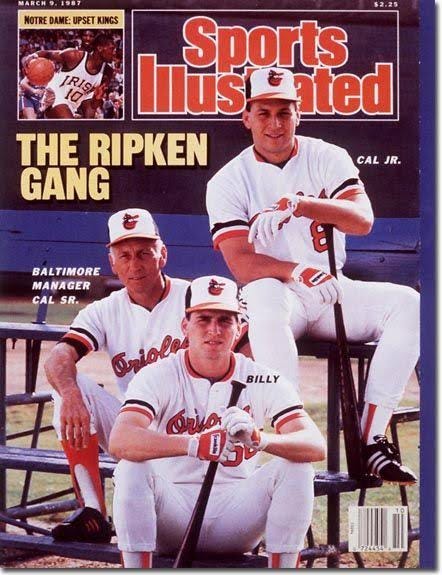
Again, hardly ordinary.
“I think I’m the only person in the history of the game who hit their first (major league) home run and shook their brother’s hand at home plate because he was hitting after me … and then shook my father’s hand on the top step of the dugout going in. I don’t think anyone else can claim that,” Billy told me.
The early years of his career were his best. He hit .308 as a rookie and .291 in 1990, when he generated his career-best 4.1 wins-above-replacement figure and led the league in sacrifice bunts. All along, his play at second base kept him on the field. He and Junior eventually became so in tune in the middle of the infield that a glance between them was all it took to know where to align and what play was on. They set the major league record for double plays executed by brothers — a record likely to stand forever.
Yup, anything but ordinary.
Billy credited the length of his career to his strong defense, a quality all but mandatory for a utility infielder, which is what he became as an older player. But having recently retired from a long run as an analyst for the MLB Network, he didn’t hesitate when asked how “catching the ball” is viewed now in a game that prioritizes hitting the ball hard at the plate and throwing fastballs 100 mph.
“Defense has taken a back seat in today’s game,” Billy said.
It’s hard to believe. I’m not sure it’s smart. But he’s right.
(Note from John Eisenberg: My conversation with Billy Ripken is the latest new interview of 2026 that I’ve added to the Bird Tapes Podcast stream, following Roy Firestone, Buck Showalter, Dr. Charles Steinberg, Mike Bordick. Andy MacPhail, Ed Wheatley, Rick Dempsey, Chris Hoiles and Rick Vaughn. You need a paid subscription to hear most of the 65 interviews in the archive. I’ll continue to post new interviews with major figures from Oriole history throughout 2026. A paid subscription gives you 24/7 access to the entire archive of interviews. Click on the “subscribe now” button to survey your subscription options.)
Comments
Nothing yet. Say the first thing.
Sign in to join the conversation.