
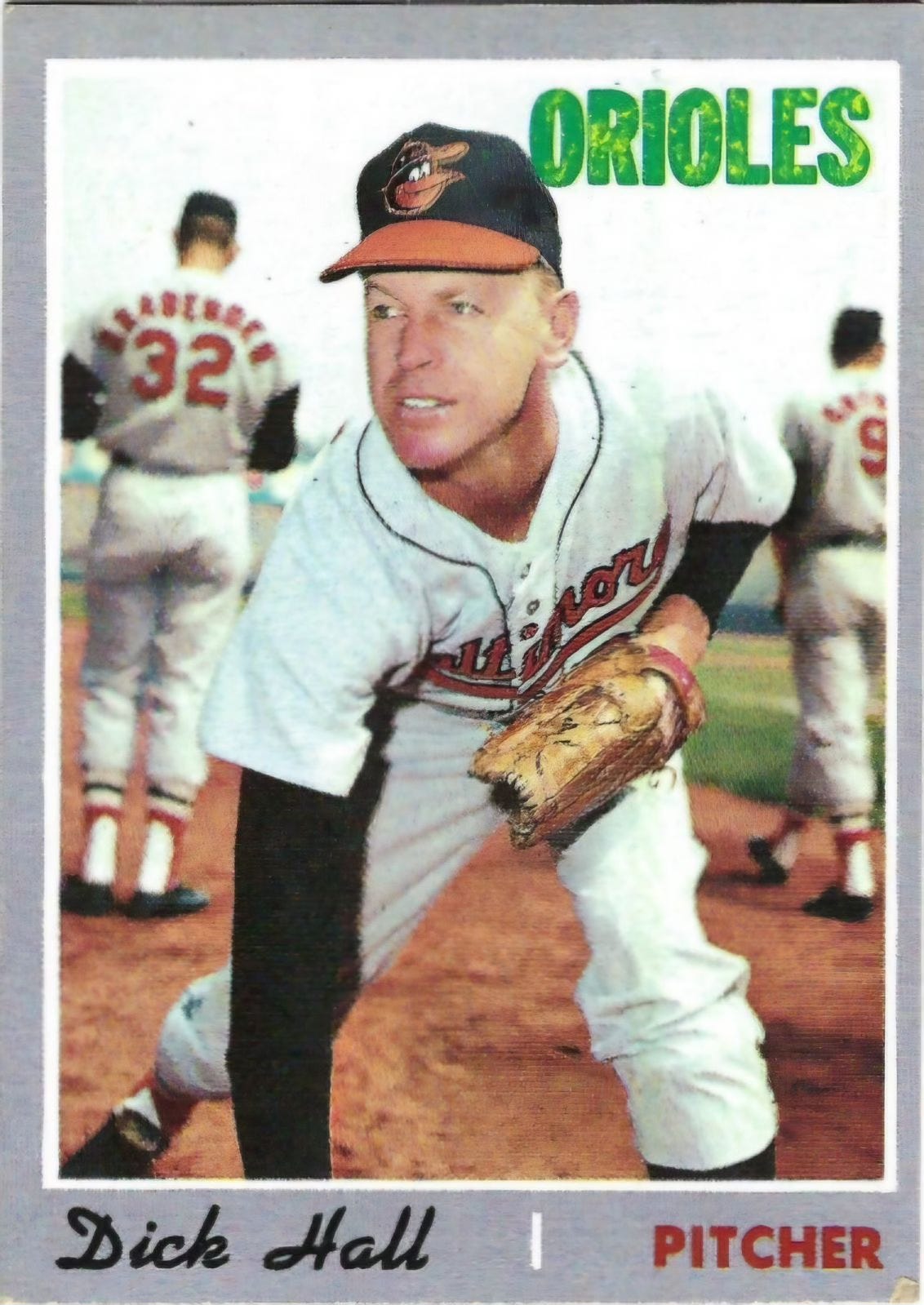
During my 1999 interview with Dick Hall, one of the Orioles’ top relief pitchers from the ‘60s and early ‘70s, he offered the simplest of explanations for how he lasted 16 years in the major leagues without a dominant repertoire of pitches.
“I didn’t walk anybody,” he said.
It wasn’t hyperbole. Hall literally almost never walked a batter.
During the Orioles’ World Series-winning 1966 season, he faced 268 batters over 66 innings and walked just four unintentionally.
Even more absurdly, he unintentionally walked just seven of the 672 batters he faced over a three-year period beginning in 1969.
Indeed, he literally walked almost no one.
“That’s how I survived,” Hall said in his lengthy and wonderful interview, which I’m adding to the Bird Tapes Podcast stream with this post.
When we spoke, Hall, who raised his family in Baltimore and worked as a CPA for years after playing baseball, was so observant and engaging on so many subjects that my recorder just ran and ran and ran.
He was the first to admit he didn’t have a dominant fastball or jaw-dropping off-speed pitches. But he did have pinpoint control. Wherever he aimed his pitches, he hit the spot precisely.
Enhancing that control with a herky-jerky, neo-sidearm delivery (really more front-arm) that the tall, lanky Hall once described as resembling “a drunken giraffe on roller skates,” he threw strikes, worked ahead and frustrated an entire generation of batters who strode to the plate thinking they could hit him ... until they didn’t.
“How can you be out there with that garbage?” Johnny Bench reportedly yelled at Hall from the Cincinnati Reds’ dugout during Game 2 of the 1970 World Series, according to a Society of American Baseball Research profile of Hall.
Standing on the mound, Hall just grinned back at Bench. He was in the middle of what, for him, was a typical outing. Having entered the game in the seventh inning with the Orioles up by one run, he retired seven batters in a row to earn a save as the Orioles took a 2-0 lead in a Series they eventually won.
Hall was 39 that day, the oldest player in the American League. He’d started late in professional baseball years earlier, at age 24, because he was busy earning an economics degree (with minors in history and political science) from Swarthmore College, an elite academic institution, where he excelled at football, basketball and track as well as baseball. Hall then proceeded on a long, winding journey in baseball, experiencing his share of failure, before emerging as a control master for the Orioles.
Early in his career, the Pittsburgh Pirates, who’d signed him, viewed him as an everyday player. They tried him at first base, third base, shortstop and the outfield. In 1954, he appeared in 112 games as an outfielder for the Pirates, hitting .239.
But he struggled to hit curveballs (“I couldn’t hit” was Hall’s frank assessment years later), and meanwhile, while playing winter ball in Mexico, he worked on his pitching. The Pirates saw enough potential to give him 24 starts in 1955 and 1956.
Eventually, he experienced arm pain, which impacted his performance and prompted a return to the minors. In 1960, the Pirates traded him to the Kansas City A’s, who traded him to the Orioles a year later.
Hall arrived in Baltimore after a season in which he’d made 28 starts for the A’s, going 8-13. Orioles manager Paul Richards initially saw him as a starter, too. But his arm began to hurt again, and Richards moved him to the bullpen — a critical move that extended Hall’s career.
Carrying a lighter load out of the bullpen, Hall not only pitched without pain, but also pitched more effectively. He became a late-innings specialist.
“I was kind of a set-up guy. I’d come on in the seventh or in extra innings,” Hall said.
He was a mainstay in the Orioles’ bullpen from 1962 through 1971 except for a two-year period (1967 and 1968) when he was with the Phillies. Overall, he finished 175 games in Baltimore and pitched to a 2.89 ERA over 770 innings with a 65-40 record.
According to baseball-reference.com, he ranks 41st-all-time among all major league pitchers for issuing the fewest walks per nine innings.
“We always said he could hit a little thimble on the outside corner because he had great control,” Jim Palmer said when Hall died at age 92 in 2023.
In 1999, I interviewed Hall at his condo in Baltimore County. He and his wife, whom he’d met in Mexico while playing winter ball, had raised their kids and downsized and were enjoying being grandparents. Mostly retired from his post-baseball career, Hall was playing a lot of golf (very well, no surprise).
Talking about the old days, he told stories with a wry grin and a keen eye for detail. Among many things, he told me about the only time in his career he grooved a pitch; how easy it was to talk manager Billy Hitchcock out of pulling him; and why the Orioles kept Memorial Stadium’s infield rock-hard.
He was a pleasure to interview, and all these years later, he’s a pleasure to listen to, a superb oral historian and pure fun. As I listened back recently in preparation for adding the interview to the Bird Tapes Podcast stream, I realized the conversation had churned out a series of outstanding Oriole-themed trivia questions. For instance:
Q: When Steve Dalkowski, the hard-throwing minor league legend, injured in his arm on the last day of spring training in 1963, it opened the door for whom on the major league pitching staff? A: A 20-year-old named Dave McNally took his spot. (McNally went on win 181 games for the Orioles over the next 13 seasons while Dalkowski never came close to pitching in the majors again.)
Q: Which pitcher on the Orioles’ pennant-winning teams from 1969-71 once set a record for hitting home runs? A: Hall himself did it as an everyday player for a winter-ball team in Mexico in 1954, before he became a pitcher.
Q: Which Oriole pitcher from that era once phoned the opposing bullpen mid-game and, imitating the opposing manager, ordered a pitcher to warm up? A: Moe Drabowsky, the one and only, did it during a game in Kansas City in 1970, and then, feeling guilty after the Royals’ Lew Krausse did start to warm up, he called the Royals’ bullpen back and confessed to his prank.
Q: Who came up with the idea of keeping the infield grass at Memorial Stadium cut extremely short in the mid-1960s, creating a rock-hard surface? A: Pitching coach Harry “The Cat” Brecheen realized that his staff – and the Orioles as a whole – would benefit because Gold Glovers Brooks Robinson and Luis Aparicio could handle ground balls on a close-to-concrete surface but opposing infielders couldn’t.
And lastly:
Q: When the Orioles held sessions of their legendary Kangaroo Court with mop-topped Frank Robinson presiding in the 1960s and collectively fined players for such lapses as asking stupid questions, forgetting how many were out in an inning or falling asleep in the bullpen, who handled the money?
A: “I was the treasurer,” Hall said.
I love this detail from deep in the crevices of Orioles history. The Kangaroo Court is a classic piece of baseball lore and Hall’s revelation fleshes it out as a memory. You can almost hear Frank Robinson issuing a final judgment to a player who, say, had started heading toward the dugout after the second out of an inning.
Give Dick a dollar!
“It was great for morale,” Hall said of the Kangaroo Court.
I mean, could you possibly find a better player to handle your cash stash?
Hall wasn’t the biggest star among the nearly 100 Oriole figures whom I interviewed for my book on the history of the team, but he was among my favorites, telling story after story with wry humor and great insight. It’s the only Bird Tapes interview in which you’ll hear a player confess to eating a 17-year locust and also compare pitching in the majors to preparing a tax return.
My advice? Don’t miss it.
Comments
Nothing yet. Say the first thing.
Sign in to join the conversation.