

Welcome to the birdy side of the internet! This week’s newsletter pairs an unprecedented breeding mystery with a timely look at one of birding’s most challenging identification groups. In This Week in Birding History, we revisit a recent discovery in Tennessee that evolved into something no one expected. In Birding Tip, we explore why taking a broad, methodical approach is the best way to tackle shorebird identification as southbound migration gets underway.
This Substack is reader-supported. To receive new posts and support our work, consider becoming a free or paid subscriber.
This Week in Birding History: A Flycatcher First in Tennessee
July 27, 2025 — One year ago today, the puzzling saga of a rare ornithological discovery reached its conclusion. The events unfolded not in some remote, under-surveyed wilderness, but in the tree-lined median of a busy four-lane highway near downtown Jonesborough, Tennessee.
The story began two summers earlier when Daniel Huffine discovered a Scissor-tailed Flycatcher while baling hay on June 10, 2023—a notable rarity in eastern Tennessee. Presumably the same bird, though impossible to prove, returned the following spring with a mate. Together they successfully fledged at least two young, documenting the first known nesting attempt by Scissor-tailed Flycatchers in northeastern Tennessee. Then, in April 2025, a Scissor-tailed Flycatcher returned once again. Although no mate was ever confirmed, by late June the bird was tending a nest containing three healthy nestlings. Even more remarkably, observers watched an adult Eastern Kingbird regularly feeding the same young, despite maintaining a nest of its own—with another Eastern Kingbird—in the very same tree.
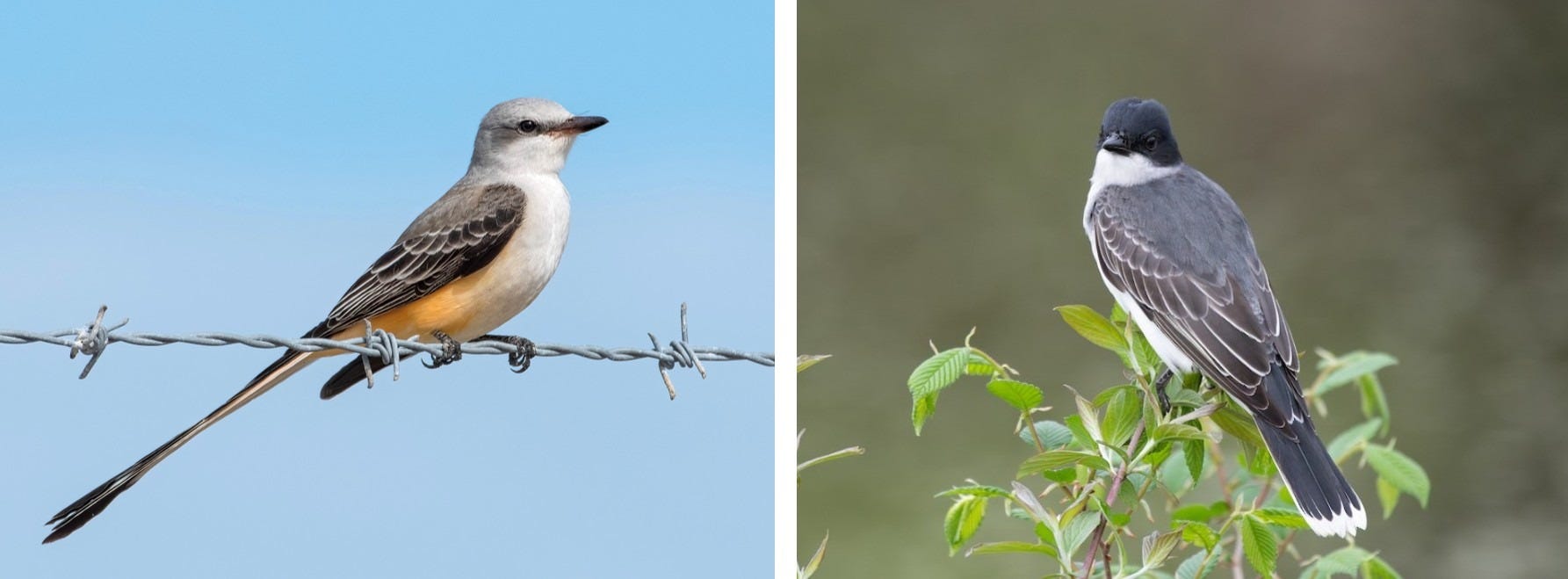
Naturally, birders began debating what they were witnessing. Were the neighboring Eastern Kingbirds responding instinctively to the begging calls of hungry nestlings? Were the adults somehow sharing responsibilities between two nearby nests? Or had something even more extraordinary occurred?
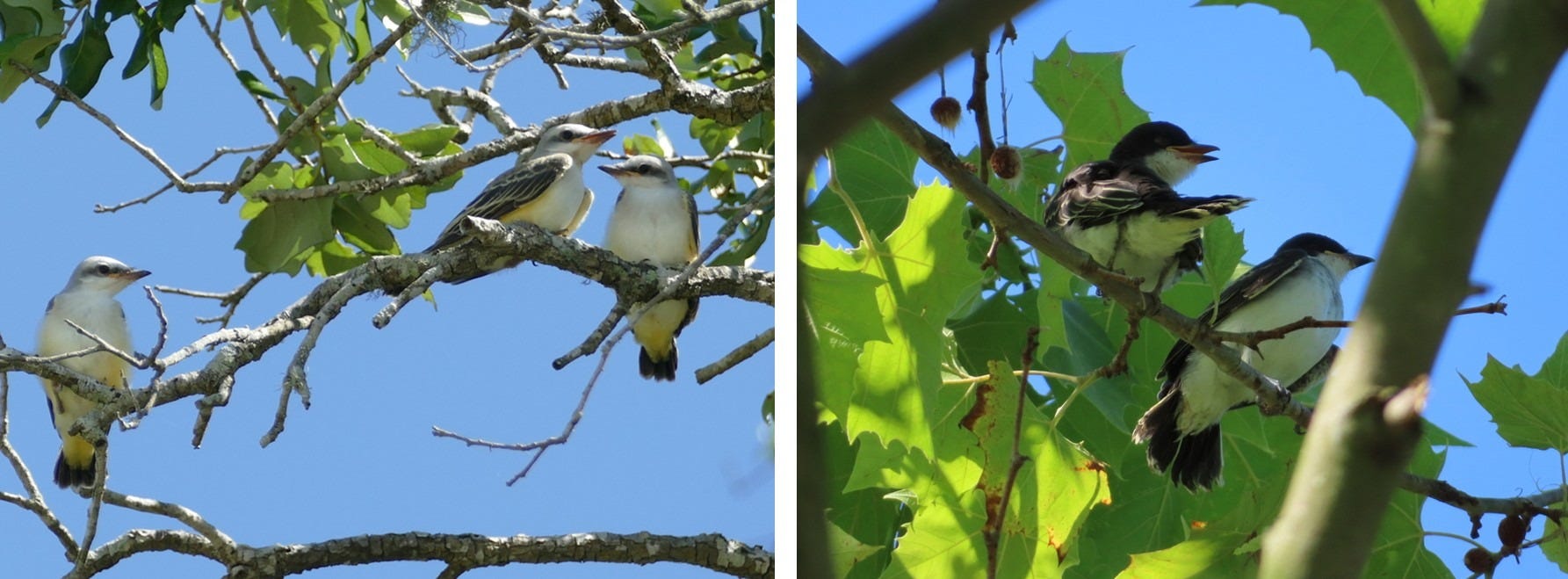
Recognizing the significance of the situation, local birders—including Rick Knight and Daniel Huffine—carefully monitored both nests for more than five weeks. Early photographs, obtained by raising a telescoping inspection mirror above the Scissor-tailed Flycatcher’s nest, showed young birds with pale heads and dark eyelines that did not quite resemble either species. As the nestlings matured, photographs of two surviving fledglings confirmed the answer: they were Eastern Kingbird × Scissor-tailed Flycatcher hybrids—apparently the first documented hybrids between these two species.
Hybridization within the kingbird genus (Tyrannus) is uncommon but not unprecedented. Scissor-tailed Flycatchers occasionally hybridize with Western Kingbirds and Couch’s Kingbirds, while Eastern Kingbirds are known to interbreed with Western Kingbirds. Until the Jonesborough nesting, however, no documented hybrids between Eastern Kingbirds and Scissor-tailed Flycatchers were known. The young disappeared shortly after July 27, and no additional records of this hybrid combination have surfaced. What these remarkable birds would have looked like as adults remains a mystery.
The story may not be over. This year, a Scissor-tailed Flycatcher again returned to the same Jonesborough nesting area and, despite no second Scissor-tailed Flycatcher being reported, was observed incubating a clutch of eggs. Whether history repeats itself remains to be seen. If nothing else, the Jonesborough saga serves as a reminder that some of North America’s most remarkable ornithological discoveries can emerge from the most unexpected places—even a highway median.
Birding Tip: Start Broad with Shorebird Identification
Shorebirds are often considered one of the most challenging groups of birds to identify. Many species share similar plumage, gather in mixed flocks, and change appearance considerably with age, season, and feather wear. Challenging viewing conditions and constantly moving birds can make the process even more difficult. With the shorebird southbound migration beginning to ramp up, preparing for these identifications will make a day in the field far more enjoyable.
The key is to avoid beginning with fine plumage details. Instead, use a consistent process that moves from broad characteristics toward more specific field marks. Over the coming months, keep an eye out for our upcoming shorebird study series, where we will take a closer look at the features, behaviors, and identification challenges associated with this diverse and fascinating group.
Begin With Structure and Behavior
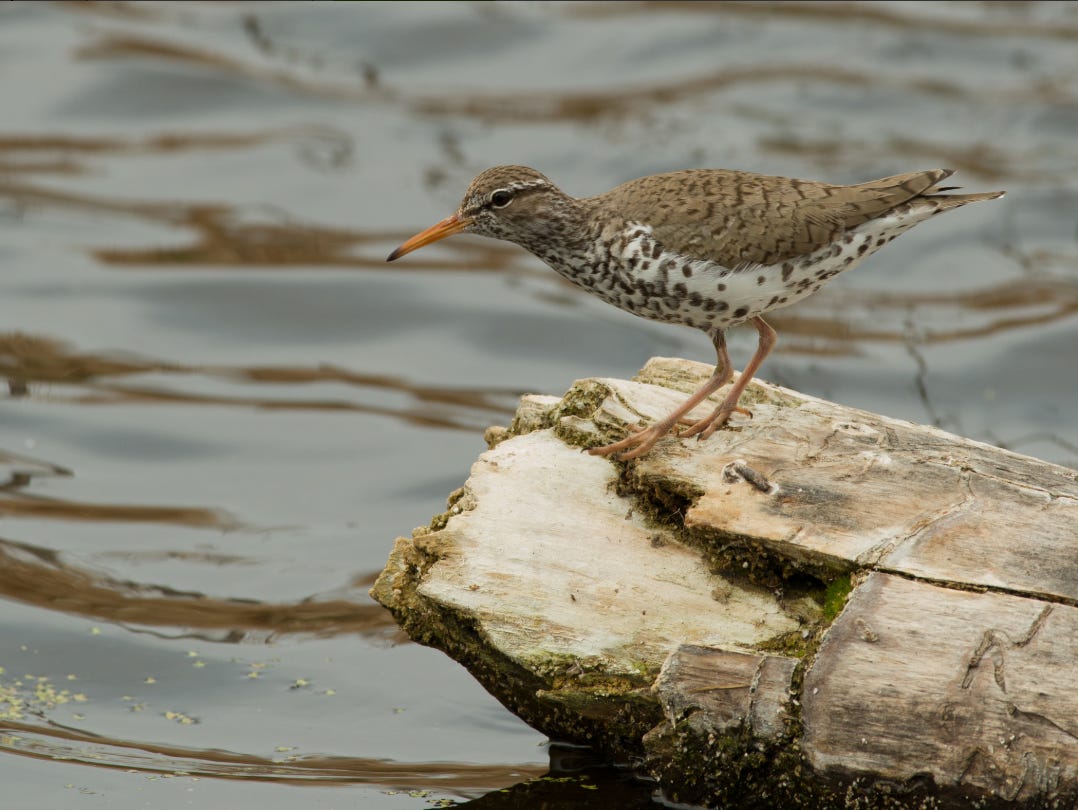
Resist the urge to name the bird immediately. This is a very common pitfall that can lead to difficulty breaking from your initial ID. Start with its overall size, shape, posture, and behavior. Is it plump or slender? Long-legged or low to the ground? Does it probe deeply into the mud, pick food from the surface, chase waves, or forage while swimming?
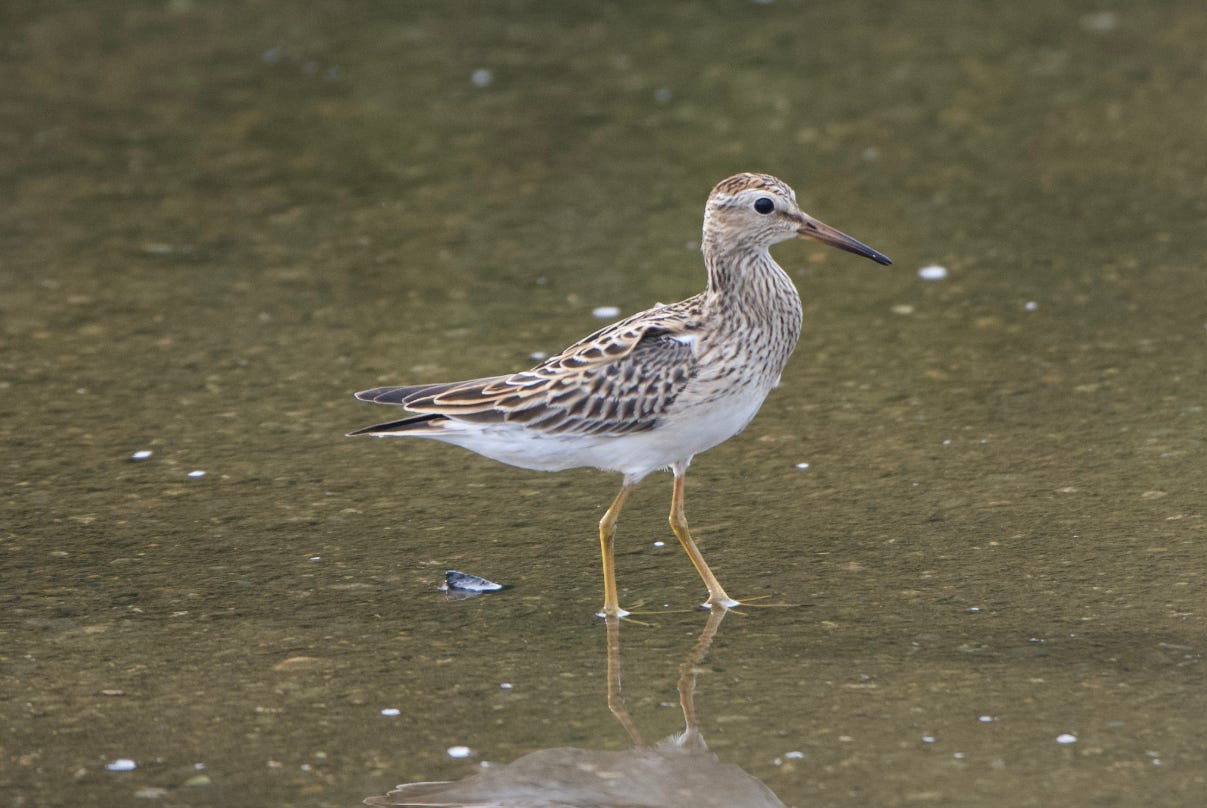
Next, study the bird’s proportions. Pay particular attention to bill length and shape, leg length, neck length, wing projection, and the relationship between the head and body. These structural features are often more reliable than subtle plumage markings, especially when birds are distant, molting, or in worn plumage.
Use Context to Narrow the Options
Once you have a general impression, consider the bird’s habitat, flock composition, and position within the feeding area. Some species favor open mudflats, others remain near vegetation, and some stay close to breaking waves. Comparing an unfamiliar bird with nearby shorebirds can also provide a valuable sense of scale. You can also use temporal context if you understand the general movement patterns of these species during migration seasons.
Listen for vocalizations and look for a few supporting field marks rather than trying to evaluate every feather at once. Leg color, breast pattern, eyebrow shape, rump pattern, and wing markings may help confirm an identification, but they are most useful after structure and behavior have already narrowed the possibilities.
Shorebird identification becomes more manageable when it is treated as a process of elimination rather than a search for one perfect field mark. Start broad, compare carefully, and allow yourself time to observe the bird. With practice, even a crowded mudflat can begin to look less like a collection of nearly identical birds and more like a series of recognizable shapes, behaviors, and species.
Thanks for Reading
Some of birding’s greatest rewards come from slowing down and letting the evidence guide you. Whether you’re documenting an unusual nesting pair or sorting through a flock of migrating shorebirds, careful observation often reveals details that first impressions miss. By building strong identification habits and remaining open to the unexpected, you’ll not only identify more birds—you’ll be better prepared for the rare discoveries that continue to reshape what we know about them.
Get Your Birding University Sticker!
Show your love for Birding University and brighten up your gear with our official sticker. Grab yours today—every purchase helps support our work!

Comments
Nothing yet. Say the first thing.
Sign in to join the conversation.