
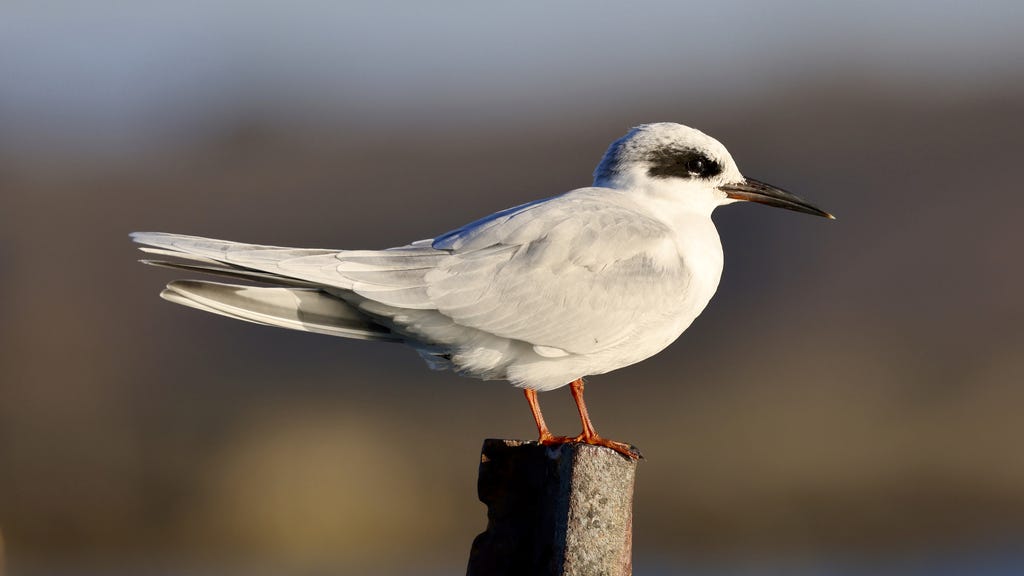
Welcome to the birdy side of the internet! Today’s newsletter takes a closer look at gulls and terns, two closely related groups of water-loving birds that are sometimes lumped together under the catch-all term “seagulls.” In This Week in Birding History, we highlight an unusual gathering of terns near the hometown of a famous field guide author, while the Birding Tip breaks down key differences between gulls and terns. Our simple approach to separating the two groups can be easily practiced the next time you’re at the beach, along a lake, or anywhere these familiar birds gather.
August 24, 2024 — In celebration of famed artist-naturalist Roger Tory Peterson’s (1908-1996) birthday week, we travel to Peterson’s hometown in western New York’s Chautauqua County to highlight a notable group of terns. Two years ago today, birder Jason Robinson discovered a group of seven Forster’s Terns at Barcelona Harbor—a new high count for the county.
Located along the eastern shore of Lake Erie, Barcelona Harbor is no stranger to terns, gulls, and shorebirds, particularly during migration. Even so, finding more than two Forster’s Terns together is unusual in Chautauqua County at any time of year.
Forster’s Terns have bred in New York’s coastal saltmarshes since 1981, but the Barcelona Harbor birds more likely originated from freshwater-marsh breeding colonies around northern or western Lake Erie or nearby Lake St. Clair. Roughly 3% of the global Forster’s Tern population breeds in the Great Lakes region, with additional inland breeding populations extending at least as far north as Edmonton, Alberta. Among North America’s 14 regularly breeding tern species, Forster’s Terns may be the most cold-tolerant: they winter farther north than any other tern and are the only species whose year-round distribution lies entirely within the continent.
This animated map of Forster’s Tern abundance, generated from eBird data, estimates how the species’ population is distributed throughout the year | Cornell Lab of Ornithology.
Many birders have heard the average beachgoer pointing out “seagulls” to those around them. This colloquial term, while descriptive, is often used to describe species that are not actually gulls. Understandably, someone who is unfamiliar with birds could mistake many different beach-going species as a gull, especially terns. Despite frequent overlap in the color palette, habitat, and behavioral characteristics of gulls and terns, learning to spot key differences between these groups can make identifying them a breeze.
Gulls and terns both belong to the taxonomic family Laridae. Recent research that incorporated both genetic analyses and fossil records suggests that gulls and terns shared a common ancestor about 27.5 million years ago. Since then, this group has diverged into 105 species. Historically, early ornithologists did little to separate gulls from terns until 1758, when Carl Linnaeus sorted gulls into the genus Larus and terns into the genus Sterna. These two genus names still exist today, yet ornithologists classify gulls and terns into 22 distinct genera.
Currently, the 105 Laridae species consist of 54 gulls (subfamily Larinae), 48 terns (subfamily Sterninae), and 3 skimmers (subfamily Rynchopinae). Referencing AviList, all English common names for gulls either end with “gull” or “kittiwake,” whereas the common names of terns include “tern,” “noddy,” or “white tern” (also spelled “white-tern”).
While many gulls display a classic gull body (more on this below), some of the smaller gulls can exhibit a tern-like appearance.
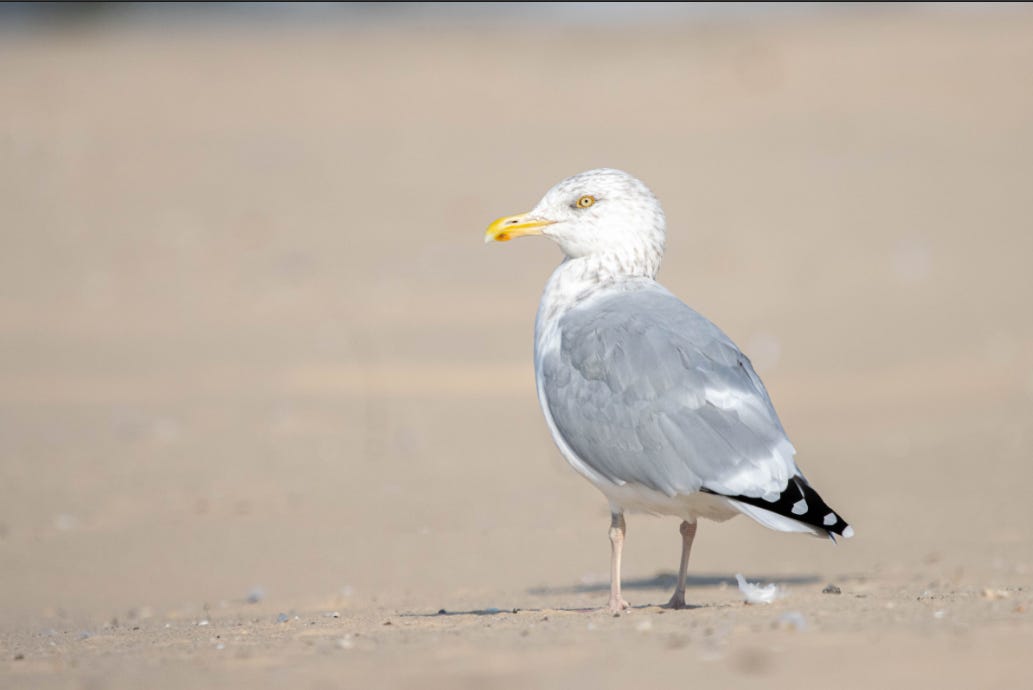
As with most identifications in the birding world, the most reliable place to start your ID process is with structure. A bird’s overall structure—how it is built—is consistent between individuals of the same species, regardless of time of year and molt cycle. For separating gulls and terns, several structural features help distinguish these groups.
Generally, gulls are larger-bodied and bulkier than terns. This does not necessarily mean that they appear smaller overall, as many terns are similar in length to smaller gulls. The key is to focus on the heft of the bird in question. A long, thin, and aerodynamic body suggests a tern rather than a gull. Gulls also show larger and rounder heads than terns, while terns will have a distinctly streamlined appearance. When perched, a gull often presents a more upright posture with a pronounced head and neck. A tern, on the other hand, will look relatively delicate and horizontally aligned.
Bill shape is another prominent difference between gulls and terns. Even smaller, more tern-like gulls have broader and heftier bills, which enable their wide-ranging diet. The thin, sharp-pointed bill of a tern is well suited to catching fish, and this pointy bill shape contributes to the overall sleek appearance of terns.
Much like the bills of terns and gulls, their wings are also adapted to different lifestyles. Tern wings are long, narrow, and pointed, suited to agility. On average, gulls have rounder and broader wings. This difference is even more prominent when looking at a perched bird, as the long folded primaries of a tern project well behind its tail.
Regarding tail shape itself, most gulls have short, square-ended tails that can appear rounded when fanned in flight or while preening. The beautiful Swallow-tailed Gull of South America is one of just a few exceptions. Most terns feature an eye-catching tail that is forked, often deeply so like that of the Roseate Tern. While not all terns show distinctly forked tails—for example, the Brown Noddy—and some gulls have forked tails, this trend is useful when paired with additional structural features.
The last structural feature worth considering is the legs. Relative to their body size, gulls tend to have thicker and longer legs, whereas terns feature daintier and shorter legs. The shorter legs of terns make them look lower to the ground when standing. Combined, the structural differences in body, head, bill, wing, tail, and leg characteristics present different silhouettes that can be all you need to differentiate a gull from a tern.
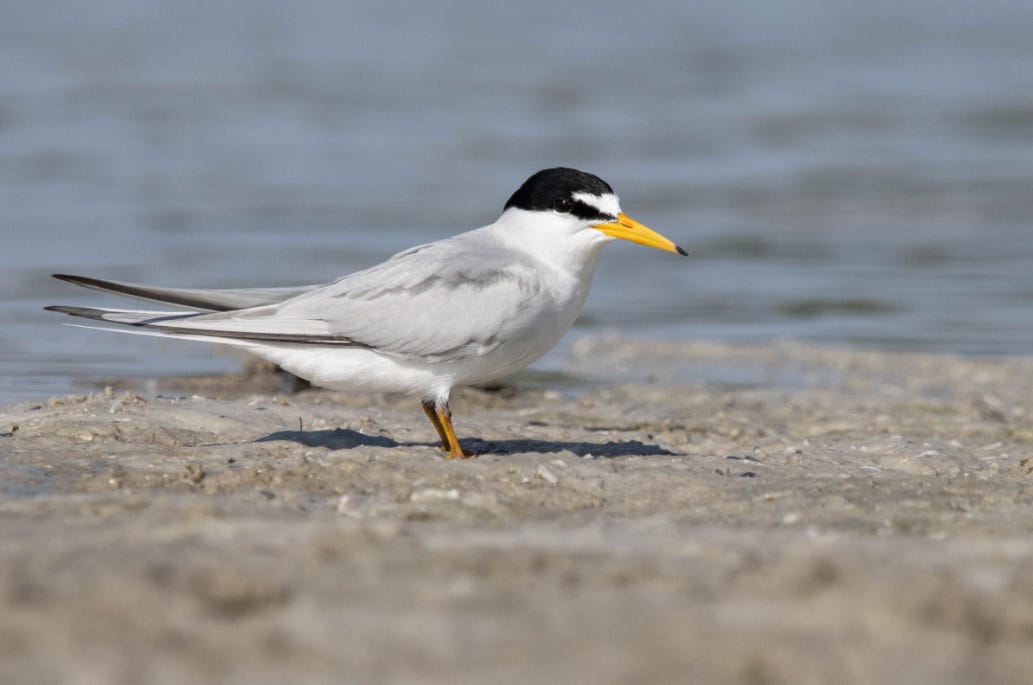
The structural differences between gulls and terns result from millions of years of evolution, which optimizes the interaction between body design and lifestyle. A gull’s relatively broad wings, sturdy legs, and hefty bill are well adapted for more soaring flight, frequent perching and wading, and a generalist diet. In contrast, a tern’s aerodynamic wings, petite legs, and long, pointed bill fuel a fast-flying, plunge-diving, fish-eating way of life.
While occupying the same habitat much of the time, the ecological niches of these birds are different. It would be highly improbable to see a tern swoop down and steal your sandwich while on the beach. Similarly, it would be uncharacteristic of a gull to hover over the water, diving again and again at small schools of fish. Certainly one group is better adapted for each of these tasks. If you see a bird walking around and picking at scraps of food, chances are it’s a gull rather than a tern.
For a bird in flight, watch the way it moves. Quick, choppy wingbeats with a very buoyant flight style suggest a tern, while slower wingbeats and a more gliding flight style lend themselves to typical gull behavior. While foraging, terns often appear to bounce around over sections of water, making quick turns and diving into the water after fish. Foraging gulls, on the other hand, swoop towards food, congregating in areas where they can walk or paddle, or even follow boats that may be chumming water. These behavioral clues are especially helpful for separating distant gulls and terns that are too far away to directly observe structural characteristics.
While plumage can be a useful feature to help identify gulls and terns, it is best as a final feature. Before you head out into the field, consider a few of your target species in the family Laridae. When you know what you’re looking for, consult a field guide to find some key plumage details for these species. Remember that age and season can influence the details you may be looking for.
Understanding the differences between gulls and terns in isolation is the best starting point. Learning to apply that in the context of the field is the next step. Approach these species with a mental schema. Start with the structure and understand the direction those features are pointing you in. Then consider the behavior and ask yourself whether that supports or opposes your initial judgement. There may be times when small size and a thin bill will suggest a tern, but a Bonaparte’s Gull can show those features (despite the bill still being thicker than that of most terns). Careful attention to detail, however, will reveal a squared-off tail, broader and less angular wings, and a stouter body with a round head. This is a perfect example of how identification must be done holistically in order to come to the proper conclusion.
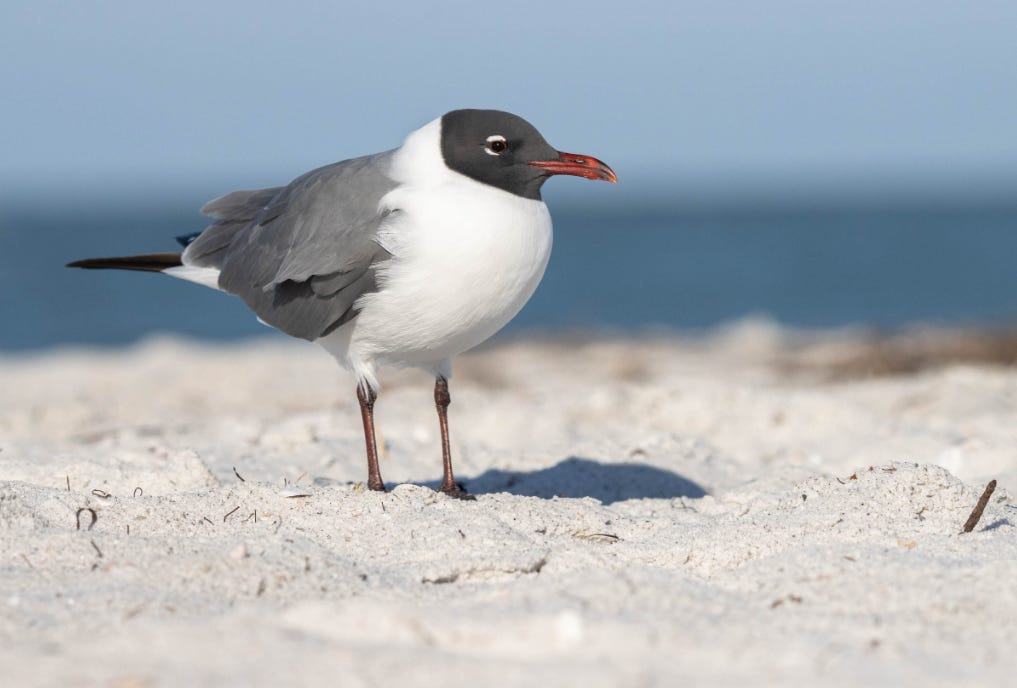
Gulls and terns frequently overlap in habitat and display similar color palettes, but their different body shapes, flight styles, and foraging strategies offer useful clues for separating the two. The next time you encounter a “seagull,” resist the urge to start with plumage alone. Take a moment to look at the bird’s silhouette and behavior first to determine if it’s a gull or tern. Then, use plumage details to narrow down the list of potential species. With practice, the key differences between gulls and terns will become much easier to recognize.
If you enjoy our work, you can show your appreciation with a one-time tip by buying us a “bird-friendly coffee.” Every contribution helps us keep creating content you love!
Comments
Nothing yet. Say the first thing.
Sign in to join the conversation.