
“You would harm no one, and disturb nothing, and never pay off, and never kick back, and never compromise or lose your bearings. You would do it in a new sin-free way, win-win, which of course is also part of the American character, perhaps the most defining part: the notion that, if we were only given one more chance, we could finally get it right.”
—Rich Cohen, The Fish that Ate the Whale
There have never been enough birds in America, at least according to Gardiner Bump. This deficiency was not just the result of America being dealt an unfortunate evolutionary hand (although this was also true—Bump complained that the southern United States had only three resident game birds compared to India’s seventy). The main problem was that the country’s turkeys, quail, prairie chickens, and bobwhites had all been devastated by overhunting. Even after the government began enforcing hunting limits, their populations kept dwindling as soybeans and suburbs ate up the land.
When resident game birds disappear, Gardiner explained, “something is needed to fill the gap.”1 If native game birds were unable to rise to the occasion, it was a practical necessity to meet the demand with foreign ones. To give America’s post-war army of hunters the birds that they so badly needed, Gardiner Bump led a federal program from 1948 to 1970 that brought the world’s most huntable birds to America’s “game-deficient areas.”2
Stocking the country with foreign game birds was not a new idea. Enthusiastic amateurs had succeeded in establishing Ring-necked Pheasants from China in the 1880s, Gray Partridges from Hungary in the 1910s, and Chukar from Iran and Afghanistan in the 1930s. The early success at naturalizing these three species suggested that the world might hold other birds which would thrive in America’s recently-depopulated forests, prairies, and scrublands. By 1914, South Dakota’s Department of Public Instruction could explain that “Almost every state in the Union has awakened to the fact that our native wild life is fast disappearing as civilization and cultivation are wending their way over mountain and plain, and at the present time great effort is being made to introduce varieties of wild game birds that will thrive in close proximity to the habitation of man.”3
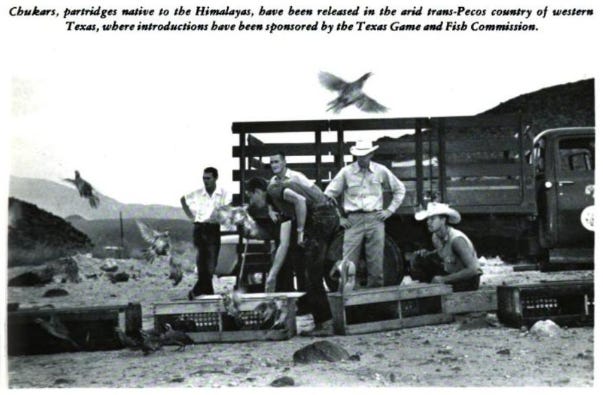
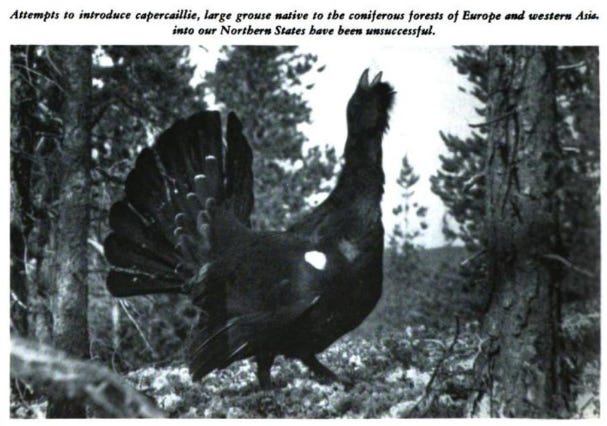
In the heady and unregulated inter-war days, anyone with the motivation and means to add another bird to America’s aviary could give it their best shot. One after another, private individuals and state game departments unceremoniously shoved curassows, tinamous, chachalacas, capercaillie, francolins, tragopans, bamboo partridges, button quail, and sand grouse into the hungry wild. But pitted against an alien environment with harsh weather and unfamiliar predators, every one of these birds disappeared before gaining a foothold.
Not everyone was on board with these experiments. Conservationists argued that the millions of dollars being spent on fruitless efforts to import foreign birds would be better dedicated to restoring habitat for threatened native species. Another threat was that the birds might do too well—house sparrows and European starlings represented cautionary examples of the dangers foreign birds could pose to native ecosystems. There were spiritual risks as well. In 1938 an Audubon Society representative argued that “from an esthetic, economical and patriotic standpoint we should perpetuate the things associated with our continent… The importation of foreign species is as unthinkable as the restoration of Mt. Vernon with chromium and concrete.”4
As a seasoned wildlife biologist, Gardiner Bump was well aware of these risks. But by bringing scientific management to a field previously defined by reckless experimentation, he was confident he could have things both ways. With careful evaluations and bureaucratic precision, he would not make the mistakes of the previous generation. He would find those mythical birds that would thrive in America and give good sport to its hunters without doing a lick of harm to its native ecosystems.
Fully bought into this vision, the U.S. Fish and Wildlife Service launched an initiative in 1948 to bring the world’s birds to America, with Gardiner Bump at the helm. Official reports and news articles variously called it the Foreign Game Introduction Program, or the Foreign Game Importation Program, or most frequently the Foreign Game Investigation Program. The FGIP was never so prominent that people even within Fish and Wildlife could agree on the name; regardless, when taken together these titles do a good job of summarizing the program’s activities.
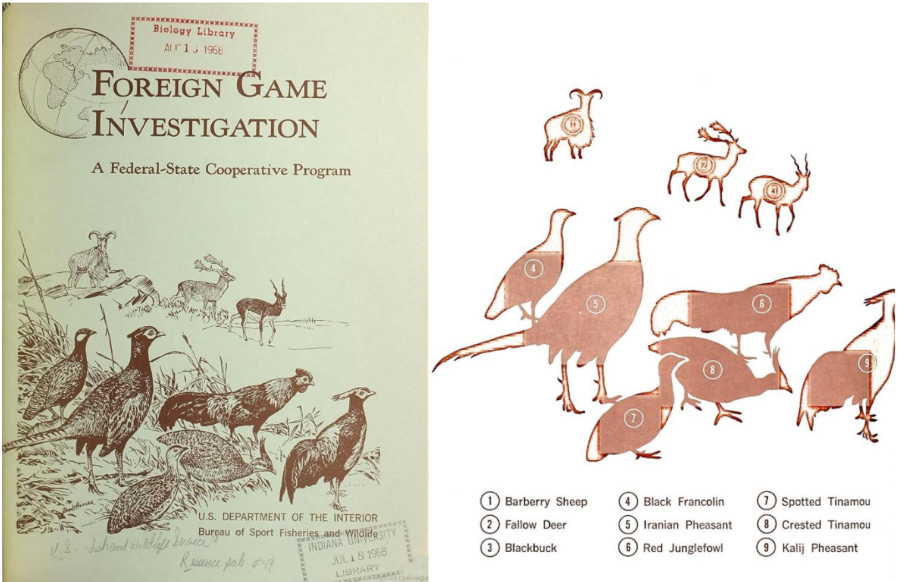
Here’s Gardiner Bump explaining how it worked: “The program is based on requests for assistance from State Commissions following a detailed ecological appraisal of their game-deficient habitats. After analyzing these, biologists are assigned to make a careful study of game species occupying similar habitat and climatic niches in foreign countries. From dozens considered, one or two may then be selected on the basis of their characteristics, habits, reproductive capacity, resistance to predation and disease, relationship to agriculture, ability to withstand heavy hunting pressure, and the possibility of competition with game species native to the United States. Modest, carefully-planned trial introductions of these species, utilizing wild-trapped individuals, carefully quarantined before shipment are then carried out in cooperation with interested State Fish and Game Commissions.”5
From the beginning, Gardiner Bump was at the center of the action. In what Time magazine called “the most interesting job of his career,”6 Bump spent fifteen years traveling the globe in search of promising species. For Bump, this globetrotting expedition was a family affair. He traveled with his son Robert and his wife Janet, who helped out by raising eggs from wild-trapped birds, checking birds for parasites, and coauthoring reports. Traveling by plane, jeep, train, and camel on the government’s dime, the Bump family considered whether the tinamous of Argentina, partridges of Spain, sandgrouse of India, and pheasants of Afghanistan might make themselves at home in the United States.7
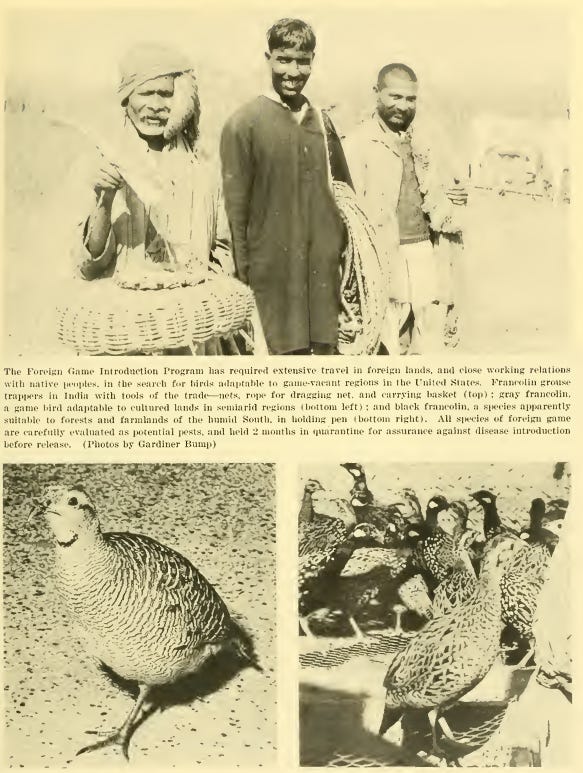
Not everyone thought that globetrotting in search of strange fowl was an appropriate use of taxpayer dollars. In 1951 Senator Homer Ferguson blocked the Fish and Wildlife Service from using its federal appropriation for “investigations, surveys, studies, trapping or similar work in foreign countries.” He’d read about Bump’s travels and explained that the goal of State game departments should be to restore habitat of “species God put in this country, not what He put in Africa, not what He put in Egypt, not what He put in Turkey, or some other foreign place, when certain species may be well suited for conditions there but not so well suited to our country.”8 But the Fish and Wildlife Service stood with Bump. By switching to a revenue stream from a tax on firearm sales, they kept his travels funded for another two decades.
It’s worth sharing an example of what just one of Bump’s evaluations looked like. The warmer woodlands of the southeastern U.S. were one of the “game-deficient habitats” that Bump was looking to stock with foreign game, where “grouse, turkey, or quail are not found in sufficient numbers to provide satisfactory hunting opportunities.” While working in India, program biologists rejected Hill Partridges and Red Spurfowl because their “secretive habits” made them poor game birds. But the Kalij Pheasant was widely hunted in India, could be propagated in game farms, occupied similar climatic zones, and wouldn’t pillage farmers’ fields.9
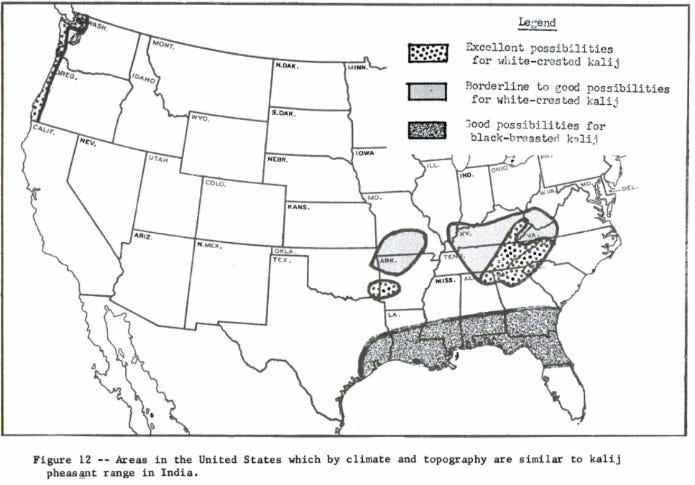
More importantly, Kalij Pheasants were an attractive game bird. “For the alert, energetic hunter,” wrote Bump, “the kalij offers a trophy that attracts the skilled and the novice alike.” Successful hunters could enjoy meat that was “white, tender and toothsome.” Bump summarized the Kalij Pheasant’s “usefulness” at the close of his twenty-page report: “Potentially adaptable to the warmer, rough lands and hills of the southern United States, where the ruffed grouse does not thrive, its possibilities as a woodland game bird should not be overlooked.”10 Following this positive review, the U.S. Fish and Wildlife Service worked with the state game departments of Washington, Tennessee, and Virginia to release 2,993 Kalij Pheasants between 1964 and 1968.
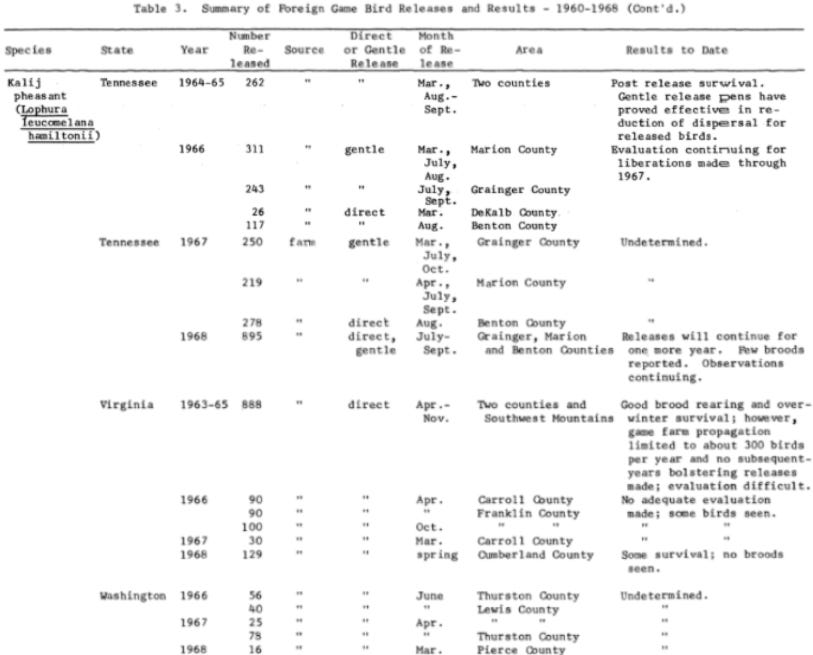
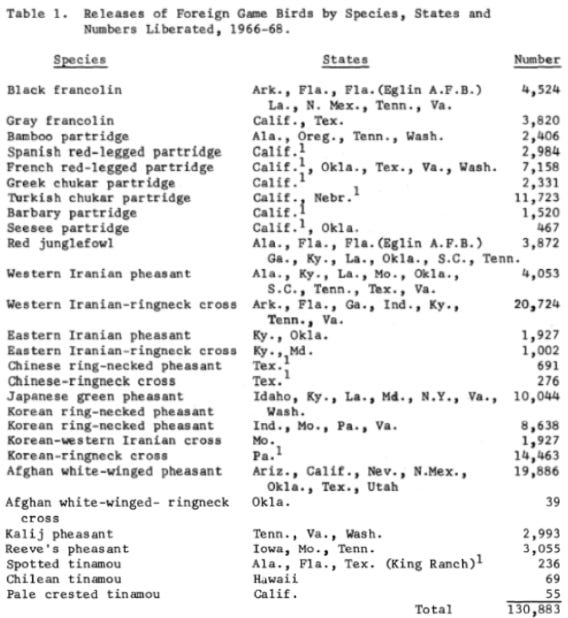
By 1969, the program had considered more than 150 species of birds, of which twenty-six proved promising enough to capture, breed, and send back to the United States for trial introductions. Thirty-two states and the territory of Guam eventually attempted to naturalize foreign game birds. Between 1960 and 1968 alone, the program released 130,883 birds into the wild.11
Every few years, Bump issued a report with updates on the program’s successes. They all read like this one, from 1963: “Although it is still too early to evaluate results for most species under trial, some trends are evident. Iranian pheasants, black francolin, and gray francolin have definitely demonstrated the ability to survive, reproduce, and increase substantially in a number of release locations… Six other species are maintaining themselves in numbers great enough to justify guarded optimism, and two others have probably failed.”12
Yet while each report expressed hopefulness, it proved maddeningly difficult for the FGIP to establish a permanent population of any bird whatsoever. Sometimes birds would run away from their original release location rather than settling down to start families, like when Common Sandgrouse released in Nevada turned up in Sonora, Mexico a year later.13 Sometimes predators or harsh winters wiped out a struggling colony. The birds didn’t often leave an explanation before walking out the door.
Some stray representatives managed to cling on for ten or fifteen years. As late as the 1980s you might chance upon a Black Francolin in southwest Louisiana. Green Pheasants were reported on Virginia Eastern Shore into the early nineties. But ultimately, even the most promising species couldn’t withstand the pressures of a strange and unwelcoming land. Today there’s nowhere in the continental U.S. you can go to hunt birds introduced by the FGIP. All 1,520 Barbary Partridges released in California vanished into the wild, as did the 2,406 Bamboo Partridges and 467 Seesee Partridges. The United States is entirely absent of wild Spotted Tinamous and wild Reeves’s Pheasants.
Outside of Hawaii, every one of the FGIP’s attempts to establish a new species of game bird to America was a failure. For all its purported scientific rigor, for all the millions it spent investigating, importing, and introducing foreign game birds, the FGIP was no more successful than the crowds of private game enthusiasts it was designed to replace.
By the end of the sixties it was clear that the FGIP had not only failed its mission, but that its mission had fallen out of step with the times. Changing sensibilities preferred protecting native species over introducing new ones, and in 1970 the program was formally terminated. Some states continued to release exotic birds they maintained in breeding farms, but none of these introductions were any more successful. On May 24, 1977, the era of foreign game importation was more or less brought to a close when President Jimmy Carter signed executive order 11987, restricting the introduction of exotic animals to the United States.
After a century of attempts, it seems like the early successes establishing Ring-necked Pheasants, Gray Partridges, and Chukars were the exceptions that proved the rule. Of the scores of species released in the wild, these alone have become established as widely-hunted game birds. Yet if you know where to look, you can still find remote, self-sustaining remnants from earlier experiments.
With few native predators, limited competition, and a gentle climate, Hawaii has a greater concentration of exotic game birds than anywhere else in the country. The Gray Francolin, Black Francolin, Erckel’s Spurfowl, Kalij Pheasant, and Chestnut-bellied Sandgrouse introduced by the Foreign Game Introduction Program were able to stick it out in Hawaii when they failed to take hold on the continent. They joined an already eclectic cast of non-native game birds introduced decades earlier, including turkeys and quail from the mainland and Chukar and Ring-necked Pheasants from Asia. Nowhere else have introduced game birds found such an accommodating welcome, and nowhere else have they done so much damage.
Travel to Sapelo Island on Georgia’s Atlantic coast and you might be able to spot a Plain Chachalaca. These lanky, chicken-like birds, confined to their island home, have stuck around since they were first introduced by Howard Coffin in 1923.
High in the Ruby Mountains of northern Nevada, there’s a small, established population of elusive Himalayan Snowcocks. Their inaccessibility, beauty, and large size has made them a bit of a holy grail for American hunters and birders alike. Credit for introducing these hulking birds in 1963 goes to the Nevada Department of Fish and Game, however, rather than the FGIP.
Finally, you can find the FGIP’s strangest and most enduring impact in the small town of Fitzgerald, Georgia, where the descendants of Red Junglefowl released by Gardiner Bump still wander the streets by the hundreds. To the untrained eye they don’t look much different than chickens. They are, after all, the wild ancestors of the thirty billion chickens spread throughout the world today. In their native range, the genes of Red Junglefowl are severely threatened by crossbreeding with domestic chickens. But Fitzgerald’s junglefowl, protected and celebrated by the town’s residents, are some of the purest breeding stock of the birds in the world.
I hate to admit it, but I’m drawn to Gardiner Bump’s maximalist vision for wildlife. The earth has 11,000 species of birds, and I want to see all of them. I want them all in my backyard! I doubt I’ll ever see a Chukar in its native range, but I was ecstatic to see one in Utah last December. Whether it’s native or naturalized, I get the same thrill when I spot a bird for the first time.
My conscience tells me that this acquisitive impulse is one that needs fighting. I’m well aware of the damage done by introduced species to native flora and fauna, and with the ravages of climate change and habitat destruction, native birds are only becoming more vulnerable. Even a small increase in competition within a fragile ecosystem can be disastrous. I don’t want to romanticize the ecological cost of throwing birds into unfamiliar habitats and hoping they stick.
Birds are intimately related to the environment they evolved in. They’re a piece of a network, shaped by millions of years of give and take with the land and the life it supports. To rip them from their home and ram them into a new environment is like taking a piece from one puzzle and trying to find a slot in another. You might find a space where the piece fits but the picture will still come out wrong.
When we talk about the impact of foreign introductions we often focus on species, populations, and ecosystems, and there are extremely good reasons for doing so. But as I was reading about the birds the FGIP introduced—a dozen here, a thousand there—I couldn’t help thinking about them as individuals. Kidnapped from their homes or raised on a game farm, they were released in a strange land with little hope for survival. Most died out of our sight, from hunger or predation or elements they were unprepared to face. Most too died lonely, unable to find more of their kind after scattering into the wild.
By conscripting these foreign birds as unwilling settlers, we violated an original obligation to do no harm to them and to the environment they colonized. But now their descendants have made this land their own, and I believe there’s something we owe them as well. At the end of the day, I’m still stuck with a paradox. I don’t believe these birds should have been introduced in the first place. But now that they’re here, I think they deserve a place at the table.
Bump, Gardiner. “Foreign Game Investigation: A Federal-State Cooperative Program.” Washington: Bureau of Sport Fisheries and Wildlife. Resource Publication No. 49. 1968.
Robinson, Lawrence. “Introduction of Exotic Game Birds in South Carolina.” Proc. 23rd Ann. Conf. SE Ass. Game & Fish Comms. P. 152-156. 1969.
South Dakota Arbor and Bird Day Annual. South Dakota Department of Public Instruction. 1914.
“Alien Game Birds Viewed as Pests.” New York Times, October 25, 1938.
Bump, Gardiner. Red-legged Partridges of Spain. United States: United States, Department of the Interior, Fish and Wildlife Service, 1958.
“Science: Bird Hunt.” Time magazine. May 29, 1950.
“Senate, Friday, July 13, 1951.” Congressional Record: Proceedings and Debates of the 82nd Congress First Session. Volume 97 – Part 6. United States: U.S. Government Printing Office, 1951, p. 8120.
Bump, Gardiner., Bohl, Wayne H.. “Red Junglefowl and Kalij Pheasants.” United States: U.S. Fish and Wildlife Service, 1961.
Robinson, Lawrence. “Introduction of Exotic Game Birds in South Carolina.” Proc. 23rd Ann. Conf. SE Ass. Game & Fish Comms. P. 152-156. 1969.
Bureau of Sport Fisheries and Wildlife. “Wildlife Research: Problems, Programs, Progress 1963.” United States: Department of Interior. Circular 188. 1963, p. 41.
Christensen, Glen, and Bohl, Wayne H.. “A Study and Review of the Common Indian Sandgrouse.” United States: U.S. Fish and Wildlife Service, Special Scientific Report – Wildlife No. 84. 1961.
Comments
Nothing yet. Say the first thing.
Sign in to join the conversation.