
It’s impossible to pick a favorite bird name. The world’s ornithologists have given us more than 11,000 to choose from, and they’ve stretched the limits of creativity to make sure every one is unique. While there’s no shortage of literal bird names out there (I always get a kick out of answering the question, “what’s the name of that black bird with red wings?”), there are hundreds of names that are humorous, obscene, confounding, evocative, and simply bizarre. A short-list of best names has to include the Predicted Antwren, Plains-Wanderer, Inaccessible Island Rail, Blood-Pheasant, Zappey’s Flycatcher, Horned Screamer, Bare-faced Go-away-bird, Mrs. Moreau’s Warbler, and King-of-Saxony Bird-of-Paradise, and that’s just scratching the surface.
A few weeks ago, invited me to come on her podcast The Thing With Feathers to talk about some of these bizarre bird names, as well as Passenger Pigeons, feather fashions, and the lessons we can learn from earlier generations of bird activists. Courtney is a pastor, author, and birder, on top of being a deeply warm and generous person, and I feel lucky to have been brought into her orbit. You shouldn’t stop after listening to our interview. She’s also had memorable conversations with Amy Tan, Kenn Kaufman, and scores of other thoughtful, brilliant people about birds and the hope and meaning they bring to our lives.

A little over two years ago I sent out my first post on Substack. Since then, I’ve learned so much about America’s history. I’ve gained a greater respect for and understanding of the birds and people who came before us. I’d also like to think that I’ve become a better writer and more reflective person. But maybe the best thing I’ve gotten out of this writing project is relationships with other writers. It’s given me a chance to meet thoughtful, curious, and creative people like Courtney who are putting in the work to understand their relationship with the more-than-human world, and then sharing what they’ve learned with you and me.
In those two years, I’ve sent out 49 posts, totaling a little under 100,000 words. That makes this post number 50! To mark the occasion, I’m going to take a leaf out of ’s book by reaching back into the archives and sharing some stats, highlights, and superlatives. In the select snippets I’ve pulled from some of my previous posts below, I hope I can show you something new.
First post: How Robins Got Their Name
From way back on August 5, 2023. While I cringe a little bit every time I open up my earliest posts, it’s also reassuring to realize that I’ve become a better writer and more careful researcher over the last two years.
During the 15th century, the English had an endearing practice of granting common human names to the birds that lived among them. Virtually every bird in that era had a name, and most of them, like Will Wagtail and Philip Sparrow have been long forgotten. Polly Parrot has stuck around, and Tom Tit and Jenny Wren are still sometimes found in children’s rhymes. Other human names, however, have been incorporated so durably as to almost entirely obscure their origin. The Magpie was once simply called “pie.” The English named these birds Margaret, which was then abbreviated to Maggie, and finally left at Mag Pie. The vocal, crow-like Jackdaw was also once just a “daw” named “Jack.”
The English also gave their ubiquitous and beloved orange-bellied, orb-shaped bird a human name. The first Anglo-Saxon name for the Eurasian Robin was ruddoc, meaning “little red one.” By the medieval period, its name evolved to redbreast (the term orange only entered the English language when the fruit of the same name reached Great Britain a century later). They chose the satisfyingly alliterative name Robin for the redbreast, which became so identified with the bird that Redbreast was dropped because it seemed redundant.
Most read post: The First Cat War
From January 25, 2024.
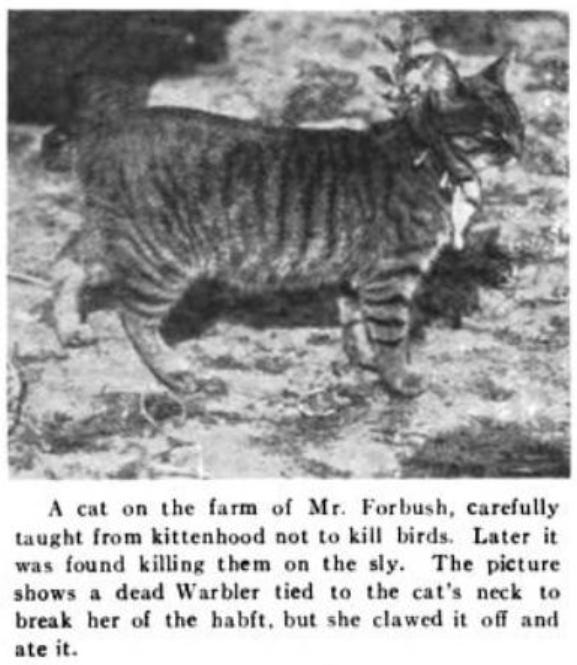
In 1916, a serious debate about cats was consuming the country’s attention. Conservationists blamed cats for being the greatest threat to the country’s bird life, while cat-lovers accused bird-lovers of hysteria. The conflict was often reduced to zero-sum terms, with the naturalist John Burroughs declaring that “the preservation of birds involves the nonpreservation of cats.” Even casually, people had to pick a side. Carl Van Vechten quipped that “One is permitted to assume an attitude of placid indifference in the matter of elephants, cockatoos, H. G. Wells, Sweden, roast beef, Puccini, and even Mormonism, but in the matter of cats it seems necessary to take a firm stand.”
Least read post: The Extinction of the Eskimo Curlew
This was my second Substack post, published August 6, 2023. According to Substack, it’s been read a grand total of 90 times!
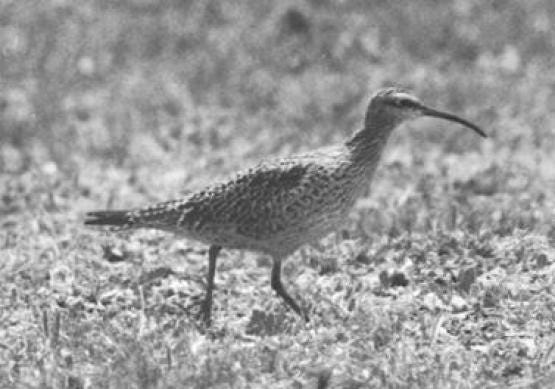
The Eskimo Curlew was a medium-sized shorebird—about as long and heavy as a loaf of bread—with mottled brown feathers and spindly legs, perfect for wading in shallow water. Like all curlews, this bird had a long, narrow, downward-curving bill. And like other long-distance migrants, they lived in perpetual summer, taking advantage of the explosion of insect life packed into the short breeding seasons near the extremes of the northern and southern hemispheres.
While only a portion of the curlew population passed over New England on their voyage south, every curlew traveled through the heart of America as they journeyed north in the spring, and it was here that the true size of their population was observed—and exposed to market hunters. Gunners in the great plains called them Prairie Pigeons for their resemblance to the enormous flocks of Passenger Pigeons in the east. Hunters from Texas to Nebraska shot birds by the wagonfull for pleasure or profit, sometimes killing more than they could carry and leaving the excess in “piles as large as a couple tons of coal, where they would be allowed to rot.”
Most liked post: Dining with Robins
Originally published December 10, 2024.
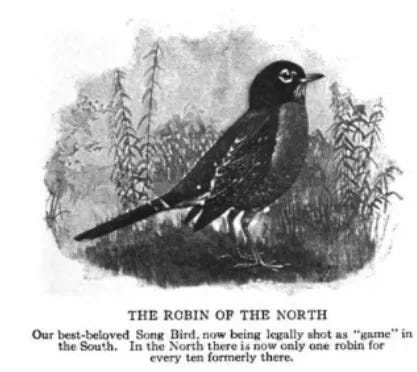
In the 1830s, the painter-ornithologist John James Audubon witnessed “a sort of jubilee among the gunners” in southern states when robins returned for the winter. There, “the havoc made among them with bows and arrows, blowpipes, guns, and traps of different sorts” meant that hunters could “stand round the foot of a tree loaded with berries, and shoot the greater part of the day, so fast do the flocks of Robins succeed each other.” With so many “fat and juicy” birds being killed throughout the season, robins could be found abundantly in Southern markets and sell for as little as two for a penny.2 Virtually every town had an open-air market where shoppers were sure to find robins piled in barrels or tied up in strings next to ducks, geese, quail, and woodcocks.
Most new subscribers: Economic Ornithology
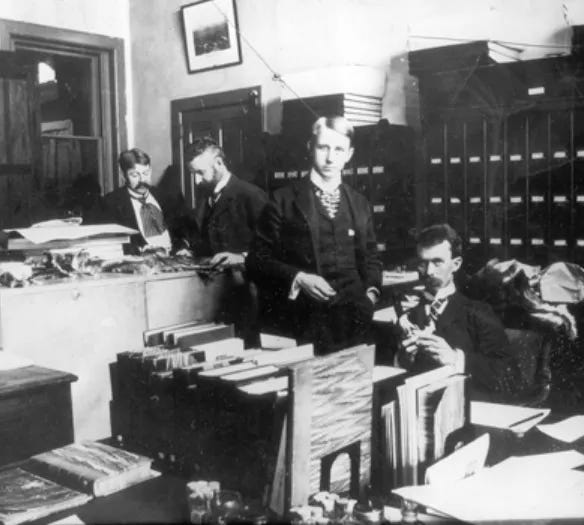
I originally published this piece on January 10, 2024. It somehow made its way to Bloomberg’s Tracy Alloway, who invited me to appear on her podcast Odd Lots a month later to talk about it. Give it a listen here!
After the turn of the century, conservationists, as well as much of the general public, had a justifiable fear that many species of birds might soon disappear if drastic action were not taken for their protection. Thanks to overhunting, Passenger Pigeons and Carolina Parakeets had disappeared from the wild, and many ducks, swans, and egrets seemed destined for the same fate. The devastation brought out by insect hordes, without birds to hold them at bay, felt like an immediate threat. The famous ornithologist Frank Chapman said that “economic ornithologists now agree that, without the services rendered by birds, the ravages of the animals they prey upon would render the earth uninhabitable,” while National Geographic predicted that if birds disappeared, “not only would successful agriculture become impossible, but the destruction of the greater part of vegetation would follow.” With these statements in mind, the claim that “every bird that lives on insect life is worth its weight in gold to mankind” did not seem like much of an exaggeration.
The one my dad said was his favorite: Trash Birds
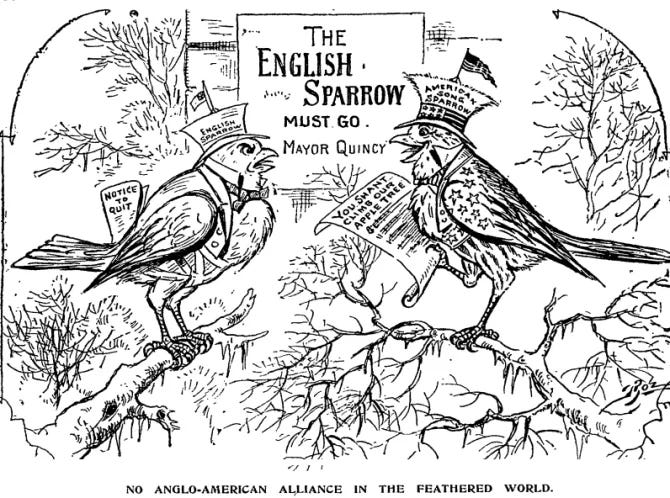
From May 29, 2025. I wrote this piece for the Nature Writing in Cities course I took at the New York Botanical Garden, taught by the fantastic . If you enjoy my writing, you’ll love Russell’s. He has a Substack called Landlubber, where he writes about the places where land meets water and humans meet nature. Do yourself a favor and subscribe!
House Sparrows seemed to belong in the city, and exemplified the city’s worst attributes. Unlike the sweet songs of other backyard birds, the sparrow’s grating squeak “harmonizes perfectly with the jarring sounds of man’s contriving” and “the clatter of iron-shod wheels over city pavements.” Their plumage was no more attractive than their song, and their behavior was somehow even worse. Their “clumsy, straggling nests” were strewn with “rubbish of all sorts and colors,” while their relationships were characterized by “combats, brawls, forcible divorce, and persecution of the unfortunate.” Worst of all, they seemed to chase from the city its resident native birds. A 1923 manual for birdhouses described how, “By squatter’s right, by sneaky intrusion, or by open assault, this foreign intruder takes possession of bird boxes, destroys eggs and young, and gradually presses blue birds, house wrens, chickadees, swallows, robins, and purple martins beyond the borders of their rightful heritage.”
My favorite piece: Carolina Parakeets
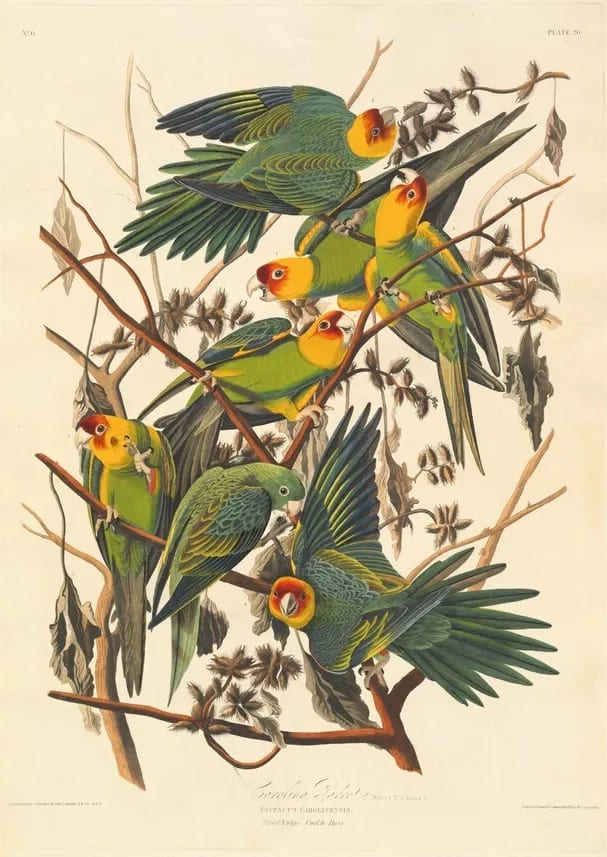
For several years I’ve kept John James Audubon’s painting of the Carolina Parakeet as my phone background as a reminder of the birds we’ve lost and the birds we can still save. I wrote a three-part series as a meditation of what it was like to share a world with these incredible creatures and what meaning we can find in their lives even after their extinction.
What was remarkable about these birds, though, was that they stuck around once the leaves fell from the trees. Parrots are tropical birds. Nearly all of them live in areas where it’s balmy year-round. Not so the Carolina Parakeet, whose green feathers were as conspicuous in winter as they were camouflaged in summer. Alexander Wilson once saw a flock flying and squawking through a February blizzard along the banks of the Ohio river. And in 1780, a large flight of the birds landed near Albany in the middle of winter, which so alarmed the “more ignorant Dutch settlers” that “they imagined, in dreadful consternation, that it portended nothing less calamitous than the destruction of the world.”
My thesis: Why I Write About Birds
From January 21, 2025.
America is the market hunters that drove passenger pigeons extinct, and the children who mourned their passing. America is the wealthy white northerners who fought to protect birds, and the immigrants and southern Blacks who they persecuted for using them as sustenance. America is the land, and all the beings who live on it. It’s the geese and crows and robins, and it’s the gaping void where five billion passenger pigeons once lived. It’s the foreign starlings and sparrows who made America their own, who have been reviled and slaughtered ever since. America is the migrating warblers that make a mockery of national boundaries. It’s the wetlands that ducks call home, and the wetlands dredged to make room for suburbs and soybeans. These are many histories —billions of histories—but they’re also one history. And that’s the one I’m trying to tell.
The print I’ve sent most frequently to paid subscribers
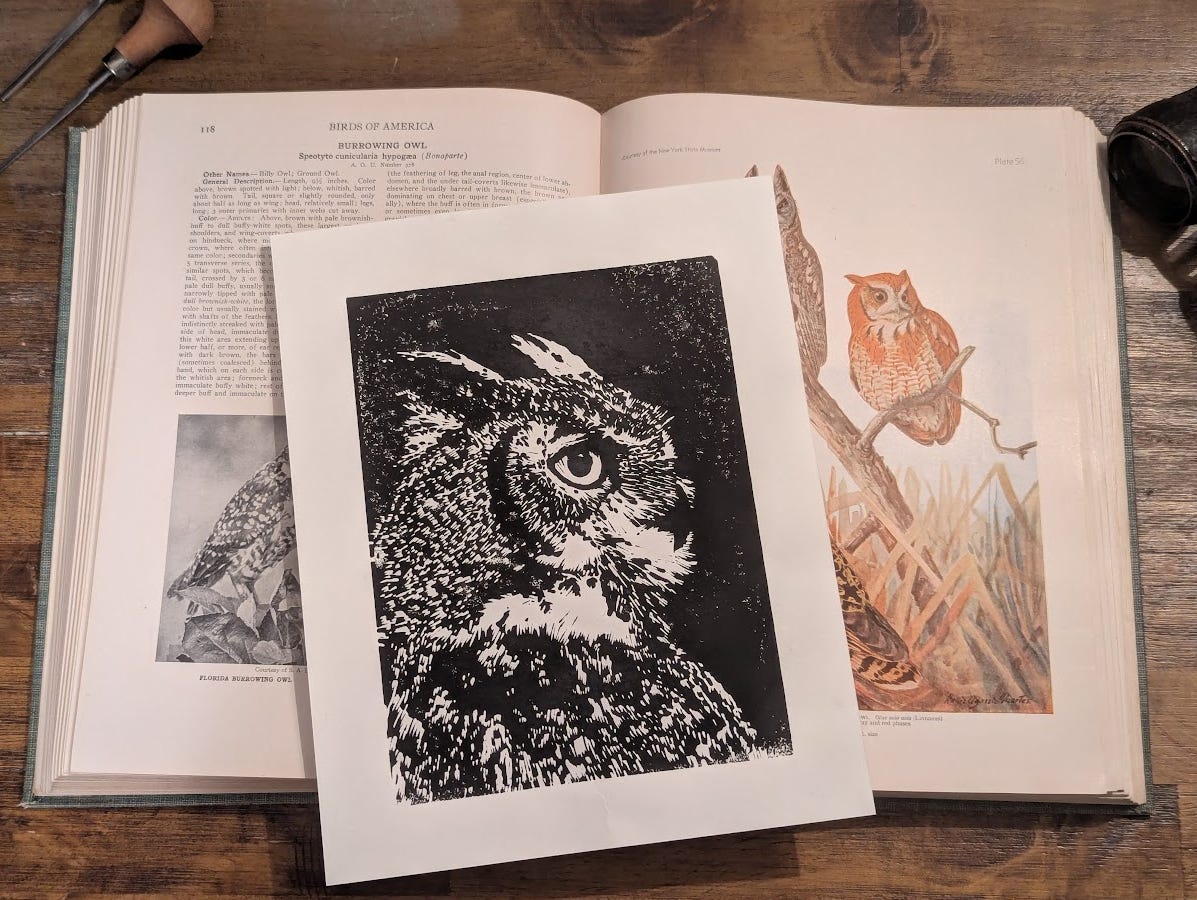
I’d like to close with a note of gratitude for everyone who’s upgraded to a paid subscription. These go for $6 a month or $60 a year, and I offer one of my hand-made linocut prints as a little thank-you to everyone who subscribes. This support has been immensely helpful as I try my hand at being a full-time writer, but it’s meant just as much as a vote of confidence that this project is worthwhile, that it’s filling an important niche. Researching and writing about America’s birds has been a more fulfilling and fascinating venture than I could have imagined, and I’m deeply grateful to have you along for the ride.
Bird History is a reader-supported publication. To receive new posts and support my work, consider becoming a free or paid subscriber.
Comments
Nothing yet. Say the first thing.
Sign in to join the conversation.