
While I’m researching my free bi-weekly articles, I find a lot of great tidbits, tangents, and delightful but not-quite-on-topic quotes that don’t make it to print. I offer Field Notes as a dispatch to paid subscribers that includes clippings from primary sources, stand-alone quotes, and snippets that got cut for time. This issue of Field Notes covers material that didn’t make it into last week’s post about America’s wild parrots.
When I was writing my piece about America’s wild parrots, it would have been really helpful to find a single source tracking foreign bird imports by species and over time. But this would have made things too easy. America’s official policies around importing foreign birds were pretty haphazard throughout the 20th century, and official record-keeping for birds crossing America’s borders was just as sporadic. The government didn’t always require that birds be declared at the border, and even when they did, they didn’t always do a good job recording and reporting their species, numbers, or countries of origin. But the data we do have access to (or, at least, that I was able to find) still paints a really interesting story.
From 1901 to 1942, the Bureau of Biological Survey (precursor to the U.S. Fish and Wildlife Service) collected data on bird imports, although they only recorded broad family groups rather than individual species. Throughout this period, canaries were clearly the bird of the masses (I wrote about the popularity of canaries in a previous piece). Most years saw Americans importing between four and ten times as many canaries as all other pet birds combined. In that period, foreign bird imports totaled 10.2 million canaries and 2.5 million “miscellaneous birds,” a category that included 575,000 parrots. Most of the parrots that came to the U.S. in this era were budgerigars and lovebirds. Even so, one report indicates that by 1928 a third of all known parrot species had been imported to the United States.1
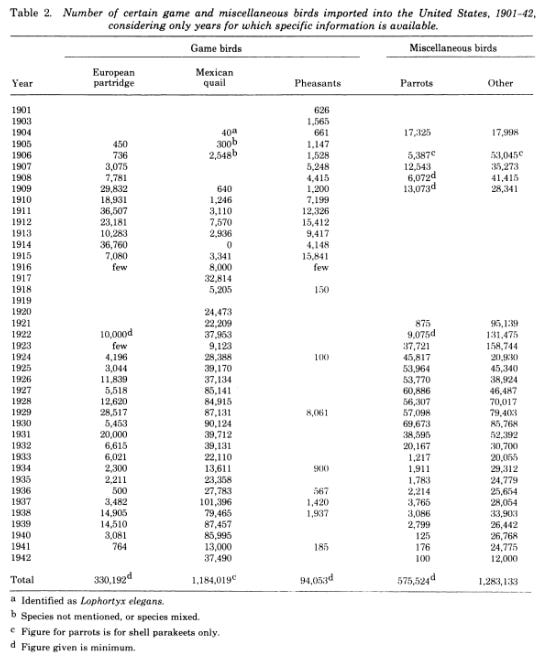
During World War II, live animal imports to the United States mostly halted, and so did the country’s efforts to collect systematic data on imported animals. From 1942 to 1965, there doesn’t seem to be any reliable information on the number of birds entering the country. It wasn’t until 1966 that the U.S. resumed the requirement that all foreign animals, including birds, be declared at customs. Even then, canaries and parrots were exempted from this requirement until 1970, meaning that they were vastly undercounted until their reporting was also mandated.
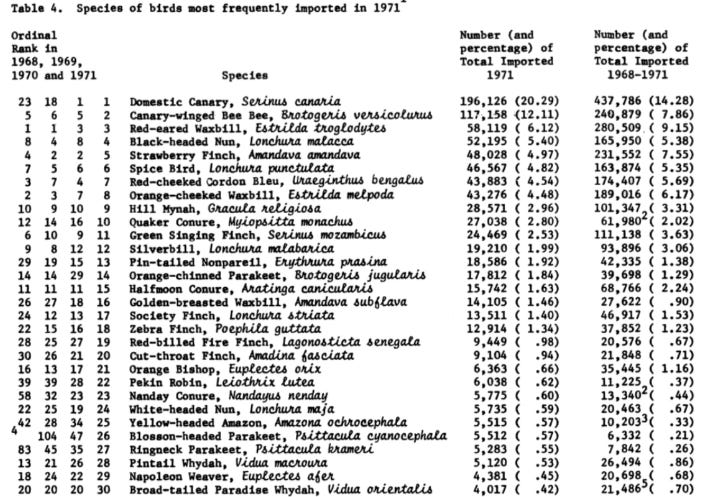
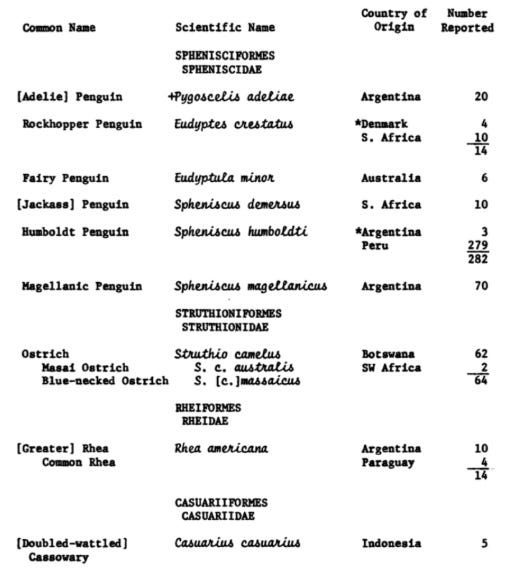
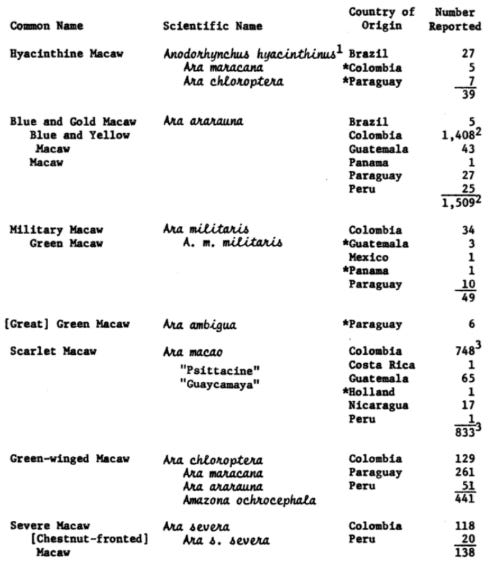
The most granular data I’ve been able to find is for 1970 and 1971, when the U.S. Fish and Wildlife Service released detailed reports listing the number of birds from each bird species imported to the United States, including their country of origin. The reports are extremely specific—in 1971, for example, the U.S. imported 6 Fairy Penguins from Australia, 1,408 Blue and Yellow Macaws from Colombia, 25,238 Monk Parakeets from Paraguay, 115,598 Yellow-winged Parakeets from Peru, 20 Scops Owls from India, 10 Sword-billed Hummingbirds from Ecuador, 18 Keel-billed Toucans from Panama, and 20,486 Hill Mynahs from Thailand. These were some of the 966,561 individual birds representing about 750 species that were imported from 63 countries that year. Here’s a sample of some of the data included in that report.
And then midway through 1972, an outbreak of Newcastle Disease led to a complete halt to bird imports for two years to protect domestic poultry. Bird imports only resumed with the imposition of a required 30-day quarantine for birds entering the country. This created a much more formal process for bringing birds into the country, although I haven’t been able to find where the government keeps this data.
And there’s a chance it wouldn’t be accurate even if I could find it. One expert who gave testimony during a 1992 congressional hearing on the Wild Bird Conservation Act explained that many shipments of foreign birds weren’t inspected, and even those that were often misidentified the birds:2

Comments
Nothing yet. Say the first thing.
Sign in to join the conversation.