
The New York Times recently published a story that stopped me mid-sentence. I was on a call, mid-thought, and someone mentioned it: a landmark study showing that the effects of childhood trauma can be reversed.
I put everything down and read it.
The study tested a clinical intervention called HOPE—Healthy Outcomes from Positive Experiences—built around four components. The results were rigorous, quantitative, and striking. The kind of damage we once believed was permanent can actually be repaired.
When I finished reading, I felt something I’ve learned to trust over many years: the feeling of dots connecting. Because this study doesn’t just tell us something important about trauma. It tells us something urgent about right now, about the crisis in youth mental health, the debate over phones and screens, and what nearly everyone is missing in the conversation.
When the original ACE study came out decades ago—the research linking adverse childhood experiences to long-term health consequences—I was in clinical practice. I watched what happened when people learned their scores. A woman would sit across from me and say, “I have six ACEs. Does that mean I’m going to have a heart attack at fifty?“
The ACE study was important. It elevated our understanding that adversity has real, lasting biological consequences. But many felt labeled, or worse given a death sentence, without offering a way forward. It told you what was wrong. It didn’t tell you what to do about it.
I was a child psychiatrist and avoided labels altogether with my patients because they hurt and didn’t help. As someone who has known childhood trauma, I know what it feels like to carry a number that feels like destiny.
This new study does something different by showing us that there is a pathway to reverse the damage that trauma can do. And it does so by understanding something fundamental about how the brain actually works.
The biology that makes trauma reversible—connection-driven neurobiological change—is the same biology that is affected when human connection is displaced in the daily lives of young people.
The human brain weighs about two and a half pounds. It consumes roughly 25 percent of the energy your body uses in a given day, an astonishing amount for something that fits between your two hands. And it makes that energy the same way every cell does: with oxygen and glucose.
But brain cells have a problem no other cells in the body have. They cannot store oxygen or glucose. Not even a little. The only way the brain gets energy is through blood perfusion—blood flowing to the brain, delivering fuel in real time. You can decide to get more blood to your biceps by picking up a weight, but you cannot decide to get more blood to your brain.
There is, however, something that does it reliably, something every one of us has access to: human connection. When we are in the presence of someone who truly sees us, who is attuned to us, present with us, a cascade of neurochemistry is activated. It’s led by a hormone called oxytocin, joined by dopamine and several other chemicals. But here is the part most people don’t know: in this cascade, oxytocin is the dominant hormone, not dopamine. And oxytocin has enormous influence on the vasculature of the brain. It drives blood perfusion. It literally delivers the nutrition the brain needs to grow, to repair, and to thrive.
The technical term for it is neurovascular coupling. I didn’t discover it, but my work with children who have known trauma had me translating science to young people so they could understand what was going on in their brains and bodies and most of all to know that they could heal and grow from whatever had happened to them. That’s what I strive for.
This is why nurturance leads to brain growth. This is why love matters, not only as a feeling, but as a biological event.

Jonathan Haidt has done an enormous service by drawing attention to what screens are doing to young people. His data on rising rates of anxiety, depression, and loneliness are convincing, the trends are alarming, and he is not wrong.
But he has identified a problem without going to some of the deeper explanations for the crisis we are seeing. Because of that, the only solution most parents and policymakers can imagine is to reduce screen time—take the phones away. That is part of what the solution looks like, but by itself, it is not going to fix what is actually broken.
Here is what I mean.
When a young person spends hours a day on a screen, alone, two things happen simultaneously. First, their dopamine pathways are highly engaged. The pathways get strengthened and they want more dopamine. And once you grow those pathways, they demand even more. This is the addiction cycle Haidt describes, and he describes it well.
But the second thing is less visible and ultimately more devastating: the displacement of human connection—of time with other humans.
When screens outpace time with other humans, the oxytocin system won’t be stimulated and the neural cocktail that energizes the brain, reduces stress, drives curiosity and engagement is dramatically reduced. Perfusion to the brain decreases. The neural pathways that grow with connection don’t get built.
We know what happens when children are deprived of human connection. Studies of infants raised in Romanian orphanages—children who were fed and sheltered but rarely held, spoken to, or loved—showed that their brains were measurably smaller than those of children who had consistent human contact. The cause wasn’t malnutrition in the traditional sense. It was the absence of connection, which starved their brains of the neurochemical fuel they needed to grow.
I want to be careful here. I am not saying that a teenager on a phone is the same as a child in an orphanage. I am also not saying that the use of technology is a bad thing. I am saying that we are social creatures and that our brains have a social core that didn’t evolve to solve abstract math problems but instead to navigate the complex terrain of social relationships. Our bodies and our minds developed intricate systems for synchronizing with others, which shaped neural development, gene expression, regulation of stress and ultimately whether our full potential can emerge.
The ACE study did with trauma what I believe Jonathan Haidt is doing with anxiety. It named the problem and quantified the damage—and that matters. But the framing has amplified anxiety instead of empowering people to do what actually heals.
Putting phones down will not, by itself, correct the energy problem in the brain. What will correct it is human-centered experiences that activate the biology of connection.
The antidote to the “anxious generation” is human connection, trust and presence. It is designing the environments in which we live and work and learn and grow so that they deliver the fuel and the energy to our minds and our bodies to do exactly that.
This is our biology and what we are designed for. And it is exactly what the HOPE intervention proved: that through consistent, caring, human connection, you can change neurochemistry. And when you change neurochemistry, the brain rewires.
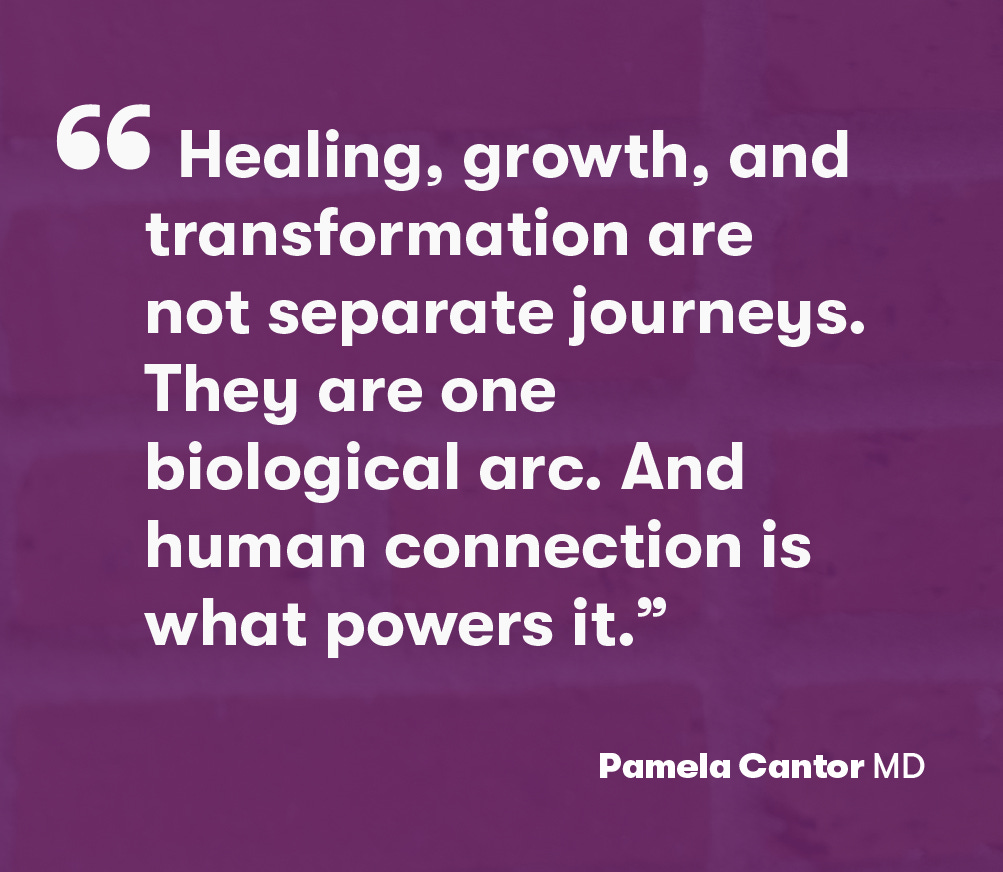
Healing, growth, and transformation are not separate journeys. They are one biological arc. And human connection is what powers it.
The same circuitry that repairs also strengthens, the one that strengthens also performs and the one that performs can flourish.
This is why trauma is not destiny. Anxiety is not destiny.
Three Things You Can Try this Week
Replace one screen moment with a human one. This isn’t about policing technology. It’s about choosing, even once a day, to be fully present with someone—a child, a partner, a friend—without a device between you. That presence triggers a biological response no app can replicate.
Name what you see in someone. When you notice something good (effort, kindness, resilience, humor) say it out loud. That small act of recognition is an oxytocin event. You are not just being kind. You are delivering nutrition to someone’s brain.
Ask a better question than “how was your day?” Try: What made you laugh today? Was there a moment you felt proud of yourself? Did anyone surprise you? Specific questions invite connection, and connection is a neurochemical event, not just an interpersonal one.
If these ideas resonate with you, I’d love for you to share this with someone who needs to hear it. And if you want to go deeper into the science of how we become who we become, please subscribe.
—Pam

Comments
Nothing yet. Say the first thing.
Sign in to join the conversation.