
Garden Timing is Hyper-Local
I’ve been thinking about this for months, as I watch all the photos and articles flow through my Substack feed, showing the progress of people’s plantings or recommending what to plant for the month. My usual inward response is something like; not here, not now, not yet, or already too late.
Garden timing is hyper-local. The last place I gardened, before here, is only five miles away. Warm season veggies had to be carefully timed, and that is true here as well. Many veggies require a longer warm growing season than we had there, and that is true here as well. But five miles from here, in that very particular spot, I could throw down cool season seeds any month of the year, and they would grow. That’s not true here.
Garden timing is hyper-local. It is affected, literally, by the way the wind blows, by geography, by the human-built environment, by thermal mass or the lack thereof. It’s also affected by how well or poorly your soil stores heat, and a zillion other things that we may not yet be conscious of.
Garden timing is hyper-local. We can make suggestions that other people can try. We can share what works for us. And we can try what works for others, but ultimately, we must experiment to find the timing what works best for us, and be ready to adapt as weather and climate cycles change.
And there is this other thing. When we purchase seeds or roots, or tubers, or bulbs, or starts, they arrive preadapted to the weather, the climate, and the stewardship of the place they came from, and that has an effect on their own internal timing. They may be confused about—when to do what—for a generation or two. They may not know the best timing for germination, blooming, setting seed, and releasing the seed in the new location. They may have to experiment too.
By saving seed (or roots, tubers, bulbs, or cuttings) when you and the plants are at least a little successful with your timing, those linages will start adapting to the weather, climate, soil, etc., where they now find themselves, and to your stewardship as well. And together, the timing will become better, more synchronized, more symbiotic between the place, the plants, and you. But this takes observation and intuition and relationship.
While I have been thinking about all of this for a few months, a few things got this trend in my thinking to become a little more settled and a little more articulate. The first was checking out a photo of a sunflower plant that is now taller than the steward at Desert Dirt Diaries , and is developing a large terminal flower bud. (I love Desert Dirt Diaries, by the way. Check them out, you might love them too.)
I saw the photo above, in the afternoon of same day I had taken a photo of the most mature ornamental sunflower we have in our little apartment complex community garden. We have a few self-sown volunteers that germinated back when our soil temps were in the 40’s-f. Sunflowers don’t typically germinate until the soil gets much warmer, but allowing plants to self-sow helps them acclimate. Self-sowing is even better than saving seed. (But it is a good idea to do some of both if you can.)
Our sunflowers here, typically get about 12 feet high. The one I photographed is our largest, most mature, and most vigorous at this time. I can still stand above it and point the camera down at it. This sunflower chose its own timing, based on everything it’s linage had learned right here. And that timing is most likely different than for most other sunflowers growing in other places, even when they are the same species and variety. Garden timing is hyper-local.
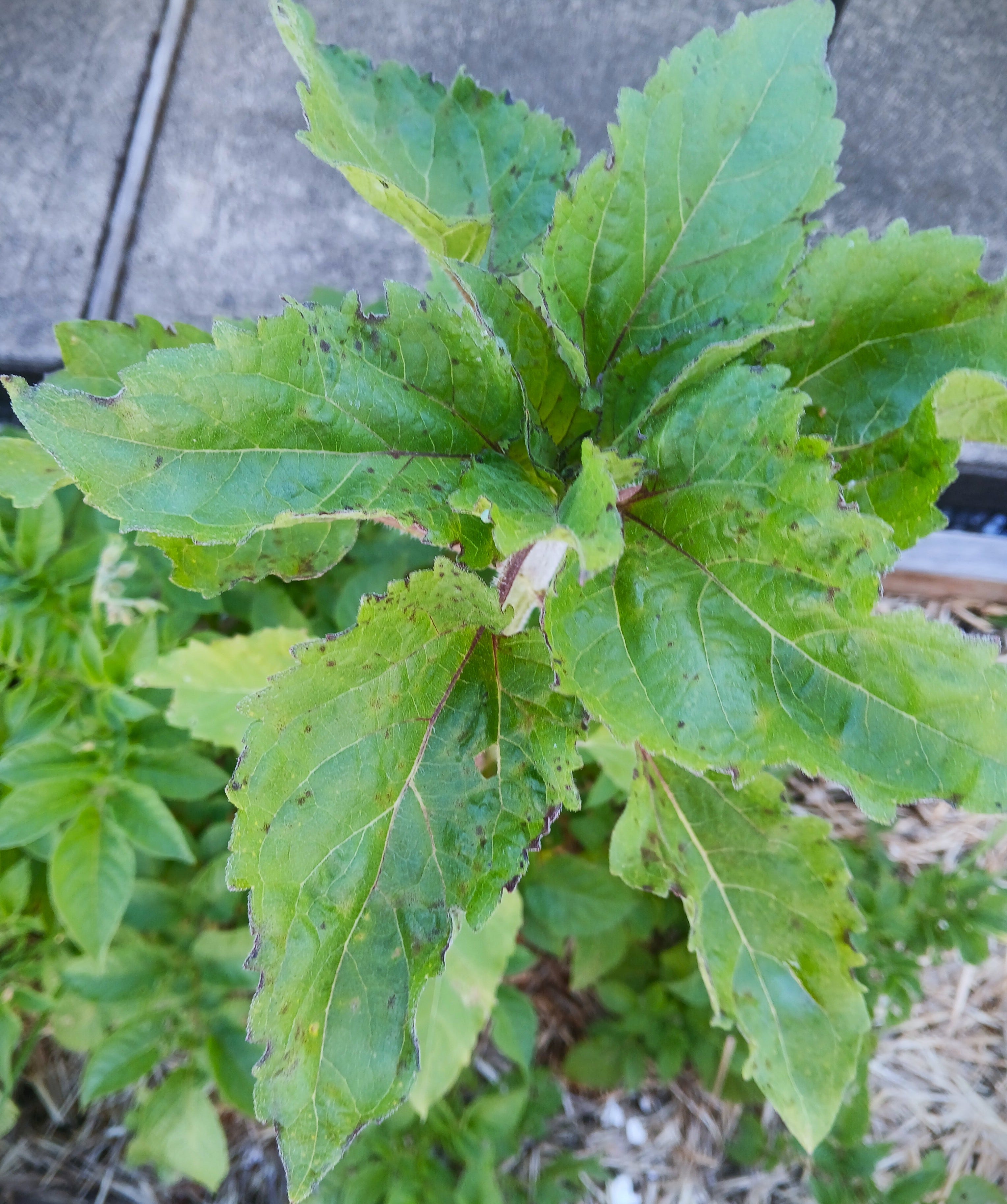
By the way, this sunflower is growing in a bed that has a strawbale garden at one end, and a lasagna garden (where the soil has been layered with organic matter) at the other end. And it is growing right in the spot where these two different soil building practices meet. This connects to the idea of edge habitats in nature. Edge habitats are generally very productive. Think about the edges of forests and meadows for instance. They are great spots to watch for wildlife.
Soil is a habitat too, and different types of soils provide different types of soil habitat. And this particular spot where this particular sunflower is thriving, has lots of edges. It has the edge of the strawbale garden, and the edges where the layers of organic matter and the layers of soil rest on each other in the lasagna garden. Edges are good. You don’t need the soil in your beds to be well mixed and homogeneous.
Pivoting back to garden timing: One other thing that moved me past just making editorial comments under my breath when reading proclamations about garden timing, was one of green dreamer kaméa’s podcasts. Her interview of Ixchel Lunar in the podcast titled ‘Decolonial time and flow as a birthright’ (Ep464), is a very deep, far-reaching, and articulate discussion about time; ways to look at time; how time is viewed and experienced in different cultures; and how certain concepts of time are used (consciously or unconsciously) to steal personal time from people, places, and things.
At about this same time, I happened across a discussion between a number of Substackers, on timing the planting carrots. They didn’t all find the same timing was useful, and some hadn’t found the right time to plant for their area. (My apologies to all concerned, I’m an old fart these days, and I have forgotten the names of the folks who participated in this carrot conversation. But I do appreciate the way it drove me deeper into my thoughts about garden timing. Thank you. :) )
So, this comparison of sunflowers and carrots, the deep conversation about time began mingling with one other thing from Kaméa’s interview of Ixchel Lunar, and that was a deep conversation about flow. My personal writing flow has been somewhat blocked recently. It’s been nearly a month since I was last able to really give myself over to any long form writing, because I had time pressures blocking my flow. But it looks like I am getting a break from those pressures for a little while, and I feel the flow welling back up. Right here, in fact, in this essay on garden timing being hyper-local.
While we explore and experiment with the timing of our plantings, it is important to remember that plants (& seeds, roots, bulbs, starts, and cuttings) carry their old timing with them, when they are moved to new locations. It can take a few years for any plant linage to really understand the light, temp, rainfall, and stewardship cycles in their new home. We need to be as patient with them as we need to be with ourselves.
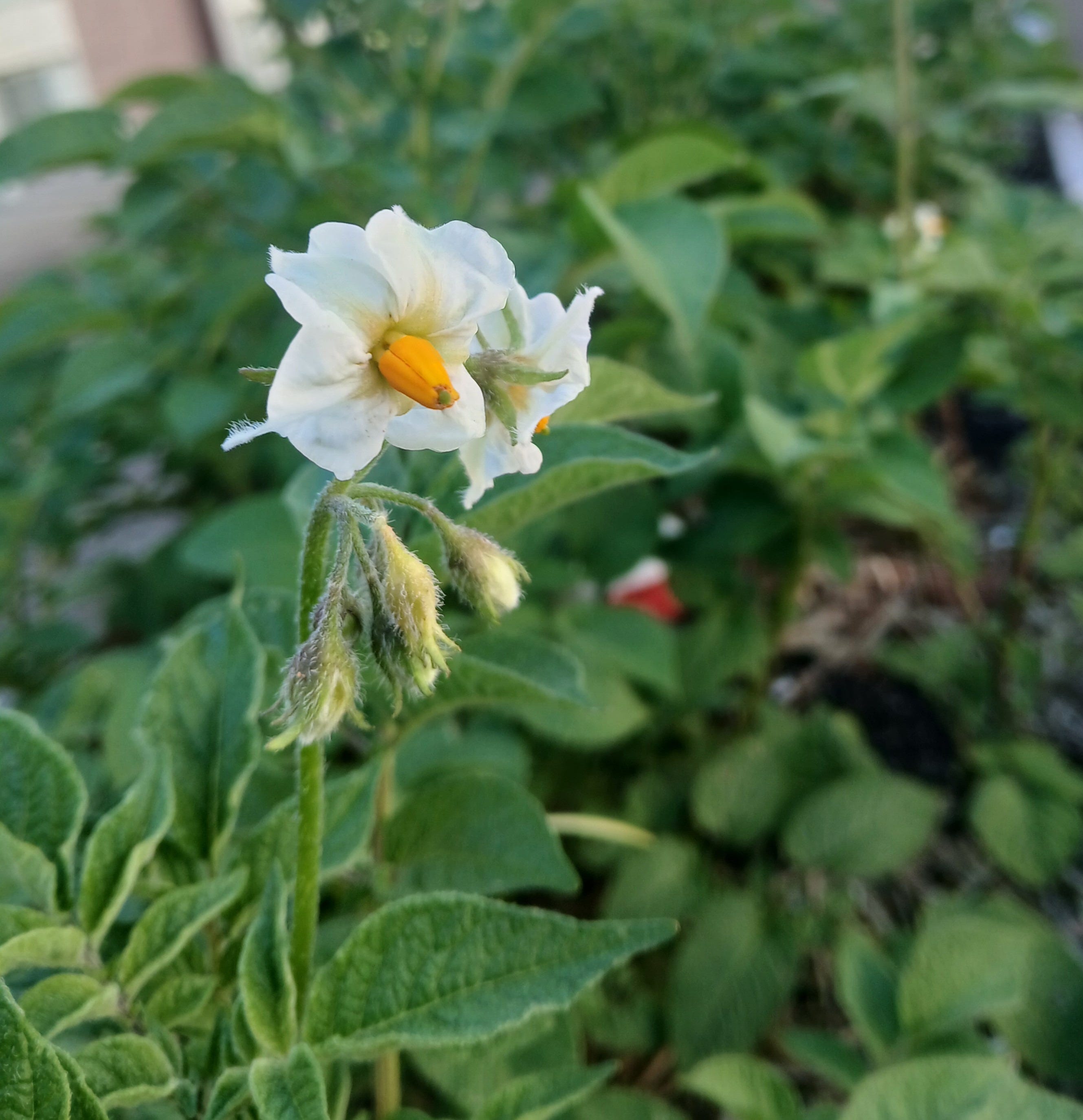
As an example of plants in the process of working out their own timing, I am sharing some photos of potato plants in our little apartment community garden. First, our French fingerling potatoes, who have lived in our garden for several years, are blooming right now. They have had the advantage of experiencing the weather, year around, right in the garden bed for the last few years. They have synchronized their timing to this very particular place they live and the stewardship they receive, and they are very productive.
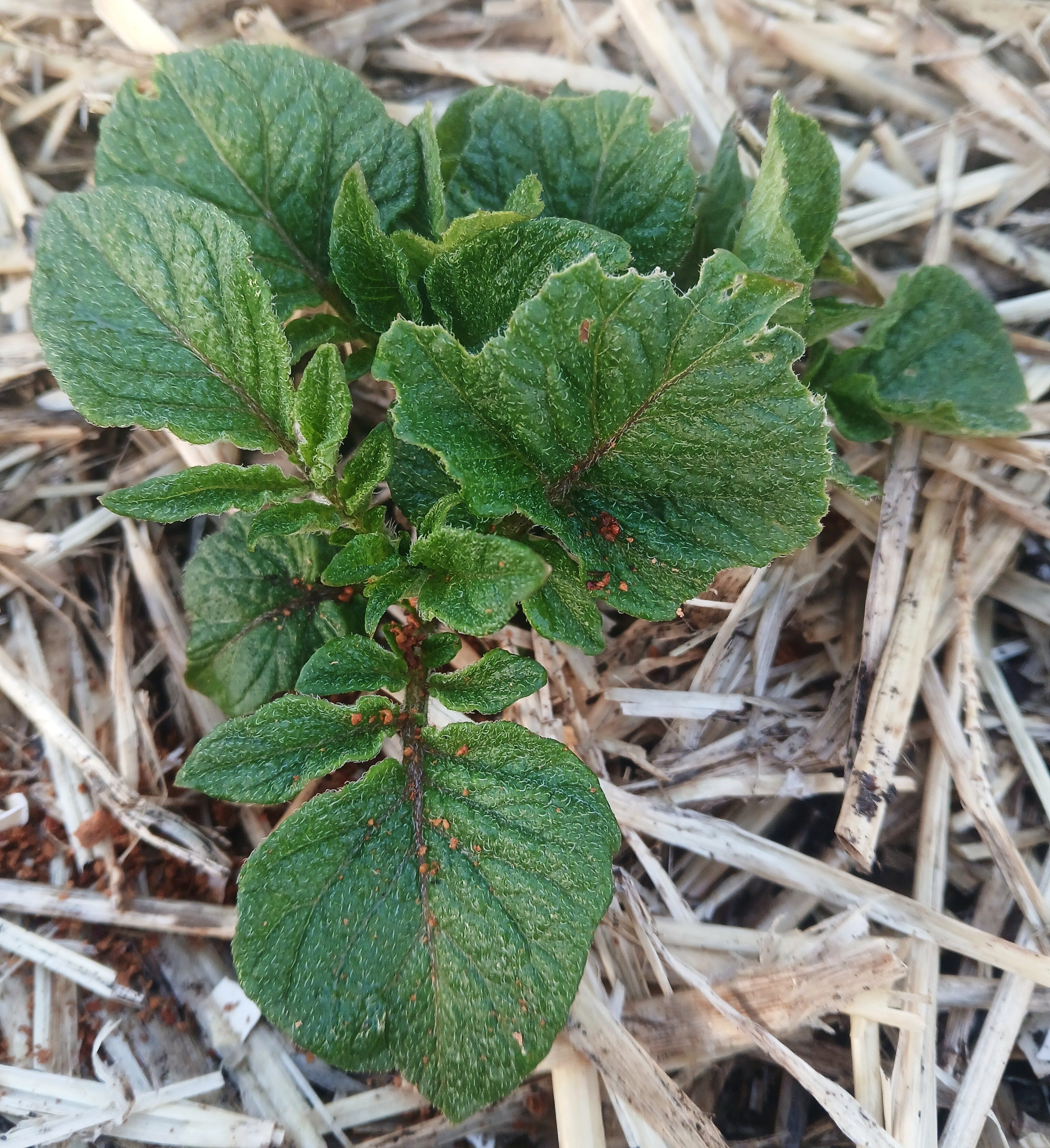
Meanwhile, the red potato plant below was planted in the strawbale garden, a few months ago, after it started sprouting in my fridge. (I first pulled some big handfuls of straw out of the bale, and replaced them with garden soil to make it a nice little nest.) I had actually started thinking that it wasn’t going to grow, and then suddenly it erupted out of the soil. I am not completely sure what took it so long to get started, but I think maybe it’s sense of place had to heal before it could grow. There were two of these sprouting red potatoes in my fridge, and the other one took a couple of more weeks to start growing and is still quite small.
Last but not least, a month or so ago, one of my neighbors and I were discussing potatoes, kind of generally. She mentioned that she had some purple potatoes. I said that if she ever had any that started sprouting, that I would like a couple to plant in the garden. The next day she had two sprouting purple potatoes for me to plant. There is still no sign of growth above ground, but we will be patient.
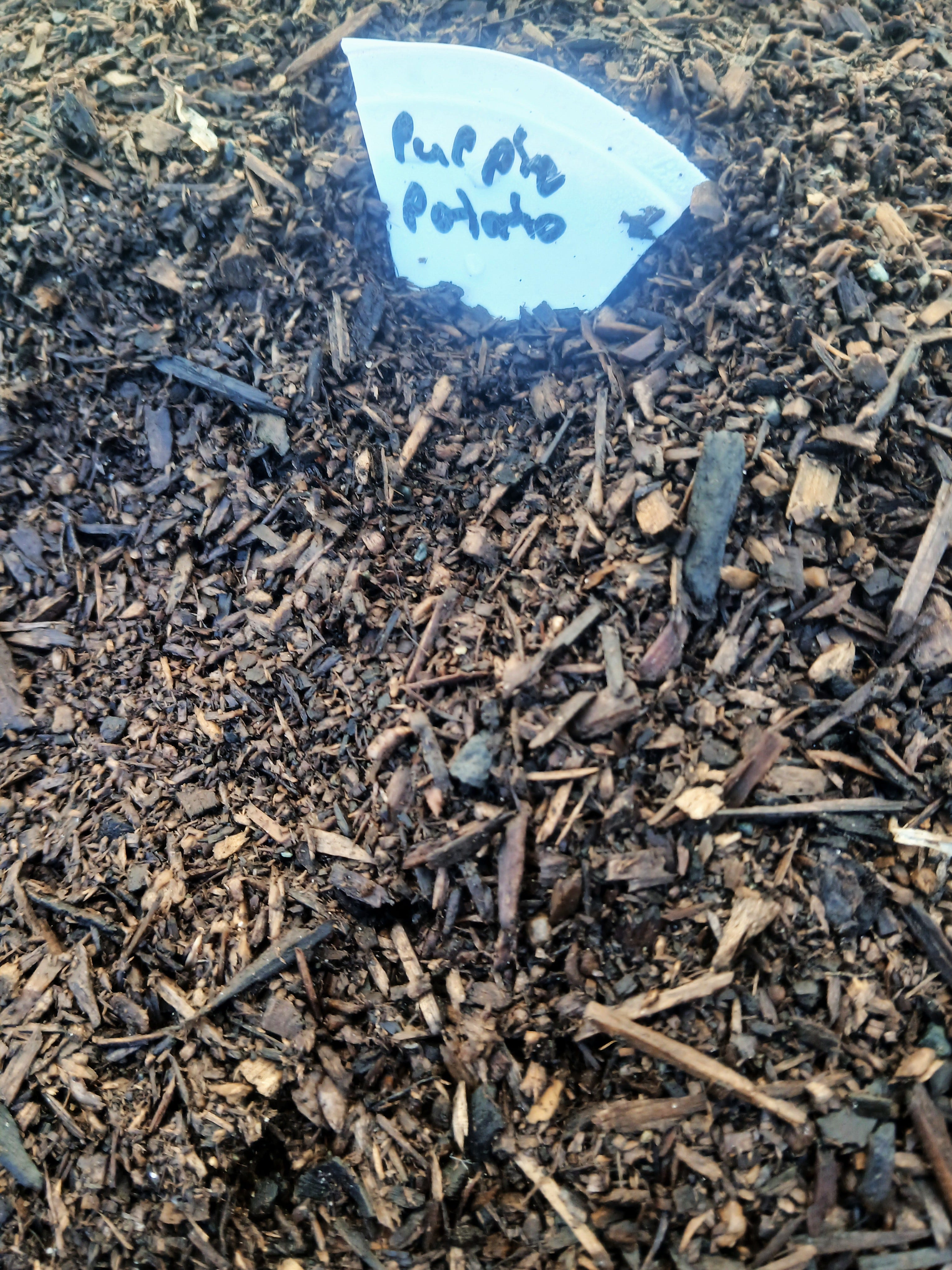
What will be most interesting to see, is how these potato plants time their growth in the future. I am not sure if over time that they will synchronize or not. But up until now their lineages have grown in different places, they have had different experiences, and they all sprouted at different times.
~ ~ ~
That’s all for now, but if you have any unique garden timing stories to share, I, for one, would love to read them. Questions are also welcome. Please feel free to leave a comment.
Thanks for reading! I appreciate all of you, whether you subscribe, follow, or are just stopping by for the first time. If you enjoyed this article, please feel free to share.
For next week, I have a post on Real Food & Brain Health nearly ready to go, and I have a start on the long promised and not yet finished article on Gray Water. So, I will probably be sending one of those through next Sunday, unless something else grabs my passion and takes over my flow. :)
~ ~ ~
If you don’t already receive my Sunday afternoon articles in your email and want to, you can subscribe for free (however, paid subscriptions are certainly welcome).
If you want to access an archived article that is behind a paywall, you can subscribe for $5.00 a month, and then unsubscribe before the end of the month to avoid reoccurring charges.
Substack retains a portion of paid subscriptions, and that is its only source of revenue. Your paid subscription(s) helps support Substack and it also helps support your favorite writers. I love the fact that Substack doesn’t have advertising, and I hope they never have to resort to advertising to make this work for all of us. :)
~ ~ ~
Please feel free to forward, share, restack, excerpt, or quote this or any of my articles or notes, as long as your post automatically includes (or you add) a link back to the original here on Substack. Contact me about any other ways you might want to use my writing, as all other rights are currently reserved.
Text and photos copyright, Harvest McCampbell, 2026.
No posts
Comments
Nothing yet. Say the first thing.
Sign in to join the conversation.