
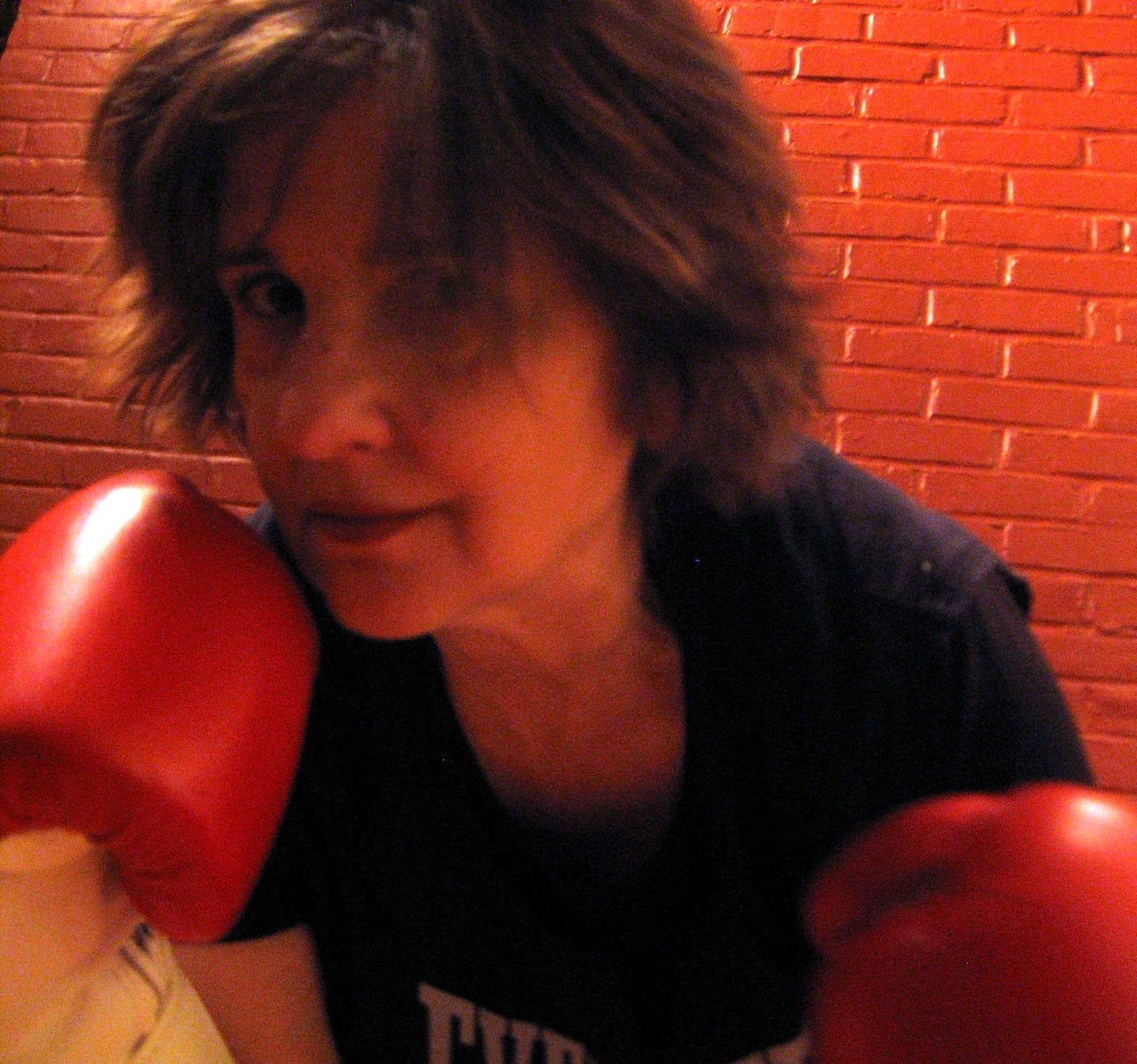
After my boxing lessons, I try to keep a notebook of bits of learning:
The Jab is the introduction, the handshake, the animal sniffing at the new rear-end, the establishing punch.
Stretch out and present yourself with a firm left, pull back, don’t throw wildly. Drive, don’t push.
Your reach shouldn’t exceed your grasp (what is my reach?)
Find your range (what is my range?)
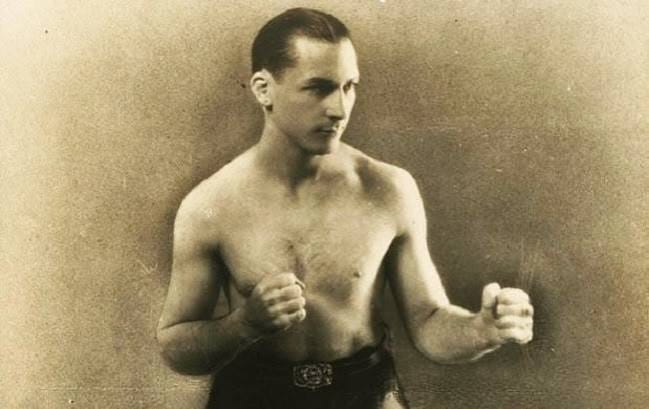
Benny Leonard (1896-1947)
Snap it back.
“C’mon,” my coach John warns, “you’re hitting like a girl!”
I’m not even sure what it means to hit like a girl (or a boy for that matter:I was never athletic. I didn’t know at first why I got involved in the game of hurt, as it is called, but in watching the films with John I always admired the choreography and footwork In boxing, where timing is paramount, and champion Benny Leonard was particularly fast and precise. He was small, so defense was important. As far as the aggression itself, a therapist might assume there is one face you want to render unconscious. John says “with women it is the sense of empowerment, with men it is the bully from the 6th grade.” In one lesson, I had a profound sense of what I came to think of as “collective rage”, as I pounded on the mitts, my mind flooding with images of Nazis and the holocaust. It was visceral.
“What was that?” John says, noticing my intensity.
“Do it again.”
In our four room apartment in Newark, New Jersey, we watched a lot of TV. The television (and we had one of the first in the neighborhood) was like a hearth. Occasionally, the family would go to an actual movie theater. My sister Susan and I were very taken with “West Side Story,” billed as a modern-day Romeo and Juliet. But the gang battles in that film about upcoming “rumbles” between the Sharks and the Jets (we had such fun mimicking the songs as we danced around the living room) were tame compared to the real neighborhood brawls on the Lower East Side of New York City in the late 1800s and early 1900s. The best fighters were those who captured the territory, the turf – or had the goods to back up their claim to being the best. The streets were dangerous; if you couldn’t defend yourself, you couldn’t be out there, and future champion Benny Leonard, being small, was often an object of bullying. Kids fought with anything they could find – baseball bats, rocks, even snowballs packed around chunks of coal.
Benny had a sympathetic uncle who took him to The Silver Heel Club to get some boxing instruction. By eleven years old Benny was the boxer of Eighth Street. He not only liked taking on the bullies he was mensch enough to protect older Jewish women if they were harassed on the way to synagogue. By the time Benny “The Ghetto Wizard” Leonard was fifteen-years-old, he had been knocked around in gang wars, illegal fights, and bootleg brawls. Fighters were hungry. Sometimes payment was simply a hot meal, sometimes a few dollars. At first the Irish were in charge of the power structure in the boxing world, and a distinct rivalry was growing between the Jews and the Irish. Benny fought many Irish fighters before he turned professional at just fifteen years old, in 1911, the year my father was born. His mother Minny was fearful that her son would get hurt, like most of the Jewish mothers of fighting sons. He tried to keep his training from his mother, but when the money came in, there was no doubt: he should keep boxing.
Benny was a lightweight, and like most of the Jewish fighters had a sinewy, muscular body. He was considered a gentlemen, and extremely bright. He fought for humanitarian causes, and a journalist once wrote, “Benny Leonard has done more to conquer anti-Semitism than textbooks.” Benny studied fights like a scholar, developing brilliant footwork and clever defensive strategies. He wasn’t considered the strongest of fighters, but the blows themselves were precise, fast, and well-timed, and that made all the difference.
When World War I broke out, Benny joined the army, like my grandfather Barney. But when Benny returned, he got back in the ring, fought everyone, and made a modest fortune, enough to open some businesses. However, he lost everything in the Depression and at 35 had to try again to fight to make money.
After one of my boxing lessons, when I fantasize meeting Benny Leonard, I picture us at the infamous Stillman’s Gym, what AJ Liebling called “The University of Eighth Avenue.” I don’t know how I get in, because there’s no other women there, but that’s the beauty of fantasy.
Benny walks me up the stairs and starts telling me about how he first came to Stillman’s.
“We were all at Billy Grupp’s, that was the gym where everyone trained, up on 116th Street. But one day, Grupp, he was unpredictable, starts talking about Jews in a derogatory way, well, actually, he was also inebriated, but still he implied that we were the cause of World War I. So I took everyone, I mean I led us right out of there. So we wind up at Stillman’s storefront, first in Harlem, and then eventually the real one, on Eighth Avenue.”
Leonard’s not as handsome or devilish as Barney Ross, but he’s got another head of dark hair that he doesn’t like anyone to muss up, and he’s got this way about him; you feel like you could listen to him forever.
“Right about here, here’s where you’d pay your fifteen cents to the guy with the little glasses, Curley.”
I look up at the tall ceiling and then down again to a row of folding chairs where I can imagine guys sitting, cigars firmly tucked in mouths, occasionally spitting on the floor. There are two raised rings, side by side.
“Who was Stillman exactly?” I ask. We sit down on a couple of the ancient chairs.
“Ah, that’s kind of a mystery. Some say he was a cop once. One thing I know, he was like a piece of sharp metal, and always yelling. No soft side to that fellow.”
The windows look glued shut. Narrow, dented, green metal lockers line the walls.
George Plimpton was a journalist who competed in sports to learn about the games, and boxing was one of them. He was the inventor of “immersion journalism.” Although Plimpton’s trainer begged him to stay out of Stillman’s because he’d probably get some awful disease, he did go there to prepare for his brief experience boxing, and described it this way:
“A dark stairway led up into a gloomy vaultlike room, rather like the hold of an old galleon. One heard the sound before one’s eyes acclimatized: the slap-slap of the ropes being skipped, the thud of leather into the big heavy bags that squeaked from their chains as they swung, the rattle of the speed bags, the muffled sounds of gym shoes on the canvas (there were two rings), the snuffle of the fighters breathing through their noses, and, every three minutes, the sharp clang of the ring bell. The atmosphere was a fetid jungle twilight.”
In other words, Stillman’s was a total dump. The great Angelo Dundee, Muhammed Ali’s trainer, said the windows in the place were “a monument to dirt and grit, never opened and so caked with layer upon layer of filth that even the pigeons had given up trying to look in.” Gene Tunney, the bookish boxer who never quite won the public’s love, said he could not believe the stench: “Let’s clear this place out with some fresh air,” he said. Johnny Dundee, the featherweight champion, reportedly said, “Fresh air? Why, that stuff is likely to kill us!”
“But just two blocks from the Garden, what could be more perfect?” Benny asks rhetorically.
“After sparring, we’d all go down to the bar, the Neutral Corner,” Benny goes on. “Eighth Avenue also had the Ringside Bar. But the Neutral Corner was sweet. You’d find everybody who was anybody there, in the afternoon, siesta time, 3 to 5 pm. Stillman’s was closed during those hours, so you could get a ten-cent beer and listen to the stories.”
“Mr. Leonard, I think you met my friend Steve Acunto there once?” I say.
“Ah, let me see. Small fellow? Wiry? Lightweight? Yes, I recall. I walked into Stillman’s and there he was in the ring. Lou Ambers, great lightweight, real solid jab, was working with him. And I walked right up and said, ‘kid, who taught you that style?’ Because he was boxing like me! And the kid says, ‘I been watching all the films of your fights!’ So I brought him downstairs to Riker’s for a cup of tea and he looked up at me, you know, I was the older fellow, so I held forth for a while and he drank it in. I said it was a rough sport, but there was also a science to it, and that’s the truth. Boxing taught me more than any university. It made a real man out of me. If I had a child and he wished to learn about boxing, I wouldn’t hesitate to introduce him to the finer points. It gave me my life.”
I look around at the two rings in front of us, and imagine all the great fighters that had worked their asses off in them.
“Do. . . you have any questions?” Benny Leonard asks me.
“Yes. I do. There is something. I don’t feel that strong. I mean I feel powerful, but I don’t know if I can ever get my arms to be as strong as a man’s, or other women who are just stronger. Maybe it’s genetic. I don’t know. I use the weight machines, but I don’t know if my right cross is ever going to get more powerful,” I say.
“Listen, my portion of knock-outs is not that impressive. The truth is, I wasn’t so strong myself. But I never made the same mistake twice. I watched everything. I kept my head sharp. Size up your opponent, and develop a strategy, and you’ll do fine. Accuracy, accuracy, and never give up. Someone once said, ‘To rest is to rust.’ Does that help?” Leonard looks at me.
“It will. Just to get a few words from you – I can’t believe it – I read that in the Jewish Daily bulletin they said you were greater than Einstein!”
“Aw, how can that be?” Leonard stares at his shoes.
“Well, the way they figured it, Einstein was known at first in America by only thousands, but millions knew you.”
“The Jewish papers,” Leonard says. “They didn’t know much about prize-fighting, but I guess they appreciated its popularity.”
The stale air in Stillman’s is getting to me, so I say goodbye to Benny Leonard, of whom boxing historian Bert Randolph Sugar, known for his ever-present cigar and fedora, said, “Benny Leonard was like an artichoke—the more you peeled away the more you discovered. Leonard was the nearest thing to a perfect fighter boxing has ever seen.”
In 1947 Benny was working as a referee in St. Nick’s arena in Manhattan. He staggered and fell. At 51, he died of coronary thrombosis.
Leonard competed from 1911 to 1932. He held the world lightweight title from 1917 to 1925, making him the longest-reigning champion in the division’s history.
My coach had lit the flame for me the day he began to teach me about the history of Jewish boxers, and I just kept feeding it.
For the first installment of “I Threw a Punch and It Threw Me into the Past” about me and Barney Ross
go to:
Stay tuned for the next conversation: with Daniel Mendoza! And a peek at my time at Gleason’s Fantasy Boxing Camp in the Catskills.
This series is adapted from my book Blows to the Head: How Boxing Changed My Mind (SUNY Press)
Comments
Nothing yet. Say the first thing.
Sign in to join the conversation.