
“Come on baby, that punch wasn’t sexy – put your hips into it.”
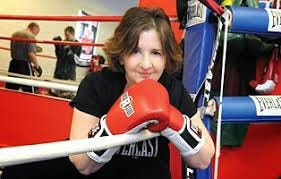
I am learning how to perfect my jab, in an inner-city gym where you can work out for $9.95 a month and then pop next door to the unemployment office to pick up your check.
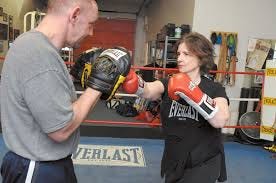
John “The Punisher” Spehar, my coach, is a 200-pound unusual brute, physically a cross between Bruce Willis and Tony Soprano. His hobby is studying the French Revolution. My Venus of Willendorff belly is flopping as I lurch forward and try to make contact with his leather punch mitts, brown cushions around ten inches; up by his shoulder height they make him look like an angry bear coming out of hibernation.
My hobby for the moment -- is boxing.
I’m mesmerized by my coach, perhaps because he is a happier and more vigorous version of my father. On the road as a traveling salesman, with his Oldsmobile’s trunk stuffed with sample cases, Julius Alexander Klein (aka “Jay”) was funny, warm, clever – beloved by the brokers he visited all over his territory – but at home he left the personable “Salesman of the Year” at the door and in came “Sullen-Man,” full of fury at not actualizing his dream of being a journalist and exuding the malignant depression that fell over my mother, my sisters and me like a moldy blanket.
“Jab, one-two. Jab, jab, blow to the body, blow to the head. There ya go,” John is saying to me.
“The Punisher” is teaching me to crouch like a Ninja, slip and weave, keep my hands up, and send force up from my heavy legs into my middle and out through my arms, using my body in ways I never thought possible. It’s a surprise to feel so exhilarated by my own body and its abilities. My body. What a drag it’s been – what a disappointment! Sometimes it just seemed like a necessary over-sized backpack for my brain. My body has been, um . . . sensitive.
I certainly never knew any boxers while growing up. Although my father had been a track star at Thomas Jefferson High, I never even saw him walk fast. My family was aggressively sedentary and my parents, like many of the immigrant families in our Newark neighborhood, just seemed worn out. I considered myself something of a pacifist, and I thought boxing was horrible.
“No one’s got any balls anymore in this nation,” John is saying. “It’s the worst for men – they get babied, and then they just look to be mothered.”
Simplistic but oddly compelling.
By the hour’s end, my sweat smells like a mixture of bitter oranges, aluminum, and old pastry.
“Okay, baby,” John beams. “Not too shabby.” He knows I’m shot. “Now go hobble over to the water and take a break.”
I walk over to the window ledge and encircle a bottle of vitamin water with two giant gloved hands, like a clumsy baby. Water spurts everywhere and dribbles down my chin. John laughs, and tells me not to worry; it’s a dirty sport.
I knew when I took up boxing lessons in middle age, to rehab a broken ankle and fight the slide into invisibility, that although many great authors (Ellison, Mailer, Hemingway, Oates), had been drawn to explore the complex elements of boxing and its characters, people would look at me and say: “YOU?” It’s been described as a mirror of society, a sport for the poor, and many of the stories have a basic, predictable sequence: somebody needs to improve his/her economic status, has enough rage to fight, finds a mentor, and struggles to win. Of course these tropes were not my story. I wanted to get more comfortable with my own aggression, and wound up becoming a bit of a historian. I wrote a book, covered a pro fight, interviewed famous boxing celebrities like Burt Sugar and Angelo Dundee on my WPKN radio show.
One session, thinking about boxing as a sport for early immigrants, I asked John:
“Were there ever any Jewish boxers?”
“Absolutely there were! Al “Bummy Davis, Abe Attell, Barney Ross, “Slapsie” Maxie Rosenbloom. In 1930 there were six Jewish champions. Sometimes they took Irish names. Like Mushy Callahan. Light welterweight – real name was Moische Schneir. And they were all very good, too. If you go way back? Danial Mendoza in Britain. Bare-knuckle boxer—he even wrote a memoir.”
Wow. Hearing these names was disorienting. Although I grew up hearing the names of great boxers (my father loved to watch boxing) – Dempsey, Graciano, Ali, Tyson, Frazier…I hadn’t heard these new ones—the ones who sounded like relatives. Strong tough Jews? Boxers? That had not been the image the culture provided me. Weren’t we the weak, pale scholars?
John had lit the flame. I started studying. Between 1910 and 1940, one third of all boxers were Jewish. At one point, Jews held three titles simultaneously. Proportionately, it was an enormous number, and a direct result of the huge migration of Jews from Europe in the late nineteenth century and through the first three decades of the twentieth century. Escaping their countries, or driven from them, Jews wound up in the poorest and most crowded ghetto neighborhoods in the cities. Penniless, speaking no English, many found they could not walk through the streets of New York wearing a yarmulke without being threatened. Not surprising then to read that the Thesaurus of the Yiddish Language lists 392 synonyms for the word “hit,” which most likely come from being on the receiving end and then learning how to fight back. K’nack, patch, tzetle, zet, diokh, hak, to name a few. I watched films. I read the books. I held Daniel Mendoza’s memoir in my gloved hands at Yale’s Beinecke Library.
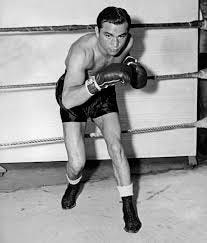
My father was addicted to the racetrack, and knew some shady characters. He and champion Barney Ross both appear in photographs in tilted fedoras, looking dapper, up for anything, and a bit nuts. When Barney Ross wasn’t boxing, he was an unlucky gambler who loved the track.
One training day after John had told me about fighters throwing up in the ring, he told me that when Barney Ross first stepped into Kid Howard’s small gym on the South Side of Chicago, he was a scrawny fifteen-year-old suffering from malnutrition. When they fought, the Jewish boxers often proudly wore the Star of David on their trunks. “My Yiddishe Mama” was played as Barney Ross entered the ring. I left the gym filled with these images and got into my Subaru. Even my eyeballs were sweating. I started the engine, imagining Barney Ross in the passenger seat looking at me. “Where we goin’ baby?” His voice was a little husky.
I look over at Barney -- “Beryl the Terrible,” “One Punch Rasofsky,” Champion of the World in the Lightweight, Junior Welterweight, and Welterweight divisions from 1933 to 1938. He was adorable, if you could say that about a champ. Thick bushy eyebrows, like those on my father in an early photograph taken before the war, as he leaned against a small plane, jaunted in a thick turtle-necked sweater. Barney also had an impish smile, and slicked-back dark wavy hair.
“Barney, I can’t believe it’s really you,” I said, feeling shy and flirty at the same time.
The sun speared through the gap in his top teeth, and he grinned. “So I heard you say your dad liked the ponies. You know how I got into all that? Al Jolson! He took me to Arlington Park, Chicago.”
He pronounced it “Tchi-cawgo” – just the way my dad did, like the sound of a disapproving crow.
“But I could never pick a winner. After a while Mr. Jolson didn’t even want me near him. He said stay away! He didn’t want to get the curse. The bookies liked me, though. How’d your dad do?”
“Not so great, either. Small gains – then he’d blow it on dinner.”
“Aw, my kind of gent! You were a lucky little lady.”
“I suppose,” I murmured, remembering my father’s pushing food away and glowering. I tried to focus on the turn I was making onto the busy Post Road.
“Cmon! Keep your chin up, whatsa madda? You got troubles? Let me tell you a story. When Itchik my father, god rest his soul, came over here, he didn’t have anything…they called him Isidore, more American-like….”
“Barney! Isidore was my grandfather’s name, too!” I said. “I was named after him. If I was a boy, I was going to be called Benny.” Ohmygod, that’s right. It wasn’t just about that actress Binnie Barnes. There was also the other story, the one before that one – if you were a boy… the name Benny came before the name Binnie. They must have wanted a boy, after my two older sisters. They were all set for that, name picked out and everything.
“You see that? We’re like family – and you’re feeling better already, aren’tcha? He took off his white fedora and brushed off a few straw dots of dust. “Benny – that’s a special name you know, because of Benny Leonard. Don’t forget him. He gave us everything.”
I continued to drive and he continued with his story. The greasy smell of Brylcreem permeated my car. I guess Barney didn’t believe in the old slogan “A little dab’ll do ya” – he must have used the whole tube on that helmet of dark hair.
“….like I was sayin’ he had nothing. There was pushcarts. My mother, god rest her, too, was from Poland…”
“My mother, too, a shtetl,” I said.
“….I’m never gonna get this out, am I? Jes’ kidding you, you’re a good egg. But when I was two we got on the train and went to Chicago. My mother’s uncle had a store there. What a scene, the smells and sounds and crowds. We didn’t have much, but I loved the action, you know what I mean? And there was nothing like the taste of the cholont, only on Shabbes of course. My mother’s hands would be raw from peeling the potatoes. But that’s not the thing, the thing I want to tell you. I heard you say about your dad, and the Murder, Inc goons, well I got caught up, too. The thing is, it was action, but it was you know . . .the usual . . .in the neighborhood . . .we were roaming around, unsupervised, so what do ya get? Gangs!” He reached into the pocket of his suitjacket and pulled out a gold-tipped toothpick.
“I roamed around, too, in Newark, but I was just looking for boys,” I said sheepishly.
“Well, with me it was rough. They called us scheenies. I heard it all – ‘kill the dirty little Jew,’ that kind of thing. They wouldn’t let us swim in the pool so we got physical. Then I’d come on home and my father, the rebbe, he’d see the bruises and he would get out the leather cat-o-nine tails….I got beat even worse at home. So you know I stole, I gambled, everything, fights on the streets.”
“I didn’t have anything like that, Barney. So I don’t know why I box, but you …” The traffic on the Post Road was congesting in that sudden way it often did -- cars battling for their turns into Linens ‘n Things, Trader Joe’s, TGIF, and other chain retailers and restaurants. It was hard to stay focused on what Barney was saying. I kept thinking about the names. Benny, Barney, Binnie. Odd.
“Well, I know you’re a psychologist; I thought you might be interested, you know, in what started the boxing really. I had four before me, they all died. Me, I wasn’t so strong either. Asthma. My tate was a Talmud scholar, a rebbe. He started on the lower East Side, but couldn’t make it there. We had family in Chicago, West Side. I lived in a tenement flat on top of a fish market. Barely two rooms. Hundreds of families shared one bathtub, can you imagine? Anyway, my father opens this grocery store, see, across the street. I was to become a Hebrew teacher; that was his dream. I wasn’t that much of a trumbenik until…” He paused, and took a silk handkerchief out of his pants pocket. The letters B & R were monogrammed in deep red.
I knew what was coming. I had read about it.
“First I heard the shot, then my pa yelling. I was fourteen, and they broke into the grocery store, hoods, you know? They took everything from the cash register and then…they shot him… I saw him on the floor, my father. There was blood. They’d killed him. And after that my mother, she…wasn’t the same…they put her in the hospital, I, couldn’t do anything for her. Me and Morrie, my brother, were sent to cousin Henry, and the others, the others, they were…well, the orphanage. I clenched my fists right then and there and made a personal vow to get them out. And you know what? It made me a better fighter. Every time I fought, I pictured it, kicking Pa’s murderers until they screamed in agony.”
“What a senseless, horrible crime,” I said. I reached out to touch his cheek but his hand went up reflexively, and caught mine in a grip.
“Ow!” I recoiled.
“Pardon me, I just, when I remember I’m back there. You meant well. Well, hey, this is no joke today, huh? I just wanted to tell you this. You’re intelligent.”
I wanted to change the subject. “Is it true? About you and Al Capone?”
“That’s a turn! Capone and I, we were close. He knew everything about my life, what happened to my family, everything. Yes, he was ruthless, but with me he was kind. I did some jobs for him, but this is how he was kind, you see, he told me to beat it, he gave me money to leave the mob. He insisted. He didn’t want that life for me.”
I could tell Barney was feeling better after spilling the details of his childhood trauma. He was flicking his toothpick between his thumb and forefinger.
“For a while I gave up all the Jewish things. You know, I’d taught Hebrew. But I just couldn’t anymore; I didn’t think there was a God. I did say Kaddish three times a day, out of respect for Pa. But the next year it was boxing, all the way. I gotta tell ya, though, ma couldn’t know. You know my real name?”
“Beryl, right?” I said tentatively.
“Hey, you’re all right! Beryl Rasofsky. I had to hide it, the boxing from my ma -- I took on Barney Ross. Didn’t go stupid like Mushy Callahan. We couldn’t have our mothers knowing we were fighting.” Ross said.
“Wow. I thought Mushy was adding the Irish name to avoid the anti-Semitism,” I said.
“Nah. I mean not that there wasn’t anti-Semitism. It was his ma. But my ma found out. To her it was horrible. It made me a a bum. But you know, it saved my life, boxing. I wrote something, let me see.” He fumbled in his breastpocket and pulled out a cocktail napkin.
“Here we go: It wasn’t long before I could feel my chest expanding, my hands hardening, my body toughening and my mind growing sharper.”
“That is beautiful. Seriously, I love that. I feel sharper too,” I said.
“Anyway, I got to be going,” Barney smoothed out his hat. “I could talk all day to you, young lady. You’re a good listener. But I gotta head out to Grossinger’s – they got it all decked out for me as a training retreat. You ever been up there? It’s Ferndale, New York. They got everything there. Runyon’s coming up to write it up. They’re all watching me. I’m kind of you know, the center of it all. You oughta come up sometime. I’m real worried, though. I been reading in the papers about problems in Germany for our people. They’re boycotting our businesses. It’s grim, I tell ya. What do you think, Mrs., what do you think is going to happen with this Hitler guy?”
I pulled over to let him out at Jacob Marley’s, thinking he might enjoy a drink. He liked that sort of thing, and wasn’t training just yet.
“I don’t know, Barney.” We looked at each other. The bushy eyebrows were making a less perky shape, and the tough guy looked worried. “Have a great fight!” I called out as he shut the car door.
“Gezinterhayt, Mrs,” he said, walking backwards while he spoke. “Don’t forget Benny. He was a real scientist. I was, what, fourteen when they shot Pa but I remember – it was just a few months after that Benny Leonard fought Lew Tendler – that was July 1923. Anyway, it was a real pleasure talking with ya.”
There he was, “Beryl the Terrible,” studying the menu outside the restaurant, his hands in his pockets, leaning forward and rocking back and forth on his heels. The crease in his white pants was still crisp as if he’d never sat inside the car.
Eleven days before Barney Ross’ fight, at a rally in Madison Square Garden for George Washington’s Birthday, 20,000 people wearing swastikas goose-stepped outside in big black boots. They shouted “Sieg Heil!”
Back at the Grossinger’s camp Beryl Rasofsky read the continuing bad news from Germany and wrote later that it had strengthened his resolve to fight “like I was fighting for all my people.”
Ross became hugely successful as a lightweight boxer, his fights bringing huge crowds, big purses for the time, and an entourage of celebrities. He is sometimes ranked with Hank Greenberg as the most admired Jewish athlete in America. He retired from boxing in 1938 and at age 32, enlisted in the US Army after the Pearl Harbor attack on New York. In the battle of Guadalcanal, Ross sustained serious injuries while rescuing his comrades from a Japanese ambush. He won a silver star for heroism.
Perhaps his greatest contributions ultimately came through political activism. He was a well-known supporter of the Emergency Committee to Save the Jewish People of Europe. He was outspoken – criticizing the allies’ apathy towards the Holocaust, and assisting on a committee to rescue Jews.
The Jewish prizefighters’ legacy often extended outside the ropes of the boxing ring.
Barney may never have gotten over the traumatic losses of his early life, and certainly spent plenty of time trying to self-medicate his pains, both physical and emotional. He did beat his addictions finally. The great 1948 boxing film Body and Soul had been commissioned by actor John Garfield (a boxer himself who starred in the title role) to depict the life of Barney Ross, but Hollywood moguls, worried about the taint of the addictions, disguised the details. You can feel him in the story, though. In another film, in 1957, Monkey on My Back, Cameron Mitchell plays Barney Ross, and it’s all about addiction. Ross reportedly hated the film, and I can understand why – it’s a curiously flat story with none of Ross’ troubled childhood in it. It’s Barney the boxer, then Barney the irrepressibly optimistic and stubborn gambler, then an agonizingly long war sequence, and then Barney the morphine addict.
Barney Ross got a small part in a production of “Requiem for a Heavyweight.” “The Pride of the Ghetto” died in his hometown of Chicago, at the age of 57. His first wife’s name was Pearl Siegel. Siegel. My mother’s maiden name.
Brylcreem lost its popularity in the 1960s, when men began to prefer a drier look for their hair.
THIS PIECE WAS ADAPTED FROM Blows to the Head: How Boxing Changed My Mind (SUNY Press, 2010) by Binnie Klein, available at SUNY PRESS and back order from Amazon.com.
COMING UP!!! Keep reading Open Tuning as Binnie meets Benny Leonard and Daniel Mendoza in subsequent posts!
Comments
Nothing yet. Say the first thing.
Sign in to join the conversation.