
We were promised a revolution. Instead, we got Revit. To understand why construction productivity is still flatlining, we have to look back at the PC revolution of 1987.
In 1987, the economist Robert Solow looked at a world increasingly filled with desktop computers and made a remark that would haunt the tech world for decades: “You can see the computer age everywhere but in the productivity statistics.”
Despite billions of dollars in IT investment, the needle on national productivity wouldn’t move for another 15 years. Economists called it the Productivity Paradox.
If you are a BIM Manager, a VDC Director, or an Architect, this should sound painfully familiar. We have been “doing BIM” for twenty years. Our offices are filled with high-end workstations, cloud-workshared models, and generative design scripts. And yet, if you look at the macro-level productivity of the construction industry, it has remained virtually flat since the 1960s.
We are living through our own Solow Paradox.
In a recent viral article, George Kosmidis compared the current AI hype cycle to the 1987 computer age. But for those of us in the AEC industry, the parallel isn’t just a curiosity: it’s a roadmap. If the history of the PC (and the future of AI) is any indication, we are finally approaching the “breakout” phase for BIM.
But only if we stop using it as a faster typewriter.

1. The “faster typewriter” trap
Kosmidis notes that in the 1980s, the productivity boom didn’t happen because organisations were simply using computers to do old tasks. They used PCs as “faster typewriters.”
In the BIM world, we did the exact same thing. For the first decade of Revit and ArchiCAD adoption, we used 3D modelling software primarily to produce 2D paper drawings. We took a revolutionary data-rich environment and flattened it so it could be printed on a dead tree and stamped by a building official.
This is what industry experts call “Lonely BIM.” The individual (for example the architect) might feel faster, but the aggregate (the project) doesn’t improve. Why? Because the workflow (the sequence of Design-Bid-Build, the adversarial contracts, the silos between the engineer and the sub-contractor) didn’t change.
The Lesson: You don’t get a productivity surge from a new tool. You get it from a new workflow.
2. The 15-year lag
The PC became ubiquitous in 1985, but the productivity payoff didn’t arrive until the late 1990s. Why the gap? Because it took 15 years for the workforce to “age in” and for organisations to stop “digitising old processes” and start “designing digital ones.”
BIM followed a nearly identical script:
The Early 2000s: BIM is a niche tool for “super-users.”
The 2010s: Mandates arrive. Adoption is “everywhere.”
The 2020s: The Solow Paradox remains. We have the data, but we are still fighting over RFIs and change orders.
If the 15-year rule holds, we are currently at the “1994” of BIM. We have the infrastructure, but the true “breakout” (where the data becomes the legal contract and a source of truth for the entire lifecycle) is what happens next.
3. The scorecard: roles fading vs. roles emerging
Kosmidis’ article includes a “Scorecard” for AI, showing fading roles like “Manual Tester” and “Customer Support” against emerging ones like “Prompt Engineer.”
The BIM transition has its own scorecard, and it’s a brutal one for those who refuse to move.
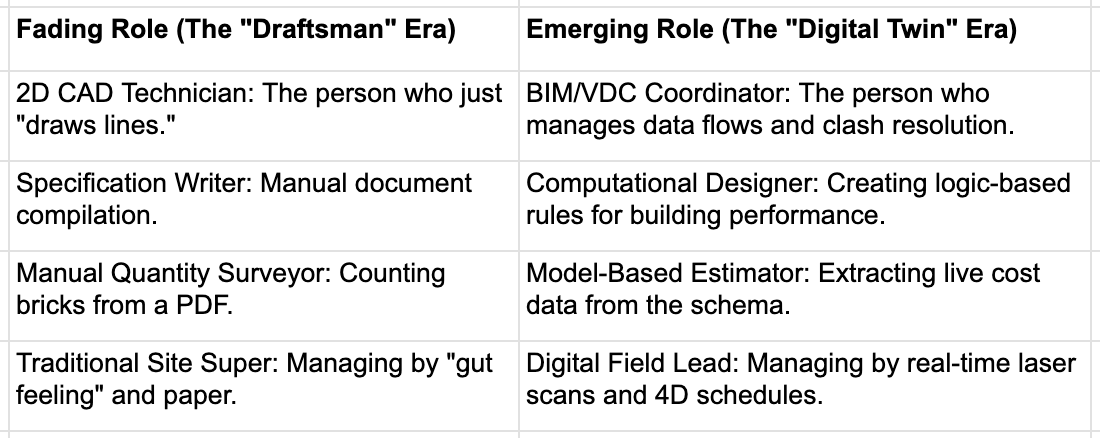
Just as entry-level software jobs are dropping by 20% due to AI, entry-level architectural roles that rely on “production drafting” are disappearing. The market no longer values the ability to draw; it values the ability to manage the data that is the source for many derivatives.
4. Why AI is the “gasoline” on the BIM fire
The Kosmidis article argues that AI adoption in 2025 is following the 1987 PC script. For BIM data, AI isn’t a replacement for BIM; it’s the catalyst that finally resolves the Solow Paradox.
BIM created the data (the “bricks”). AI provides the labor to assemble that data into insights (the “mortar”).
For decades, we’ve complained that BIM takes “too much time” to model. AI is now automating the tedious parts—placing families, routing MEP, checking for code compliance. This moves the BIM professional from being a “Modeler” to an “Editor”.
5. 2026: Your training year
The conclusion of the “Historical Parallel” article is a call to action: Treat 2026 as a training year, not a waiting room.
In the BIM world, the “waiting room” is the firm that is still waiting for the client to ask for BIM. The “training year” is the firm that is currently:
Moving beyond the 3D data into 4D (time) and 5D (cost) integration.
Upskilling their staff in Python or Grasshopper to automate the “faster typewriter” tasks.
Redesigning their contracts (IPD) to allow the productivity of BIM to actually hit the bottom line.
The bottom line
Robert Solow was eventually proven wrong. The computers did show up in the productivity statistics, but only after the people who grew up with them took over the C-suite.
BIM is about to have its “Late 90s” moment. The tools are mature, the data is there, and the AI is ready to process it. The paradox is resolving. The only question is: are you on the right side of the scorecard?
What do you think? Are we finally seeing the “BIM Breakout,” or are we still just using faster typewriters? Let us know in the comments.
Subscribe to BIM Business for weekly deep dives into the intersection of AEC, Data, and Profitability.
Comments
Nothing yet. Say the first thing.
Sign in to join the conversation.