
The future of Building Information Modeling isn’t generic public AI. It’s private, hyper-customised organisational intelligence that protects IP and automates ‘Design DNA’.
For the past few years, the Architecture, Engineering, and Construction (AEC) technology ecosystem has been caught in a frantic, reactionary loop. Every major Building Information Modeling (BIM) software vendor and nimble startup has scrambled to build plugins connecting standard design environments to several Large Language Models (LLMs) and text-to-image diffusers. We have seen endless demonstrations of architects prompting AI to generate beautiful architectural renderings or text-based schedule summaries.
Yet, behind closed doors, industry leaders are frustrated. These public, generic AI models present a massive paradox. An architecture or engineering firm’s primary competitive advantage is its historical data: decades of proprietary Revit families, bespoke detailing, spatial efficiency frameworks, and localised structural logic. Feeding that intellectual property (IP) into public foundational models is legal and strategic corporate suicide. Conversely, generic models lack the specific “Design DNA” and rigorous structural constraints required to build actual, physical infrastructure safely.
To understand why the current approach is failing, we have to look at the philosophical foundation of modern AI. OpenAI has consistently maintained that its Generative Pre-trained Transformers (GPTs) are fundamentally “general systems”. A massive, shared baseline meant to serve as the starting point for developing specific applications. The theory is that one monolithic, all-knowing brain can be lightly customised or prompted to handle any task, from writing poetry to optimising a logistics network.
But while a “general” foundation works spectacularly for summarising documents or drafting emails, the AEC industry cannot safely build its future on a shared public utility. The stakes are too high, the data is too proprietary, and the physics are too unyielding.
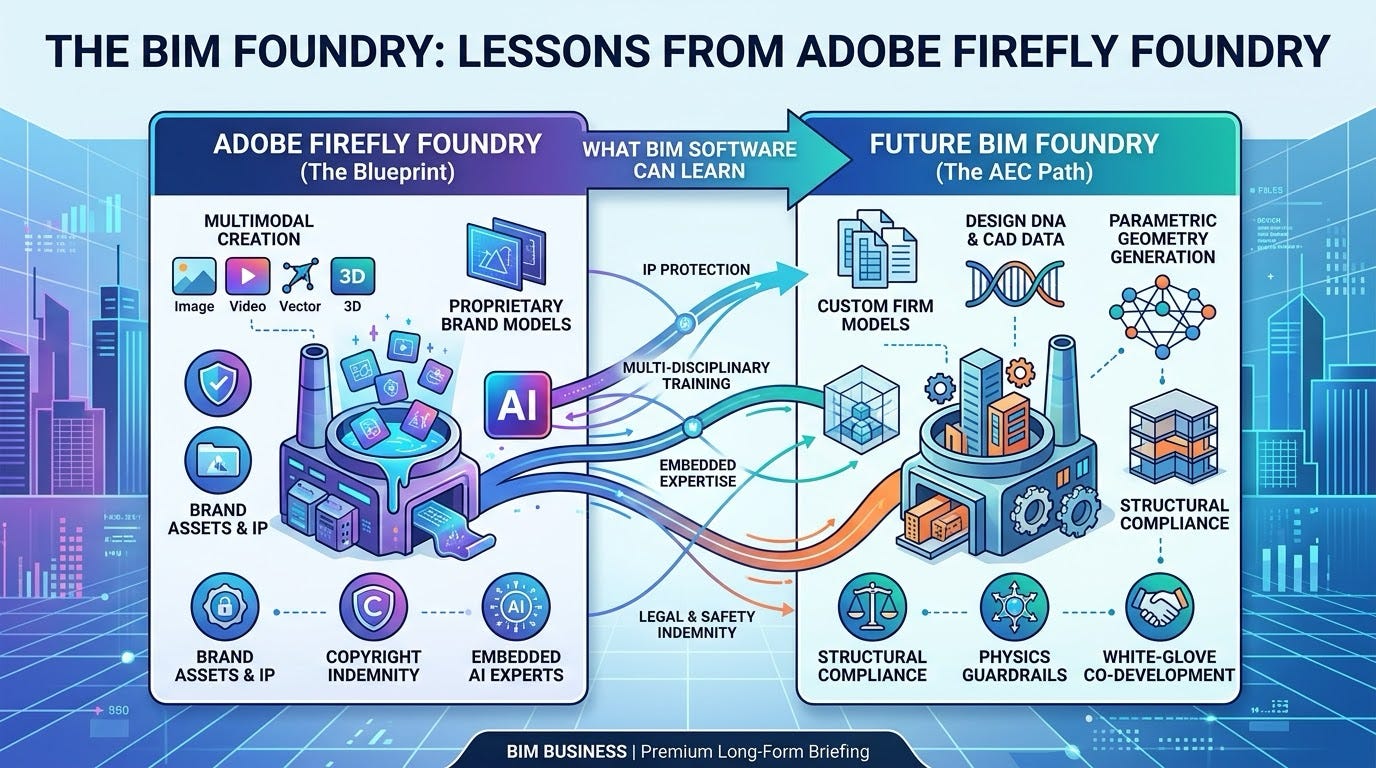
If BIM platforms want to understand how to bridge this chasm, they need to stop looking at tech startups and start looking at an unlikely pioneer: Adobe. Specifically, they need to analyse the strategic blueprint of Adobe Firefly Foundry, which rejects the single “generalist” model in favour of deeply isolated, bespoke corporate intelligence.
The Core Thesis: Adobe Firefly Foundry shifted the AI paradigm from “generic public tools” to “private white-glove enterprise engines.” BIM software companies must replicate this model to move AI from a superficial rendering novelty to a core, structural co-pilot.
Launched as an enterprise-grade solution, Adobe Firefly Foundry represents a profound shift in how corporations interact with generative AI. Instead of forcing enterprises to log into a generic public web application or use baseline APIs, Foundry allows massive brands and entertainment studios to build private, deeply tuned custom models trained securely on their own proprietary assets and creative guidelines.
Crucially, it is not a pure self-serve product or a simple “wrapper” around a general model. Adobe embeds its own applied AI/ML scientists directly into client organisations to co-design, train, and maintain these private models from the ground up. The resulting AI natively understands the brand’s aesthetic across multiple mediums (images, vectors, video, and 3D) while guaranteeing absolute commercial safety and full data ownership.
This is precisely the infrastructure blueprint that the AEC industry desperately needs. Here are the four foundational lessons BIM software companies must learn from Adobe’s strategy.
When an architect uses a standard public AI tool, the output is a mathematical average of the entire internet. It ignores localised construction methods, structural engineering realities, and the firm’s unique stylistic signature. It generates a view of a building (or other asset), not an actual building asset.
A “BIM Foundry” model would flip this. Instead of a general model, a major global design firm (e.g., Gensler or AECOM) would partner with a BIM platform vendor to train a private, isolated model on their vast, historical archive of successful projects. The AI would ingest historical 3D models, component libraries, detailing standards, and past spatial programmatic data.
When a project team prompts the AI to generate layout options for a complex medical office building, the system wouldn’t pull ideas from Pinterest. It would generate mathematically sound, parametric 3D geometry built explicitly around the firm’s proprietary component families, internal efficiency standards, and (maybe most important!) localised compliance histories.
Adobe Foundry’s power lies in its deep, multimodal integration. It doesn’t just do images; it handles vectors, video, sound, and 3D textures seamlessly. It understands how a change in a vector logo propagates across an entire video sequence.
Current BIM AI initiatives are painfully siloed. We see a tool for text-to-rendering, another isolated tool for schedule optimisation, and a third for structural analysis. This ignores the fundamental nature of BIM, which is inherently a multi-disciplinary data matrix.
A true enterprise BIM must be multi-disciplinary. It must understand the reciprocal relationships between geometry, physics, cost, and logistics. If an architect modifies a structural massing boundary via an AI prompt, the underlying network should instantly compute the downstream impacts on HVAC spatial requirements, carbon footprint optimisation, and real-time material quantity takeoffs. The AI must speak the language of unified schemas like IFC (Industry Foundation Classes) natively, rather than just generating superficial visual pixels.
AEC firms are masters of design and engineering, but they are not advanced software engineering houses. They cannot simply take an open-source AI model framework, rent thousands of GPUs, and train an enterprise-grade model independently. Conversely, software companies do not understand the nuanced liabilities of designing a multi-million-dollar stadium or bridge.
Adobe’s breakthrough with Foundry isn’t just the code: it is the delivery model. By embedding their own AI/ML engineers and data scientists directly within enterprise clients, they eliminated the technical barrier to entry. They acted as structural interpreters between the raw technology and the corporate application.
BIM giants like Autodesk, Bentley Systems, and Nemetschek need to pivot from selling static software licenses or raw API keys to offering white-glove AI training services. They must establish dedicated ML engineering units that embed with global AEC firms to clean, structure, and train custom architectural models safely. The software vendor provides the machine learning core; the enterprise firm provides the domain expertise and proprietary data vault.
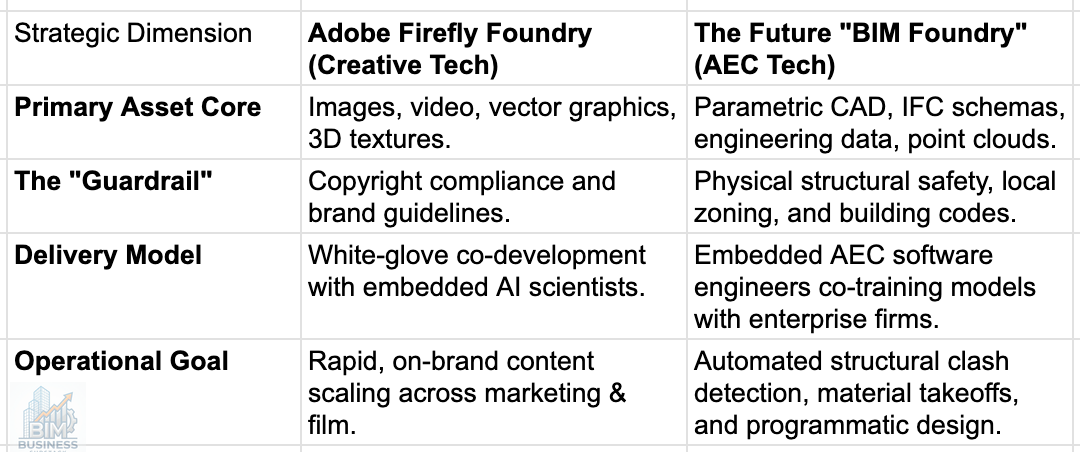
Adobe won the enterprise market by promising complete commercial indemnity. They guaranteed that no Firefly-generated asset would infringe on intellectual property, rendering it immediately legally viable for global marketing campaigns and Hollywood productions.
In the AEC sector, the stakes are exponentially higher. A copyright violation results in a fine; a structural calculation failure results in a catastrophic collapse (with engineers going to jail), immense financial liability, and potential loss of human life. This is why risk-averse engineering firms refuse to trust current generative tools based on general public architectures.
The defining feature of a future enterprise BIM AI must be its structural, physics-based, and legal guardrails. The model must be trained with hardcoded, uncompromisable parameters encompassing local zoning laws, ASHRAE guidelines, and structural physics. The AI shouldn’t just present a design because it “looks beautiful”; it must prove, via embedded analytical validation, that the option is completely compliant and structurally sound before presenting it to a licensed human professional.
Ultimately, the winners of the next decade of AEC technology will be those who execute a fundamental business shift: pivoting from selling static software licenses or raw API keys to offering white-glove AI training services.
Success will belong to platforms that reject the illusion of the public generalist model, embed deeply to unlock an enterprise’s proprietary “Design DNA,” and treat hardcoded physics and legal compliance as the ultimate software features.
By abandoning the race for superficial pixels and adopting the secure, isolated learning approach, the next generation of BIM will successfully transition from generic automation to true structural intelligence; safely turning centuries of collective engineering data into highly protected, competitive, and legally indemnified operations.
Comments
Nothing yet. Say the first thing.
Sign in to join the conversation.