

Yes, like everyone else who shares an interest in the kinds of things we’re interested in, I saw the relatively new trailer for the upcoming Lanterns TV show. While I neither loved nor hated it (my passions for superhero shows having diminished over the past few years), one sequence in the trailer caught my attention enough to consider it worth my time to comment… and maybe even opine.
First, we must back up a few years, to describe what the sensationalists might call the “inciting incident.” During the heyday of DC’s ongoing publication of my Fables comic series, as I often did, I had occasion to visit their offices, when said offices were still located in Manhattan. I was in town to deal with some sort of business involving Fables. As part of our day, Vertigo editors Karen Berger and Shelly Bond were taking me (along with a couple of other Vertigo-related freelancers) out to lunch. As we were headed out the door, a group of DC execs, editors, and maybe a couple of freelancers were just then coming in the door, having gone to lunch (meals out in NYC being the place where real business is often done. Plans are hatched. Schemes are schemed).
In the brief scrum at the door, with folks going out colliding or maneuvering around folks coming in, Geoff Johns, one of the DCU group, recognized me and breathlessly took me aside to quickly explain an epiphany he’d just had. This was years ago, so I paraphrase here (but accurately, I think):
“I finally figured out Hal Jordan,” Geoff said. He was the BIG guy at writing the directing the course of the Green Lantern characters at that time. Also note that this wasn’t a complete “out of the blue” non-sequitur. Knowing Green Lantern was one of my all-time favorites in the DCU while growing up, Geoff and I had enjoyed more than one previous conversation about Hal Jordan and the extended GL gang.
Geoff went on to say, “Not only is he fearless, but he has no hesitation. He’s the kind of guy who’d throw himself off of cliff and then figure out what to do about it on the way down.”
At the time, from context implied by the excited utterance, I assumed Geoff meant Hal Jordan wouldn’t be wearing his power ring at the time. I didn’t have time to ask, because, as I said, we were going out while they were coming in, and I had to catch up to my group, who were hungry while patiently waiting for me. If Hal Jordan had his ring, then throwing himself off of a cliff would involve no jeopardy whatsoever, the ring being the ultimate tool whose top priority was to preserve the wearer’s life. So then, it had to be a case of no ring handy, but he’s still willing to go over the cliff.
In the process of one group coming in, and the other going out, we didn’t get to discuss the details of Geoff’s epiphany. Nor was I able in our short encounter to find a politic way to mention I disagreed with his assessment. It was neither the time nor place.
But the moment stuck with me and I presumed we’d have time later to discuss it more thoroughly. We never did, and seriously, folks, in the grand scheme of things, was it really all that important?
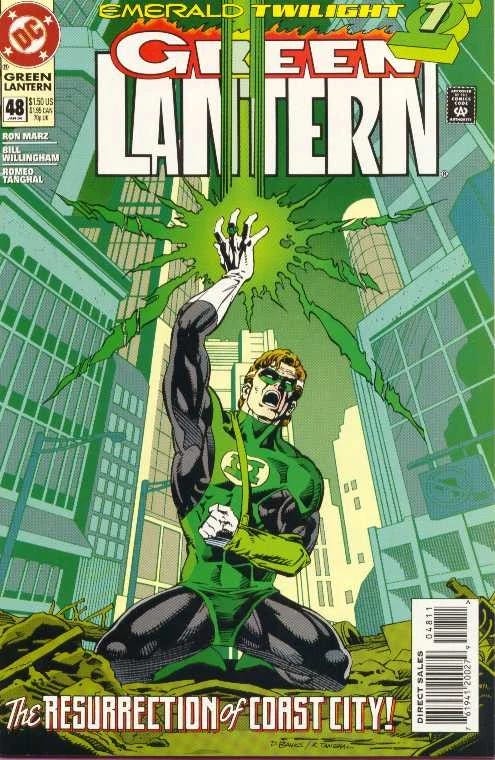
Geoff was driving the big Green Lantern machine back then, and, judging by the overall quality of the books, making many good (and sometimes great) decisions, while I was just a guy on the sidelines who still sort of liked the character(s). By that time Geoff, and the stalwarts with whom he created, had pulled GL out of the dismal dregs of the Emerald Twilight fiasco,1 in which Hal Jordan went totally bonkers and turned evil. Geoff and his gang of talented creators redeemed a great character, for which I remain grateful.
So then, let me be candid that this extended note is not an indictment of Geoff Johns, just because we disagreed on some unimportant aspect of storytelling. It’s not intended that way. Every writer is going to have his own take on a character and story. That’s just the way it is.
Getting back to our subject, now let’s flash forward to today, and the new Lanterns trailer. The more clever among you have already figured out where I’m going.
In the trailer, there’s a scene where a crusty old Hal Jordan, long time veteran of the Green Lantern Corps, is training his apprentice (replacement perhaps?) GL candidate John Stewart. One of the things he does in said training is to send Stewart over a cliff in a speeding car (which Stewart wasn’t driving), to plunge to his death, unless Stewart was able to figure out what to do about it on the way down.
Immediately, on seeing that scene, I wondered if the fanciful incident described so many years ago by Geoff Johns hadn’t made its way to the new show writers, passed down through the misty ages and forgotten generations, until they chose to make use of it in the new TV series.
Ideas are sometimes hardy things, that persist. That’s basically my point, if point I truly have. I warned you it wasn’t anything earthshaking in importance. Just an interesting (to me at least) observation.
Let’s treat all of the above as preamble; an excuse to publicly ruminate over what I might have said to Geoff in that doorway encounter, if I’d had the opportunity (and the time to be properly diplomatic about it). You may rightly ask, “Okay then, Mr. big talking Willingham, if his take on the character was wrong, what’s your take?”
Since you asked…
At a comic convention in Dallas I once had to opportunity to interview Martin Nodell, who was the original creator of Green Lantern. this was during a comic panel, devoted to me interviewing him.
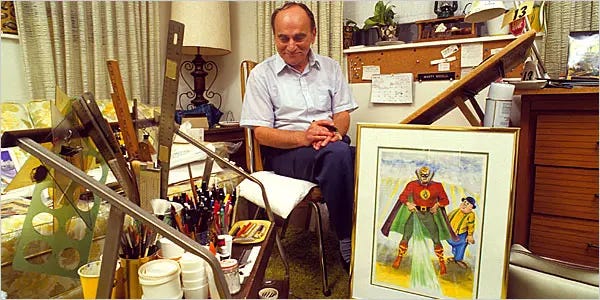
Durning the interview of course I had to ask him how he came up with the idea for the character. Here, as best I can recall,2 is his answer (once again, many years have passed, and I paraphrase):
“I was a young artist looking for work. A friend told me the folks at National Comics (which later became National/Detective Comics, and then DC Comics) were looking for freelancers, so I got on the train into Manhattan and went up to see them. While I was there they told me all about Superman and Batman, and said you need to come up with your own character and pitch it to us. Then they sent me home. On the train home, I was trying to think of an idea. We were paused on the underground tracks because there was construction. They had the lights on in the tunnel and I could see them working. I could also see the red lights up ahead along the tracks, indicating it wasn’t safe to proceed. After a while, one by one, all of the red lights ahead of us turned green, and we were able to continue safely. That’s when I got my idea for a character. When the green light shines, you’re safe. When bystanders are in trouble but then they look up and see the green light, they know then they’re safe.”
That’s it. The idea was simple and elegant (as the best ideas usually are). When the Green Lantern arrives, you’re saved. That was the absolute foundational stone on which to build all the rest. Over the years to come others made changes and added details. Green Lantern was no longer a single individual, but one of an interplanetary order of paladins, space cops wielding the ultimate power. But the additions and changes didn’t alter the basic foundation: When the Green Lanterns arrive, you’re now safe.
But then, they had to change that too. Due largely to the books being put out by the competition over at Marvel Comics, the age of complicated, hard luck, oft-failing heroes was upon us, and some of those over at DC decided to make adjustments in order to catch up with the new way. Green Lantern was no exception. In fact, it could be argued his character was the one (one of the two, actually) who led the way into converting DC’s roster of characters into grim, hard-traveling heroes,3 just like those other guys over at Marvel.
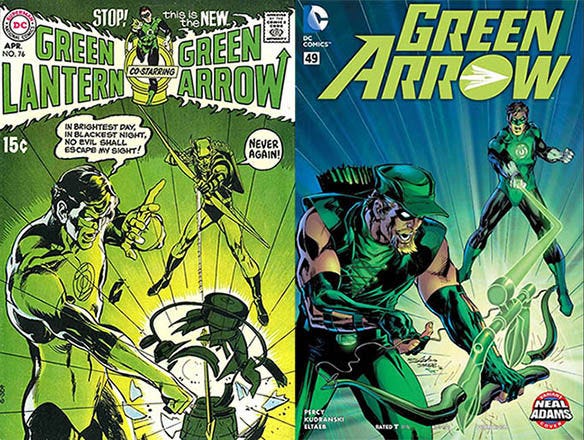
Green Lantern and Green Arrow teamed up in an ongoing series. Its central idea was, Green Lantern is a fuddy-duddy conservative who’s always wrong, while his frenemy Green Arrow is an angry liberal firebrand, who’s always right. Yes, that’s a simplification, but not by much. In order to make the team-up work, Green Lantern had to lose most of his nearly god-like power, so he couldn’t constantly overshadow his pal who had trick arrows. Seriously, they even had a panel where Green Lantern’s green beam petered out before it could reach whatever it was being shot at in the not-too-distant background. Don’t get me wrong, it was an impressive series simply by virtue of the artist Neal Adams’ amazing pages, but the stories, although dressed in the gritty causes of the day, were terrible.4 More to the point of this article, Green Lantern was forever after no longer a guarantee of safety. He was just another hero wannabe screwup.
Later on, since the Neal Adams/Denny O’Neil run established him as an oft-dithering idiot, subject to occasional tantrums, and with a moribund creative and editorial staff, out of ideas on what to do with yet another of their overpowered heroes, it was almost inevitable they’d turn him evil5, so as to finish the job of breaking the character.
You’re digressing too much. Get back to the thing with the cliff. What’s your problem with it, Willingham?
Easy. It’s reckless.
In his early days, Hal Jordan wasn’t a reckless character. In fact, possessed of a weapon that could potentially destroy worlds, he was anything but. As a test pilot, yes he was brave and willing to risk his life in order to test the latest iteration of some fighter jet (so as to find out its dangers before other pilots have to rely on the machine — see? Even then his main motivation was to make others safe). But, contrary to what the movie and TV thrillers would have you believe, test pilots seem to be a careful bunch. Their risks are calculated. They aren’t Mavericks, playing entirely by their own rules, and taking risks on a whim, they’re Ice Men, cold, careful, and calculating.
Hal Jordan was careful. He wielded a power that put lowly nukes to shame and he wasn’t going to let it corrupt him, or take his responsibility lightly.
That’s the core of the character. That’s what makes him tick. Bailing out of a speeding car, headed for a cliff, in order to put your trainee in sudden maximum jeopardy, with nothing but a, “I hope you figure out something on the way down,” in parting isn’t very heroic in my opinion.
And reckless heroes aren’t interesting, much less inspiring.
Which, I confess, I had taken some part in perpetrating, by drawing one of the key Emerald Twilight issues (issue 48, I think, but don’t hold me to that). My excuse is, at the time Kevin Dooley (who was then the GL editor) called me out of the blue to ask how quickly I could draw one of the issues, since the artist who was going to do it (Dooley didn’t say who, and I never asked — as I do have rare moments of tact) dropped the ball. Believe it or not, there was an age, way back when, when I was known as an artist fast enough to be able to come to the rescue in situations like this. I agreed to completely draw the issue over the next four days (I only took three), without asking what the story was. Only when I received the script did I find out it was one of the middle issues involved with ruining one of my favorite characters. But by then I was committed. I did the best art job I could. But yes, it is appropriate to include me in the blame for making Hal Jordan an evil psycho killer.
No, I didn’t think to record the interview, either on video or on tape. Don’t think for a moment Mr. Nodell didn’t politely scold me for the oversight. Mia maxima culpa.
I have no evidence of this, one way or another. In my one meeting with Denny O’Neil (at a breakfast in a really spiffy diner outside of Brandeis University), I never got the chance to ask him, as our young host at the meal wouldn’t let me get a word in edgewise. He was aware of monopolizing the time with Denny O’Neil enough to be somewhat embarrassed about it, and even explained, “This was my one chance in the world to talk to the great Denny O’Neil, and I’m not going to squander a moment of it.” (I don’t suppose I can blame you, host, whose name I can’t recall. Opportunity knocks once, and all that). So then anyway, I have no evidence of it, but I often wonder if the groundbreaking team-up of Green Lantern and Green Arrow didn’t happen simply because someone at the DC offices said out loud, “Hey, they both have ‘Green’ in their name. We should put them in a book together.” I’ve overheard many other, equally feeble, ideas kicked around in the DC and Marvel offices, to know my theory is anything but unlikely.
Granted. It’s only my opinion.
Once the competition over at Marvel gave us the Dark Phoenix saga, turning established heroes evil became all the rage. Sure, it had been done in bits and asides before Dark Phoenix, but that’s the one that stuck hard in the comics-reading psyche. It was important and changed comics in a big way. It seemed every hero at both of the big companies had to go through his turning-evil story arc. Explaining why this was the most short-sighted of trends, ruining many a character for decades, deserves its own article, so we’ll let it go for now.
No posts
Comments
Nothing yet. Say the first thing.
Sign in to join the conversation.