
Hello, Friends of Mavis. Been a long time since I posted here. What follows is a story I came upon while looking for something else. It’s Mavis Gallant adjacent only in that it involves a member of the rogue sorority to which MG’s mother, the gender bending renegade Benedictine Wiseman, belonged. This is for those of you with an appetite for oddity and, sad to say, tragedy.
———————————————
In 1893, members of the Ladies Charitable Society in Cedar Rapids, Iowa, began to press for the hiring of a police matron, someone to bring to the jailhouse a woman’s sensibilities when a tender touch was required. The template for such a position was available in more progressive Davenport where a matron was already engaged. Her duties, executed for a monthly salary of fifty dollars, were outlined in the Cedar Rapids daily paper, the Gazette, on February 1.
She gives all of her time. She lives in apartments at the station, and is within call day and night, with one hour off for dinner. Breakfast and supper she prepares herself and then goes out for dinner. If she wishes to go to church or anywhere outside the building special permission must be obtained from the chief. The east end of the police station is fit it up for her and her prisoners and this part is called ‘The Home of Detention.’ She cares for lost children and small boys who may be under arrest; for penniless women and girls who may be in need of a night’s lodging; women and girls arrested on suspicion, a respectable percentage of whom, are after all, innocent, female vagrants and criminals and insane women pending examination.”
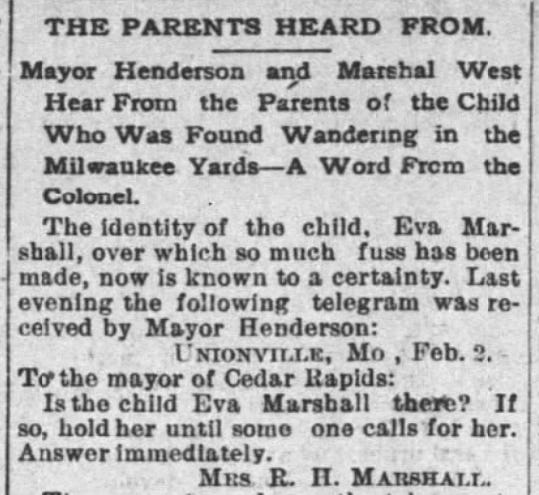
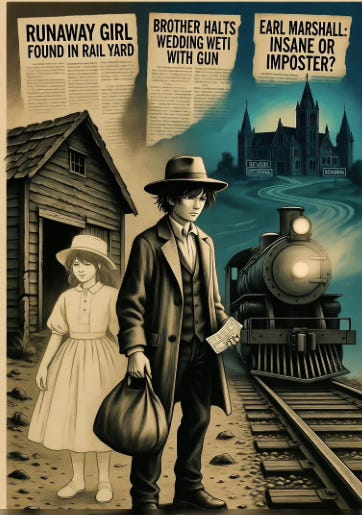
To everything there’s a time and reason, and the charitable ladies of Cedar Rapids, Iowa were in that moment interested in the Davenport example because a girl, a runaway, had been latterly apprehended in the local rail yard. She spent the night in the town jail and then was consigned to the care and keeping of the women of the missionary society, pending further action. She gave her name as Eva Marshall, but she was disinclined to offer any explanation as to how she had washed up in Cedar Rapids, whence she had come, or why she was skulking about at dusk, hoping to hop a freight for anywhere else. Inquiries were made through the usual channels and soon enough a series of letters and telegrams arrived from Unionville, Missouri, 164 as-the-crow-flies miles to the north north-east.
George Roth wrote to say that Eva was the daughter of a coal miner, employed by the Blackbird mine. It was Mr. Roth’s understanding that she had left Unionville with her sisters, bound for Morning Sun, Iowa, the maternal family seat, and the home of their grandmother. When the sisters disembarked, Eva lingered; hence her presence in Cedar Rapids, sixty miles down the line.
Then came a telegram from Mrs. R. H. Marshall, Eva’s mother, addressed to the Mayor, and asking that the child be held until someone could come and retrieve her.
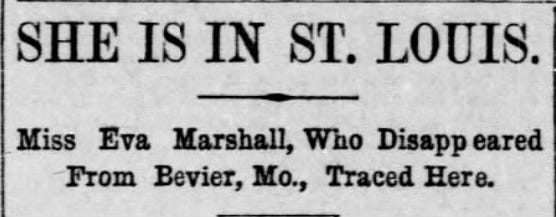
The sheriff, Marshal (not Marshall) West, may or may not have connected the Eva Marshall who was causing such a ruckus in his town with the Eva Marshall who, two years prior, had run away from Bevier, Missouri, forty-five miles from Unionville. The 1891 iteration of Eva Marshall, by cunning subterfuge, had made her way to St. Louis. Then, apparently in the company of a man named James Perry, she got to Decatur, Illinois, and then to Indianapolis, where she tried to beg a train ticket to Louisville; Kentucky, it seems, had always been her destination. Authorities were alerted and Eva ended up in the Home of the Friendless while her family was located and she was repatriated.
With or without this information, and whether or not he had connected the Eva Marshall of 1893 with the Eva Marshall of 1891, Marshal West had cause to believe that this was not the girl’s first runaway rodeo. The better to forestall the incorrigible’s bolting, and to keep her contained until a family member arrived to from Missouri to collect her, he tried to reclaim her from the missionary ladies. They declined to give Eva up. She was ill, they told him, a bad head cold. He replied that she was faking it. The ladies countered that she was better off under their supervision than she would be, an undefended juvenile girl, in a jail cell with no matron to attend to her needs. Marshal West took umbrage at this imputed criticism but the feet of the ladies were put firmly down. They prevailed.
In 1891, Eva’s father, sniffing out the traces of his prodigal daughter, was described as “a highly respected coal miner,” and “a wealthy mine owner.” In 1893, the missionary ladies of Cedar Rapids, Iowa, privy to a different parsing of his character, summed him up as “a father, who enslaved by drink, had dragged his family down with him from the comfortable home, that he, as a lawyer, proved for them, to a hut of a coal miner.” One assumes that Eva, “whose family history is, alas, but repetition of the old story,” was the source of this intelligence.
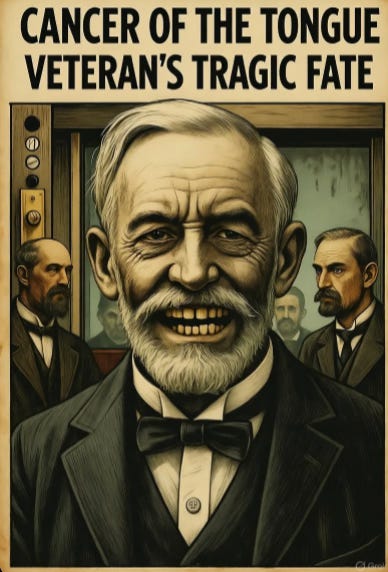
Robert Houston Marshall died in Pomona, California, in 1916. His obituary gave his birth year as 1842. Elsewhere it was reported as 1844. “Colonel R H Marshall” was how he was described in the several appreciative accounts of his life and passing that appeared in the local press. The cause of death was cancer of the tongue, a pathology reported publicly in 1915 as a kind of curiosity, a lighter side of the news story.
A number of dentists ran their practices out of Pomona’s Investment Building. where “Colonel” Marshall — in truth, he never rose above the rank of Private — was employed as the elevator operator. Eight hours a day, five days a week, he ferried them up and down, up and down, engaged in good-natured palaver delivered up with southern charm, making no secret of his toothlessness. The dentists, chatting amongst themselves, decided to do something nice for the garrulous old veteran of the Civil War. True, he’d fought on the Confederate side but, well, after all, many did. As a kind of group project, they took on the manufacture of some false teeth. They worked on the dentures as they had time, each at his own behest, each having eyeballed the oral cavity for which they were intended, but never having looked deeply into it. Because the prosthetics were a surprise, they were made without benefit of measurement or proper fitting and - surprise! - they didn’t properly fit. The Colonel was afraid to offend and kept on wearing them, even though they were uncomfortable, very, and grated against his tongue. A sore developed that, in time, became a malignancy. (So it was reported, I am not equipped to say whether a lesion with an external cause is susceptible to such an evolution.)
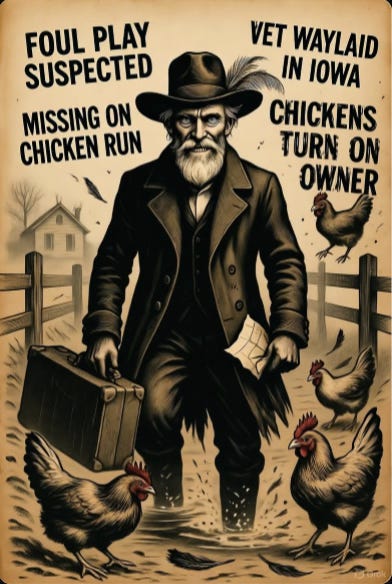
A year before R H Marshall quit the quick and rode the elevator to Heaven, this story was told in the Pomona and Los Angeles papers with a kind of “too many cooks spoil the soup” punchline offered as the moral. When he died, on March 1, 1916, his obituary noted his employment as an elevator man, his membership in the Presbyterian church, his origins in Union County, Kentucky, and his military exploits: wounded at the battle of Chickamauga, saw the surrender of General Lee. Much else was overlooked. His arrests in 1861 and 1863 - for use of seditious language and robbery - were omitted from the final summation, as was his brief time as a school teacher in his hometown of Morganfield, Kentucky; likewise, his failed attempt to start a newspaper there in 1879. His subsequent career as a collier, in Iowa, in Missouri, merited no mention, and nothing was said about how or why he ended up in Casey, Iowa, in 1902, and the four long, windy, nonsensical letters he wrote to the editor during his time there. One wonders if Casey was a kind of self-imposed exile, a consequence of something that happened during his 1901 stint as a traveling salesman for a poultry operation in Ottumwa, Iowa, when he caused his family much concern and confusion by going missing during a chicken buying trip. During his absence of a week or so many rumours circulated: that he had jumped a freight and taken his own life in a refrigerated car, that his was the body discovered behind a rooming house, a body with a head wound much like the one R H Marshall had sustained at Chickamauga. “Foul Play Suspected,” said the headlines, and we can only suppose the pun was intentional, and that the compositor paused to wonder if he should just give in and write “Fowl.” No official public explanation of his truancy was ever offered when, at last, R H Marshall turned up again; it was generally understood that he’d been on a bender. One wonders if his daughter, Eva — see above — came by her AWOL condition naturally. And what of Eva, also not mentioned in the obituary?
Eva was the eldest of the five Marshall daughters. She was born in Morganfield, Kentucky, April 3,1874. Was she someone who, as she matured, looked younger than her years? Her youth and vulnerability, her childishness, were stressed when she turned up in Cedar Rapids in 1893, even though she was of an age when many women, at that time and in that place, would have been well into motherhood. Ten years later, when Eva made her biggest public splash, when she hit the papers big-time, her age was given as “around 20.” Her age was only part of the confusion.
By 1903, the Marshall family had relocated. They left Ottumwa, Iowa, and moved to Kenosha, Wisconsin. (Why Kenosha? Beats me. Why not?) On August 31, in the new Marshall family home, on Pomeroy Avenue, the parlour nicely decorated with palms, Eva’s youngest sister, Nellie, married J W Roberts. John William was also an Iowan, from a farming family nearby Dudley, twelve miles from Ottumwa. Nellie was attended by her sister, Berry and the best man was Berry’s fiance, Louis Beyer. (Fifteen years later Louis would also vanish for a spell, and then resurface.) All was going according to plan. Nellie and J W were about to pledge their eternal troth. Then everything went awry. The story, as told the next day in both the Kenosha and Ottumwa papers, was essentially this.
Just before the happy couple pronounced their “I do’s,” Nellie’s brother Earl burst into the room, waving a revolver. He shot twice, wildly. One bullet passed by the head of the minister, the other nearly grazed the noggin of the patriarch, R H Marshall, whose skull had already been damaged at Chickamauga. Earl ran outside, was seen through the window making a couple of quick circuits around the house. He stuck his head back into the room, inquired if anyone had been damaged, was told they had not. Then he ran off down Pomeroy Avenue and into the gathering dusk. One paper reported that the bride collapsed into the arms of her intended. According to another, she took it all “philosophically.” The ceremony was successfully concluded, despite the dampened mood. The union endured. J W died in 1948, Nellie in 1964.
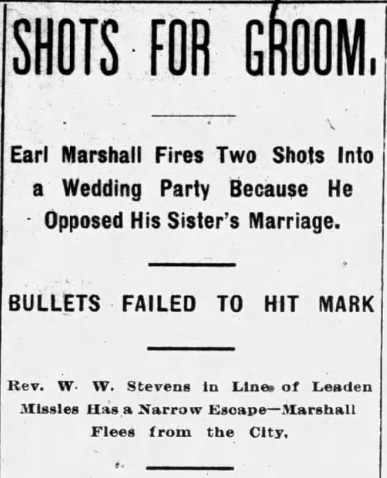
The Marshalls were recent transplants, strangers in Kenosha, not well known, and their new neighbours would not have been as surprised as were the Ottumwans back in Iowa at this news of Earl. Earl? Who on earth was Earl? The Marshall children were all girls, as everyone knew. Then, a day or two later, a letter signed by Berry appeared in the Ottumwa paper. Berry explained that the pistol was not brandished by their brother Earl, as had been reported, but by their sister, Eva, in masculine attire, and whose name had been given out as Earl by their mother, the better to soften whatever consequences might come Eva’s way owing to this rash action. Earl, said Berry, was a fiction. There was no Earl. There was only Eva. But then, it was reported — and by this time newspapers all over the country were covering the case — that the letter ostensibly written by Berry had been written by Eva who had masqueraded as Earl. Another bizarre twist was the news that Eva had been misidentified as a girl at birth, that her parents were only made aware of the error when, at some uncertain point, Eva was sent away to the Iowa Lunatic Asylum at Mount Pleasant and there the error of that assignment was detected. Male clothing was requested from the family. A name change was required. Earl was born. Eva was no more. It is Eva who appears in every census and directory up until 1901. Only then does Earl appear.
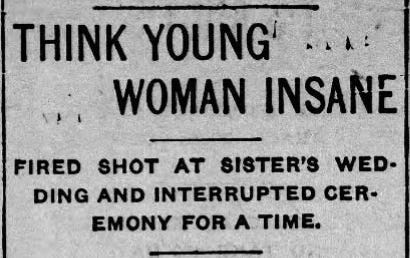
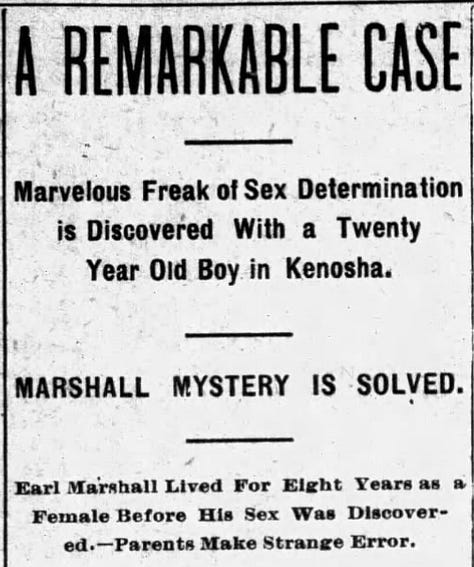
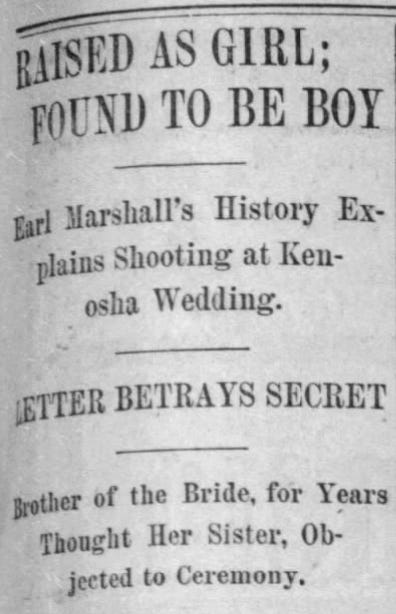
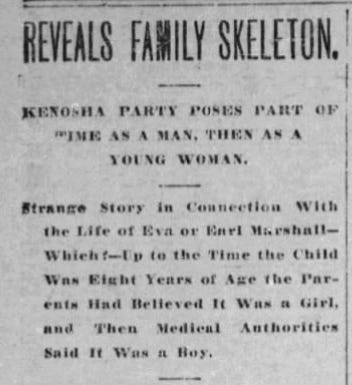
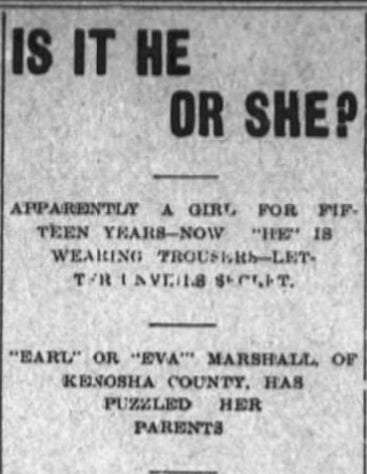
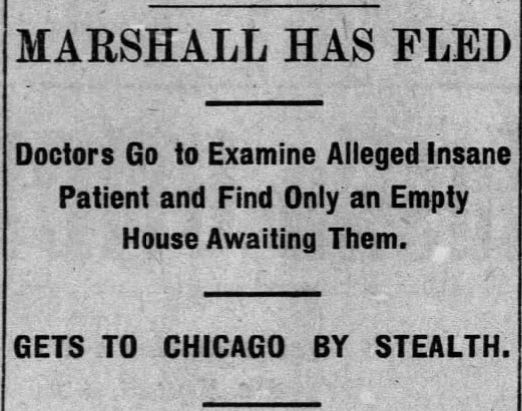
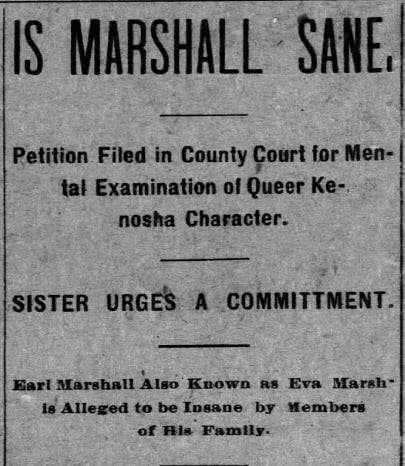
That Eva / Earl was intersex seems a certainty. Also certain is that she must have felt she’d lost touch with gravity. What could be less surprising than the newly minted Earl, who had lived as Eva without “detection” for, it would seem, the better part of a quarter century, going off the deep end when abstracted from an identity in which (s)he was secure? Shortly after the shooting episode, there was another process of committal. It was tricky because Earl, intuiting what would happen, flew the coop and had to be retrieved from Chicago by his new brother-in-law, to whom Earl was said to be unwholesomely attracted, hence his ire on the wedding day. Earl was sent to the Northern Hospital for the Insane, was a resident there in 1905. In that same year, adjudged cured, Earl was released. By then, the Marshall family had decamped for St. Louis. Earl joined them - perhaps not at their invitation - and cracked up again. Earl was admitted to a Missouri asylum but when it was discovered that he was an alumnus of Northern, in Oshkosh, a Wisconsin sheriff was summoned and Earl was sent back. The last trace I can find - uncertain but likely - is a 1910 census listing for one Earl Marshall, resident in Wisconsin’s Walworth County Insane Asylum and Poor House. That was the year the Marshalls moved to California, and R H began to work as an elevator man. I wish I could tell you what happened to Eva / Earl, though the chances of a happy ending are, I think, remote. I so wish I knew. And I’m just as glad I don’t.
No posts
Comments
Nothing yet. Say the first thing.
Sign in to join the conversation.