
Here we are once again, coming up on Remembrance Day. One could argue, if one thought there was any need or that it would do any good, that it was the Second World War that shaped Mavis Gallant (MG); that made her the person and writer she became. The same could be said, of course, for and about many of her generation, both those who saw active service (mostly men, including her husband, John Gallant) and those, like MG, whose lives were shaped first by their absence and then their return.
Women worked in journalism before all the able-bodied men were sent off to the front. MG was persuaded she was engaged by the Montreal Standard via the same human resources imperative that saw women hired as, say, riveters. Maybe that was so, but she was so conspicuously talented, also determined, that I think there’s every chance she might have been taken on even were the circumstances not what they were; that she would have been given her position as a features writer despite the conspicuous disadvantage of her youth and sex, and without the leg-up of the war-mandated vacancies. That is speculative, but it can more certainly be said that the war, in its duration and in its global aftermath of disruption, displacement, and repair, was grist for her mill, and one of her enduring, informing themes.
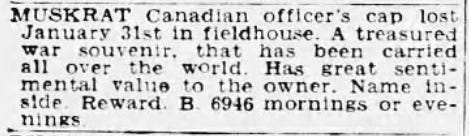
I am a simple person, spottily educated in institutions of middling reputation, and I’ve always been someone who tries to get under the rock of what is major by focusing on the minor. About war, its cause and effect, no one would care to read whatever I might think or write; likewise, peace. I cover the waterfront of the oblique, the inconsequential, and what follows came out of some sketchy research I undertook into a shambolic California family who came to my attention when I was collecting examples of one of war’s more trivial outcomes, i.e. newspaper lost and found ads placed between 1919 and 1925 by those seeking missing war souvenirs. You’ll understand better if you read what follows. And if I had to recommend one MG story to read on Remembrance Day, it would be “Ernst in Civilian Clothes,” (1963).
This little essay is called “Let Everything Go Until Jack Comes Home.”
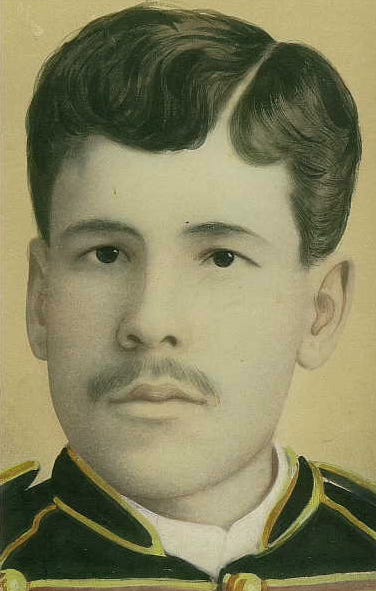
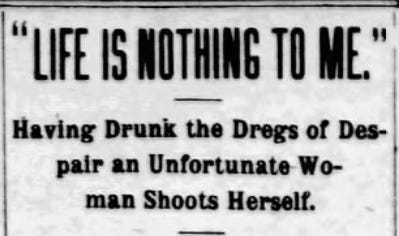
In 1903, towards the end of February, a 33-year old miner turned solider of fortune named Juan Maltos - American, born to Mexican parents, and known to all as Jack - shipped out to Honduras and fought on behalf of profit-minded American fruit companies in the so-called “Banana Wars.” His second wife, whom he’d married in Reno in 1901 - after a ten year alliance with Juanita, the mother of his two children - was to have followed. She didn’t. “Despondency” was the reason given by the coroner to explain why the second Mrs. Maltos, who had seemed cheerful at lunch, shot herself in the heart instead of getting on the southbound steamer. Also, she’d been drinking.
Her name was Winnifred - known as Winnie - but at some point in the short time between Jack’s departure and her demise she had started calling herself Pearl Ashton and had taken up residence in a house of ill fame in Napa, No. 4 Stewart Street. (The name changed in 1907 to Curtis Street.)
Winnie / Pearl, before she went to Reno with Juan / Jack, had worked as a waitress, and it was in this capacity, in 1896, that she met and married her first husband, a waiter, Scott Munson, recently arrived from Michigan. In the still early days of their marriage, in a fit of pique brought on by jealousy, to which he was susceptible, Scott made a half-hearted attempt to slash his throat. He did this in front of Winnie, locking her in their room and forcing her to watch as he cut, then fell - theatrically, as the papers said - before her, at her feet. Her screams brought help, and Scott’s wound was closed with eight stitches, applied by a local doctor while four men held him down.
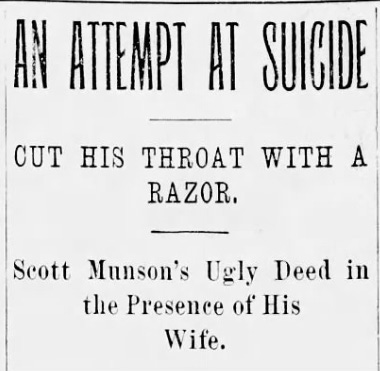
His failed dalliance with self-harm, and his penchant for histrionic gestures expedited by drink, were lavishly mocked the next day in papers up and down the west coast, as far north as Portland, which was where Scott Munson died, of cancer, at Christmas, age 70, in 1930. He’d stayed in the hospitality game, and was, at hour of his demise, the owner of the Tillicum Restaurant.
Winnie / Pearl was more determined than Scott had been. The gun she used, according to the Napa Journal, was a “cheap American bulldog,” the Iver Johnson Safety Automatic .38 - caliber snub-nose variety that would have been usual at the time. The powder burns showed that Winnie / Pearl had used both hands to hold it steady. The gun, it was reported, was the property of another brothel denizen, Ada Montrose. It was to Ada that Winnie / Pearl wrote her explanatory final note.
Ada: Life is nothing to me, and you as good as told me business wasn’t good while I was here. I am tired of life, so here goes. Ada, don’t tell my folks about it. Let everything go until Jack comes home. Pearl.
Her folks lived in Los Gatos, where her remains were shipped and Winnie / Pearl was buried. The local papers were more discreet than those in Napa, confining their remarks to the unadorned and unfortunate fact of her passing.
Before Winnie / Pearl was a Munson, she was a Eubanks, the first of eleven children born to William and Mary, ten of whom survived into adulthood. It was a family of varied and shifting fortunes. A few months after Winnie died her brother, Bob, won third prize (a toiletry set) in a “guess the number of candies in the jar” contest sponsored by a local drug store; there were 550 pieces and he had estimated 547. It’s possible that sweet moment flashed before Bob’s eyes in 1912 when, working as a lineman, he fell against some wires and was electrocuted. His mother, Mary, sued the power company for 50,000 dollars - about 1.5 million today - but the case seems not to have made it to trial. In 1914, Mary’s life took a lucky turn when she won a coffee percolator and a five-seat Detroiter town car in a subscription contest sponsored by the Oakland Tribune. Perhaps this provided her with all the satisfaction she required to ride out the rest of her life, which ended the next year, in the San Jose home of her son, Bert, a prosperous furniture merchant who would not take his own life until 1966 (sleeping pills), by which time he was into his 80’s.
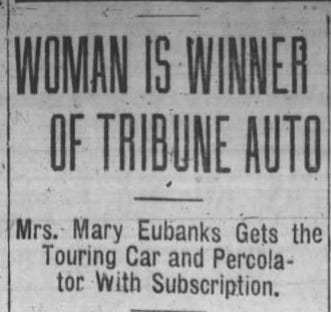
Bert had done well for himself, and so had Mary’s daughter, Marie, who, a few months after Winnie / Pearl’s suicide in 1903, and a few months prior to Bob’s close-but-not-close-enoug candy jar guess, married Martin I. Welsh, an up-and-coming attorney who, in time, became the mayor of Sacramento, and then a Federal District Court judge. The high social standing enjoyed (as one imagines) by these gentlemen was a boon for the youngest child of the family, Russell Sage Eubanks, born in 1890, who had a hard time adhering to the straight and narrow. It must have worried mother Mary (also sister Marie) that, in 1912, the year of Bob’s electrocution, young Russell, just 22 and having followed his suddenly late brother into the lineman fraternity, was just a minor error or slip of attention away from getting fried. Nor could his off-hour extracurriculars have brought them anything like comfort or reassurance. The episode described below took place just a few weeks before Bob met his maker via high voltage.
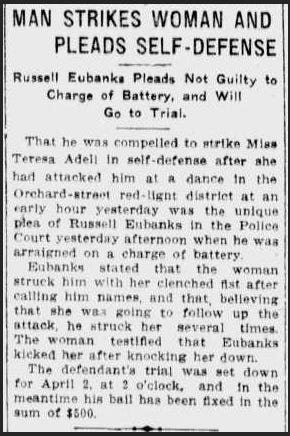
This was just one of the many collisions that came young Russell’s way from operating on the wrong side of the law. He was always being hauled into court on robbery charges, or else he’d be picked up by the police and charged with vagrancy after disappearing and keeping company with hoboes. Many were the compounding misdemeanours, some minor, some not, that required his brother and brother-in-law to bail him out and swear to judges and probation officers that they would find a way to get young Russell to straighten up and fly right.
It must have been almost a relief to them when America entered the First World War and the reprobate joined up and was shipped off to Europe, just a few months shy of the end of hostilities. If anyone was going to get himself wounded just hours before it all came to an end it would have been Russell and he did indeed come to lat minute harm in the Meuse-Argonne Offensive. He survived, was repatriated, and returned to California where, in fairly short order, he again ran afoul of the law and was sentenced to 120 days in jail after he partnered up with a woman with whom he tried to extort money from unsuspecting sailors in a so-called “badger game,” and then was arrested again for taking part in an illegal craps game in an alley, and was coming to the end of a six-month sentence in the San Francisco county jail when he died of a head injury sustained when he collided with a concrete banister while playing a game called, as it was reported, “Hide the Whip.” What was “Hide the Whip?” I have no idea. I suspect there’s an error in the telling and that it might have been a high-spirited, jail yard version of “Crack the Whip” that saw poor Russell fall down and break his crown. He was 32.
The only reason I know about Russell Eubanks and his odd career and sad outcome and his high maintenance family is because, with Remembrance Day approaching, I became interested in Lost and Found ads where the searched-for object was a war souvenir; I happened upon one of these while looking for something else, and it made me wonder. It was the First World War that was my particular concern for reasons that are murky even to me.
In the main, this proved a disappointing line of inquiry. I think I was expecting a greater preponderance of the sinister. Now and again, someone would be searching for a dagger with a rust-coloured handle and German writing on the blade, but mostly the items hauled back from Europe were wallets, or field glasses, or bracelets and pendants made from foreign coins. Someone lost a folding camp cot. someone else was missing a walking stick. It was all a bit ho-hum. I was, however, intrigued to read in the Chicago Tribune, December 13, 1920, an ad for a lost Scotch terrier, brindle, black face, described as a “war souvenir from France.” It’s here:

I was vaguely aware of a whole subset of war literature, fiction and non, about the roles, often heroic, played by animals - dogs and horses in particular, also pigeons - in trench warfare. Sometimes the creatures accompanied the invading armies to the battlefields, sometimes they were local strays that saw an opportunity for employment and enlisted in their doggy way and went on to careers of greater or lesser distinction, killing rats, pulling soldiers out of harm’s way, and providing gentle distraction. When I broadened my inquiry beyond the lost and found ads, I found many stories about servicemen who adopted dogs they encountered in France, Germany, Belgium, and then, when hostilities ceased, brought them home, sometimes through devious means. Trembler, Olive, Sport, Metz were some of the many who went on to lead American lives. These were not creatures about whom books were written; they were of momentary interest, page 8 fillers, and that was the case with the dog that accompanied home the wounded Russell Eubanks. This was published in the Sacramento Bee, May 26, 1919.
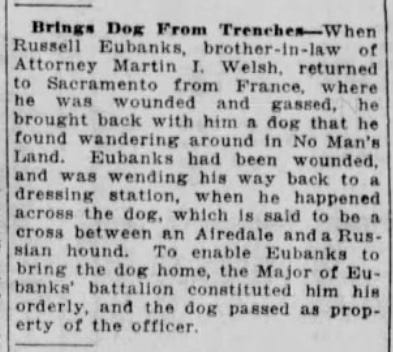
What became of the Russell’s best friend, whose name we are never told? I can’t imagine that Russell was able to take him in and out of the jail cells to which he was so often confined. Maybe the dog wound up in the care and keeping of his sister, Marie, who would go on to become First Lady of Sacramento, and to become the mother of a bevy of daughters, most of whom followed their father (d.1951) into the law. She died in 1962.
Lest we forget, every family has them, the Russells of the world, the ones who just can’t, won’t or don’t fit in, and who can be counted on only to test the limits of affection and loyalty. As Mary had Russell, and also Winnie, MG had her Uncle Nicholas, the bigamist shoe salesman who masqueraded as a French count and caused all kinds of misery and, no doubt, embarrassment to the family. All one can do is make as many accommodations as one can, and reply civilly when the police come knocking.
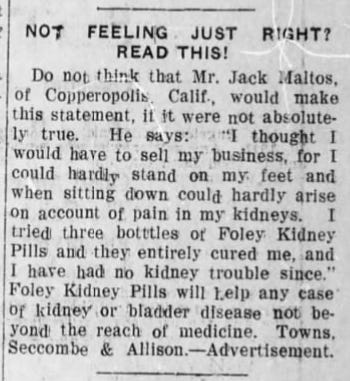
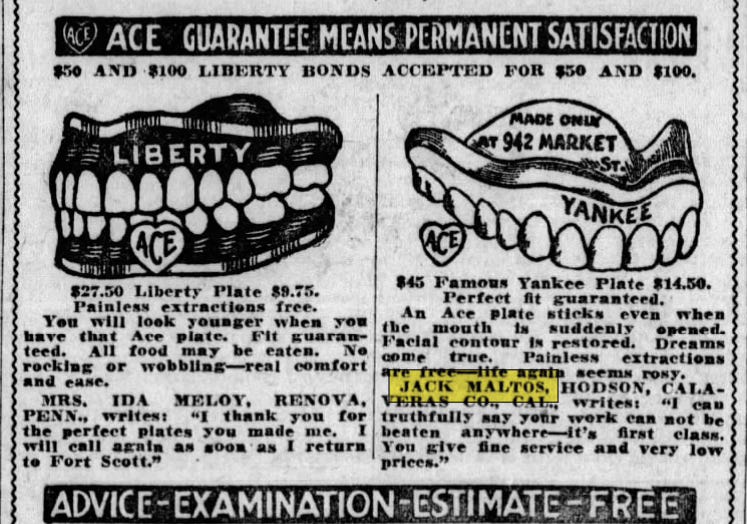
As for Juan / Jack Maltos - this is completing the circle - he acquired a kind of national celebrity as an endorser of both kidney pills and dentures - his name is appended to literally thousands of newspaper ads that appeared between 1913 and 1920. As well, while he was avoiding canon fire in Honduras, in 1903, he noticed how study and munitions-repelling were the local adobe walls. When he returned to California he set about building an adobe building that became a beloved landmark of Hodson, California and was still standing when he was not, in 1936. Thanks for reading. BR
No posts
Comments
Nothing yet. Say the first thing.
Sign in to join the conversation.