
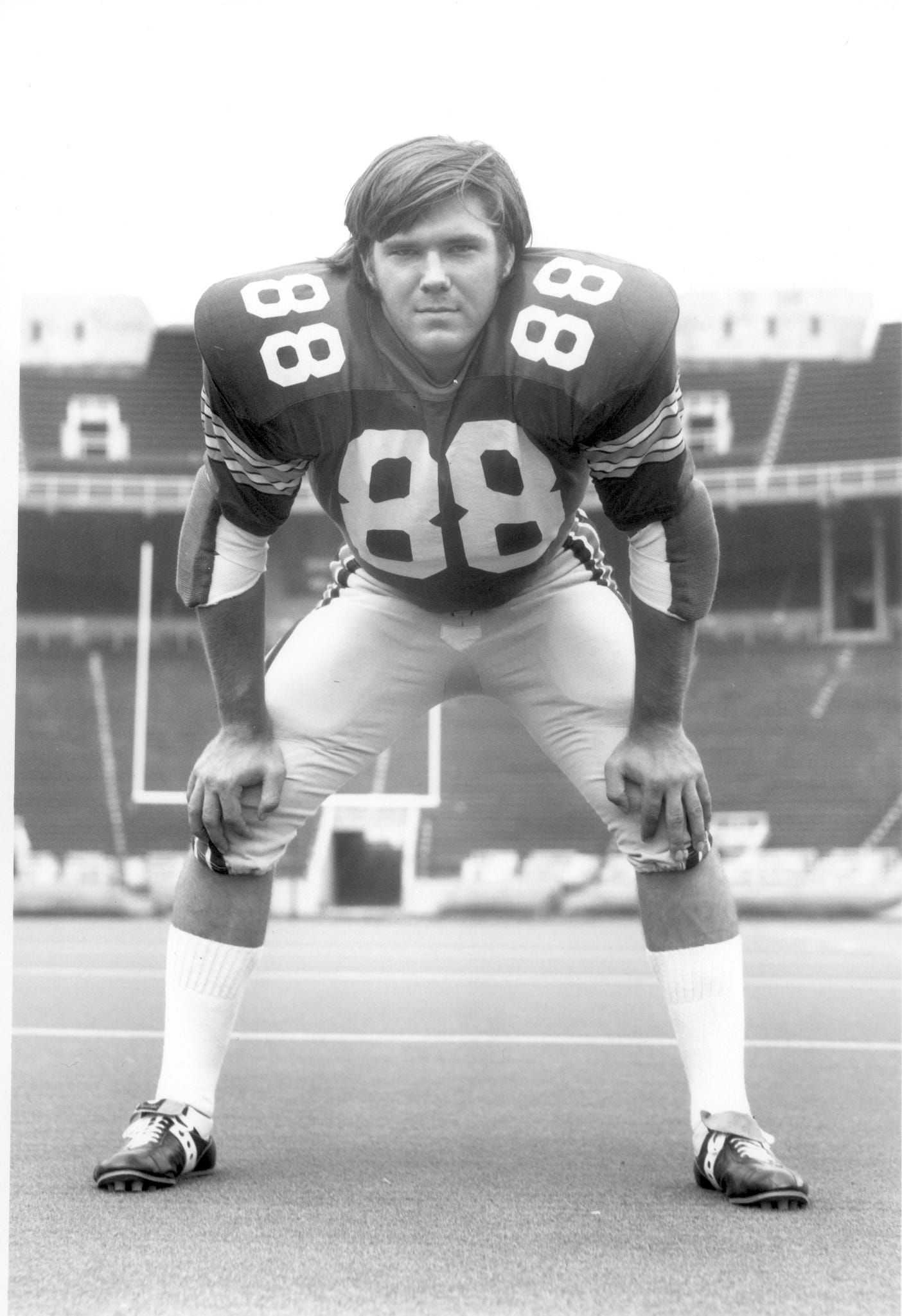
When Ohio State Varsity O president Bill Andrews called Stan White Jr. to tell him of White’s father’s election into the OSU Athletics Hall of Fame, Andrews said it was long overdue.
But in a way, the timing of Stan White Sr.’s induction makes it even more poignant.
This is not an easy time for him. He is still recovering from knee replacement surgery in April and is battling back issues. His wife of 53 years, Patty, is fighting Stage 4 liver cancer.
Five years ago, she was diagnosed with breast cancer. Early this year, doctors discovered that it had metastasized. The first round of treatments didn’t work. Doctors will try an experimental drug starting next week.
The hope is that Patty will be able to attend the Hall of Fame induction.
“We’re all working towards and hoping she can be there for that,” White Sr. said.
He is one of nine former Buckeyes who’ll be honored the weekend of the Illinois game on Sept. 26, joining quarterback J.T. Barrett, Katie Borchers, Diane Dixon and Oyesade Olatoye (women’s track), Chris Sanders (men’s track), Jincy Dunne (women’s hockey), Danielle Meyer (women’s volleyball), and Nick Swisher (baseball).
At 76, White is by far the oldest of the inductees. He was a star linebacker at Ohio State from 1969-71 before a long pro career, mostly with the Baltimore Colts. He then became a lawyer and broadcaster. He also was an assistant high school coach, retiring only this year.
A storied OSU career
White arrived at Ohio State after being a three-sport star at Theodore Roosevelt High School in Kent. Though he played baseball and basketball at OSU, he made his mark in football.
He arrived on campus in 1968. Freshmen were ineligible to play then, so he spent his first year as fodder on the scout team for the “Super Sophs” national championship team.
“Oh, they beat us up every day,” White said. “I’d go from offense to defense. I was recruited as a tight end, and they moved me to linebacker. It definitely prepared you for your sophomore season.”
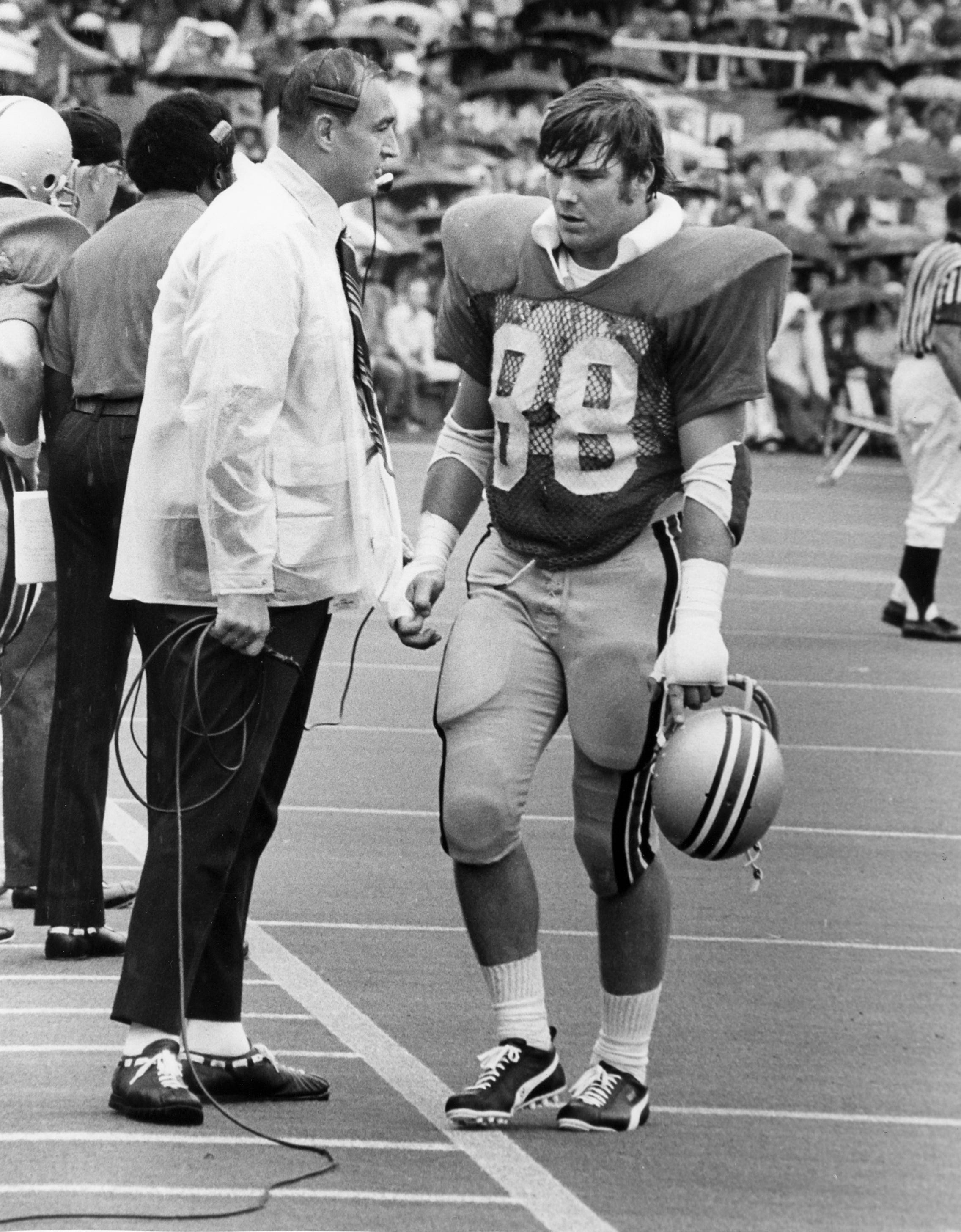
He got to play in 1969 as a backup linebacker and served as the placekicker.
“I set the record for the most extra points made, and I also set the record for the most extra points missed,” he joked.
One of those misses came after OSU’s first touchdown in the infamous 24-12 loss to Michigan that sparked the Ten Year War between Woody Hayes and Bo Schembechler. White said the pain from that loss still lingers.
“I always wonder if it would have made any difference if I had made that first extra point,” he said.
If he needed redemption, he got it the next year. The Buckeyes were hell-bent on revenge, and White intercepted a pass with OSU leading 13-9 that set up a game-sealing touchdown.
“I’ve said many times that I’ve never heard the crowd during a game, except that one point when the ball was about 3 yards away from me, and they could see I was going to intercept it, and then the crowd erupted,” White said. “I could hear it as I was catching the ball. I never was aware of the crowd in any other circumstance.”
White said that remains the highlight of his entire playing career. The Buckeyes seemed primed to win another national title in 1970. But Stanford upset OSU in Pasadena.
That trip was doomed from the start. The team’s seniors, who’d lost only one game in their careers, hoped that Hayes would treat the game as a reward for their work in returning the program to the top. When it was announced on the flight to California that players needed to get taped up for a practice soon after they landed, the players rebelled.
“The seniors said, ‘No way,’” White recalled. “They were going to strike. There was a mutiny.”
Things went further downhill when Hayes booked the team in a monastery before the game. Even with that negativity, White believed the Buckeyes would beat an inferior Stanford team. Instead, they lost 27-17.
That denied Ohio State a consensus national title. The National Football Foundation kept OSU as the No. 1 team because the NFF didn’t conduct a poll after the bowl games.
Asterisk or not, White claims the national title.
“I know a lot of people don’t count it, but I do,” White said. “I got a ring that says national champion on it.”
With the core of the ’68 team gone, the Buckeyes struggled through the ’71 season with a 6-4 record capped by a loss to Michigan in which Hayes tore up the sideline marker.
Draft day disappointment to All-Pro
White played through a neck injury in 1971, but he still expected to be a fairly high NFL draft pick the next spring.
“People kept telling me that I’d be a third- or fourth-round draft choice,” he said.
The draft wasn’t televised back then, so he waited for a phone call. The first day came and went. Nothing. He stewed for almost all of the second and final day of the draft as well.
Finally, he got a call. He’d been drafted in the 17th round by the Baltimore Colts with the 438th selection out of 442. Adding to the ignominy was that the call didn’t even come from the team.
“I didn’t even know I was drafted until a reporter from the Akron Beacon Journal called me about 10 or 11 o’clock at night,” White said. “The Colts didn’t even call me until the next day.”
White said he was so embarrassed and dejected about the draft that he sat in a closet the entire next day until high school and OSU teammates Tom Campana and Tom DeLeone, along with Patty, convinced him to come out.
Given his lowly draft status, White seemed a longshot to make the team. His signing bonus was $1,000.
But White had some fortune on his side. Colts linebackers coach Hank Bullough had been at Michigan State and was familiar with White. Then one of the linebackers retired during training camp because he was offered a high school coaching job. (Imagine that happening now.)
That he could serve as a backup kicker also helped, considering that NFL rosters then were limited to 40 players.
White shared a linebacker room with Ted Hendricks and Mike Curtis. Hendricks, nicknamed “the Mad Stork,” became a Pro Football Hall of Famer. Curtis might have been just as eccentric.
“Mad Dog was a good name for him,” White said. “My rookie year, I just played on special teams. Once in a while, I got put in the game when Mike Curtis would cuss out the coach, and they’d take him out. That was a crazy room.”
White became a starter in his second season and became a star. In 1975, he was a first-team All-NFL pick after intercepting eight passes. In 1977, White became the only player in NFL history to have at least seven sacks and seven interceptions in the same season.
He was so cerebral that the Colts let him call the defenses. His knowledge compensated for a lack of speed.
“As I always said, I couldn’t run with O.J. Simpson, so I figured out where he was going to go and went over there and waited for him,” White said.
By today’s standards, NFL players made a pittance in salary. In his first three seasons, he made a total of $48,000 (plus the whopping $1,000 signing bonus).
In 1983, White became the first NFL player to jump to the upstart United States Football League when he signed a three-year contract worth $400,000 per year.
“I made more in two years in the USFL than I did in 11 in the NFL,” White said.
Post-career success
White quipped that he had an incentive early in his pro career to make it. In his final two years at Ohio State, he dated Patty Welsh, the sister of DeLeone’s roommate. They got married after White’s rookie season.
“I always joke that she waited to make sure I made the team before she married me,” he said.
In 1974, Patty was instrumental in White starting a second career. White told Hayes during his recruitment that he wanted to major in accounting and then go to law school.
“Every year I was in the pros, Woody would call my wife and say, ‘Why hasn’t he gone to law school yet?’” he said.
Patty wouldn’t let that promise slide. Unbeknownst to her husband, she signed him up for the LSATs in 1974. White found out about it only two days before taking the test.
“Woody had helped her maneuver it and signed me up,” he said. “Luckily, I did well enough on it, and I think because I was playing for the Colts, it helped me get into law school.”
White attended night classes twice a week during the season and full-time in the offseason. After his career ended, he practiced corporate law before shifting to broadcasting.
When the Baltimore Ravens came to town in 1996 — 12 years after owner Bob Irsay moved the Colts to Indianapolis — White became a color analyst for more than a decade. All the while, he also served as an assistant high school coach while he and Patty raised Stan Jr. and daughters Meghan and Amanda.
White became beloved in Baltimore, serving as a bridge between the Colts and Ravens eras.
“There was a gap there in Baltimore that allowed him to have kind of legendary status from his playing days,” Stan White Jr. said.
Stan Jr. is too young to remember his dad’s playing career, but it was clear he was raised in a football home. Father and son would roughhouse in the living room. Stan Sr. was his son’s linebackers coach in high school. The old intensity occasionally flared.
“We were going through corrections,” Stan Jr. said, “and I gave him some smart aleck remark. He takes me by the face mask – me with a helmet on and him with no helmet on – and he head-butts me. His whole forehead starts bleeding. He tells me to run, and I think I ran the rest of practice. It humbled me pretty quickly.”
Stan Jr. went on to play at Ohio State in the early 2000s. He started as a linebacker and switched to tight end, the opposite of the switch his father made. Like his dad, Stan Jr. was a freshman on a national championship team – the 2002 OSU one.
White Jr. lives in Columbus and sells commercial real estate after earning his MBA as a Buckeye player. It was his honor to drive to Baltimore to inform his dad about his Hall of Fame enshrinement.
When he was an OSU player, Stan Jr. remembers seeing Hall of Fame inductees announced and getting an ovation during a break in the game.
“To see my dad do that, and I’d love it if my mom is there by his side, it’s just so well-deserved,” he said. “It would be a boost with all the other things that are going on.
“The way it’s worked out, it’s in God’s time, and it’s perfect timing.”
Thank you for being a paid subscriber to my Substack. You allow me to continue covering Ohio State football and other sports.
Here is an Amazon link to my book on the 2024 season, “Buckeye Brotherhood.” If you would like to purchase a hardcover book from my personal supply, send me an email.
Bill on the Buckeyes Substack is a reader-supported publication. To receive new posts and support my work, consider becoming a paid subscriber.
Comments
Nothing yet. Say the first thing.
Sign in to join the conversation.