
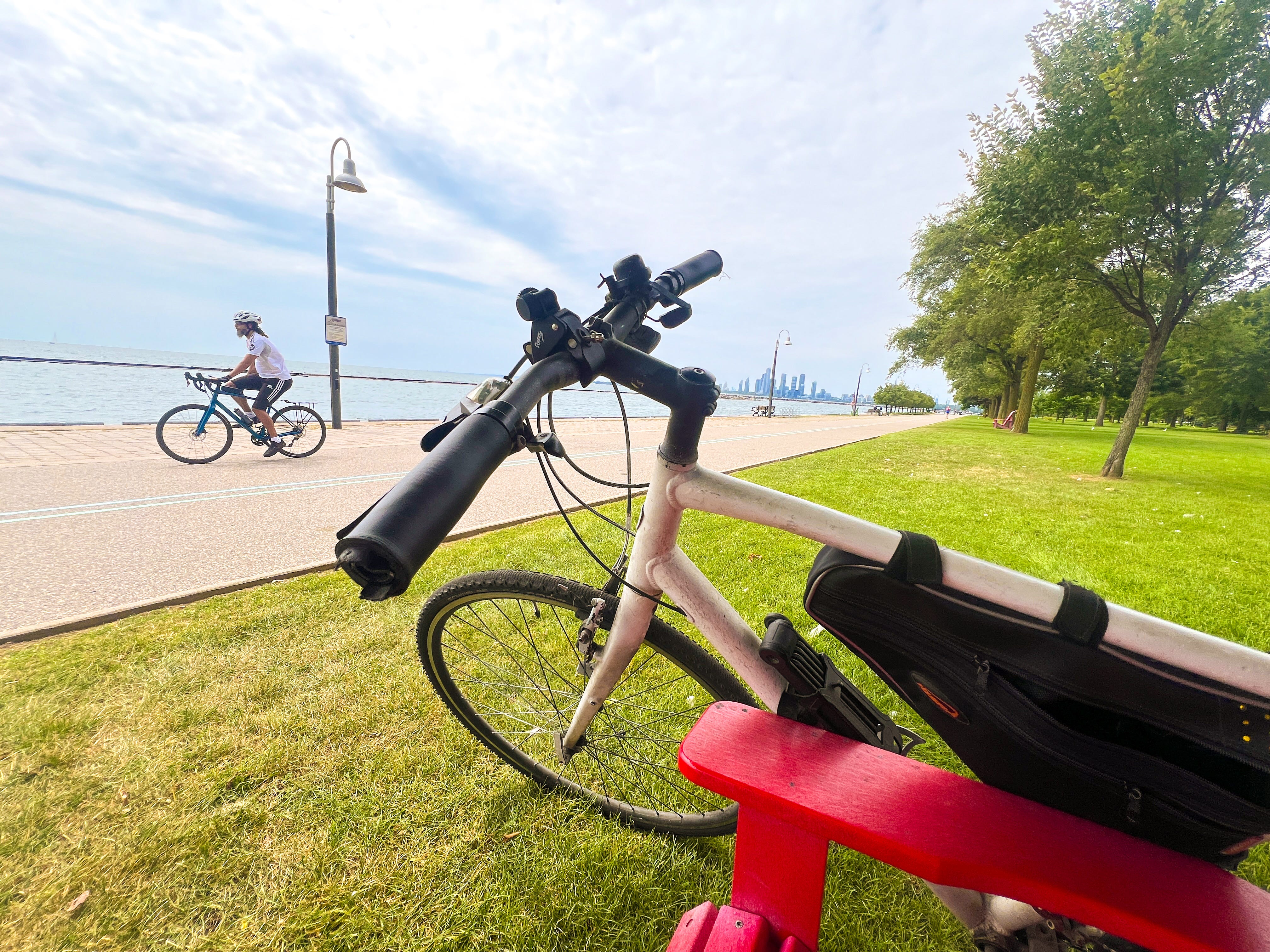
(Bill King Photography)
“With the recent Ontario Court of Appeal ruling that the Ford Government can remove 19km of Toronto’s bike lanes, here are some facts that underscore the importance of cycling infrastructure. Data shows that cycling does in fact increase when protected bike lanes are available. And despite the Ford Government’s claims, cycling lanes have been shown to reduce traffic. More cars on the road create congestion; you’re not in traffic; you are the traffic!”
Mary-Margaret McMahon is the Liberal MPP for Beaches—East York
If even one person posting bile on my Facebook page paused long enough to understand why cycling infrastructure matters, perhaps the conversation would rise above resentment and return to reality.
In 2025, two cyclists were killed in traffic collisions among 39 traffic deaths citywide—the lowest overall total since 2016.
In 2024, six cyclists were killed, the highest number since records began. Five of those deaths occurred on roads without dedicated bike lanes.
That is not an abstraction. It is the difference between a protected route and a painted suggestion; between getting home and becoming a statistic.
If the Ford government proceeds with removing 19 kilometres of bike lanes, cyclists will not simply disappear. Neither will delivery workers, e-bike riders, scooter users, commuters, students, parents, or seniors. They will be forced back into mixed traffic, where every contest between a bicycle and a two-tonne vehicle has a predictable winner. Traffic congestion will ramp up, and main arteries will freeze in place.
And there are more riders now than many critics seem willing to admit.
Bike Share Toronto—the closest thing we have to a reliable citywide measure—recorded 7.8 million rides in 2025. Its network now includes more than 10,400 bicycles and over 1,000 stations, operating around the clock, every day of the year. Ridership between November and March has also risen sharply, clear evidence that cycling is becoming year-round transportation rather than merely a summer pastime.
The system is reportedly on track for 8.1 million trips in 2026, its busiest year yet.
Follow the money, too:
In 2019, before the pandemic: $3.5 million in revenue from 2.4 million trips.
In 2024: $13.4 million in revenue against $16 million in expenses—still a shortfall, but revenue was up $2.9 million from 2023.
In 2025: $17.1 million in revenue.
For 2026: projected growth of 9 percent, placing revenue somewhere around $18 million to $18.6 million.
This is not a passing fashion. It is a transportation network, a public service and, increasingly, a permanent feature of city life.
Still, the old hostility persists. So let us offer a brief history lesson to those who appear determined to conduct a twenty-first-century transportation debate from the comfort of the Stone Age.
Roads were not handed down on stone tablets for automobiles alone. They are public space. They belong to everyone—including those who travel without wrapping themselves in several thousand pounds of steel.
Bike lanes do not create cyclists. Cyclists are already here.
Bike lanes help keep them alive.
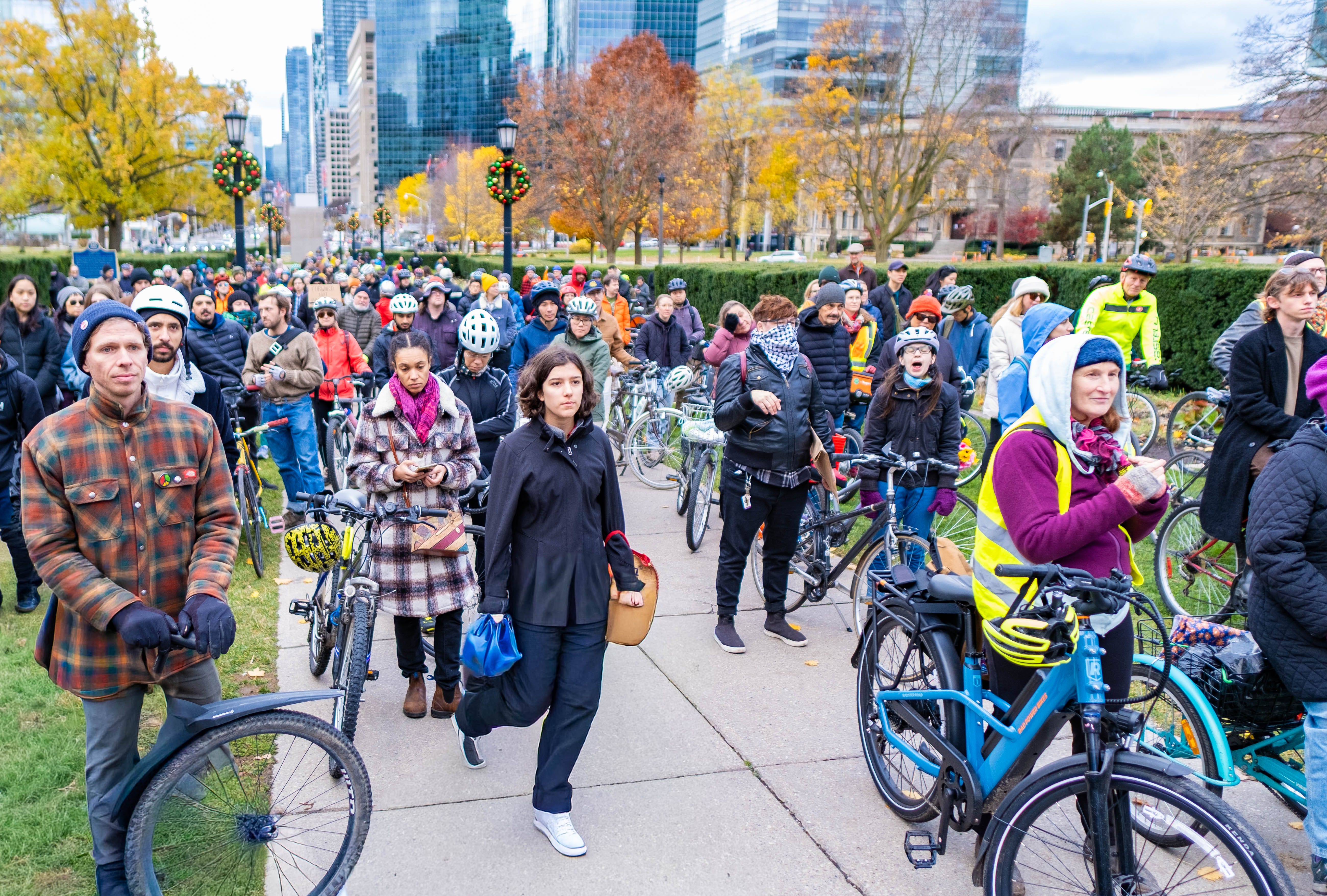
(Bill King Photography. Toronto Bike Protest November 23, 2024)
It began with a wooden frame, two wheels, and feet pushing against the road.
In 1817, German inventor Baron Karl von Drais introduced the Draisine, sometimes called the “hobby horse.” It had no pedals, no chain, and very little comfort, but the essential idea was there: personal movement balanced on two wheels.
By the 1860s and 1870s, pedals had arrived. First came the French “boneshaker,” followed by the towering penny-farthing—a bicycle as dramatic as it was dangerous. Then, in 1885, John Kemp Starley developed the “safety bicycle,” with its chain drive and equal-sized wheels. The modern bicycle had found its shape. John Boyd Dunlop’s pneumatic tire followed in 1888, softening the ride, and by the 1890s the world was in the middle of a cycling boom.
But the bicycle changed more than transportation. It changed possibility.
For women, especially, cycling offered a new measure of independence. A bicycle meant travelling without a carriage, a chaperone, or anyone else’s permission. It also helped challenge restrictive clothing and encouraged dress reform. Susan B. Anthony famously credited the bicycle with doing “more to emancipate women than anything else in the world.” Freedom, in this case, arrived on two wheels.
During the twentieth century, cycling travelled down several roads at once. In the Netherlands, Denmark, China, and elsewhere, it became an ordinary part of daily life—a dependable way to reach work, school, shops, and home. As a sport, it inspired fierce competition and enormous public enthusiasm. The Tour de France began in 1903 and grew into one of the world’s great sporting spectacles. Later, in the hills of California during the 1970s, mountain biking opened another trail entirely.
Today, the bicycle is moving through yet another chapter. E-bikes have brought new riders onto the road, making longer journeys and difficult terrain more accessible. Cities are building protected lanes and expanding bike-share systems, not simply as amenities but as practical responses to congestion, pollution, climate change, and public health.
Why does cycling still matter?
Because it remains one of the simplest and most democratic forms of transportation ever invented. A bicycle is relatively inexpensive. It requires no fuel and no driver’s licence. It works on crowded city streets and quiet rural roads alike.
It strengthens the heart, clears the mind, and folds movement into the ordinary rhythm of a day. It produces no exhaust. It helps reduce traffic and gives cities back a little of their breathing room.
Across much of the Global South, bicycles remain essential tools of economic life, carrying people to farms, markets, classrooms, clinics, and jobs. In cities such as Amsterdam and Copenhagen—and, increasingly, Paris—cycling has also reshaped the way streets are imagined. Roads no longer have to belong almost entirely to cars.
And then there is the culture of it: the Tour de France winding through mountain passes, the Giro d’Italia moving through villages and vineyards, Olympic riders circling the track, and children everywhere discovering that first sudden moment of balance.
A bicycle is a modest machine. Two wheels, a frame, a chain.
Yet for more than two centuries, it has carried something much larger: freedom, livelihood, health, competition, and the enduring pleasure of moving forward under your own power.
Comments
Nothing yet. Say the first thing.
Sign in to join the conversation.