
Over the past two weeks, democratic socialists have won a string of Democratic primaries, first in New York and then in Colorado, where a self-described socialist unseated a fifteen-term incumbent. In a sharp piece in City Journal, Jesse Arm and Sean Speer argue that these victories are not primarily about charismatic individuals — they’re about infrastructure. The Democratic Socialists of America spent years building the machinery of politics: recruiting candidates, training activists, raising money, and enforcing discipline. Now that machine wins “regardless of who is on the ballot.”
Their most important idea: “Political movements defeat collections of interests far more often than collections of interests defeat political movements.”
Arm and Speer identify a paradox. The socialist left has a movement. Its opponents have a majority: business leaders worried about the investment climate, center-left Democrats tired of purity tests, immigrant entrepreneurs, parents anxious about safety and schools, moderates of every background. What that majority lacks is not numbers. It is, in their words, “a shared political identity and the institutional infrastructure that would enable them to act together.” You might describe these folks as “politically homeless.”
Many Frontier dinner attendees over the past five months describe themselves the same way. They have watched a single party run this region for a generation, and they see the budgets balloon while the schools stall and the trains empty out. Many have quietly concluded that, at the ballot box, they have nowhere to go.
The answer is not merely to oppose socialism. As Arm and Speer argue, opposition is not an agenda, and anger is not a plan. What’s needed, they write, is “an affirmative, optimistic agenda” built around public safety, economic growth, housing, functional public services, upward mobility, and institutional competence. That’s what we are trying to build here in the Bay Area.
I should add another conviction: You cannot build a coalition from a keyboard.
Coalitions are made of relationships, and relationships are made through person-to-person contact, one conversation at a time. The DSA understands this. Before they won elections, they showed up — meeting after meeting — until they had built a coalition with a mission that is larger than a single candidate.
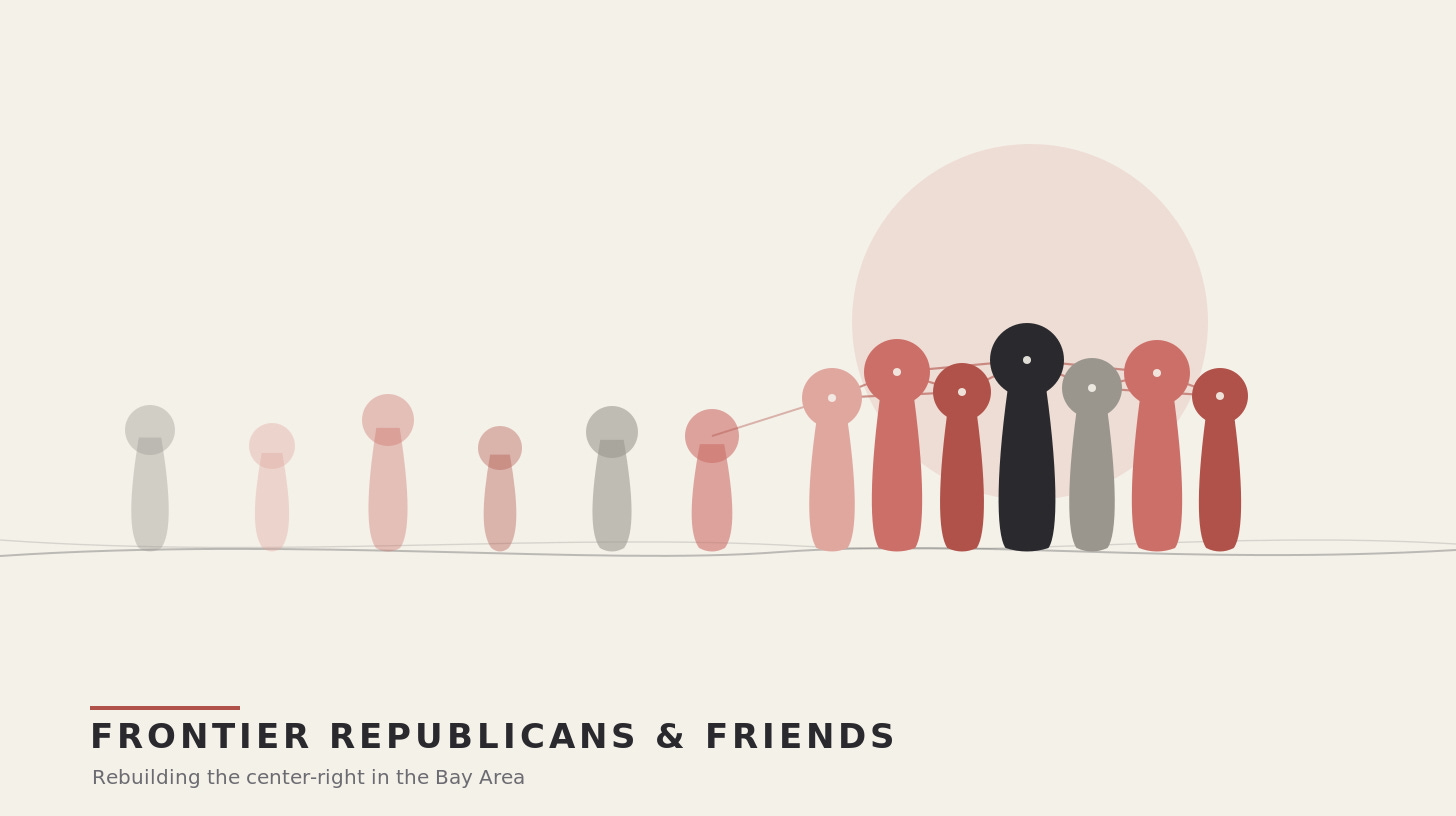
This is what Frontier is trying to do in the Bay Area, albeit with different political convictions. We bring Republicans, independents, and disaffected Democrats together around a hopeful, practical agenda: safer streets, a lower cost of living, better schools, more effective government. We aim to build a network and eventually a powerful governing bloc, candidate by candidate, member by member.
We’re not just interested in elected office: We intend to raise our hands and earn our place at the tables where this region’s future is debated and decided — in its civic and community institutions — and to bring some political diversity to rooms that have had almost none.
It is already happening. In our first five months, more than 130 people have come to a Frontier dinner, and more than half have joined. We are eighty-six founding members strong, and a majority of them were brought in not by me, but by other members inviting their friends. This is no longer just a founder with a following; it’s a network that has begun to grow on its own.
It is slow and unglamorous. And it is what wins in the long term.
The socialists spent a decade building institutions before they began collecting victories. The results we are watching now are the return on that investment. Arm and Speer ask: Is the center-right willing to do the same?
At Frontier, our answer is yes — and we’re already in the arena. If you’re one of the politically homeless, there’s a place for you here with us. Reach out to me at bill@republicanreset.org.
No posts
Comments
Nothing yet. Say the first thing.
Sign in to join the conversation.