
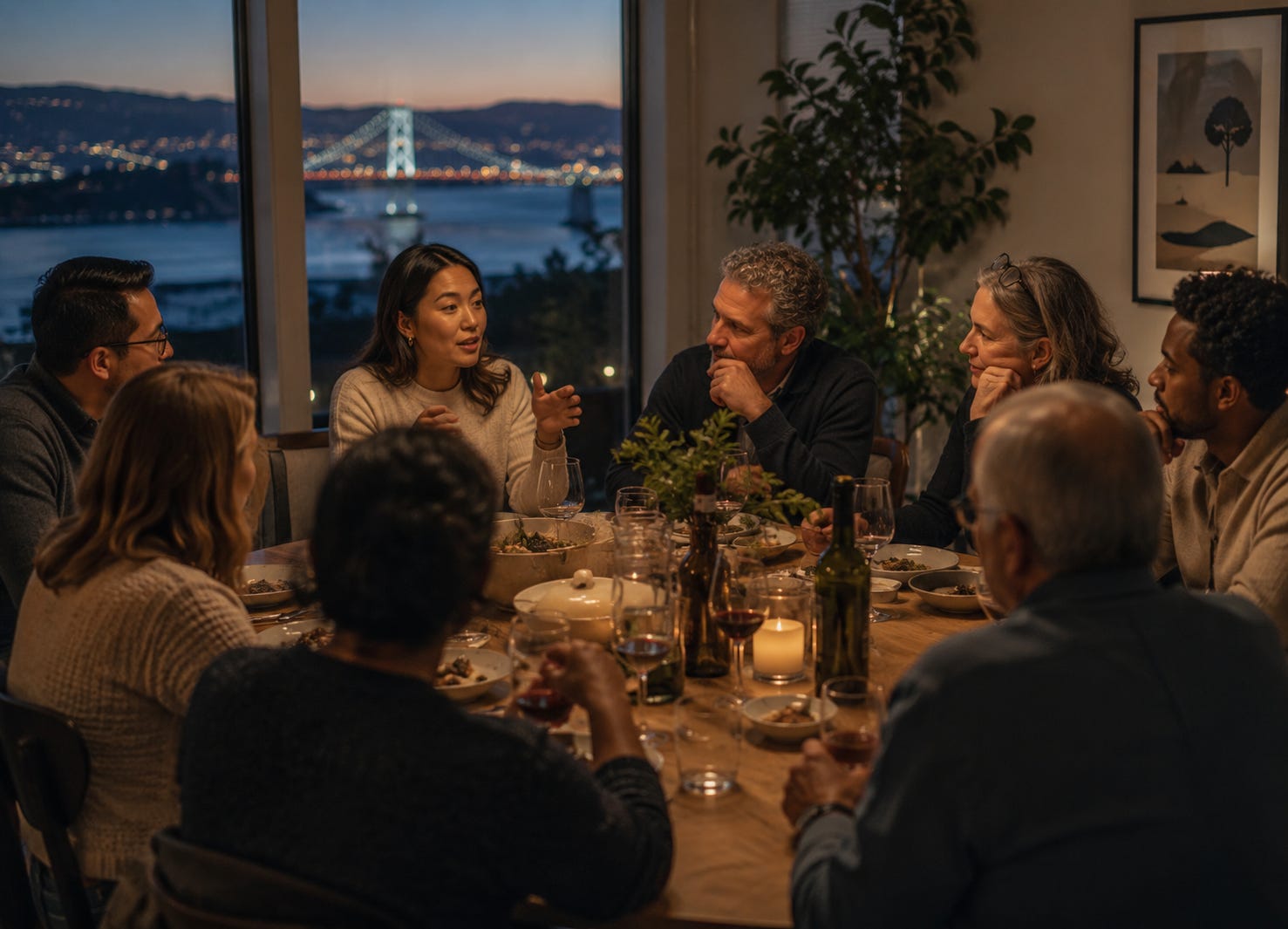
The Bay Area Republican Reset Project began with a question: Can Republicans, No Party Preference (NPP) voters, and disaffected Democrats come together to build a more credible Republican presence in the Bay Area — one capable of developing compelling ideas, fielding strong candidates, and ultimately improving governance? For the past three months, I’ve explored that question through an old technology that still works remarkably well: inviting people to dinner.
The last three dinners — in Santa Clara, Contra Costa, and San Mateo counties — clarified three themes that have surfaced repeatedly across the 16 dinners I’ve hosted since February. I suspect these themes point toward what many politically homeless Bay Area residents are looking for and what it might take to rebuild Republican influence in the Bay Area.
At one recent dinner, a participant shared that his sisters no longer speak to him because of his conservative political beliefs.
Nobody around the table was surprised. Increasingly, Americans seem to avoid political disagreement rather than navigate it. Families fracture. Friend groups narrow. Colleagues self-censor. People retreat into communities where their assumptions are rarely challenged.
That may reduce conflict in the short run, but it weakens society in the long run.
Again and again, participants expressed some version of the same desire: genuine conversation — the kind that requires listening, curiosity, and enough humility to admit that you might be wrong about something.
Transgender issues came up at two dinners. In both cases, at least one attendee had a transgender child, and many expressed compassion and concern for young people working through gender dysphoria.
At the same time, people worried that ordinary questions about developmental appropriateness, the proper roles of schools and parents, or medical interventions for children have become difficult to discuss honestly. Some feared social consequences for asking questions at all.
People are yearning for opportunities to discuss morally difficult questions without others immediately assuming bad intent. Democracies depend on citizens who can disagree — sometimes profoundly — and still see one another as neighbors rather than enemies.
The 26 people who attended my three most recent dinners are not looking for politicians who reassure them that the other side is evil. Rather, they seem hungry for leaders willing to exercise judgment, acknowledge complexity, and model how ordinary citizens can disagree honestly about important questions.
The media often focuses on the most controversial, emotionally charged issues. The people at these dinners, by contrast, kept returning to more practical questions:
Is my community safe?
How will I be able to afford a house?
Will the next generation have a better life than mine?
Affordability surfaced at every dinner. People are worried about the cost of housing, insurance, energy, and taxes. Beneath many specific complaints was a broader anxiety: the growing difficulty of building a stable middle-class life in California.
Education surfaced repeatedly. Participants were skeptical that schools are preparing children for adulthood and economic independence. One participant noted that very few students will develop the technical skills needed to become engineers at companies like Nvidia — despite growing up next to some of the most innovative firms in human history.
Others worried that screens and computers — now nearly ubiquitous in schools — are undermining attention and contributing to anxiety among young people.
Parents described children who feel overwhelmed, discouraged, and uncertain about their futures. Participants disagreed about causes and solutions, but many converged on a similar conclusion: young people need more adults in their lives who believe in them, challenge them, and help them develop resilience, judgment, and purpose.
I left these dinners with the impression that politically homeless Bay Area residents are less interested in ideological battles than in whether institutions are helping ordinary people thrive. Again and again, people expressed a desire for competent government, greater opportunity, and reassurance that effort, responsibility, and skill still matter.
Many of the deepest concerns people expressed at these dinners were not about taxes, regulations, or elections.
They were about culture.
In the Bay Area, many people instinctively distrust conservatives on cultural issues, perceiving them as judgmental, intolerant, or inclined to impose their moral standards on others. Local culture values innovation and personal freedom, and many residents are wary of a return to older norms they associate with exclusion or conformity.
But cultures can overcorrect. In reacting against one form of rigidity, they may create another.
At recent dinners, people expressed concern that some Bay Area institutions — schools, workplaces, nonprofits, even religious communities — have become so oriented toward questioning inherited norms and traditions that they no longer know how to defend the parts of them that still support human flourishing.
Participants worried that modern elite culture increasingly prizes critique over construction. Persistent skepticism toward authority, religion, merit, family formation, and shared expectations of behavior weaken the sources of meaning and obligation on which healthy societies depend. Social progress requires people willing to challenge unfairness and hypocrisy, but a culture centered on criticism risks producing citizens more comfortable deconstructing institutions than building them.
People admired builders: mentors, business owners, religious leaders, teachers, parents, community organizers, and elected officials willing to roll up their sleeves and solve practical problems. They want to live in a culture that lifts up people who build — families, companies, and communities.
That points toward a different possibility for Republicans in the Bay Area.
Perhaps rebuilding Republican influence here depends less on sharper messaging or better campaign tactics and more on becoming associated with building: stronger communities, more capable young people, competent governance, and a civic culture that both expects responsibility from citizens and believes they are capable of meeting it.
No posts
Comments
Nothing yet. Say the first thing.
Sign in to join the conversation.