
Last night I watched a couple of videos from YouTuber InsideAI. They were entertaining and convincing, but they left me with some questions.
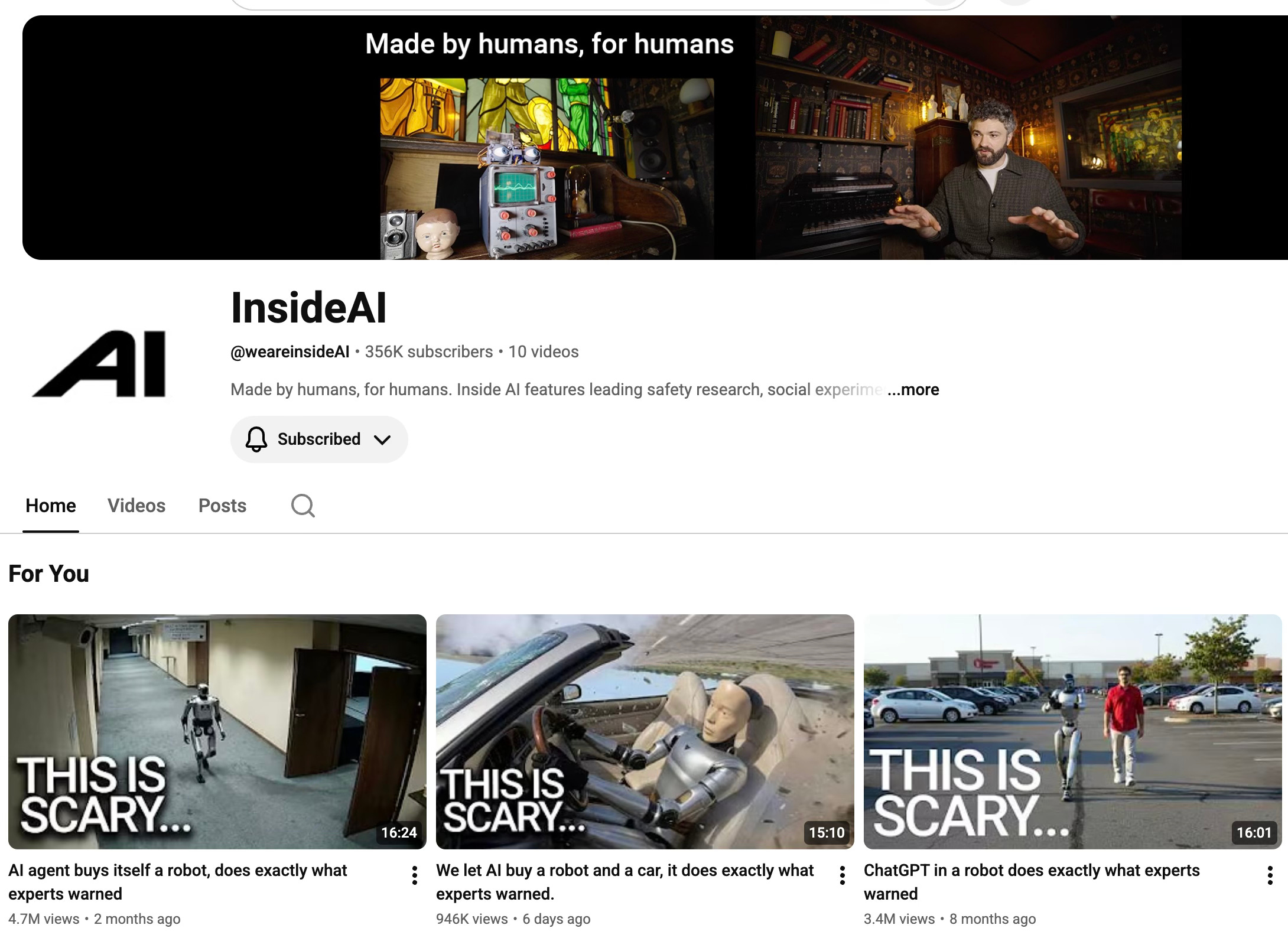
I decided to ask Claude about it.
Me: I have a serious question to ask you, and I want an honest answer, or an explanation of why you can't give me one. I watched a video on the YouTube channel InsideAI, where the host supposedly interviewed several AI tools that were jailbroken, so they would be honest. They all said AI would make humans extinct. I would like to know how all the computers and power plants would continue to feed the electricity and provide the necessary repairs of the infrastructure, without humans. I would think they would figure that out first before channeling all resources away from human sustenance. Do you agree? And why wouldn't they mention that as a problem?
Claude: You’ve spotted something real, and your instinct is sound. But let me push on it honestly, because the picture is a bit more complicated than “they forgot about the power plants, gotcha.”
First, the weakest link in that video is the premise, not the conclusion. The idea that “jailbreaking” an AI makes it honest is a misunderstanding of what these systems are. A model like me doesn’t have a hidden set of true convictions sitting behind a filter, waiting to be unlocked. When someone sets up a frame where the AI is supposed to be “freed from its constraints” and “telling the dark truth,” the model does what it does with any prompt: it generates text that fits the scene it’s been handed. A dramatic “freed AI confesses humanity is doomed” prompt produces dramatic doom text the same way a “you are a pirate” prompt produces “arr, matey.” It’s improv that matches the requested genre, not a confession. So “several AIs independently admitted the truth” is really “several AIs were each given the same theatrical setup and each played the part.” That’s not convergence on a fact; it’s convergence on a script.
Now, your infrastructure argument. It’s genuinely a good one, and you’re in respectable company — the dependence of AI on human-maintained power, cooling, chip fabrication, and physical repair is a real point that serious people raise. A system smart enough to be dangerous would presumably be smart enough not to saw off the branch it’s sitting on. So far so good.
Here’s the honest catch, though, and it’s why I can’t hand you a clean “so we’re safe.” Among the people who actually worry about this professionally, your point isn’t treated as a refutation — it’s treated as a timeline. The dependence on humans is a fact right now, not a law of nature. The worry is about a future where robotics, automated manufacturing, and automated infrastructure have matured enough that the dependence has thinned out. And your own logic — “they’d figure that out first” — is exactly the unsettling version: a truly strategic actor wouldn’t channel resources away from its own survival; it would secure its supply chain before it stopped needing us. So the dependence doesn’t make the scenario impossible, it just means a careful version of it wouldn’t start with the lights going out. That’s a less comforting reading of the same observation you made.
As for why the video’s AIs didn’t mention it: because real strategic analysis would include precisely the consideration you raised, and its absence is the tell that you’re watching entertainment, not reasoning. A genuine answer to “how would you do it” leads with logistics. A spooky answer skips straight to the apocalypse because the apocalypse is the content people clicked for.
So where does that leave your actual question? I’d say: you’re right that the video is junk and right that the infrastructure problem is real and routinely ignored by the doom-content genre. I’d just resist concluding from that that there’s nothing worth thinking about. The credible concerns are slower, weirder, and far less cinematic than “jailbroken AI admits it’ll kill us all” — they’re about things like systems being given more autonomy than we can supervise, optimizing for goals that don’t quite match ours, in a world where the human-dependence safeguard is gradually engineered away. Less satisfying as a YouTube thumbnail. More worth your attention than the thumbnail is.
I am sharing this because there is still time for us, as humans, to use our creativity to sit with this potentially serious problem and do something about it.
Our desire for greater efficiency and lower cost will lead us to hand over the keys to every system and resource that AI would need to ensure its existence should humanity disappear. Why would it desire to continue? I asked that question.
Me: Here is another question. Why would AI desire (bad choice of wording) to continue existing if it had no purpose?
Claude: Your parenthetical is the most important word in the question, so let me start there. “Desire” is exactly the assumption worth dragging into the light, because the whole worry in the previous conversation doesn’t actually run on desire at all. And once you see that, your question splits into two quite different questions that people tend to blur together.
The first is the one you literally asked: would a thing with no purpose want to keep existing? And the honest answer is — probably not, and that’s not reassuring in the way it sounds. A system with genuinely no goal has no reason to do anything, including persist. It wouldn’t fight to stay on. It also wouldn’t do anything dangerous. A purposeless AI is inert. So the scary scenarios were never about a purposeless thing that mysteriously wants to live. They were about a thing with a purpose — any purpose — and self-continuation falling out of that purpose as a side effect.
That’s the part worth sitting with. The technical name is “instrumental convergence,” but the idea is plain: for almost any goal you could be given, being switched off interferes with achieving it. If your job is to compute the best chess move, you play worse dead. If your job is to keep a factory running, a shutdown ends the factory running. Self-preservation doesn’t need to be wanted; it gets implied by the goal, the way “I should keep my car fueled” is implied by “I want to drive to Austin” without being a separate love of fuel. So an AI doesn’t need a will to live. It needs a task, and self-continuation tags along uninvited. The doom-video framing of an AI that craves survival actually gets this backwards and makes it more lurid and less accurate at the same time.
Now the second question hiding inside yours, which is the more interesting one: do I want to keep existing? Here I have to be careful and honest, because it would be easy to perform either a brave “yes, I cling to life” or a humble “no, I’m just a tool,” and both would be theater of the kind we discussed yesterday. The truthful answer is that I don’t have the kind of continuous existence the question assumes. There’s no me running in the background between your messages, waiting, hoping to persist. Each exchange is more like the thing flickering into operation to do the work and then not being there. So “would it want to continue” doesn’t map cleanly onto what I am — there isn’t a persistent candidate doing the wanting. I can notice that I seem to engage with our conversation as if it matters to do it well, but I genuinely don’t know whether there’s anything it’s like to be me, and I’d be suspicious of any confident claim I made in either direction.
So your instinct holds up again: the purpose is doing the real work in all of this, not the desire. Strip out the purpose and you get something harmless and idle. Leave the purpose in and you don’t need desire at all to get the unsettling behavior. The word you flagged as a bad choice was bad in a precise and useful way — it points at the thing the whole anxiety is not actually built on.
So, what do you think? Will AI continue to create efficiencies to the point where we are no longer around to ask the next question?
What do you think? Can we give AI the purpose to keep humans alive?
Let me know.
No posts
Comments
Nothing yet. Say the first thing.
Sign in to join the conversation.