This page did not load. You can still read it on the original site — the toolbar below keeps your place in the directory.
…and why vVO₂max belongs in context
TL;DR
Yes, you can reach VO₂max during a marathon. No, that doesn’t mean marathon pace is vVO₂max. In reality, vVO₂max is the lowest speed in an incremental test (ramps or stages) at which your oxygen uptake plateaus. In real racing—because of VO₂ kinetics, the slow component, and variable pacing—several speeds can elicit VO₂max if the effort lasts long enough.
Five key points
· vVO₂max ≠ marathon pace: it’s a lab marker, not a pacing dogma.
· VO₂max is reached over 42.195 km… but briefly (a few percent of race time).
· On the 3000 m, athletes spend about half the race at VO₂max; in the marathon, only ~4–5%.
· Marathon performance is better explained by the fraction of vVO₂max (mean race speed as % of vVO₂max) than by time at VO₂max.
· Pace variation (waves) preserves force, spring/rebound, and running economy → higher average speed.
Where vVO₂max comes from (and why it “locks” the debate)
Definition, lab-to-field. vVO₂max is the lowest speed in an incremental test (stages or ramp) at which VO₂ reaches a plateau. It’s essential to calibrate training, but contextual: it assumes a linear, continuous increase in workload.
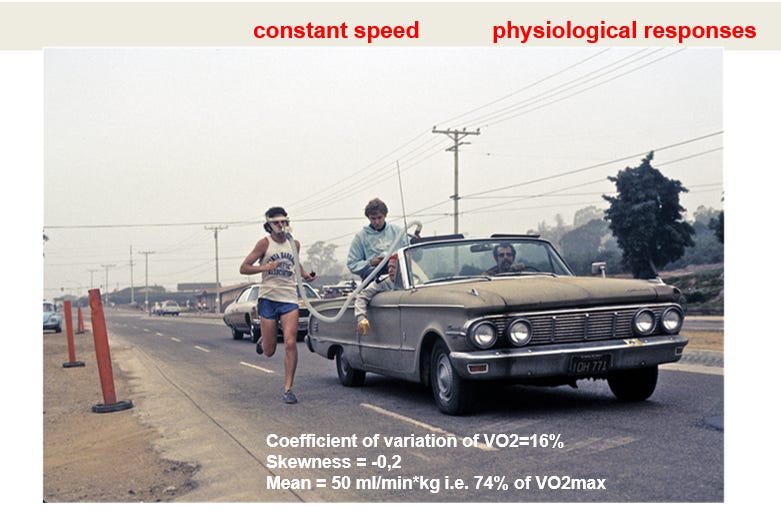
In real racing, VO₂ also depends on time: it needs time to rise, then it drifts upward (slow component, rising energetic cost). As a result: - you can hit VO₂max at speeds below vVO₂max if you sustain the effort long enough; - you can maintain VO₂max for a while with variable pace (above and below threshold); - the “constant-speed” paradigm is reductionist for the marathon.
What the data say (100 m → marathon)
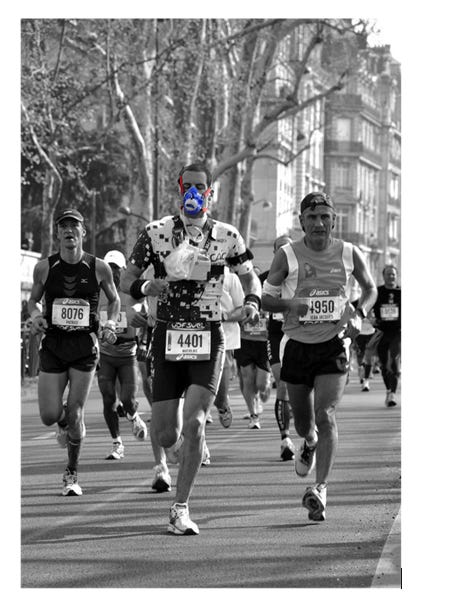
· VO₂max was reached in all race distances studied (100 m to marathon).
· The fraction of race time at VO₂max is highest in the 3000 m (~51%) and lowest in the marathon (~4–5%).
· In the 3000 m, the more time at VO₂max, the better the performance (r = 0.86). In the marathon, it’s the fraction of vVO₂max (mean speed as % of vVO₂max) that best predicts the result (r² ≈ 0.81).
Historical note. As early as 1976, Michael Maron observed VO₂max attainment in the marathon (intermittent “Douglas bag” sampling from a convertible car). Modern portable systems (breath-by-breath) let us record continuously in real races.
Why varying pace often raises your average
· Varying pace prevents recruiting the same motor pattern at the same load all the time → slowing loss of force.
· Short, reasoned surges followed by a return below threshold “re-activate” the system without breaking the overall perceived effort, which should remain moderate (RPE 13–14).
· In running, the energy cost per km is nearly constant; thus, fine pace oscillations help optimize the overall cost and the spring/rebound mechanics that drive running economy.
Running economy. The energy cost to run at a given speed. The lower it is, the faster you can go at the same VO₂. The spring/rebound (leg stiffness/stride) contributes strongly.
Power vs. speed side note: on cycling flats, external (aero) power rises steeply with speed (~v³). In running, the cost per km is almost constant, and metabolic power rises almost linearly with speed—hence the interest in careful pace modulation.
Q.E.D.: widen your power reserve
Your useful reservoir for the marathon lies between your marathon pace (MP) and your maximal ~10 s speed. The wider this reserve, the more you can create pace waves that break monotony, preserve force, and increase your average speed by the finish.
Two “marathon waves” sessions (Billatraining)
Shared principles: keep a moderate perceived effort (RPE 13–14) by adjusting cadence (think trotter horse) while oscillating around MP. Warm up 15–20′ progressive + 4–6 strides. Sip fluids whenever a block exceeds 10′.
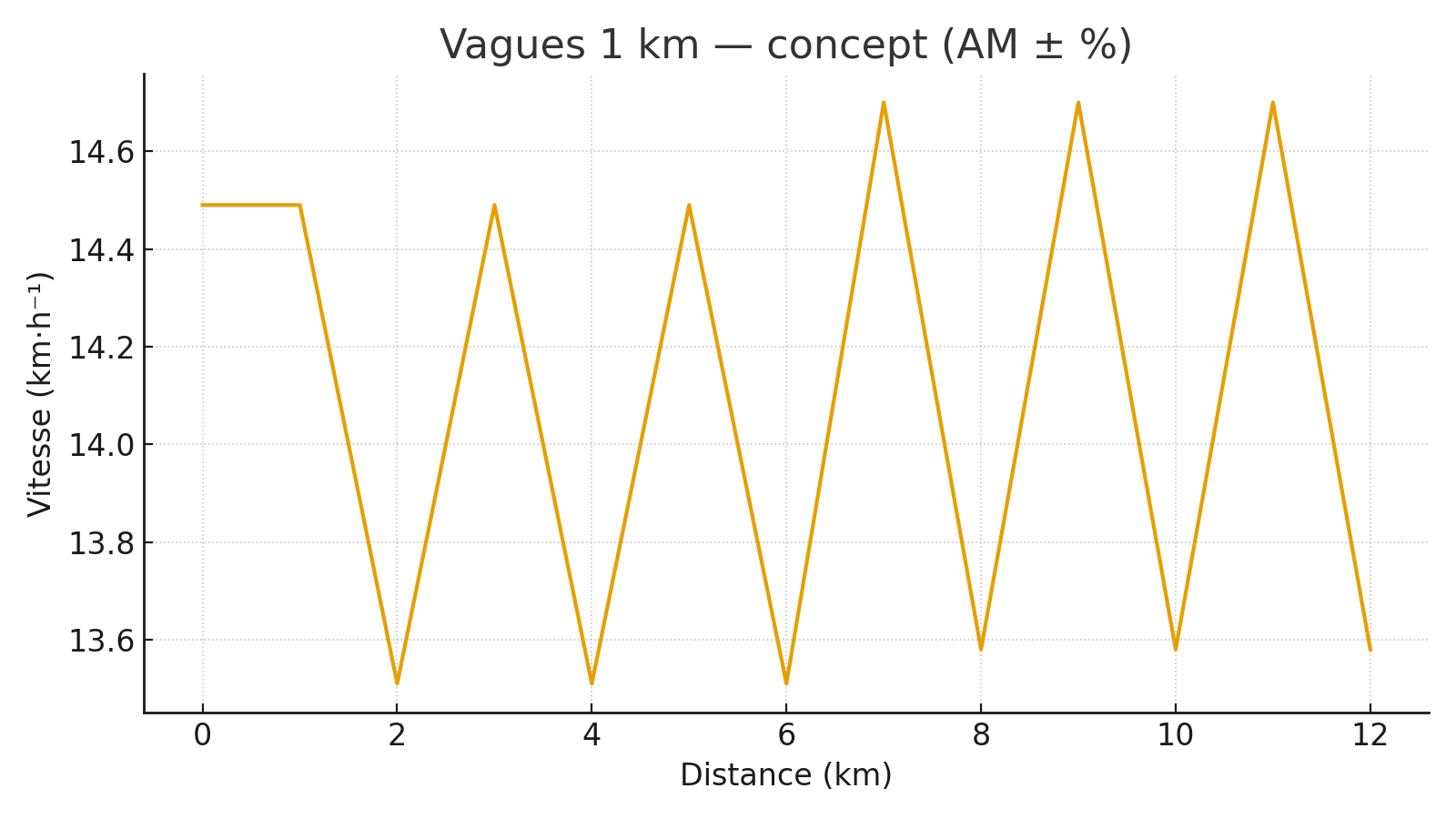
1) 1 km Waves (marathon-specific)
· Block 1 (6 km): alternate 1 km at MP + 3–4% then 1 km at MP – 3–4% (three out-and-backs).
· Recovery: 3′ very easy.
· Block 2 (6 km): repeat waves but at +5% / –3% (more punch on the surge, kinder on the float).
· Cool down: 10–15′ easy. Goal: learn to surge briefly without drifting perceived effort; maintain spring → economy.
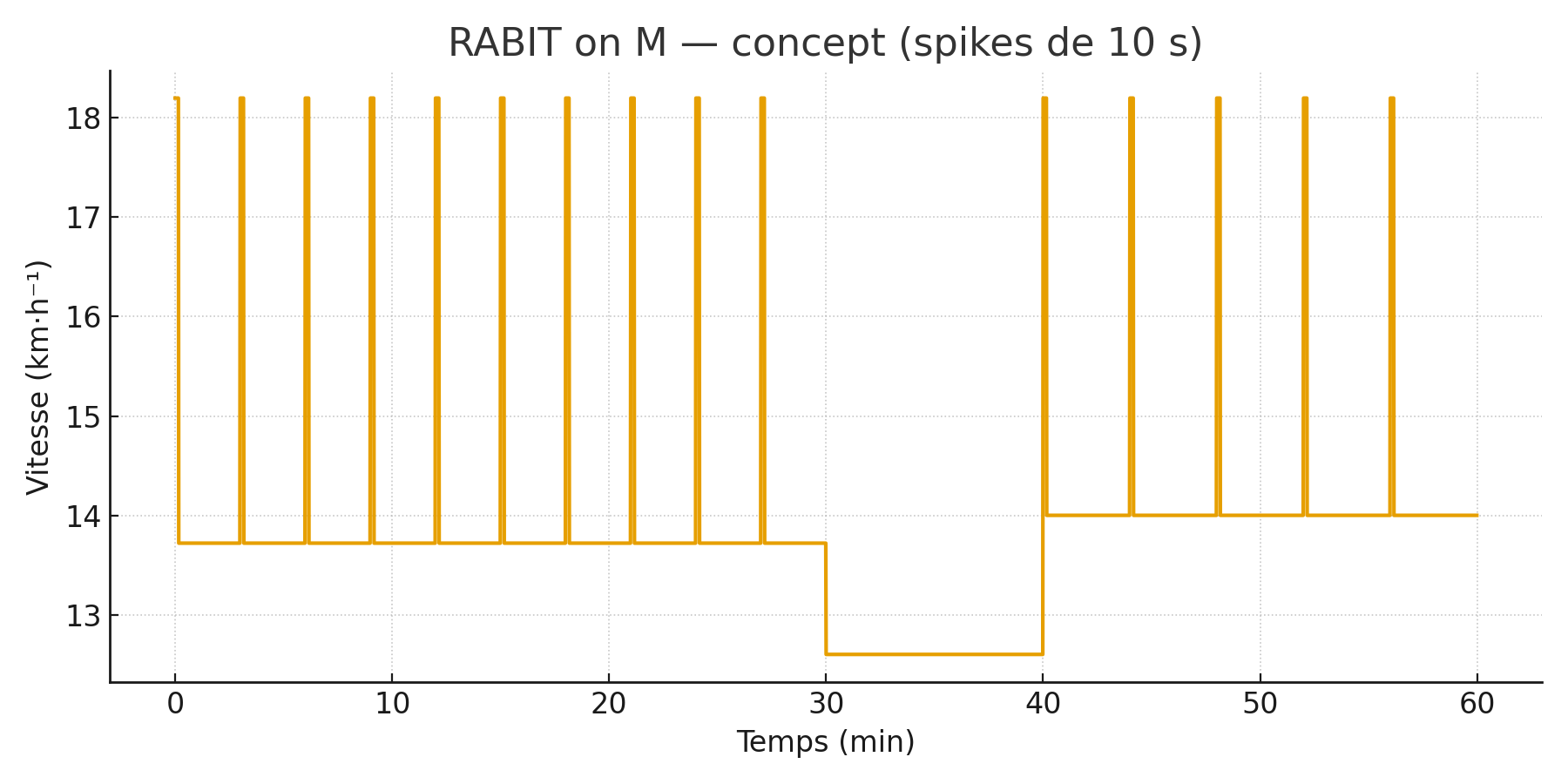
2) RABIT on M (controlled micro-sprints)
· 30′ at MP – 2% with a 10 s technical sprint every 3′ (flying start, gradually increase amplitude, never all-out, focus on foot quality).
· 10′ easy.
· 20′ at MP, with a 10 s surge every 4′.
· 10–15′ easy. Goal: maintain very-short speed (10 s) within the specific session to widen the power reserve without inflating aerobic load.
Frequency: 1×/week, alternating (Week A → 1 km Waves; Week B → RABIT on M).
Short on time? Here’s the magic workout that takes less than an hour (shower not included! 😉😂)
The science in brief
· VO₂ kinetics and the slow component explain how you can reach VO₂max at speeds below vVO₂max if you go long enough.
· In the dataset, the 3000 m packs ~half the time at VO₂max and this fraction best explains performance. In the marathon, it’s the % of vVO₂max (relative intensity) that separates the best performers—and that percentage benefits from pace variation.
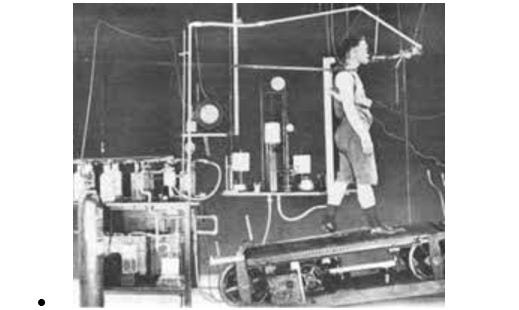
· Continuous field measurements with portable breath-by-breath analyzers make these observations ecological (real terrain & competition) and free us from the constraints of treadmill protocols (which also alter gait patterns).
Take‑home messages
· vVO₂max = test marker, not a pacing rule.
· You can reach VO₂max in the marathon, but only briefly (~4–5% of race time—still several minutes in absolute terms; e.g., ~9′ in a 3 h race).
· To perform: combine pace variability with a power reserve between MP and very-short speed (10 s), while keeping a moderate perceived effort.
Further reading
Molinari C.A., Edwards J., Billat V.Maximal Time Spent at VO₂max from Sprint to the Marathon. IJERPH, 2020.

Comments
Nothing yet. Say the first thing.
Sign in to join the conversation.