
The marathon is often seen as a fierce battle against fatigue, where every runner tries to manage their energy to avoid the dreaded “wall.” Traditionally, it’s believed that to improve performance, you need to vary your pace—speeding up at times, slowing down at others—to better recycle your metabolic resources. Yet, a surprising idea is emerging running at a constant—but optimal—pace could be the key to breaking your marathon record, without overloading your body with unnecessary fatigue.
Constant Pace vs. Varying Pace: What the Numbers Say
Let’s look at an example based on a precise physiological model:
· Hard pace (VD) for a runner: 18 km/h
· Easy zone: below 55% VD (9.9 km/h)
· Medium zone: between 55% and 80% VD (up to 14.4 km/h)
If the runner maintains a constant pace at 80% of their hard pace (14.4 km/h) throughout the race, they would finish the marathon in about 2 hours and 56 minutes.
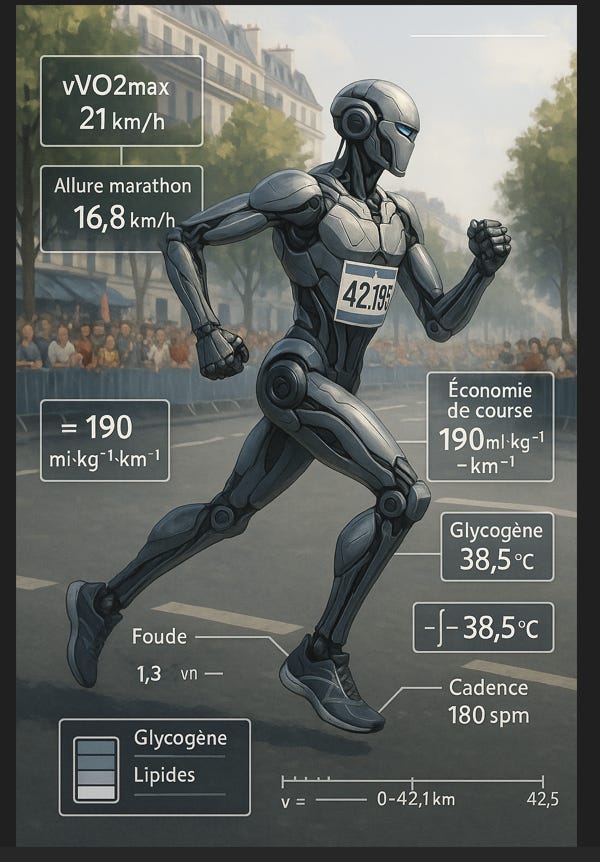
Scenarios simulating controlled pace variation (always below hard pace, between 55% and 80%) show that the overall average speed is actually slightly lower than 80% VD, which slightly increases the total time compared to the optimal constant pace. Even aiming for a fraction of the “hard” pace (RPE 16-17 on the Borg scale of 6 to 20), strictly maintaining this speed without fatigue is unrealistic (unless you’re a robot runner!).
Why Vary Your Pace?
While the maximum constant speed gives the best mechanical average, varying your pace serves an essential function: it helps manage metabolism, specifically lactate recycling—a major source of muscle fatigue.
Running uniformly near the maximal threshold can quickly lead to lactate accumulation that’s hard to eliminate. On the other hand, modulating your pace within the medium zone allows you to alternate between effort phases and active recovery, reducing the feeling of exhaustion while maintaining strong mechanical momentum.
The Key: A Compromise Between Mechanics and Metabolism
· Constant speed near threshold is the ideal mechanical goal for the best time performance.
· Varying speed helps preserve performance over time by optimizing bioenergetic balance.
So, the optimal strategy isn’t just to run fast, but to run efficiently—using the right effort zone and maintaining a constant “action” (a physical concept combining speed and cumulative distance).
Rethinking Pacing with Physics and Biology
Marathon performance isn’t just about endurance or mental strength. It combines dynamic management of the motor and metabolic systems, integrated into a concept called “action”—the product of speed and distance, which must remain stable.
The challenge is to run fast enough to break your record, while avoiding abrupt fluctuations that would waste energy and cause early slowing. This science opens new perspectives for smarter pacing, supported by computerized modeling and artificial intelligence.
Conclusion
Breaking your marathon record by running at a constant pace is possible, as long as that pace is well-calibrated to be as high as possible without exceeding the critical metabolic zone. This approach, combined with a solid understanding of underlying physiological mechanisms, offers a promising horizon for sustainably improving performance while minimizing fatigue.
Trying to run faster by multiplying pace changes without strategy risks increasing fatigue and compromising performance. It’s better to aim for the perfect balance between mechanical strength and lactate management, allowing you to go faster, longer, without breaking down.
To Go Further
Discover how stride entropy reveals essential motor signals for runners, or how artificial intelligence can simulate your ideal marathon strategy in real time. We’ll explore this next week and beyond, sharing insights from our research on real-time marathon exploration using complete biomechanical, neurophysiological, and cardiorespiratory measurements in the field.
Key Session: Sensation-Based Fartlek for Marathon Pace Variation
Goal: Get your body and mind used to alternating paces in the medium zone, listening to your sensations, to optimize lactate recycling and fatigue management for the marathon.
“Sensory Marathon Fartlek” Session
Warm-up
· 20 minutes at total respiratory ease (you should be able to talk effortlessly, legs feel light).
Main block (60 minutes)
· Alternate every 5 to 7 minutes between two sensations:
o “Energetic but controlled” pace (upper medium zone): You feel “active,” your stride is dynamic, you could hold this rhythm for a long time but you feel you’re working (deep breathing, you can speak in short sentences but not hold a full conversation).
o “Relaxed but engaged” pace (lower medium zone): You feel like you’re “actively recovering,” your stride stays smooth, you focus on keeping your arms and shoulders relaxed, you could speed up at any moment, but you stay in a solid comfort zone.
· Golden rule: Never feel “blocked” or “burning” in your legs. You should always feel you could accelerate, but choose to stay in control.
· Tip: If you feel you’re “accumulating” (heavy legs, short breath), extend the relaxed phase.
Finish with 10 minutes
· Return to a very easy pace, total relaxation, you should finish the session feeling like you “still have energy.”
Sensory cues to remember:
· “Energetic but controlled” = upper medium zone, you feel the effort but remain master of your stride.
· “Relaxed but engaged” = lower/median medium zone, you recover without switching off.
· Never enter the “hard zone” (no burning legs, no short breath, no tension).
· You should finish the session feeling you’ve worked, but not exhausted.
Why this session?
· It trains you to sense and manage the micro-variations in pace needed on marathon day to recycle lactate and maintain constant mechanical momentum.
· It develops your ability to listen to your sensations, anticipate fatigue, and stay in the “green zone” of sustainable performance.
Next week, I’ll share the simulation framework for these 10 possible pacing strategies to help you outperform constant pace running.
Great session—send me your Garmin or other brand files!
Aucun post
Comments
Nothing yet. Say the first thing.
Sign in to join the conversation.