
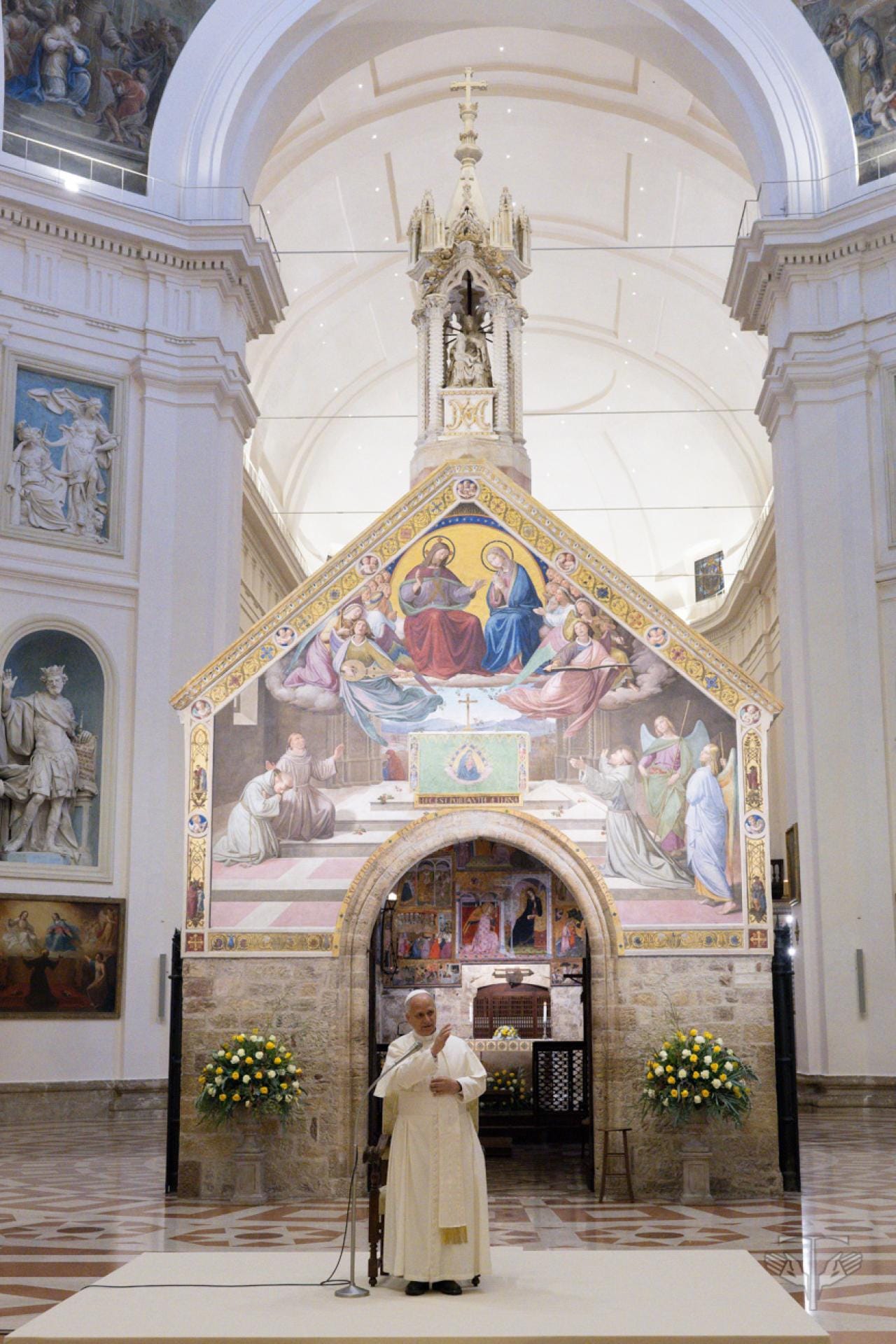
On the morning of August 6, Leo XIV boarded a helicopter at the Vatican and flew to Assisi.
By 8:28, he had landed near the city of Saint Francis. He was driven to the Basilica of Santa Maria degli Angeli, where young Catholics from across Europe had gathered for the “Go! Franciscan Youth Meeting 2026.” The setting carried eight centuries of Catholic memory: the Portiuncula, the friars, the poverty of Francis, the call to rebuild the Church.
Hiraeth In Exile is a reader-supported publication. To receive new posts and support my work, consider becoming a paid subscriber.
Then a young woman from Zagreb asked Leo how Catholics could remain faithful disciples of Christ in a disoriented world.
His answer moved quickly toward dialogue.
He praised the Franciscans for fostering peaceful coexistence “among Catholics, Orthodox and Muslims.” He warned against the “dangerous intertwining of religious identity and nationalism.” He told the young people that Christian witness requires freedom from “artificial boundaries,” fears created by misinformation, and walls built by prejudice.
Then came the line that supplied the key to the entire address:
“Saint Francis, however, teaches that radicalism of the Gospel is the very opposite of fundamentalism.”
The Vatican published the exchange as the official text of Leo’s conversation with the young people. The words deserve attention because Rome has spent the summer deciding which Catholics qualify as dangerous radicals.
The Fundamentalists Rome Can See
On July 1, the Society of Saint Pius X consecrated four bishops at Écône.
The Vatican’s answer was swift. The Society was accused of a schismatic act. Clergy and bishops were threatened with or declared subject to grave canonical penalties. Traditional Catholics were warned against receiving sacraments from priests who celebrate the Mass codified by Saint Pius V, teach the catechism, condemn contraception, preach the social kingship of Christ, and reject the ecumenical revolution that emptied churches across the West.
The accusation centered upon authority and communion. Yet the doctrinal dispute beneath the canonical language remained plain. Leo himself had already identified the Society’s refusal to accept “fundamental elements” of Vatican II as a central obstacle. Rome’s complaint reaches beyond episcopal paperwork. The SSPX preserves a Catholic conception of the Church, worship, conversion, and religious truth that the postconciliar establishment has spent sixty years dismantling.
Then Leo arrived in Assisi and warned young Catholics against “religious identity.”
The phrase deserves careful treatment. A Catholic may abuse religious identity. Nationalism can become idolatrous. Tribal hatred can wear a crucifix. The Church has never taught that every political movement using Christian language deserves baptism.
Yet Leo’s examples and vocabulary direct the warning toward firm religious boundaries themselves.
He praised coexistence among Catholics, Orthodox, and Muslims. He spoke of walls built by prejudice. He set Gospel radicalism against “fundamentalism,” a word whose modern use usually places doctrinal certainty, missionary conviction, and inflexible religious claims under suspicion.
The speech offered no comparable warning about religious indifferentism. It contained no reminder that the Catholic Church alone possesses the fullness of revealed religion. It never told the young people that charity toward Muslims includes a desire for their conversion and baptism.
The omissions are important because Assisi carries history.
The Long Shadow of Assisi
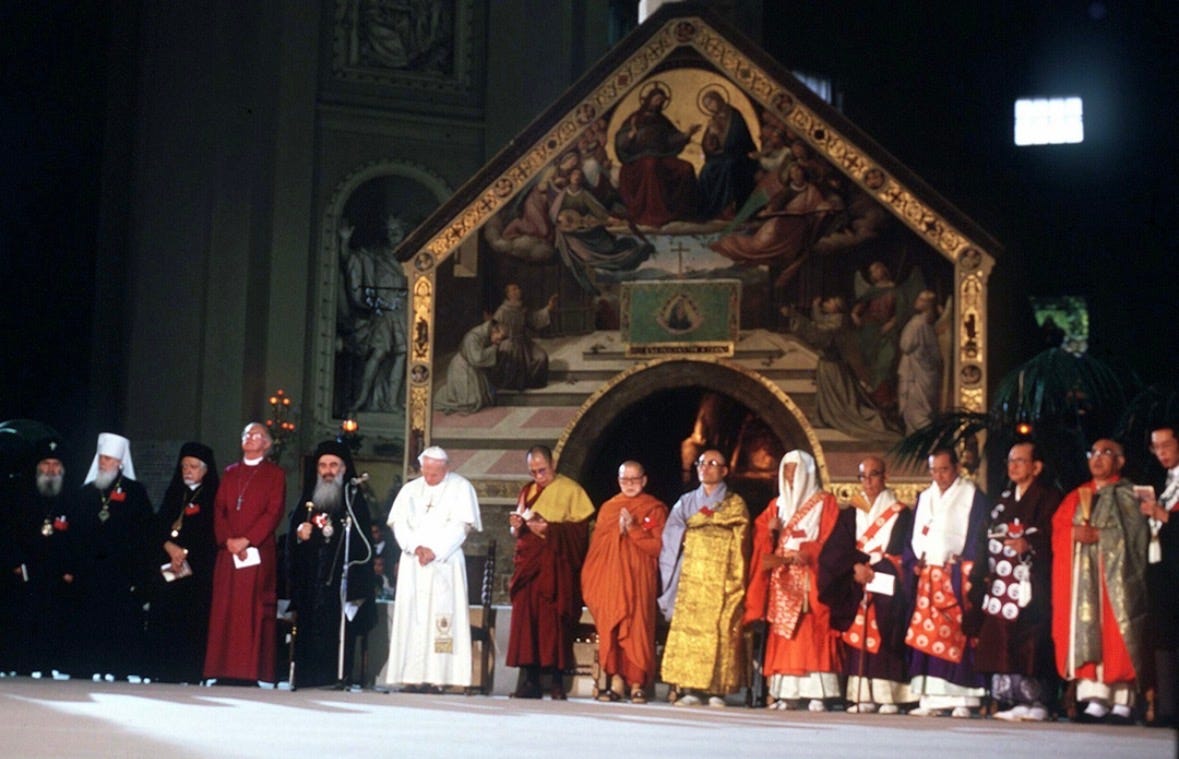
In October 1986, John Paul II assembled representatives of the world’s religions in Assisi to pray for peace.
Defenders carefully explained that the participants had gathered “to pray,” rather than to “pray together.” The distinction failed to repair the public image: Catholicism appeared as one religious voice among many, each contributing its spiritual resources to a shared human project.
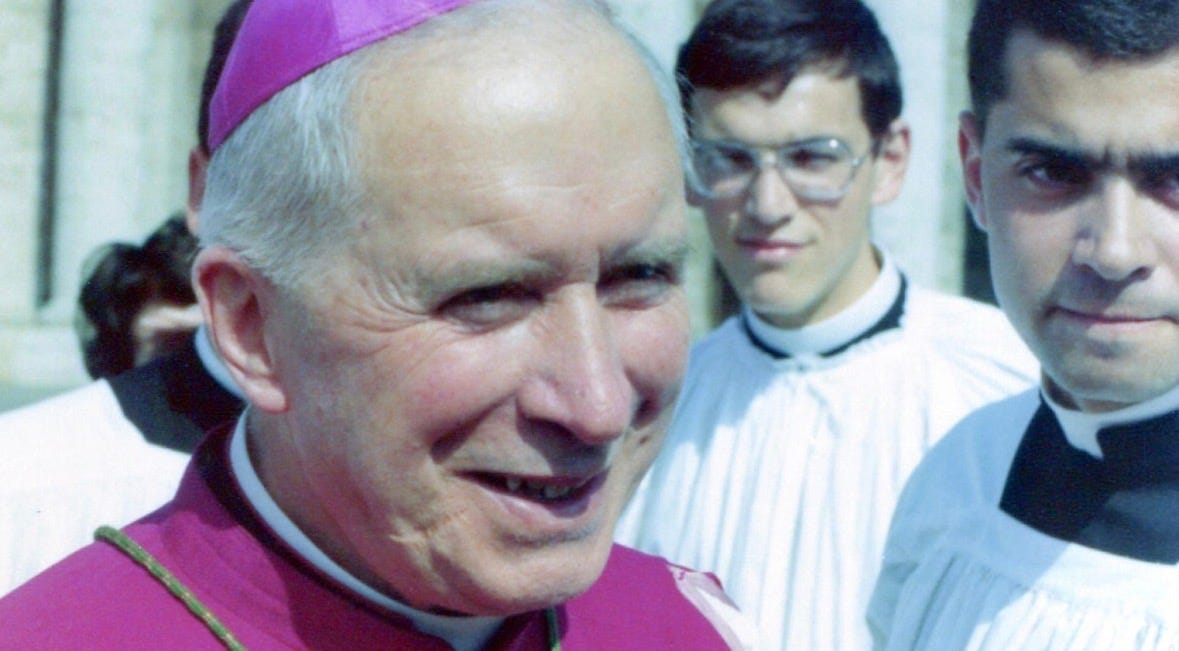
Archbishop Marcel Lefebvre recognized the doctrinal meaning immediately. Assisi gave visible form to the errors he had opposed throughout the Council and its aftermath. The event treated false religions as legitimate partners in a common sacred enterprise. Mission yielded to dialogue. Conversion receded behind coexistence.
Forty years later, the language has become smoother and more deeply institutionalized.
Leo did not stage another grand assembly of religions on August 6. He did something more ordinary, and therefore more revealing. He spoke to Catholic youth as though peaceful coexistence with Orthodox Christians and Muslims formed part of the Franciscan inheritance itself. He presented the chief danger as religion becoming too bound to identity, nation, boundary, or certainty.
The new religion rarely announces itself through dramatic repudiations. It catechizes through emphasis.
Dialogue receives praise. Boundaries require suspicion. Religious identity needs purification. Radical commitment remains acceptable so long as nobody mistakes it for fundamentalism.
The old Catholic categories—truth and error, Church and sect, conversion and unbelief—fade into the background.
Which Francis?
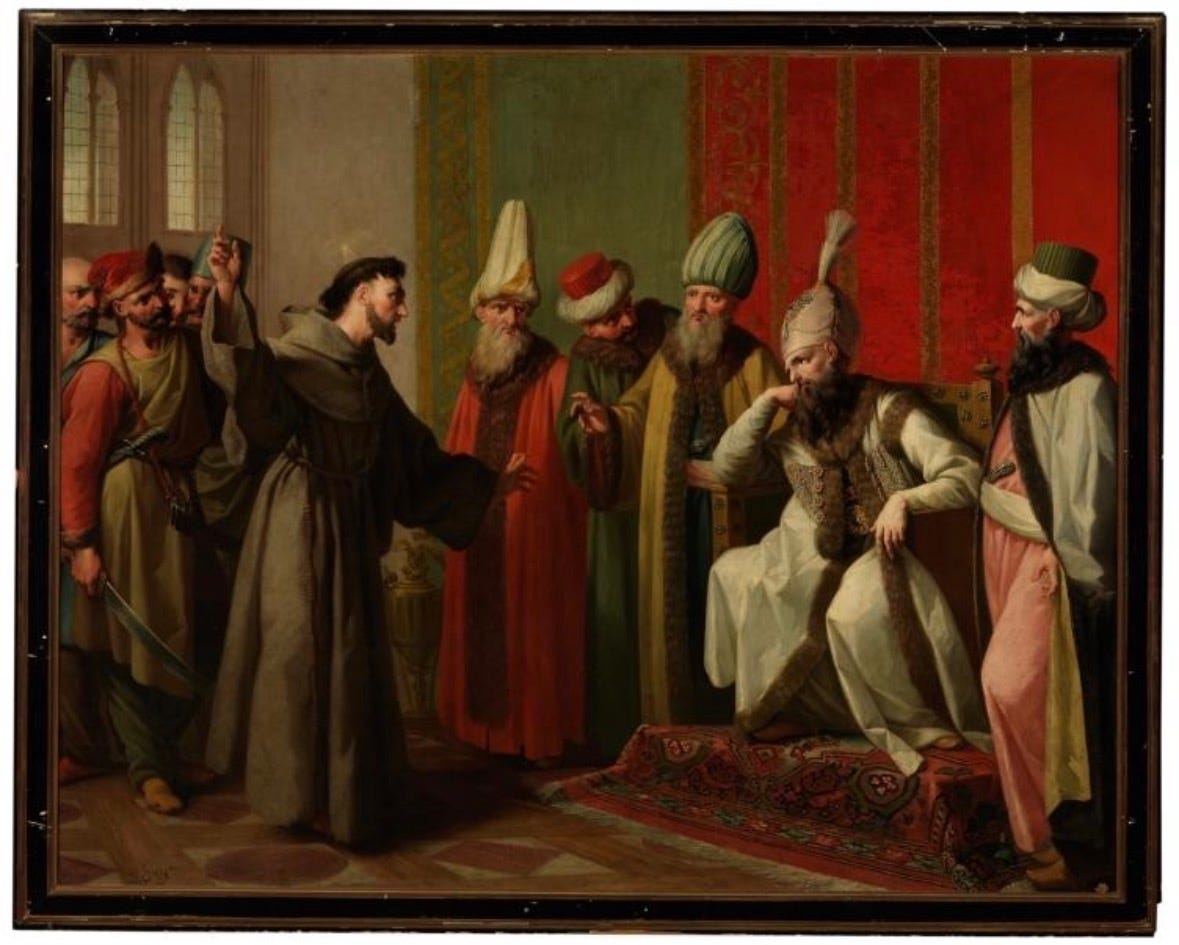
(St. Francis confronting Sultan al-Kamil in Egypt)
Saint Francis has suffered more posthumous editing than almost any Catholic saint.
The modern version appears barefoot, smiling, ecological, interreligious, and safely detached from dogma. He blesses animals, admires the sun, crosses boundaries, and confirms everyone’s spiritual journey.
The historical Francis lived under a different sky.
He worshipped the Blessed Sacrament with trembling reverence. He demanded obedience to the Roman Church because he regarded her as the guardian of the true Faith. He preached penance. His Rule spoke of friars living among Muslims, while preserving a missionary purpose that included the proclamation of the word of God when it pleased the Lord.
Francis went to the Sultan during the Fifth Crusade. Modern retellings often turn the meeting into an early interfaith summit. Medieval sources present something sterner: Francis sought access to a Muslim ruler because he desired martyrdom and the conversion of souls.
His courtesy never required silence about Christ. His poverty never dissolved doctrine. His peace never rested upon the fiction that contradictory religions lead men equally toward God.
When Leo says Gospel radicalism stands opposite fundamentalism, he borrows Francis’s authority for a distinction foreign to Francis’s world. The saint knew fanaticism, violence, pride, and false zeal. He also knew that Mohammedanism was false and that Christ commanded His Church to teach all nations.
Francis possessed the very religious identity modern churchmen approach with embarrassment.
The Convenient Elasticity of “Fundamentalism”
“Fundamentalism” works because the word can mean almost anything.
It may describe terrorism. It may describe a Protestant who reads Genesis literally. It may describe a Muslim theocrat. It may describe a Catholic father who refuses religious indifferentism.
Its vagueness gives it power. A churchman can place violence and doctrinal rigidity within the same rhetorical neighborhood without directly accusing his target of violence. The audience supplies the association.
The traditional Catholic becomes troubling because he believes religious truth places real obligations upon society. He believes false worship harms souls. He believes rulers remain subject to Christ. He believes the Mass handed down through centuries carries a claim stronger than a diocesan permit. He believes conversion is an act of charity. He believes the Church received a mission to teach, govern, and sanctify rather than facilitate dialogue among identities.
Such a Catholic need never strike anyone, hate anyone, or serve a nationalist movement. His convictions alone disrupt the conciliar peace. He still speaks as though Catholicism is true in a way Islam, Orthodoxy, Anglicanism, and secular humanitarianism are false.
That is the boundary Assisi has labored to blur.
The SSPX Understands the Dispute
The strongest defense of Leo’s address runs as follows: he was speaking to young Europeans shaped by war, nationalism, online propaganda, and social fragmentation. He wanted them to reject hatred while living visibly Christian lives. He explicitly spoke of following Jesus and described Christian witness as demanding. His comments should therefore receive a generous reading.
That defense carries some weight. The speech contains orthodox phrases. Leo spoke of discipleship, vocation, prayer, sacrifice, and Christ’s continuing presence in the Church. .
The problem lies in the governing pattern. Rome’s generosity always travels in one direction. When a Muslim retains a strong religious identity, churchmen seek dialogue. When an Orthodox Christian rejects papal claims, churchmen praise fraternity. When a punk singer denies Christian morality, the Vatican discovers cultural partnership.
When Catholic traditionalists hold tightly to the inherited Mass and preconciliar doctrine, Rome reaches for words such as disobedience, rupture, rebellion, schism, and fundamentalism.
The SSPX understands that the liturgical war cannot be separated from this doctrinal revolution. The old Mass embodies a religion of sacrifice, hierarchy, conversion, judgment, propitiation, and objective truth. The new ecclesial establishment prefers encounter, listening, coexistence, accompaniment, and the managed softening of every boundary that causes modern man discomfort.
This explains why Rome can tolerate nearly any Catholic experiment except the recovery of Catholic certainty.
The Mother Who Corrects Everyone Except Her Revolutionaries
Later in the Assisi meeting, a young man quoted the Rule of Saint Francis on obedience and reverence toward the Roman Church. He asked how Catholics could remain faithful to a Church marked by contradiction and crisis.
Leo answered by describing the Church as a mother. Catholics, he said, should participate in the work of building her up, walk together, support one another, and correct one another along the way.
The maternal image is true. A mother gives life. She teaches. She nourishes. She corrects. She protects her children from poison.
The crisis begins when motherhood becomes a demand for unconditional submission to administrators who tolerate poison while confiscating bread. Rome invokes maternity when traditional Catholics resist. It invokes pilgrimage when doctrine shifts. It invokes dialogue when false religion advances. It invokes law when the SSPX acts.
A mother who welcomes every stranger into the house while punishing the children for guarding the family altar has lost the meaning of hospitality.
Assisi After Écône
The August 6 speech would have sounded different before July 1.
After Écône, it forms part of the record.
Leo’s government has identified the SSPX as a danger to communion. At Assisi, Leo identified the entanglement of religion and identity as a danger to peace. He praised centuries of Catholic, Orthodox, and Muslim coexistence, warned against boundaries and prejudice, and placed Gospel radicalism opposite fundamentalism.
The contrast reveals the conciliar settlement in miniature. Rome fears Catholic intransigence more than religious ambiguity. It wants young people radical enough to volunteer, march, welcome, reconcile, and speak of peace. It becomes uneasy when radicalism reaches doctrine, worship, conversion, or the kingship of Christ.
Saint Francis rebuilt churches because he believed the Catholic Faith had a determinate form. Archbishop Lefebvre built seminaries for the same reason. One is now endlessly repackaged as a patron of dialogue. The other remains condemned as a rebel.
That contradiction follows Rome wherever it goes, even when the helicopter lands at Assisi.
If you value independent Catholic analysis and want to help keep this work going, you can make a contribution or subscribe below. Every donation and subscription directly supports the writing, research, and production of Hiraeth in Exile.
Thank you for helping preserve independent Catholic journalism rooted in truth and tradition.
Hiraeth In Exile is a reader-supported publication. To receive new posts and support my work, consider becoming a paid subscriber.
Comments
Nothing yet. Say the first thing.
Sign in to join the conversation.