
Inspired by Jared Henderson’s post on free philosophy lectures, I want to share some of my favorite free online resources for learning PPE—i.e., philosophy, politics, and economics, an interdisciplinary degree that’s been growing ever since it started in Oxford a century ago.
Note: I’ve tried to include a variety of sources, media, and viewpoints, but this is not a comprehensive list. Tell me in the comments what you think I’ve left out!1
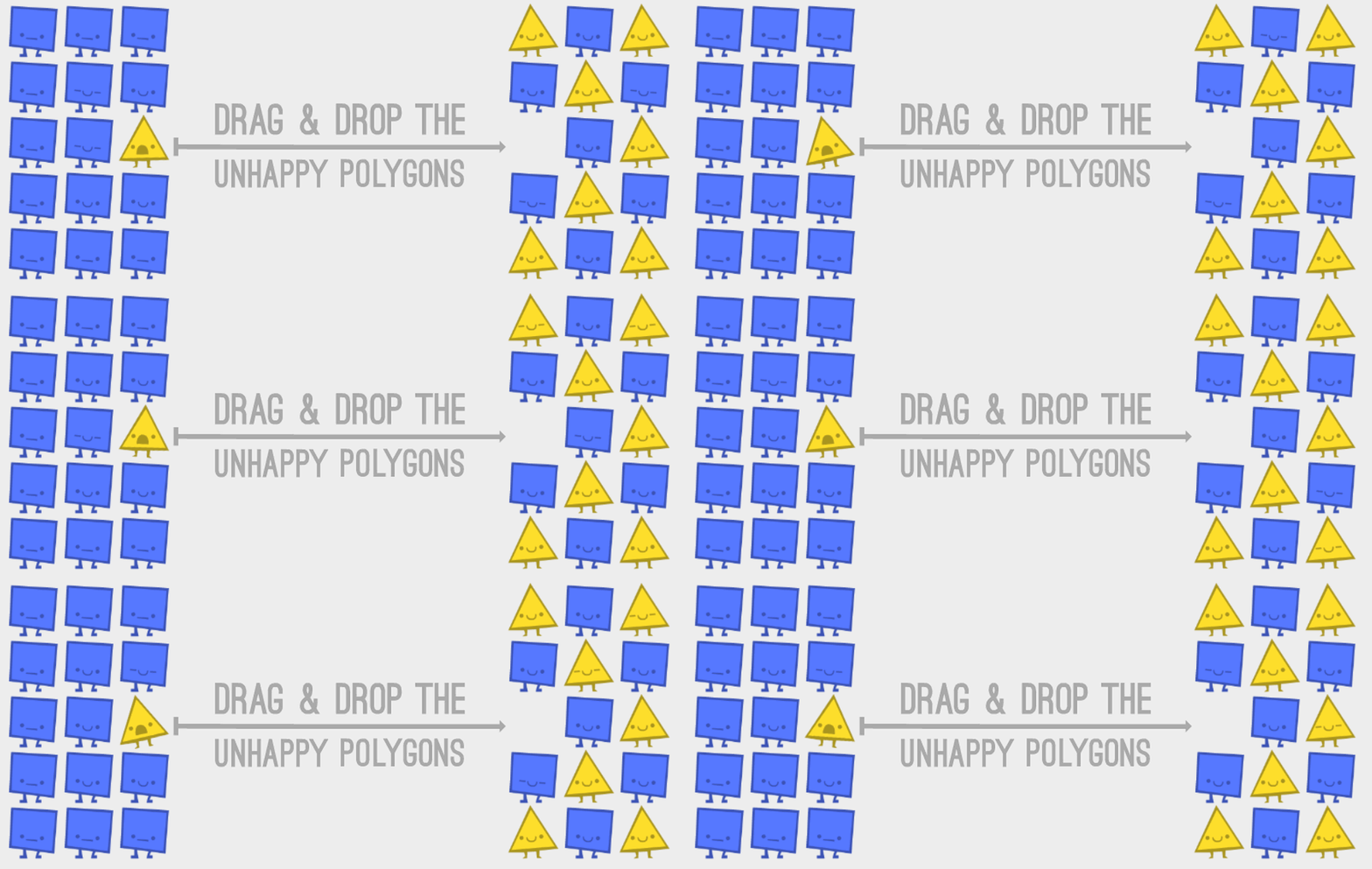
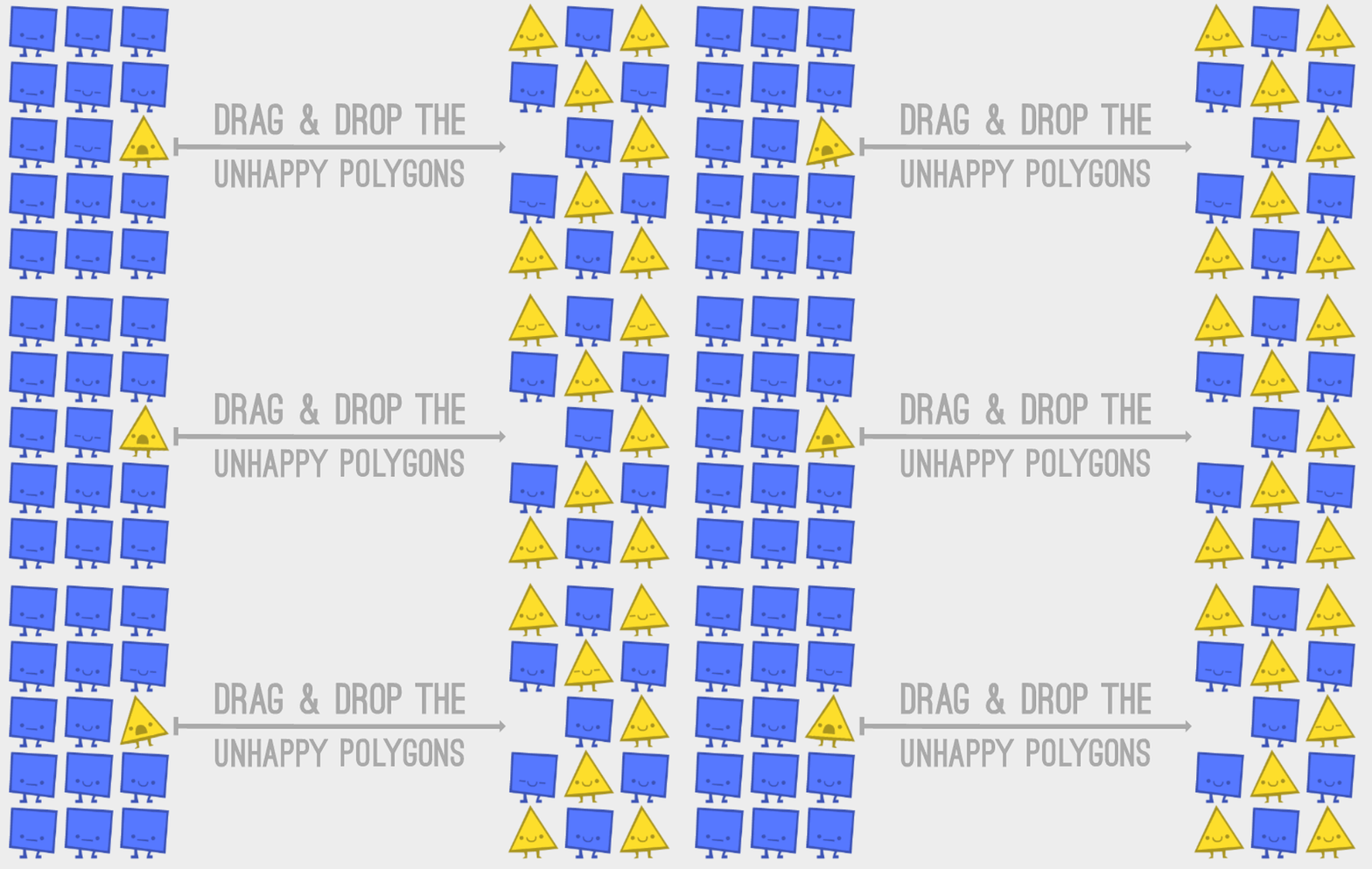
Created by Vi Hart and Nicky Case, this game lets you play around with Thomas Schelling’s model of segregated neighborhoods. It’s a perfect way to see how micromotives cause macrobehavior.
Another Nicky Case gem—this time, based on Robert Axelrod’s Evolution of Cooperation. Probably the single best introduction to the Prisoner’s Dilemma that you can find online.

For more on the repeated Prisoner’s Dilemma with noise, see Axelrod’s follow-up The Complexity of Cooperation—in particular the material about “generosity” and “contrition.”

The definitive zero-player game, John Conway’s Game of Life lets you see how self-sustaining patterns can emerge from extremely simple deterministic rules. Dan Dennett once said every philosopher should have to study it before they’re allowed to start writing.

Elinor Ostrom, “Beyond Markets and States”
This is the best version of Ostrom’s Nobel Prize lecture—a wonderful mix of theoretical and empirical insights about how people actually solve collective action problems.
For more on Ostrom, see Ashley Hodgson’s excellent videos.
Robert Putnam, “Bowling Alone”
A precursor to the classic book on community (aka social capital). This talk was five years before Bowling Alone turned Putnam from an academic “big deal” into an actual big deal. You can feel the electricity in the room as people realize they’re in the presence of something much bigger than your usual lecture.
Joseph Heath, “Recent Advances in the Understanding of Human Sociality”
A romp through big ideas in the philosophy of social science.
Geoff Sayre-McCord on Adam Smith
Speaking of great speakers…
Ian Shapiro, “Power and Politics”
If you subscribe to Big iff True, you knew this was coming. One of the greatest PPE courses ever taught. I especially recommend the lectures on money in politics, distributive politics, and 9/11.
See also my interview with Prof. Shapiro about After the Fall, his 2026 book based on this course.
Ian Shapiro, “Moral Foundations of Politics”
Not my fault the guy has two outstanding online courses. Don’t miss the lectures on Rawls, Burke, Locke, Nozick, and the “neoclassical synthesis” of rights and utility.
John Rawls, “Modern Political Philosophy”
Somebody needs to freshen up the audio and chuck in some metadata, but this is still an invaluable resource—a class on political philosophy from the most influential American political theorist of the last century, who was also a famously conscientious teacher.
David Blight, “The Civil War and Reconstruction”
My own view is that, if you want to study PPE, you should try to study at least a little history (and vice versa). Blight’s lectures on 19th-century America are a perfect case in point. You can’t possibly watch these without learning something about political power, ideology, and racism.
Bonus: Coates on Blight on Douglass.
Speaking of race in America, Clint Smith has a series of shorter videos on Black American History, several of which have great PPE themes: e.g. the vidoes on Women’s Experience under Slavery, Washington vs. Du Bois, and Frederick Douglass.
Marginal Revolution University
An extraordinary resource for econ essentials. Credit to Alex Tabarrok and Tyler Cowen. Here are some playlists to get you started:
The Wealth of Nations (includes a chapter-by-chapter summary—invaluable if you’re about to read Smith)
Veritasium on the Prisoner’s Dilemma and Arrow’s Theorem
Toby Handfield on Social Choice Theory
Ashley Hodgson
An underrated YouTube channel with tons of great economics explainers.
Dan Bonevac, “Mill on Freedom of Speech”
G.A. Cohen, “Against Capitalism”
Brian Leiter and Jamie Edwards, “Marx”
Based on their new book, which I found wonderfully clear and informative. There are also comments by Geoffrey Wodke and Steven Durlauf (who is also, by the way, an important contributor to the debate over social capital).
The Stanford Encyclopedia of Philosophy is the best free resource for learning philosophy—by far.
Here are a few pieces relevant to PPE that you might enjoy:
Funny you should ask…
I didn’t include any interviews because there were just too many to choose from. But I have to mention Bryan Magee’s classic series, Interviews with Philosophers.
No posts
Comments
Nothing yet. Say the first thing.
Sign in to join the conversation.