
In Part 1, we looked at G.A. Cohen’s core objection to capitalism.

Today, we’ll consider a notable response.
Why Not Socialism? argues for socialist ideals using the parable of a camping trip. At the campground, we prefer to be among friends and equals. It would be desirable to make society more like that, says Cohen, even though we don’t yet know any feasible way to run the economy on friendly vibes, as opposed to the “fear and greed” of capitalism.
There’s something charming about this. But it’s a “tepid defense,” says Heath. What kind of socialist won’t even come out and tell you socialism works?
Say what you will about Jason Brennan: nobody has ever described him as “tepid.” The arguments of Why Not Capitalism? are more in the style of “guns blazing,” or “dirty bomb aimed at jugular vein.” For example:
Cohen’s ultimate legacy—the ultimate result of his life’s work defending socialism—will be to help us see that from a moral point of view, the intrinsically best society is capitalist. Cohen also became famous in part for criticizing the libertarian philosopher Robert Nozick. In Chapter 4, I’ll explain that another legacy of Cohen’s work will be to show that Nozick was basically right all along about the nature of utopia. (p. 24)
Even the cover art is a dunk:

Personally, I liked teaching this book alongside Cohen’s. Brennan makes a number of interesting points that are worth any student’s time.
For example, Brennan argues that Cohen’s use of “camping trip” stacks the deck against capitalism. Cohen lovingly describes all the good things about his socialist version of the trip—bonhomie, sharing, etc.—but none of the downsides. When he imagines the more capitalist camping trip, he does the opposite, focusing on greed and fear. Brennan calls this the “the essential flaw” of Why Not Socialism?: instead of comparing ideal socialism to ideal capitalism, or nonideal socialism to nonideal capitalism, Cohen compares ideal socialism to nonideal capitalism.1
To even the odds, Brennan presents a capitalist spin on Cohen’s camping trip—the Mickey Mouse Clubhouse Village. In this idyllic community, the villagers share some facilities but also enjoy their own private spheres. They all “cooperate with a common desire that everyone have the freedom and resources to flourish under their own conceptions of the good life” (p. 26). Some villagers work for others—like Daisy Duck at Minnie Mouse’s Bowtique—but wages are fair, and the workplace is respectful. Villagers do their part, have fun when work’s done, act with extreme kindness, and accept one another’s differences. It’s a utopia. To “reinforce” that point, Brennan invites you to consider an alternative Clubhouse where the villagers act like socialists. Donald murders millions of people as he forcibly nationalizes the farmland. Goofy throws dissenters in the gulag. Minnie’s “five-year plans” wreck the economy. Mickey installs himself as Premier for life. It’s dystopia of coercion and deprivation.

Why is the capitalist Clubhouse Village more attractive? Brennan highlights five principles:
Voluntary Community: Everyone lives together without threats of violence.
Mutual Respect: People tolerate each other and value diversity.
Reciprocity: Each has something to offer to society, and people take pride in being able to exchange value for value.
Social Justice: Nobody has to live an indecent life, thanks to the norms of trade and property rights, inter alia.
Beneficence: Everyone is motivated to help those in need.
Now, there are three types of objections you might have to this list.
First, you might deny that these principles—however nice they sound in the abstract—are really so desirable to realize in society. For example, anti-liberals might argue that mutual respect is bad when some people hold views that aren’t worthy of respect. Should we tolerate totalitarian ideologies? “Harmful” views about gender? Would you value a diversity of opinions about whether the Jews caused 9/11?2
Second, you might grant the goodness of the principles while denying that they are characteristic of capitalism. In a review, Dan Iley-Williamson contends that all of Brennan’s principles are compatible with socialism. Even if that’s not right, readers may wonder: why should any sort of social justice be essential to, or even compatible with, capitalism?
There’s something right about this challenge. But let me try to stick up for Brennan a little here, since I think he’s making an underrated point. When we talk about the basic legal institutions of capitalist societies—property law, contract law, criminal law, etc.—we’re usually critiquing them. (If not just taking them for granted.) But it’s at least arguable that these institutions are, in part, the legacy of historic moral victories. To see what I mean, consider a pre-modern struggle over contracts—the saga of the colleganza in medieval Venice. The colleganza was a type of arrangement between an investor and a traveler: the investor would fund a trading voyage, the traveler would actually go on said voyage, and afterwards the two would split the profits. Of course, any Marxist would call this division of labor exploitative—why should the rich guy who stays home get to make any money? But at the time, the colleganza was seen as a threat to idle rich guys, since it gave enterprising commoners a path to nobility and prosperity.3 Puga and Trefler (2014) argue that political elites responded to the colleganza by cracking down and installing a very different set of legal institutions, designed to entrench the incumbent elites—a disaster for both community and equality.
…starting in 1297, a small group of particularly wealthy merchants blocked political and economic competition: they made parliamentary participation hereditary and erected barriers to participation in the most lucrative aspects of long-distance trade. Over the next two centuries this led to a fundamental societal shift away from political openness, economic competition, and social mobility and toward political closure, extreme inequality, and social stratification.
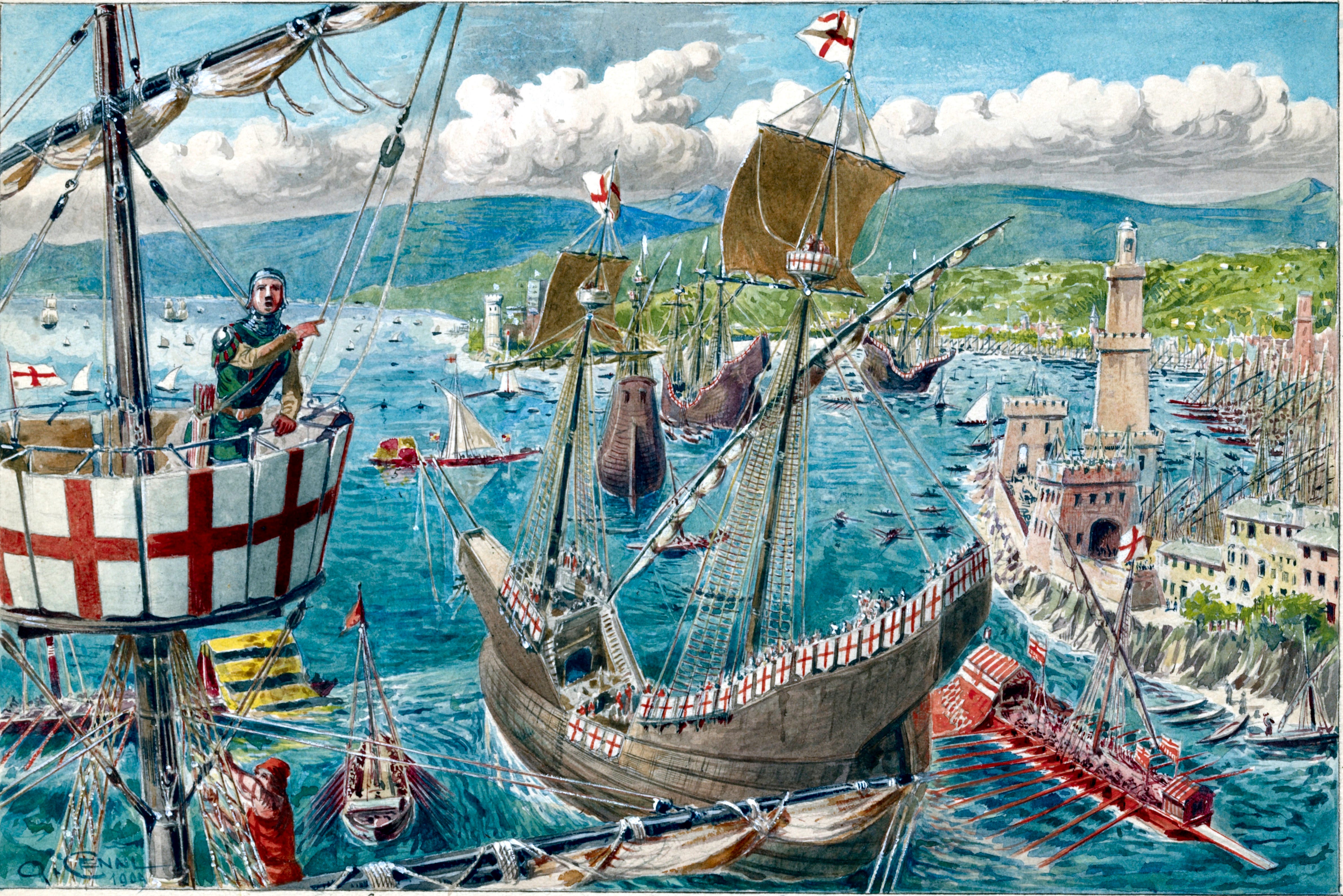
In sum, it’s an interesting question whether Brennan’s principles are all desirable and all capitalist, but even if we disagree with him, we shouldn’t go overboard, caricaturing market institutions as—always and everywhere—pure fear-and-greed machines designed by wealthy elites. Sometimes the elites are the ones trying to constrain markets, either to protect themselves from competition or prevent commoners from climbing up. It’s worth remembering that our modern legal system is, in some important respects, an inclusive institution worth preserving.
Finally, you might find yourself thinking, this whole Mickey Mouse style of argument is ridiculous! Brennan is just stuffing all the good stuff he likes into this community and calling it capitalist. How does that prove that capitalism is morally superior? Fair question! But did you ask the same about Cohen’s camping trip? The styles of argument are, by design, quite similar. (Of course, you might think that neither argument is persuasive, but then the socialist isn’t going to get much juice out of Cohen.)
Now for my favorite part of Brennan’s book, which has to do with community and equality. Recall that, for Cohen, community requires more than warm fuzzy feelings. It may require us to redistribute people’s just holdings, since inequality makes it impossible for us to relate to one another as fellows.
We cannot enjoy full community, you and I, if you make, and keep, say, ten times as much money as I do, because my life will then labor under challenges that you will never face, challenges that you could help me to cope with, but do not, because you keep your money. (p. 35)
Cohen illustrates with a lovely example: the bus-rider and the car-driver.
I am rich, and I live an easy life, whereas you are poor, because of regrettable choices and/or bad option luck, and not, therefore because of any lack of equality of opportunity. You have to ride the crowded bus every day, whereas I pass you by in my comfortable car. One day, however, I must take the bus, because my wife needs the car. I can reasonably complain about that to a fellow car-driver, but not to you. I can’t say to you: “It’s awful that I have to take the bus today.” There is a lack of community between us of just the sort that naturally obtains between me and the fellow car-driver. And it will show itself in many other ways, for we enjoy widely different powers to care for ourselves, to protect and care for offspring, to avoid danger, and so on. (pp. 35–6)
In short: we need equal incomes, or else we’ll live in what Tom Nagel once called “essentially ununifiable worlds.” For Cohen, that means bye bye, community.
But does economic inequality always undermine communal relatability? Brennan has his doubts. Think of communities based on a shared hobby—Brennan’s example is guitar geeks. Or consider the kinds of communities that can exist within an academic hierarchy.
As a graduate student, I had little difficulty being in community with my advisors, though they made at least ten times my income. Despite these differences, we had and have much stronger community with one another than we do with many others who have identical wealth. (p. 126)
I think Brennan’s point is a fair one. Cohen underrates the possibility of being in community with people who aren’t your equals.4
How could the socialist respond? They might concede that community is possible when there are relatively small income differences. But can any ordinary person be in community with a centi-billionaire? Forget the car: what about private jets? Private space shuttles? Private companies building space shuttles? Private mega-bunkers across the globe?
Maybe Cohen’s principle of community gets its revenge when we think of wealth on a larger scale.5
But Brennan has one more trick up his sleeve—pluralism. If differences undermine community, it won’t be enough to equalize incomes. What if we have different religious beliefs? Different values, tastes, and aspirations? Isn’t it bad to stamp out diversity, and perverse to do it in the name of community? Brennan thinks so, illustrating with a “Borg Camping Trip.”
Like Star Trek’s Borg Collective, everyone is the same. There are no differences in taste, values, appearance, mannerism, talents, skills, behaviors, preferences, ideas, beliefs, ethnicity, religion, lifestyle, and dreams. After all, they reason, the more distinct they are from each other, the harder it is for them to understand or empathize with each other, and so the harder it is for them to maintain community. (p. 120)
Brennan finds this “repugnant”: community is just “one value among many,” and the Borg Camping Trip maximizes it until it “destroys everything else that matters.”
One way to think of this is as a symptom of Cohen’s own lack of pluralism, specifically in his theory of values. Yes, he has equality and community—égalité and fraternité, as they were called during the French Revolution. But what about the Revolution’s other value? Whatever happened to liberté?6
If you’ve just read Cohen for the first time, I can easily recommend Brennan as a next step. Right-leaning students will get their first taste of a lot of important ideas—like the leveling-down objection. Left-leaning students will confront all sorts of provocative questions—like “Do we really need equality in order to have community?”7
But we’re not done yet. In Part 3, we’ll encounter one of the decade’s most ambitious attempts at philosophical jiu-jitsu—a dense, demanding paper full of high-proof insights about cooperation and human nature. We’re taking a cold, hard look at Joseph Heath’s argument that, for creatures like us, in large societies like ours, Cohen’s own principle of community is best realized by none other than his arch-nemesis: market capitalism.
Will Joe pull the rabbit out of the hat—or will the magic trick fall flat?
Cohen’s argument involved a kind of cheating, but I doubt Cohen realized he was cheating. Cohen probably thought there was no need to compare ideal capitalism to ideal socialism, because he thinks that “ideal capitalism” is an oxymoron—you know, like “business ethics” or “military intelligence.” (p. 77)
Relatedly, are we sure that Brennan-style reciprocity is desirable? Granted, many people do take pride in “having something to offer.” And social science does seem to indicate that, as Tibor Rutar puts it, “market competition is pro-social” in some important sense. But people also are outraged by so-called “price gouging”—e.g. jacking up the prices of water after a hurricane, or hand sanitizer during a pandemic—which is just market reciprocity at work. This point, too, has been consistently supported by social scientific findings. In the words of Nobel laureate Richard Thaler, “Basically, it just isn’t socially acceptable to raise prices in an emergency.”
For example, Patrisse Cullors, co-founder of the Black Lives Matter Movement, has advocated abolishing the court system. In An Abolitionist’s Handbook (p. 8), Cullors writes:
Abolition centers on getting rid of prisons, jails, police, courts and surveillance. Period.
“No courts, period” is a bold proposal. Cullors is, by any reckoning, one of the most influential activists in the world. Why has there been so little discussion of her take on the legal system? Do people think we can have social justice in a world without any courts? Maybe they assume she doesn’t mean it?
Consider also LastBlueDog on masculine hierarchies:
Placement in a male hierarchy, explicit or otherwise, is the mark of success in cultivating one’s masculinity. And here’s the thing progressives miss: being at the bottom is okay. In healthy male hierarchies everyone has a role to play and gets respect if they do it well. The guy riding the bench on the football team is still on the team. The only thing that’s unacceptable is being kept outside of the hierarchy entirely. That’s rejection of you as a man, not being accepted at the bottom. Progressive attempts to abolish hierarchies run counter to men’s instincts and also create structures in which men don’t know how to function.
What do you think a left egalitarian like Cohen—or like Liz Anderson—should say in response?
(Yes, of course, they could point to particular examples where hierarchies go wrong. But that doesn’t make the problem go away: some communities depend on hierarchy, and it’s not obvious what to do about that fact. Abolish those communities? Do harm reduction? Just suck it up and live with the badness? Surely some especially immoral hierarchies should be abolished, such as what Blight calls the “slave society” of the antebellum South. But every hierarchy? (Are we abolishing high school prom, the Super Bowl, the Billboard Hot 100, Substack leaderboards, etc.?) For more, see Brad Skow on status inequalities and Joe Heath, “Egalitarianism and Status Hierarchy,” Chapter 3 of Cooperation and Social Justice.)
At some point, however, I think the Cohenite socialist is going to have to go beyond relatability to talk about other aspects of community, like “thin trust” (which even unequal societies might have in spades) and “the dark side of social capital” (e.g. suffocating obligations to share with kin and friends, greater familial control over marriage and work, increased racial conflict due to “bonding social capital” within groups, ritualized inculcations of loyalty).
Sadly there isn’t a big knob on top of human society with “COMMUNITY” written on it—and even if there were, cranking it up might stir up energies that Cohen would rather leave dormant. It’s worth remembering that when George Orwell was trying to persuade England to go socialist, he appealed primarily to patriotism—not exactly the go-to value of American socialists. For example:

That’s the DSA’s Darializa Avila Chevalier, Democratic nominee for NY’s 13th district. When pressed about the deleted tweet, she didn’t exactly take it back.
To be clear, I’m not saying anything about whether patriotism and nationalism are good. I’m just saying there’s a tension between thinking patriotism is cringe, as many contemporary socialists do, and basing your socialism in love of community, as Cohen does. In the 21st century, the most potent communitarian force in the world is probably flag-waving, patriotic nationalism. Even people’s most heartfelt commitments to political principles—whether to socialism, liberalism, or democracy—don’t have the same resonance. When Ukrainians volunteer to fight in the fourth year of a deadly war, do you think they’re fighting for the timeless principles of liberal democracy? They’re fighting for Ukraine.
It’s interesting that, in the history of political philosophy, individual liberty and collective diversity have tended to go together. “Liberty upsets patterns,” Robert Nozick used to say. The main text of Friedrich Hayek’s The Constitution of Liberty literally ends on the word “diversity.” Edmund Burke goes the other way round: a “diversity of members and interests” helps secure a “general liberty.” Or just open On Liberty to a random page and behold.
These days, “diversity” is better known as the fading watchword of academic and corporate progressives, who prefer concepts like “systemic racism” to old-fashioned liberté. See, e.g., my discussion of academic DEI:
(Of course, diversity ain’t dead—read some Ryan Muldoon if you don’t believe me.)
For a more critical take on Brennan’s book, see e.g. Dan Iley-Williamson, who argues that Brennan doesn’t do enough to support free-market capitalism over the alternatives—like welfare-state capitalism and property-owning democracy—and contends that Brennan misreads Cohen at several points. (Thanks to Tanya Polarbear for the pointer.)
Did I leave out your favorite objections to Brennan and Cohen? Remember: Substack sharing is solidaristic caring.
No posts
Comments
Nothing yet. Say the first thing.
Sign in to join the conversation.