
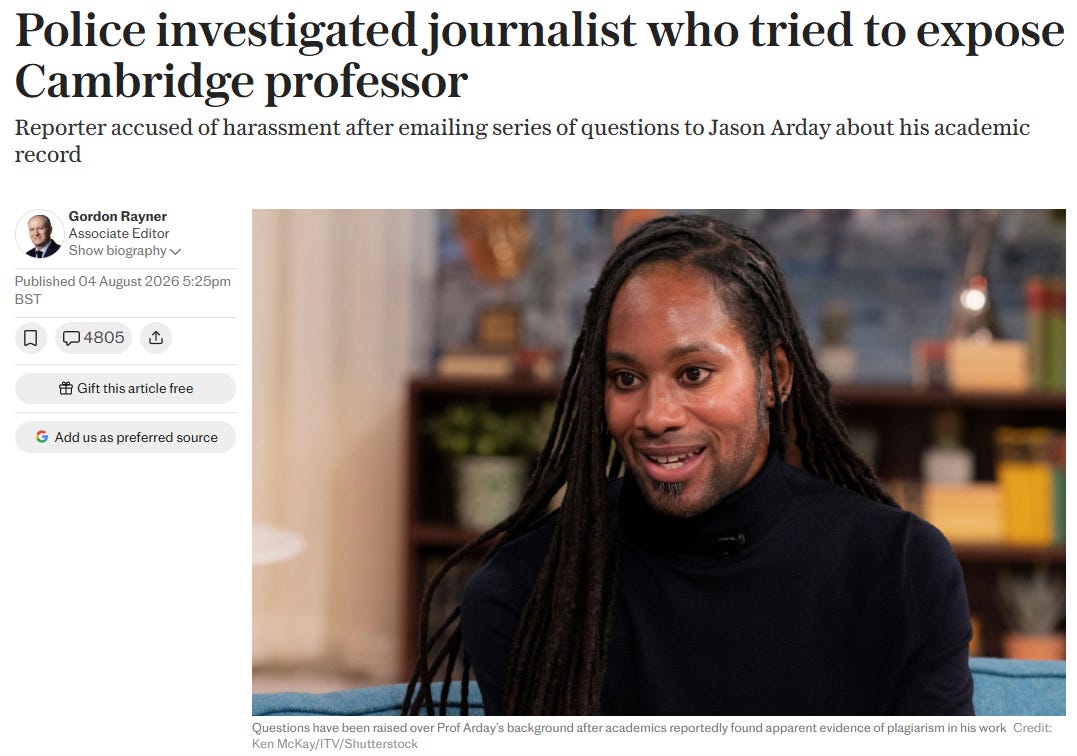
Jason Arday, formerly Professorial Chair in the Sociology of Education at Cambridge University (and onetime Olympic torchbearer), has resigned, shortly after Cambridge announced it was opening an investigation in light of “new information about Professor Arday’s academic qualifications and honorary appointments.”
Good. Arday was a serial plagiarist who lied about his charitable work and academic credentials. He was also taking unethical means to protect himself from scrutiny. When people began raising questions about Arday’s work—which is shot through with stolen text and bogus quotations, as shown by Nathan Cofnas—Arday lawyered up and contacted the police. The result was that, for years, Arday got away with it. When the journalist Jack Grove emailed Arday some questions, for example, Grove’s reward was a warning from Scotland Yard: quit investigating Arday. A powerful academic was using the coercive power of the state to prevent a journalist from doing his job.
What a disgrace.
But while it’s good that Arday is gone, I don’t think it’s good enough.
For one thing, too many academics, politicians, and influential people came to Arday’s defense even after it was abundantly clear that he was plagiarizing. That kind of “circle the wagons” mentality does real damage to the reputation of academia. Those involved should, at minimum, take back what they said—especially the contents of the pathetic “Solidarity Letter” defending Arday to the hilt.
Entirely false allegations of plagiarism were made against Professor Arday and referred to two universities. Investigations have found no evidence whatsoever of wrongdoing. The relevant academic journals also found no basis for the claims.
Yet despite these unequivocal findings, rightwing media have attempted to smear Professor Arday’s reputation and undermine his career. That should concern everyone who believes in academic freedom, fairness and due process.
It is just bananas that distinguished academics like Simon Baron-Cohen put their names to this nonsense. (As did five British MPs! The mind reels.)
Almost as bad was Arday’s “Update” announcing his resignation, which is notably missing a certain magic word. Instead of apologizing—or taking any measure of responsibility for his actions—Arday explains his decision as a way of taking care of his “own wellbeing.” He wants peace and privacy. He wishes to be free from judgement. In Kantian terms, he is following a hypothetical imperative (“if you want it, go for it”), not a categorical imperative (“you should do it no matter what you want”). You can’t justify violating communal norms by citing your own self-interest. Where’s the honor in that?
Read the key bit for yourself (with shameless self-interest in bold):
Sadly, the years since my appointment have also been marked by an unrelenting level of public scrutiny and personal attack. While criticism is an inevitable part of academic life, what I have experienced has gone far beyond scholarly disagreement. The relentless accusations, speculation and public commentary have taken a profound toll on me and on those I love.
I have tried to continue because I believe deeply in the values of higher education, in rigorous scholarship, and in the transformative power of universities. I have tried because of my students, my colleagues and the countless people who have written to tell me that my journey gave them hope.
But there comes a point when the personal cost becomes too great.
I have a family. I want to be present for them. I want to reclaim some peace, some privacy and some semblance of an ordinary life. I no longer wish to feel as though I am living under a constant spotlight, where every aspect of my life is subject to public examination and judgement.
For my own wellbeing, for my family, and for those who have stood by me throughout this difficult period, I have concluded that the only way to bring this chapter to an end is to step away.
This decision should not be interpreted as a loss of faith in scholarship or in the values that first brought me to Cambridge. Nor should it be mistaken for an acceptance of the narratives that have surrounded me. It is simply the decision of someone who has reached the limits of what any person should reasonably be expected to endure.
Again: disgraceful. It’s better than trying to defend the indefensible, but where is the admission of guilt? Where’s the bare minimum of “I’m sorry,” or at least “I did it”?1
For my own part, I don’t believe in holding grudges into eternity. We’re all flawed, after all, and even wrongdoers have rights against excessive punishment and harassment.
But if you’ve violated the core norms of your profession, the bare minimum you should do is admit what you’ve done and say you’re sorry. If you reject the allegations against you—and those allegations are both credible and serious—you are exacerbating the problem, not putting it to rest. And the rest of the academic community has an obligation to take this unresolved problem seriously (as Cambridge finally did), because if we can’t convince the world that we can police ourselves, we are not going to make it.
What makes plagiarism so serious is that it undermines what professors sometimes call our “honor code.” We, as academics, rely on the public’s trust. As teachers, we need the trust of parents. As researchers, we need the trust of our readers. When one of us fraudulently passes off dozens of passages as their own work, or makes up quotations, that is a direct attack on the principles that underwrite academic research. Such actions violate Kant’s Categorical Imperative in a profound way: if every academic lied and plagiarized whenever it suited them, our journals wouldn’t be worth the paper they’re printed on.2 Nor would the academic honor code, if none of us were willing to call out dishonors in our midst.
On a personal level, I really do feel for Arday. I want him to resolve this issue and move on with his life. I don’t want him to be harassed. I don’t want him to get psychologically wrecked by a social media pile-on.
But if someone cheats their way to the highest echelon of academia, and big-shot academics, non-profit leaders, and politicians try to interfere with legitimate inquiries into plagiarism…—sorry, but I have to call that out! This is not my attempt to make Jason Arday and his family feel bad. It is an attempt to stand up for the principle that there is no place in academia for plagiarism or fraud, no matter the perpetrator.
I’ll stand up for that principle when the perpetrator is named Jason Arday. I’ll stand up for it when the perpetrator is named Francesca Gino.
And if anybody who once defended a plagiarist or fraudster decides to switch sides, I will grant full amnesty and welcome them with open arms. But they have to actually switch. “Sorry, not sorry” doesn’t cut the mustard.
One of the remarkable paradoxes of human society is that self-interested groups often punish their own members for mistreating the outgroup. It is no surprise that prison gangs (e.g.) take revenge against an outsider who attacks their members. More interesting is that gangs will also punish insiders for unauthorized attacks on outsiders. Why would they do that?
To quote Shakespeare: “Reputation, reputation, reputation!”3 Often, a group needs to cultivate a reputation for the sake of cooperation with other groups. A company wants to be trusted by its customers; a government wants the trust of its citizens; etc.—and how can a group be trustworthy if it doesn’t care when its members break the rules?
Here is how the philosophers John Thrasher and Toby Handfield (2018) put the point in their paper “Honor and Violence”:
Prison gangs operate on a “community responsibility” system whereby, “Each gang is responsible for their members’ actions, so they have an incentive to monitor their members to ensure they maintain their collective reputation” (Skarbek 2014, 83). We find the same type of mechanism of collective responsibility and reputation used, for similar reasons, by medieval merchants (Greif 2006, 96–97). The punishment of plagiarists in an academic setting also works this way and is frequently prescribed by what is called an “academic honor code.” Professional standards boards frequently inflict sanctions—the most severe being expulsion—upon members who have behaved in ways that damage the reputation of the profession.
Punishing plagiarism is thus a kind of “purification”—i.e. “in-group policing” that signals a group’s commitment to its own norms. Purification may be costly, but precisely for that reason, it is a powerful way to signal “you can trust me.”
I can’t stress it enough: every real academic, who produces actual research, has a fundamental interest in preventing and punishing plagiarism. Every act of plagiarism is an attack on the core principles of academic integrity. Every failure to enforce the norm against plagiarism is a signal that it’s open season—i.e. that anyone can violate our core principles with impunity. It is a good sign that Arday, an unrepentant plagiarist if ever there was one, knew he couldn’t keep getting away with it.
In my view, universities should strive to be inclusive communities. As long as you can teach, research, and abide by the legitimate norms of the profession, you deserve a fair shot at an academic job.
But you have to do the job. And if you don’t (while pretending you did), you should accept the consequences of your actions. It’s the only honorable thing to do.
Bonus note:
Also, I can’t help myself: “unrelenting level of public scrutiny”? The level is unrelenting? Shoddy writing.
On Arday’s fabrication of quotations, see the evidence compiled by the retired academic Dave Harris. Here’s an excerpt, with quotations in bold.
1. There are two articles, published in 2018 and 2022, which pursued two separate projects, one researching students and one staff, and reporting the views of respondents in the form of verbatim quotations. However, two of the quotations in each article, seem very similar (not identical). There is another quotation in one of Arday’s articles which is also very similar to a quotation in Memon et al. (2016) (1).
As examples:Arday (2018a)
‘As a student who is a recent immigrant, my understanding of English is improving daily. As a result, sometimes I struggle to articulate clearly and accurately what I would like to say to the healthcare professionals provided at university. For this reason, I prefer not to discuss my psychological issues as they will misjudge what I am saying and then heavily medicate me’ (Female, Asian, UG, 4).
Arday (2022a p. 95):
‘As someone relatively new to the United Kingdom (UK), my understanding of English is improving daily. Despite my improvements, I still struggle to converse and make sense sometimes of what others are saying… sometimes I struggle to articulate clearly and accurately what I would like to say to the healthcare professionals provided at university. I am aware of the potential manipulation of my words and meanings… and so sadly to avoid a wrong diagnosis, I just I prefer not to discuss my psychological issues, as my biggest fear is being heavily medicated, which would mean potentially not being able to work and having my visa revoked…’ (Female, Latin-American, Female, [sic] Academic, 38).
Arday (2018a p. 16):
‘Positive, interpersonal dialogue between service users and healthcare providers’ (Female, Black, UG, 27) where the consultation was ‘a reciprocal dialogue’ (Male, Asian, PG, 25).
This was considered to be an important factor in facilitating better ethnic minority engagement with mental health services at universities and wider society.Memon et al. (2016) (no page numbers, but found in the section on Power and Authority):
The need for a positive interpersonal connection between service user and healthcare provider where the consultation was “a dialogue” (Male D. FG1) was seen as an important factor in engaging with mental health services.
Othello, Act 2, Scene 3. Iago gets Othello’s lieutenant Cassio drunk; Cassio then gets into a brawl and Othello dismisses him.
CASSIO Reputation, reputation, reputation! O, I have
lost my reputation! I have lost the immortal part of
myself, and what remains is bestial. My reputation,
Iago, my reputation!IAGO As I am an honest man, I thought you had
received some bodily wound. There is more sense
in that than in reputation. Reputation is an idle and
most false imposition, oft got without merit and lost
without deserving. You have lost no reputation at
all, unless you repute yourself such a loser.
Shakespeare pro tip: you probably don’t want to listen to Iago.
No posts
Comments
Nothing yet. Say the first thing.
Sign in to join the conversation.