
David Oks had a great note recently:
This reminded me of an experience I had at MIT, where I was once part of the budgetary rounding error known as the Department of Linguistics and Philosophy.

In grad school, I lived in the Sidney-Pacific graduate dorm, a concentration of nerdiness so dense that it visibly warped the fabric of spacetime. One day, my friend Nic from Sid-Pac was defending his PhD dissertation in math, and a group of us were going to support him. I’d never been to a math defense before—but I was excited to see if I could follow along.
At first, I almost did. Nic was motivating his project, explaining the problem, ruling out easy fixes. There were revealing moments—turns out “boring” is an important concept for mathematical research. Equations appeared and disappeared in puffs of chalk. I was feeling proud of myself for hanging on for dear life.
Then Nic turned to the crowd, sighed a knowing sigh, and said (I’m paraphrasing): “Sorry, friends, but now I have to do the real math.” The rest of the talk was absolutely incomprehensible gibberish. I understood not one sentence for 30 minutes straight.
Humbling experience, would recommend.
I love that memory because I was just so totally dumbfounded. I was in the presence of someone who knew much, much more than I did about something I considered important, to which I had devoted a fair bit of time—and yet, clearly, I didn’t get it. Not even close.
The feeling of undeniable ignorance is probably dangerous in high doses; you don’t want to crush your self-confidence (as I learned the hard way towards the start of grad school). But sometimes it’s nice to be dumbfounded. It’s important to be reminded of how complicated the world is—and how finite one’s knowledge can be.
Most of us don’t have to think about our finitude. Thanks to the division of labor, knowledge workers can spend most of their lives within that tiny slice of the human experience in which they have acquired expertise. A specialist in Kant’s theoretical philosophy may know little about how microchips work, or how Claude works, or how the greenhouse effect works, but if they’re spending most of their days with The Critique of Pure Reason, they don’t have their ignorance rubbed in their faces.
But sometimes it’s good to have your ignorance rubbed in your face—good on a spiritual level, I mean. (I’m not railing against divided labor. Without it, who would have taught me Kant’s theoretical philosophy? Or invented the laptop I wrote my papers on? Made my pencil? Etc.)
With that in mind, I have a question for you.
Seriously. Not a trick question. Take a moment and try explaining to yourself what the greenhouse effect is. It’s the mechanism that climate scientists posit as the driver of global climate change. You’ve probably heard it explained dozens of times. But how does it work?
Whenever you’re ready, read on.
…
…
…
If you’re like me, you might have said something like the following:
The greenhouse effect is when certain gases, like CO2 and CH4, trap heat inside the Earth’s atmosphere—like a giant blanket.
Not bad. But did you notice that this doesn’t really make sense?
Think about it. If greenhouse gases serve as a barrier to heat, why would that make the Earth hotter? Sure, the gases block heat on its way to space. But by the same token, won’t they also block heat on its way from space? When sunlight hits the surface of the earth (or our skin), that heats us up. Why aren’t the greenhouse gases protecting us from that celestial heat source?
I’ll give you another moment to ponder.
…
…
…
The answer is that greenhouse gases only absorb light in certain wavelengths, so they trap only the light coming from the Earth.1
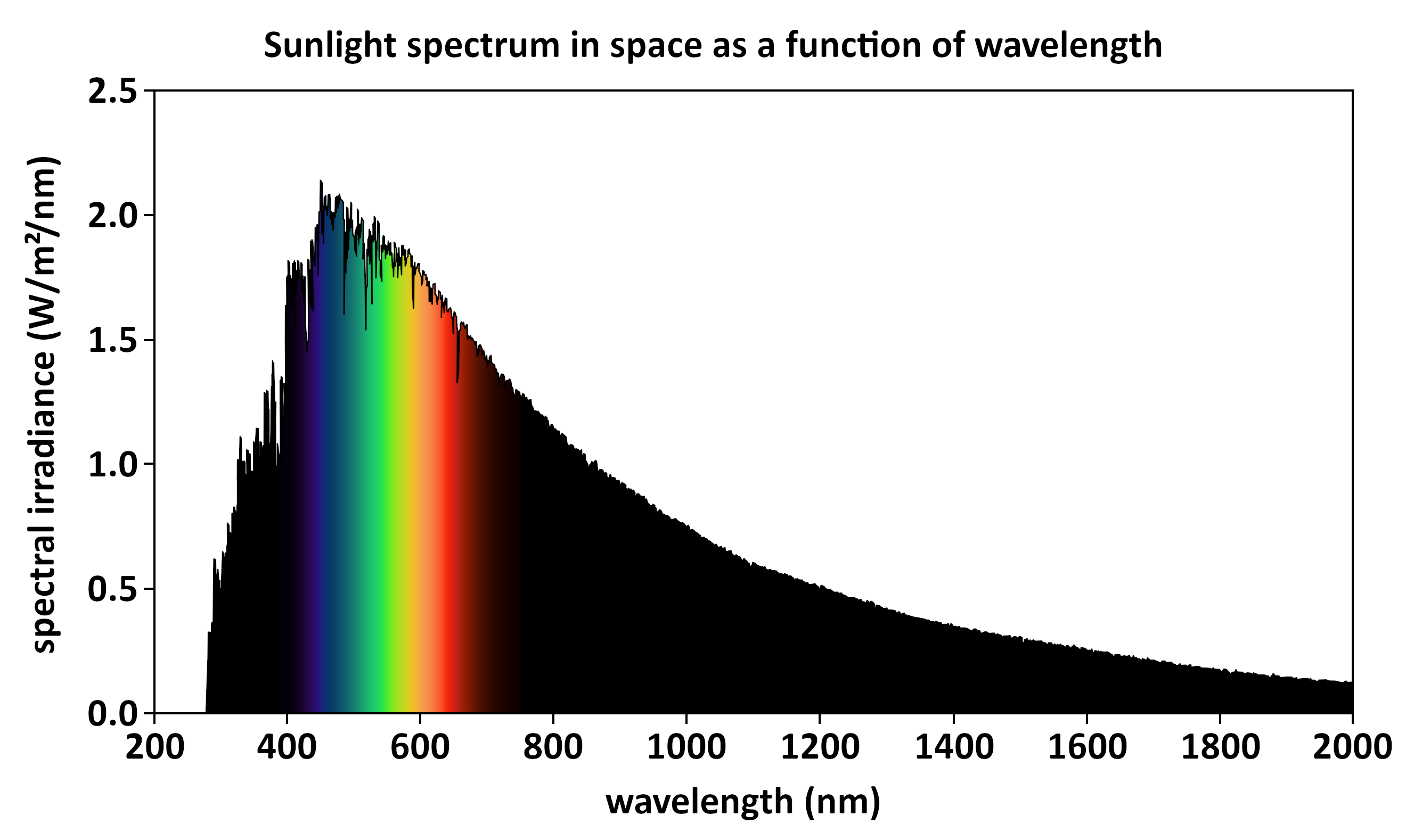
Much of the light that comes from the Sun is “visible light,” with a wavelength between 380 and 750 nanometers. Light from the Earth, however, is infrared, with a wavelength around 10 micrometers, or 10,000 nanometers.
You might be asking yourself: Light from the Earth? What light from the Earth?? Is the Earth secretly glowing when I’m not looking???
That’s a perfectly legitimate sequence of questions.
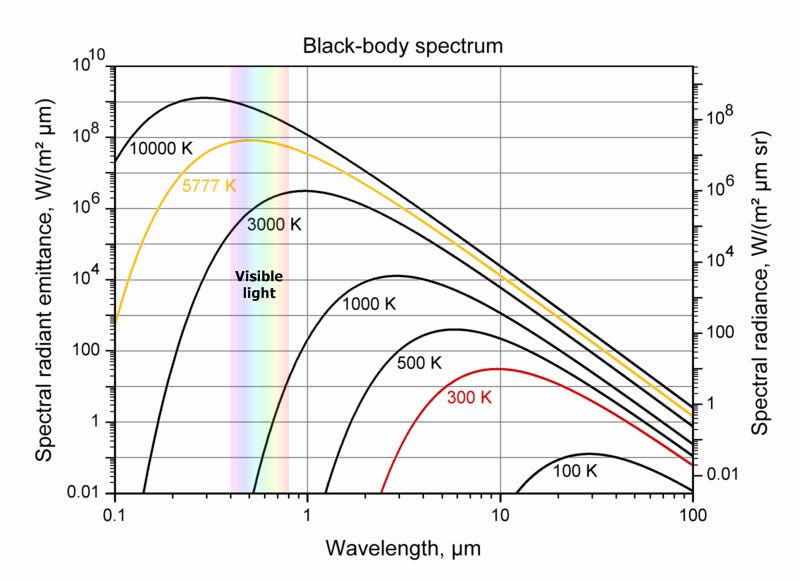
Turns out, the Earth is glowing. In fact, everything is glowing—all the time. Objects give off what’s called blackbody radiation, with the amount and wavelength dependent on the object’s temperature. Cool things emit very little light with a very high wavelength. Hotter things emit much more light at considerably lower wavelengths. When things are ultra-hot, the wavelengths are so low that you can actually see the blackbody radiation. That’s why metal starts to glow when blacksmiths heat it up—really, it was glowing all along, but only in infrared, with wavelengths too high to be visible.2

Let me put some numbers on this. Something at around 20°C (i.e. room temperature) emits essentially zero visible light: the peak wavelength is ~10 micrometers. The surface of the Sun, which is ~5,500° C, has a peak wavelength in the visible part of the light spectrum, and the Sun also just has many orders of magnitude more power (~63 million watts per m2 of radiating surface)—indeed, “the Sun radiates energy more than 100,000 times faster than an object at 20° Celsius.”3
The real explanation of the greenhouse effect, then, is as follows:
Greenhouse gases absorb infrared light and let visible light pass through.
Because the Sun is hot, whereas the Earth is cool, a lot of sunlight is visible, whereas earthlight is infrared.
So, when sunlight arrives at the Earth, it passes through the atmosphere, but when the Earth warms up, the extra earthlight gets absorbed by the atmosphere.
Finally, the atmosphere then gives off heat in all directions—so, half of the heat gets sent back towards the Earth.
This explanation, as you’d imagine, is extremely simplified. What happens next to the heat sent back towards the Earth? Doesn’t the atmosphere have multiple layers, not just one homogeneous one? What about knock-on effects of warming, such as the fact that a hotter atmosphere holds more water vapor, or that melted ice caps make the Earth’s surface less reflective?4
Simple models leave things out. But the common “heat trap” explanation isn’t just oversimple: it’s underpowered—i.e. it’s unable, even granting its assumptions, to explain the thing it purports to explain.
Some of you probably knew all that already. I salute you!
But even you—my eminent readers—would concede that no one is omniscient. The beauty of being dumbfounded is that we get to stare down the gaping void of our own ignorance—and then watch it shrink a little.
I’ll leave you with a saying I picked up from my college buddy Rick Korzekwa. “Confusion is ignorance leaving the brain.” I love that. You couldn’t get further from the vibe in Plato’s Cave, where the reward for teaching people about sunlight is to be made a “laughing-stock.”
Better to be temporarily confused than permanently ignorant!
Not all popular explanations are bad, but even the decent ones are usually unclear. Here’s a piece from the New York Times from 1988:
The greenhouse theory holds that certain waste gases let in sunlight but trap heat, which otherwise would escape into space.
What does it mean to “trap heat,” exactly? If the Earth’s blackbody radiation counts as heat, why doesn’t the Sun’s?
Far worse is NASA’s explainer (“What is the greenhouse effect?”):
The greenhouse effect is the process through which heat is trapped near Earth's surface by substances known as 'greenhouse gases.' Imagine these gases as a cozy blanket enveloping our planet, helping to maintain a warmer temperature than it would have otherwise.
The “cozy blanket” metaphor is misleading, because it implies that outer space is simply cold whereas the Earth is simply emitting heat. There’s no room for the fact that the Sun, from space, is heating up the Earth—using power to the tune of an astonishing 175,000,000,000,000,000 watts. (At least NASA’s animation got it right.)
On a happier note, hero of the blog Thomas Schelling gives one of the best non-expert explanations I’ve ever seen of the greenhouse effect—and suggests a better name (pp. 1–2).
Smudge pots, burning cheap oil on a windless night, produce substances, mainly carbon dioxide, that absorb the radiation and protect the trees with a blanket of warm air. Greenhouses, in contrast, mainly trap the air warmed by the earth’s surface and keep it from rising to be replaced by cooler air. The phenomenon should have been called the “smudgepot effect,” but it is too late to do anything about it.
Dessler and Parson (2019: 1.2.2).
Did you know that water vapor is responsible for half of the greenhouse effect? 75%, if you include the indirect effects of clouds. That’s why Dessler and Parson call water vapor “the most important greenhouse gas in the atmosphere” (2019: 1.2.4).
Of course, you don’t want to infer from this that CO2 is unimportant. More CO2 will heat the atmosphere, allowing it to hold more water vapor!
No posts
Comments
Nothing yet. Say the first thing.
Sign in to join the conversation.