
n.b. this post is too long for emails; nevertheless, I still believe it is accurate to call this a “brief” look. please read on either desktop or mobile! my hope is to have another post in two weeks (as that is the biweekly schedule I have given myself), though I may have to postpone as my life has gotten quite busy. all translations are my own with an exception of the passage from St. Isidore’s Etymologiae.
The number of women earning philosophy degrees in the United States has been increasing over recent years. According to a report by Professor Eric Schwitzgebel, the percentage of women earning PhDs in philosophy has increased from ~27% throughout the 1980s–2010s to ~37% in 2024. The percentage of women earning bachelor’s degrees in philosophy spiked in 2017, rising to >40% after hovering around 32% since the 1980s. Despite the percentage of philosophy degree holders historically leaning in favor of men, the only ancient philosopher who has no evidence of female students is Aristotle. This makes sense when considering Aristotle’s belief that women are unfit for practical wisdom.1 Although there is evidence to suggest that Plato, the Epicureans, the Stoics, and the Skeptics (the three main schools of Hellenistic philosophy in Ancient Greece and Rome) had women as students, their treatment of these women (who would have been upperclass in order to access these schools) was still discriminatory and dismissive. Martha Nussbaum notes that “the beginnings of female philosophizing went hand in hand with the beginnings of sexist "humor" about the character of the women concerned.”2 Nevertheless, when I think of philosophy, I think of women. Not because I am one myself, but because she, Philosophia, is.
In Boethius’ Consolation of Philosophy, we are introduced to a personification of philosophy: Philosophia or—as myself and other scholars sometimes call her—Lady Philosophy. Much to my dismay, there is little scholarship dedicated to Lady Philosophy herself. Scholars who work on the Consolation often find their primary concerns with other features of the text (i.e. its form, completion, genre, musicality, bibliographic elements, philosophic arguments, inter- and metatextuality, debates over its pagan or Christian influence, etc.). For that reason, Lady Philosophy is relegated to their periphery. Before I begin my own examination of Lady Philosophy, I will give a short overview of the ways Lady Philosophy has been discussed in contemporary scholarship (ca. 1980s–present).
“statura discretionis ambiguae,” Stature of Uncertain Judgement
When Lady Philosophy is looked at in scholarship, it tends to be in contrast to other personifications in ancient literature or to the Muses—who serve as her counterpart—in the Consolation. However, these discussions gesture to some ways we may think about Lady Philosophy as a woman. Scholar Anna Crabbe, draws comparisons between Boethius’ personification of philosophia and Augustine’s De Ordine.3 Of the personification in the Consolation, she states:
“[Boethius] is remarkably well-restrained about casting philosophy herself in the answering role of a desirable woman. Physician, wet-nurse, teacher, proctress, any other in the long list of common metaphors, yet the most frequent characterization as the woman desired above all others, unearthly love instead of worldly, is played down to a surprising extent.”4
This statement gives us a conception of Boethius’ Lady Philosophy as an otherworldly, helpful healer. Her allure is her wisdom and sage guidance, rather than the seductive music of the Muses. Likewise, Danuta Shanzer looks at Boethius’ personification of Lady Philosophy in contrast to other use of personifications in the period of Late Antiquity by other authors to represent a sort of revelation or epiphany. Unlike Augustine or Sidonius, Boethius did not Christianize his pagan personification of Lady Philosophy. In that way, Lady Philosophy is similar to Martianus Capella’s Philologia and reminiscent of various divine figures like Athena, Thetis, and Hypatia.5
The accounts by Anders Culhed and Stephen Blackwood situate Lady Philosophy within the Consolation, drawing comparisons between her and the Muses. Cullhed describes Lady Philosophy as “[resembling] a man disguised as a woman. She is in command of her own Muses, the philosophical ones. Their music is controlled by reason and may be described in terms of a carefully dosed antidepressant drug.”6 He considers her to be a sort of part Platonic, part Stoic “therapist” with the Narrator7 as her “patient.”8 For Cullhed, the leading woman of the Consolation is not very lady-like in the traditional sense. In Classical and Late Antiquity, femininity and its associated qualities were viewed as seductive, posing a distraction from the more virtuous and disciplined work of rhetoric and reason as we see with the characterization of the Muses. Blackwood more specifically compares Lady Philosophy to the Muses. He says that Lady Philosophy’s role is “to restore to health, by music, a man whom music has made ill.”9
A historical account of commentaries on Lady Philosophy’s role in the Consolation comes from Katharine Breen. She argues that Boethius’ personification of Lady Philosophy aligns her with the Platonic daemons of Plato and Apuleius. Breen reads Lady Philosophy as a mediator between rhetoric and reality within what she considers a satirical work. This piece offers a critique, examining Lady Philosophy’s limitations, claiming that she displays sexual jealousy toward both the Muses and Fortune, fails to bring the Narrator to transcendence (he turns to prayer instead), and that she is not a divine authority. However, all of these critiques help us situate the Consolation within the traditions of medieval allegorical writing and Neoplatonism.10
The most in depth review of contemporary scholarship on Lady Philosophy’s womanhood thus far is by Wendy E. Helleman. She focuses on the allegorical personification of Lady Philosophy before moving to examine her feminine presence in the Consolation. She views Lady Philosophy’s feminine qualities as emerging from her gentle, patient approach to console the Narrator and restore him back to himself, calling her a “dialectical physician, educator, and spiritual guide.”11 Helleman catalogues the feminine identity of Boethius’ Lady Philosophy through the text’s lack of references “beauty,” her noted “weaving” abilities, and the ways in which Boethius uses language to make maternal metaphors and compare her to a teacher, physician, and nurse.12
Although not a published, formal piece of scholarship, my own undergraduate senior thesis was an exploration of Lady Philosophy’s role within the Consolation.13 I aimed to synthesize and expand upon the use of therapeutic and medical metaphors to argue that Lady Philosophy is not acting simply as a philosopher, but also as a psychagogue (ψυχαγωγός): an ancient soul guide. Through my reading, I suggested that she used what I labeled as the four tenets of psychagogy (ψυχαγωγία)—orality, accommodation, opinion, and ascension—to heal the narrator from his illness (i.e. “lethargy,” lethargus). Additionally, I drew similarities to modern therapy via Cognitive Behavior Therapy (CBT) to show an overlap in methodology; specifically, the ten principles of CBT laid forth by Dr. Judith S. Beck. For those reasons, I believe that we can consider her to be acting as a sort of ancient therapist.
Lady Philosophy is a figure dear to my heart. My aims with this piece are not anything polemical: I seek to draw out ways in which we may be able to think about and imagine Lady Philosophy as a woman. This piece will look in depth at the personification as given in Boethius’ Consolation to see how we can situate Lady Philosophy’s womanhood within its proper historical context, attempting to avoid drawing conclusions that are too modern.
“visa est mulier,” Seemed a Woman
Lady Philosophy’s womanhood is not something Boethius avoids. He explicitly states it upon first sight, calling her “mulier.”14 The choice of declaring her as a woman is notable. At the very least, we can take it to be Boethius opting to lean into the grammatical gender of “philosophia” with some intention. It is an acknowledgement that contrasts with Seneca’s Epistuale 14, which itself gives a brief personification of philosophia, yet does not make any explicit connections to gender.15 Additionally, the Consolation is prosimetric in nature, meaning that it alternates between passages written in either prose or poetry. Although the section introducing Lady Philosophy is rich with imagery, it is written in prose, so we know that the word choice was not based on trying to fit into any poetic meter. Furthermore, her first appearance is also the first prose passage of the text, making me think there is a degree of clarity here Boethius wants to impart on the reader.16
Latin has many words linked to “woman” in English, such as femina, puella, virgo, uxor, coniunx, marita, matrona, and, of course, mulier.17 Uxor and coniunx are most typically taken as “wife.” Similarly, marita and matrona, can also be translated as “wife” for they emphasize the social status of a married woman, putting these terms in contrast with virgo as a “young girl; maiden; virgin.” Likewise, puella is a “young girl; child.” Femina means “woman, female,” leaning into the biological side of gender as sex. Where does this leave mulier, and why might Boethius choose that specific term?
Mulier holds more of a sense of “woman” without the attachment of “wife.” However, it has been used somewhat idiomatically in the sense of “becoming a woman” after marriage similar to how one might say it in English—only more contemporary phrases tend to come after menarche.18 There are a few paths which I think are reasonable for exploring the question of Boethius’ “mulier”: I.) looking at other uses of mulier by various Roman authors across time, of which there are many, II.) seeing what is written in St. Isidore of Seville’s Etymologies, then glancing at ancient queer theory to see how expected gendered social roles are both followed and subverted, and III.) a close reading of Consolation, Book I., Prose 1, where Lady Philosophy makes her entrance. This paper is not necessarily a formal piece of academic writing, nor is it exhaustive in nature, and so I want to be clear that we may only consider this a glimpse at Lady Philosophy’s womanhood. For the sake of this piece and its scope, I will be focusing on the latter two with careful attention given to the appropriate historical understanding of women.
The Etymologies were written during the early seventh century by Isidore, Bishop of Seville, who died in 636 CE before the work was completed; although, it was nearly finished before his death. The book, sometimes alternatively referred to as the Origins, is encyclopedic and contains a multitude of compendiums on essential ancient Greco-Roman and early Christian topics. Some scholars have said: “It was arguably the most influential book, after the Bible, in the learned world of the Latin West for nearly a thousand years.”19 Isidore’s extensive knowledge of Greek and Roman materials can serve as a source for situating our understanding of specific terms within their proper historical context.
Although Isidore’s work is not always etymologically accurate, it nonetheless allows us to gain an insight into the nuances of ancient philology and how terms may have been conceptually perceived. On the word mulier, this is what Isidore has to say:
“17. A man (vir) is so called, because in him resides greater power (vis) than in a woman – hence also ‘strength’ (virtus) received its name – or else because he deals with a woman by force (vis). 18. But the word woman (mulier) comes from softness (mollities), as if mollier (cf. mollior, “softer”), after a letter has been cut and a letter changed, is now called mulier. 19. These two are differentiated by the respective strength and weakness of their bodies. But strength is greater in a man, lesser in a woman, so that she will submit to the power of the man; evidently this is so lest, if women were to resist, lust should drive men to seek out something else or throw themselves upon the male sex. 20. As I was saying, woman (mulier) is named for her feminine sex, not for a corruption of her innocence, and this is according to the word of Sacred Scripture, for Eve was called woman as soon as she was made from the side of her man, when she had not yet had any contact with a man, as is said in the Bible (cf. Gen. 2:22): “And he formed her into a woman (mulier).””20
There is a lot here that some modern readers may find contentious. In particular, the focus on physical strengths and weaknesses between men and women, the notion that women are to submit to men by force, the suggestion that men will seek out homosexuality upon rejection by a woman, ideas of “corruption of innocence,” etc., could cause some resistance. However, it is important to keep in mind that there are differences between how men and women were viewed in Roman society from today’s understanding; though, there are remnants lingering to various degrees depending on one’s cultural groupings.
One useful look at powered gender dynamics in antiquity is Joseph A. Marchal’s Appalling Bodies: Queer Figures Before and After Paul’s Letters. Marchal’s book is a unique dive into a combination of queer and Biblical studies,21 focusing particularly on how to make sense of what contemporary audiences may take as “queer” in antiquity. Though somewhat anachronistic in nature, Marchal draws juxtapositions between past and present figures to examine historical conceptions of queerness within their proper contexts. I find his use of the term “kyriarchy,” coming from the Ancient Greek κύριος (kurios, “lord, master”) and ἀρχή (arche, “sovereignty, power; authority”), to be relevant here. He proposes it as an alternative power structure against applying modern conceptions of oppressive dynamics, such as “patriarchy,” to the ancient world. Marchal defines kyriarchy as follows:
“Kyriarchy is a system where only certain kinds of males are “men”—elite, educated, freeborn, propertied, imperial, and typically from particular racial/ethnic groups—who rule all who might be wo/men–females but also nonelite, uneducated, enslaved, subaltern, and/or often racially or ethnically oppressed groups of males.”22
This definition helps set up Marchal’s later exploration of cinaedi and eunuchs (castrated young men, often sex slaves), tribades (“lesbians,” but more so ancient women who take sexually assertive roles), and overall forms of androgyny, gender, sex, and sexuality in antiquity. Rather than attempting to apply understandings of homophobia or transphobia of the modern world, we may take the ancient anxieties about these queer roles to be caused from their deviation within a power structure where even males are often explicitly denied their manhood in relation to social status.
One type of androgyny came from ancient women who displayed forms of masculinity through virtus in Latin (“manliness, virtue, or valor”) or ἀνδρεία in Greek (andreia, “manliness, bravery, courage”). As Marchal says himself in reference to the work of other scholars on the subject:
“[E]lite Roman men were often pleased to describe elite Roman daughters as similar to their fathers, or to other male kin. Cicero, for instance, calls his daughter, Tullia, “the image of my speech and mind.” By their speech and their studies, daughters were said to bring their deceased fathers back to life.”23
These women, through their relation to their elite fathers, escaped some of the negative connotations of androgyny in antiquity. By proximity to the social status of elite men, androgynous women could sometimes even go as far as to receive praise for their masculine virtues. Let us keep these things in mind as we turn back to Boethius’ description of Lady Philosophy.
“mulier tam imperiosae auctoritatis,” A Woman of such Powerful Authority
When Lady Philosophy appears to the Narrator, he has just finished composing his mournful poem. He silently sits in his prison’s bed accompanied by the Muses as he cries to himself, growing in despair over his misfortune and impending execution. From the Latin, we gather Lady Philosophy “to have stood” (astitisse) above his head (mihi supra verticem). Here, the use of the perfect active infinitive for asto (“stand”) adds an almost peculiar quality to Lady Philosophy’s entrance: it is unclear when exactly she had appeared. The very first description we get is “a woman of quite astonishing looks seemed to have stood over my head (“astitisse mihi supra verticem uisa est mulier reverendi admodum vultus”).24 Already, we get an acknowledgement of Lady Philosophy’s womanhood and a literal positioning of her as “above” (supra) the Narrator. This woman is magnificent in appearance—she is “exceedingly awe-inpsiring” (“reverendi admodum”).25
The passage then continues to detail Lady Philosophy’s appearance more in depth:
“with eyes fiery and more observant than the general powerfulness of man, [her] complexion lively and of unexhausted vigor; although she might have been full of passing time, no one would merely believe her to be of our era; her height of uncertain judgement.”
“oculis ardentibus et ultra communem hominum valentiam perspicacibus, colore vivido atque inexhausti vigoris, quamvis ita aevi plena foret ut nullo modo nostrae crederetur aetatis, statura discretionis ambiguae.”26
From this very first line introducing us to Lady Philosophy, she is given a characterization that deviates from St. Isidore’s account of the word mulier. This is a woman who is somewhat puzzling to decipher. She is both aged and ageless, full of liveliness, and attentive in ways beyond the average man. Lady Philosophy is not weaker than men—her strength surpasses them. Boethius’ description makes her more aligned with Marchal’s account of an androgynous Roman woman, possessing positive masculine traits associated with virtue. Perhaps Lady Philosophy’s ambiguity is part of a feminine androgyny.
While there is no mention of Lady Philosophy’s origin or parentage given by Boethius (she is, instead, timeless), we may be able to think of her as a daughter of an elite man: either Pythagoras or Socrates. The origin of the Greek word philosophia (φιλοσοφία) evolved over time from that of philosophos (φιλόσοφος), a term likely to have originated from the Pythagorean movement. Scholar Christopher Moore has argued against the strictly etymological definition of “philosophos” as “lover of wisdom.” In his book, Calling Philosophers Names: on the Origins of a Discipline, he argues that philosophos began as a pejorative term meaning “sage-wannabe.”27 Moore favors a historical and philological account of the origins for both words, tracing the development of the early negative connotation of philosophos beginning with accounts of Pythagoras into a more positive, redemptive meaning with the term philosophia.28 Although a thorough examination of my suggestion to think of Lady Philosophy as a daughter of either Pythagoras or Socrates is beyond the scope of the paper, I do believe it is worth considering as it relates to her womanhood. As with Cicero’s daughter, Tulia, we can imagine Lady Philosophy to earn her praise through association with men like Pythagoras and Socrates. As with Cicero’s daughter, Tulia, we can imagine Lady Philosophy to earn her praise through association with men like Pythagoras and Socrates.
In the following line, the Narrator goes on to elaborate the strange height of Lady Philosophy. He observes that:
“For at one moment she was confining herself to the common measure of man, and at another she seemed to hit the heavens with the very top of her high head; which whenever she had raised her head higher, it was piercing even the sky and eluding the stare of gazing men.”
“Nam nunc quidem ad communem sese hominum mensuram cohibebat, nunc vero pulsare caelum summi verticis cacumine videbatur; quae cum altius caput extulisset ipsum etiam caelum penetrabat respicientiumque hominum frustrabatur intuitum.”29
The language given her forms a picture of a woman lowering her great height down to that of the average man. Lady Philosophy confines or restrains herself (“sese…cohibebat”) to the measure or capacity of ordinary men (“ad communem… hominum mensuram”). This evokes Isidore’s discussion of mulier in a way the previous line did not. Here, there is a sense of aligning with the gendered traits laid forth by Isidore through submission, lowering herself to the measure of men. However, Lady Philosophy does this because she surpasses men in measure, so much so that her head “hits” (“pulsare”) and “pierces” (“penetrabat”) the heavens. Her presence evades (frustrabatur) the stares of men, which opposes notions of resistance or submission as seen in Isidore. Again, her womanhood shows a degree of androgyny; Lady Philosophy’s femininity is complex in nature.
Although thus far Lady Philosophy’s description has given us an ambiguous or androgynous depiction of a feminine figure, she does conform to some traditionally held feminine gender norms. The Narrator spends some time recounting the features of Lady Philosophy’s clothing (vestes), which are made of the finest threads (“tenuissimis filis”) delicate craftsmanship (“subtili artificio”), and indestructible material (“indissolubili materia”). These garments, as the Narrator later learns (“uti post eadem prodente cognovi”), “she herself had woven with her own hands” (“suis manibus ipsa texuerat”).30 The notion of Lady Philosophy as a weaver aligns her with other ancient female figures, such as both Penelope in Homer’s Odyssey or the goddess Athena; the latter is a noteworthy feminine figure of wisdom herself. Her dress itself seems to be an educational material of sorts:
“Embroidered on the outer edge of these [garments] reads the Greek letter Π, and on the truly highest edge reads the Greek letter Θ. And between these two letters there seemed to be marking steps in the way of a ladder, by which there could be an ascent from the lower to the higher principle.”
“Harum in extremo margine Π Graecum, in supremo vero Θ legebatur intextum atque inter utrasque litteras in scalarum modum gradus quidam insigniti videbantur, quibus ab inferiore ad superius elementum esset ascensus.”31
Woven into her dress is the Greek letter Π (pi), on the bottom trim and Θ (theta), on the top trim. The two letters respectively represent practice (praxis, πρᾶξις) and theory (theoria, θεωρία), and as decorative elements they divide Lady Philosophy’s body: the ladder-like pattern of her dress moves one's eyes from the lower practical philosophy, up to the higher theoretical philosophy. Her dress is not merely fashionable, it provides instructions for moving through the levels of philosophy.
However, not everything with her dress is perfect. Lady Philosophy’s garments show signs of damage:
“The appearance of which [i.e. her garments] a certain darkness had obscured with long neglect just like the foggy statues. […] Yet the hands of violent men had torn these very garments and each man had stolen whatever little pieces he could.”
“quarum speciem, veluti fumosas imagines solet, caligo quaedam neglectae vetustatis obduxerat. […] Eandem tamen vestem violentorum quorundam sciderant manus et particulas quas quisque potuit abstulerant.”32
The destruction of Lady Philosophy’s garments is both natural and manmade, resulting from the wear of time and of men. These men are similar to those St. Isidore contrasts with mulier. While there is no explicit use of the word force (vis), we find a sense of aggressiveness in the language here: these men are “violent” (“violentorum”), using their hands (“manus”) to “tear” (“sciderant”) and “steal” (“abstulerant”) a woman’s clothing (“eandem… vestem”). This is a clear act of violence and attack on Lady Philosophy.33 It is possible that these men, unable to grasp or consider her striking appearance, mistakenly treated her as they might an ordinary woman.
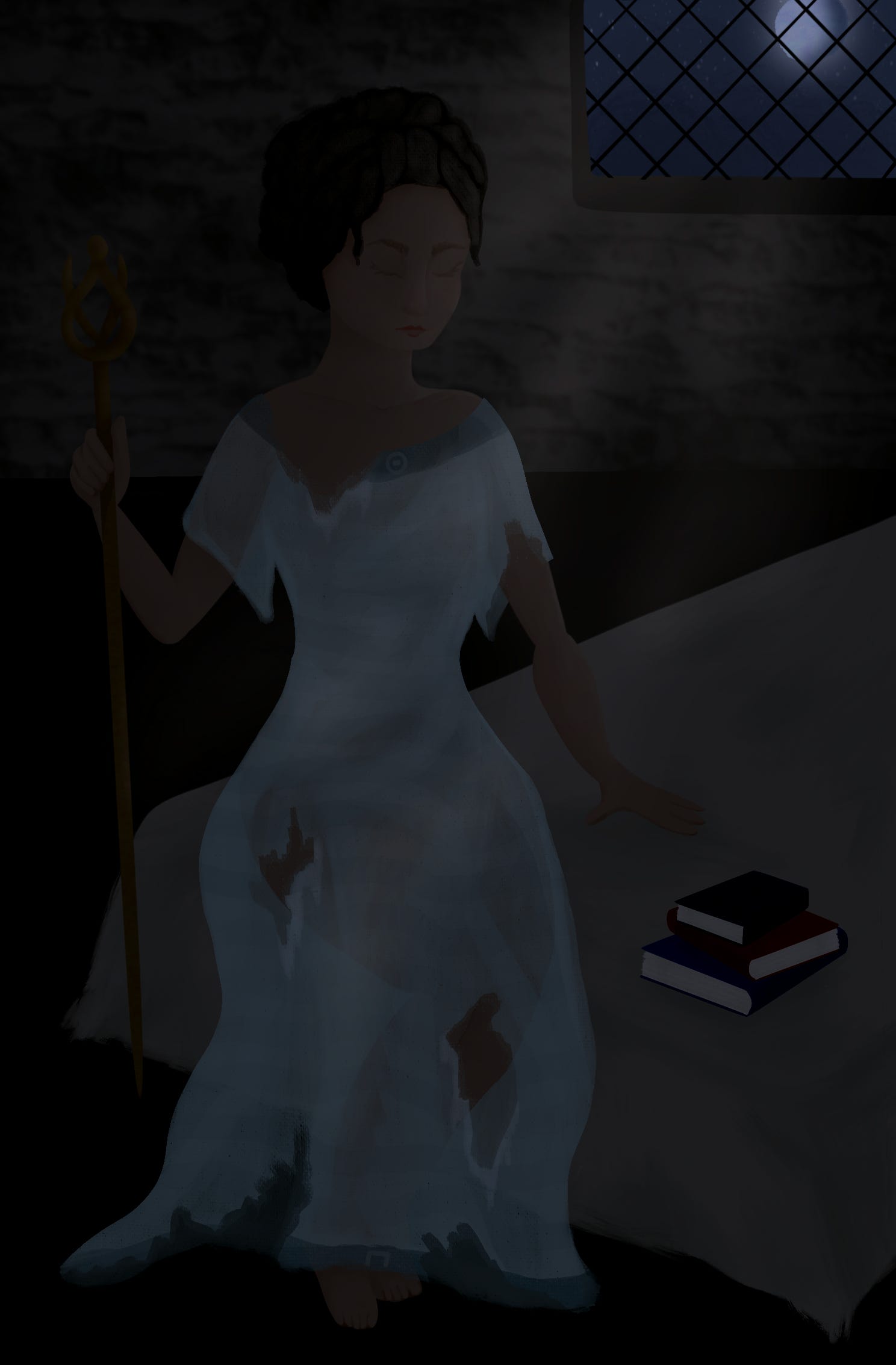
The violent men who attack Lady Philosophy give us one way to look at her positionality within a kyriarchy. We know little about these men other than the brief description of their violent behavior. It is hard to assess who these men were and whether they held more social power than Lady Philosophy herself; my assessment is that they did not, which is why they resorted to violence. Another way we can try to place Lady Philosophy in such a rigid hierarchy is by looking at her interactions with the Muses. When Lady Philosophy catches sight of the Muses by the Narrator’s bedside, she immediately takes charge and begins to scold them:
“”Who,” she said, “has allowed these theatrical whores to approach this sick man? […] You better get gone, Sirens, always up to flattering destruction; leave him to the caring and curing by my Muses.” That chorus, having been rebuked by these words, dropped their mournful faces to the ground and with a shame admitting blush, sorrowfully withdrew from the room.”
“Quis, inquit, has scenicas meretriculas ad hunc aegrum permisit accedere, […] Sed abite potius, Sirenes usque in exitium dulces, meisque eum Musis curandum sanandumque relinquite. His ille chorus increpitus deiecit humi maestior vultum confessusque rubore verecundiam limen tristis excessit.”34
Lady Philosophy’s words have the power to scare away the Muses. She is superior to these women—even possessing her own set of Muses (“meisque… Musis”). The Muses are beneath her, “theatrical whores” (“scenicas meretriculas”) who blush shamefully when chided (“rubore verecundiam”) and bring about a sort of sweet ruin or charming death (“exitium dulces”). Although both are women, Lady Philosophy’s femininity is more akin to the praiseworthy masculine virtues that Marchal would consider the markings of an ancient androgynous woman, whereas all the Muses have to offer is their seductive destruction and appeals to emotions.
Furthermore, there are other reasons to align Lady Philosophy with the elite women of a kyriarchal society. The narrator notes that:
“And indeed she was carrying in her right hand little books, and in her left hand a scepter.”
“Et dextra quidem eius libellos, sceptrum vero sinistra gestabat.”35
The stack of “little books” (“libellos”) she carries indicates that this is an educated woman. Her “scepter” (“sceptrum”) marks her of potentially even greater elite status as we can also think of it as either a “royal staff” or a “teacher’s rod.” Regardless of how we interpret “sceptrum,” it is evidence of a position of authority. Lady Philosophy’s authority over the Narrator is even explicitly stated:
“But I, whose sight drowned with tears was being blinded, was unable to discern who in the world this woman of such powerful authority was; astounded and with my gaze firmly on the ground, I silently began to await whatever she may do next.”
“At ego, cuius acies lacrimis mersa caligaret nec dinoscere possem quaenam haec esset mulier tam imperiosae auctoritatis, obstupui visuque in terram defixo quidnam deinceps esset actura exspectare tacitus coepi.”36
Here, it seems as if the Narrator—a man—is the one acting in submission. He obediently awaits her next move in silence (“esset actura exspectare tacitus coepi”) and declares Lady Philosophy to be a woman with a “domineering authority” (“imperiosae auctoritatis”). The Narrator cannot even bring himself to meet her gaze, choosing to fix his sight on the ground (“visuque in terram defixo”). The positioning of Lady Philosophy over the Narrator makes sense when taking into consideration the context they find themselves in: the Narrator is a prisoner slated for execution. It is easy to imagine that in kyriarchy a man in prison is of a much lower social status than that of the average man—possibly below that of the uppermost, elite woman. The Narrator’s own elite status as a member of the Roman Senate had been taken from him, further strengthening the connection to Marchal’s kyriarchy where only certain types of males are considered “men.”37 Compared to the Narrator, Lady Philosophy is the figure with more merit, despite her earlier assault by violent men.
There is no question as to whether Lady Philosophy is a woman. However, her womanhood is a bit peculiar. Her characterization subverts the expectations of a mulier that we find in St. Isidore of Seville’s Etymologiae: she is neither submissive nor weaker than men. Lady Philosophy's presence is domineering, intimidating, and spectacular as it relates not to any sense of beauty, but rather her power and elusiveness. Her physical appearance is otherworldly and shifting, seemingly ageless and limitless as her height blurs the line between the heavenly and mundane. Like her physical stature, her weaving work blends displays of feminine craft and intellectual knowledge through her embroidered philosophical instructions. Despite being attacked by violent men, she remains undefeated and unconquered, retaining authority over both the Narrator and the Muses. Moreover, these ambiguous traits are characterizations that soften the boundaries between traditionally feminine or masculine gendered expectations; Lady Philosophy is a figure that evades such a rigid binary. Lady Philosophy’s characterization is one that most closely fits with Marchal’s discussion of elite Roman men’s daughters as a type of ancient androgynous woman. These women possessed and received praise for their masculine virtues, and belonged to a kyriarchal class that was higher than most women. We can conceive of Lady Philosophy in a similar manner, holding a higher social status than that of the average ancient woman due to her more manly qualities. Although not everyone may agree with my assessment of Lady Philosophy as an androgynous woman, one thing is clear: she will forever be a magnificent woman.
Thanks for reading // pro legendo gratias tibi ago! Subscribe for free to support my work.
Nussbaum, Martha C. The Therapy of Desire. Princeton University Press. 2018. p. 53-54
Nussbaum, p. 44-45
Crabbe, Anna. "Literary Design in the Consolatione Philosophiae," Boethius: His Life, Thought and Influence. Edited by Margaret Gibson. Blackwell Pub. 1981. p. 252
Crabbe, p. 257
Shanzer, Danuta. “Interpreting the Consolation,” The Cambridge Companion to Boethius. Cambridge University Press, 2009. p. 228-232
Cullhed, Anders. "Boethius: The Maieutics of Consolation," The Shadow of Creusa: Negotiating Fictionality in Late Antique Latin Literature, De Gruyter, Inc., 2015. p. 439
As noted in my previous post on Boethius’ Consolation, I will refer to the first-person voice in the text as the “Narrator” for clarity and to avoid debates over the text’s bibliographic qualities.
Cullhed, p. 442
Blackwood, Stephen. The Consolation of Boethius as Poetic Liturgy (Oxford Early Christian Studies). 1st ed., Oxford UP, 2015. p. 19
Breen, Katharine. “Hello, Nurse! The Boethian Daemon,” Machines of the Mind: Personification in Medieval Literature. University of Chicago Press. 2021. p. 198-200
Helleman, Wendy E. “Lady Philosophy as a Feminine Personification of Wisdom.” Boethius’ Consolation of Philosophy: A Critical Guide. Cambridge University Press. 2024. p. 65-67
Helleman, p. 60-65
I thought this may be worth mentioning. Besides, that ~70 paged project is my baby—how could I not discuss the ways I have examined Lady Philosophy in the past?
Boethius, Consolation of Philosophy, 1.P1.1
“Ad philosophiam ergo confugiendum est; hae litterae, non dico apud bonos sed apud mediocriter malos infularum loco sunt. Nam forensis eloquentia et quaecumque alia populum movet adversarios habet: haec quieta et sui negotii contemni non potest, cui ab omnibus artibus etiam apud pessimos honor est. Numquam in tantum convalescet nequitia, numquam sic contra virtutes coniurabitur, ut non philosophiae nomen venerabile et sacrum maneat. Ceterum philosophia ipsa tranquille modesteque tractanda est.” Seneca, Epistulae 14.11
The text opens with a poetry passage where the Narrator is speaking to the Muses. When Lady Philosophy enters, she speaks in prose, but only to the Muses before turning to address the Narrator himself with poetry in the following section.
This is not every word in Latin that can be translated as “woman,” rather a decent sampling of examples.
“Cicero obiurgantibus, quod sexagenarius Publiliam virginem duxisset, ‘cras mulier erit’ inquit,” Quintilian, Institutio Oratoria, 6.3.75; “si virgo fuit primo, postea mulier,” Lactantius, Divine Institutes, 1.17; the English idiom is anecdotal.
Barney, Stephen A., Lewis, W. J., Beach, J. A., Berghof, Oliver. The Etymologies of St. Isidore of Seville. In collaboration with Muriel Hall. Cambridge University Press, 2006, p. 3
Barney et al., p. 242, XI.ii.17-20
Marchal refers to his project’s approach as “queer” and “counter-kyriarchal” itself, p. 12-13
Marchal, Joseph A. Appalling Bodies: Queer Figures Before and After Paul’s Letters. Oxford University Press. 2020. p. 12
Marchal, p. 40
Boethius, Consolation of Philosophy, 1.P1.1
N.B. Sometimes my translations will vary slightly away from more literal translations; translation work takes careful consideration and my goal is both accuracy and flow. When I point to the Latin, I will give what may be a more literal translation to a.) try to avoid biases that may emerge in my translations of longer passages or phrases, and b.) show that there is often more than one way to render a translation without necessarily making it inaccurate.
Ibid.
Moore, Christopher. Calling Philosophers Names: on the Origins of a Discipline. Princeton University Press. 2020. p. 1
Moore, p. 25-33
Boethius, Consolation of Philosophy, 1.P1.2
Boethius, Consolation of Philosophy, 1.P1.3
Boethius, Consolation of Philosophy, 1.P1.4
Boethius, Consolation of Philosophy, 1.P1.3; 5
Breen reads this assault as it is described later in 1.P3.6-7 as a possible “rape” of Lady Philosophy. She says that “Philosophy describes herself as a victim of an attempted raptus,”(p. 162-163). The word “raptus” can be rendered as “abduction, rape,” and the language used in this passage is what modern sensibilities may be more inclined to interpret as rape with Lady Philosophy crying in protest and resisting (“reclamantem renitentemque”). While I am sympathetic to this reading, I want to handle it with care and doing so would require a more thorough look than there is space for in this post.
Boethius, Consolation of Philosophy, 1.P1.8; 11-12
Boethius, Consolation of Philosophy, 1.P1.6
Boethius, Consolation of Philosophy, 1.P1.13
We learn about the Narrator’s fall from the Roman Senate in 1.P4.
Comments
Nothing yet. Say the first thing.
Sign in to join the conversation.