
Everyone wants to be a good, moral citizen. No one goes around imagining all the ways in which they can deceive others for their own benefit… at least, they better not because that would be obviously wrong. Okay, maybe I am being a tad idealistic, but I can’t help myself.
As a Classicist and potential Kantian, I have a deep love for Sophocles’ Antigone. The play follows the descendants of King Oedipus as his daughter-niece Antigone disputes with King Creon of Thebes over which law holds greater authority: ‘human law’ or ‘divine law.’
Human law refers to the rules established and enforced by the state or government—in this case, the Court of Thebes—which citizens are expected to follow. Divine law refers to laws given to us from a higher power—such as a God or the Gods—which everyone is expected to follow regardless of citizenship. Everyone knows that Antigone is the first Kantian for her commendable insistence on honoring divine law over silly human law. That’s part of what makes the play a tragedy, but you won’t get any spoilers from me.
Well, Antigone is not exactly a Kantian—that claim is anachronistic. Kantians follow what we call ‘moral law,’ which is not quite the same as divine law. Moral law states that there are objective right and wrong or good and bad sets of actions that govern one’s ethical behavior; moral law is secular and does not depend on the power of a deity, though it is sometimes attributed to divinity since supporters of moral law can vary in their beliefs on the existence of divine power. There is also ‘natural law,’ which is related to and sometimes includes divine law,1 and states that there are laws given by nature dictating what is morally right and wrong behavior for human beings and we come to know what is good or bad through reasoning.
All of this has led me to wonder: if there can be divine, human, natural, and moral law, what other types of laws are there that we might have a duty to uphold?
What about when we play games, surely then we are following another set of rules or laws that seem contrary to how we normally conduct ourselves? If that’s true, and there is what we could call ‘game law,’ then can Kantians ever play games or does this violate their duty to moral law?
In order to answer this question, we need to establish whether playing pretend, make-believe, or knowingly stating untruthful things during a game (as per the rules of the game) is a form of lying. One of the things Kant held as part of his moral law is the idea that it is never morally permissible to lie.2 If playing games makes us all liars, then it’s best to assume that Kantians won’t ever play games (and if they do, then shame on them). However, if by some means, those instances of making and acting upon untruthful statements in games are not in fact lies, then we can all come together and play games as one big, happy philosophy family.
Game law is my proposed category of law within moral theory. It is distinct from the other type of laws since what is considered right and wrong or good and bad actions vary based on the rules of a game people (whether together as a group or individually) are playing at a given time. While playing a game, people have a duty to uphold game law in order for the game to operate and for everyone to have a fun and fair experience. Playing games morally, in accordance with game law, allows us to reach a sort of post-game satisfaction or eudaimonia.
Ways to violate game law typically include cheating, jail breaking, intentional abuse of glitches, etc. However, there are exceptions to these violations in specific circumstances, such as speed-running tournaments where the use of in-game glitches are usually permitted (and sometimes necessary) for players to beat the game at increasingly faster rates. This is not to say that game law is subjective, rather that it is based on an objective, agreed upon set of rules for a game that can vary depending on the game itself, players, or judges of a tournament so long as it is established clearly before the beginning of the game.
People who participate in game law are always dual participants with another type of law—for the sake of this post and its argument, that law will be moral law. The dual participation is because of game law’s function as something distinct from the real world, and as such, it runs concurrent to moral law and has the ability to pause whereas moral law never stops. Game law functions in a realm of shared make-believe, a fictionalized world within the real world.
Before we can determine whether adherence to game law makes us liars, we must first establish whether participants in game law believe these laws as true or if they know they are false. I think that it’s possible for game law to be false in a factual or real world sense, and yet remain true in accordance with the mechanics of a game. What is important about this belief in game law as simultaneously false-and-true is that the participants in a game know when game law is operating and when it is not, that the game’s function depends on treating game law as true, and that duty to game law is separate from duty to moral law.
In Religion As Make-Believe, Neil Van Leeuwen proposes that factual belief and religious belief are two separate types of belief. He describes factual belief as being involuntary, vulnerable to evidence, and universally guides actions and inferences. Religious belief, which Van Leeuwen calls ‘religious credence,’ differs in that it is voluntary, invulnerable to evidence, guides actions within limited contexts, and does not guide inferences. Van Leeuwen suggests that people have what he calls a “two-map” view of the world, where their factual beliefs exist on one map and religious belief exists on another map.
One of the examples that Van Leeuwen uses to demonstrate these distinctions between factual belief and religious belief is that of children playing a game of make-believe. The book begins with a prologue which follows children on a playground as they create a game with their dolls personified as superhero-esque, divine-like characters. As the kids play, they interact with the real world and their make-believe game world simultaneously. Things that are true about the real world impact what occurs within the game world, e.g. if one of the kids is mad at another one of the kids, then the dolls they operate will likely be mad at each other in the game.3
Similarly, when the kids build sandscastles for their dolls, they still know to repair any damage done to the sandcastles with actual sand. Van Leeuwen says:
[the kids] imagine, for example, that the doll characters’ palaces and fortresses are built of marble or gold, but they always remember to repair the sandcastles that represent those palaces and fortresses with actual sand. They even go out of their way to find the slightly damp, best sand for repairing the sandcastles. This shows they never got the imagined materials (marble, gold) and the actual materials (sand) confused.4
Van Leeuwen’s point is that the kids have a two-map cognitive structure, nonconfusion, and continual reality tracking as it pertains to their make-believe game. The children need to acknowledge both reality and the mechanics of their game in order to play.
As a two-map cognitive structure, the children’s game requires them to operate in one map of reality and another map of make-believe. In terms of the first map, the children follow the physical limitations of reality through their movements within the real world. The second map designates the fictional, make-believe world of their game. The game needs both maps to operate. Without the first map, the children couldn’t perform any action at all (we kind of need the real world for all actions), and without the second map, no rules of the game, plotlines, lore, characters, etc. could be followed, tracked, or remembered.5
Van Leeuwen goes on to explain that a single action from one of the children (while they are playing their game) implicates both maps. He discusses how the children know that they themselves must voice the characters. The single action of voice acting, then, has a “double cognitive source.” Van Leeuwen says:
because she represents the doll figure as silent plastic, she is aware that she has to make the voice herself if it is to be heard at all, but to make the voice for Aul [i.e. one of the dolls], she also has to represent that he does have a voice; otherwise, the sounds she makes wouldn’t count as his. Pretense actions typically have this kind of double cognitive source, where one map implies precisely what the other denies.6
The important take away is that the children are explicitly aware of this odd, dual role of their actions. The children knowingly participate in reality and the game at the same time, working with both maps of their two-map cognitive structure. Van Leeuwen calls this “nonconfusion” and says that keeping the two maps separate from one another is necessary for playing the game, which is done through continual reality tracking.
Continual reality tracking allows the children to coordinate the game. Without the separation and layering of the two maps, they wouldn’t know what real world locations represent specific in-game locations. The first map of reality and the second map of the make-believe game work together to make the game function. The children are in a simultaneous agreement that the palaces their characters inhabit is, for the purpose of the game, understood as gold and, for the purpose of taking action in reality, understood as sand. Holding both beliefs as true, despite the clear differences, allows the children to have a shared imagination necessary for playing their game with consistent rules. The children need to know both the imaginative truths and the real truths to perform any action as it relates to the game; remember, if the palace gets damaged, it must be repaired with sand to continue playing.
Children are not the only ones who play games, nor is playing make-believe the only other type of game. We can better see how this type of true-and-false belief works through a more specific example—one with well defined rules useful for discussing game law. Let’s look at the board game Monopoly.
When playing Monopoly, players use a currency system designed for the game. It even has “play money” that comes inside the board game box for players to use. Although the specific play money for Monopoly is simply called Monopoly money, it has its own currency symbol, which looks like a Won symbol, “₩,” but rotated 180 degrees; there is no unicode character for the Monopoly money symbol, so I will use “-M-” when necessary.
While playing the game, Monopoly money holds real power over players. The money is spent as if it were real money with economic value. In fact, it’s a crucial mechanic of the game, and without the belief that the money works similarly to real world currency, then the game couldn’t be played at all. Players use Monopoly money to buy and mortgage properties, pay fines or taxes, and avoid or incur debt. The spending of Monopoly money serves as the driving force for the decision making, losing, and winning of the game. The game ends when all but one player has declared bankruptcy.
Nevertheless, outside of the game, the money is acknowledged as worthless. The phrase “Monopoly money” has even taken on a metaphorical meaning for money that has no worth. If someone walked into a gas station and attempted to buy a soda with -M-5, that person would likely be laughed at. Most people understand that Game Law only has an effect while playing a game and never outside of the game itself.
Additionally, playing a game never interferes with the rules of the real world. Many modern, digital games have multiple currencies programmed into their mechanics. There is the in-game currency and then a real world currency (which varies depending on the player’s location). Players are then able to use the in-game currency as per the rules of the game with in-game consequences, while also having the ability to spend real currency on the game. In fact, it is not uncommon for games to allow players to spend real currency on in-game currency. However, these transactions can only go one way, from real currency to in-game currency. The inability to transfer or convert in-game currency to real currency—despite the ability to do the inverse—demonstrates that players and game designers alike know the in-game currency lacks any real world value, even when it is valuable enough while playing the game to justify spending real money on.
As we can see, participation in game law depends on agreement among the players to follow a set of made up beliefs and treat them as true. Although this may come across as a neglect or disregard for our duties to the real world and moral law, it is not. Players do not take the rules of the game and try to apply them to real world scenarios. Their adherence to game law and belief in the rules of a game acts alongside beliefs about the real world in a two-map cognitive structure. Game law does not suspend or supersede belief in the real world, and thus, does not interfere with or prevent adherence to moral law.
Okay, so we have established that participants in game law have agreed to treat the rules of a game as if they are true, but that doesn’t sufficiently prove that holding these beliefs isn’t a form of lying! Well, let’s look at a few definitions of lying.
The Stanford Encyclopedia’s article The Definition of Lying and Deception has 17 definitions of lying and 3 definitions of deception. While I will not cover all of them here, this is not an attempt to cherry pick on my part, my goal is to give a sampling of how scholars define lying and how it relates to beliefs held within game law. We can categorize the definitions of lying into the following groups:
i. the traditional definition of lying
(L1) To lie =ᵈᶠ to make a believed-false statement to another person with the intention that the other person believe that statement to be true.
ii. lying as deception
(L11) To lie =ᵈᶠ to freely make a believed-false statement to another fully responsible and rational person, with the intention that that other person believe that statement to be true [or the intention that that other person believe that that statement is believed to be true, or both]. (Donagan 1977)
iii. lying as non-deception
(L13) A person x tells a lie to another person y iff (i) x makes a false statement p to y, (ii) x believes that p is false or probably false (or, alternatively, x does not believe that p is true), and (iii) x intends to warrant the truth of p to y. (Carson 2010, 37)
The definition of L1 requires several things: (i) a person makes a statement, (ii) the person making the statement believes the statement to be false or untruthful, (iii) this false or untruthful statement is made to another person (the addressee), and (iv) the person making the false or untruthful statement intends for the other person to believe the statement as true.
Going back to our example of the Monopoly money, I would argue that if someone playing Monopoly made the statement, “this is money,” in reference to the play money, then that statement is believed-true. While playing the game, the Monopoly money does in fact act as real money; it has buying power. The statement is true as per game law. Stating “this is money” accurately conveys to the other person how the play money operates within the game. The intention is for both the person making the statement and the addressee to agree that the colorful pieces of paper that come in every Monopoly box are money. It is necessary all of the players agree with and believe this statement as true for the game mechanics to work. Without the Monopoly money acting as money, then there is no game.
Likewise, if someone playing Monopoly held up several US dollars and stated “this is money” to another person, then that statement remains true. However, that currency has no value in-game and is not playable. The US dollar is money in reality and the real world is a needed background for playing the game. This is part of the continual reality tracking that occurs among players during games. Acknowledging the US dollar as money along with the Monopoly money helps players establish what is true per the game, and thus aligned with game law. It would be odd for a Monopoly player to respond to the statement “this [US dollar] is money” with “no it’s not!” The more likely response would be for them to say, “you can’t use that money now” or “that’s the wrong money.”
The definition of L10 follows along with the definition of L1, adding that the false statement violates the addressee’s “right to exercise liberty of judgement.” The added conditional makes lying something which interferes with someone’s ability to act or think autonomously and with informed reason. Calling liberty of justice a “right” closes the definition off from instances where consent to be told believed-false or untruthful statements was given from one person to another. The addressee can relinquish their rights to exercise liberty of judgement for the purpose of playing a game. For example, in the game Two Truths and a Lie, the players take turns consenting to be told “lies.” These “lies” do not fall into our definitions of lying because there is a.) no intent for the addressee to believe them as true, and b.) consent between the players to make false statements to one another as per rules of the game. Both players know one of the three statements is false and there is explicit consent given to not disclose which is the false statement in order to play the game via guessing.
A lie can occur in a game of Two Truths and a Lie if one of the players decides to tell three truthful statements. Telling only truthful statements violates game law by deviating from the explicit rules of the game, thus misleading one of the players and breaking agreement. The breach in the game’s rules removes the other player’s ability to exercise liberty of judgement. When agreeing to play the game, the players consent to be told two truthful statements and one false statement. Not including a false statement is what breaks the terms of consent.
The definition of L13, like L10, follows L1 with the specification that the person who makes the false statement has an intention to warrant the statement as true to the addressee. In other words, this definition of lying holds that the untruthful statement is made without any deception because an untruthful statement can be made in a situation where a.) the speaker and the addressee both know the statement is untruthful, and b.) the speaker implicitly or explicitly guarantees the statement is believed-true. The purpose of this definition is to make lying a breach of trust between two parties.
Again, I don’t think this definition of lying proves that people lie when they play games. Imagine a group of friends playing Mario Kart together. Each person picks their character and one of them, Player A, states their selection out loud, saying “I am Yoshi.” Player A is not literally Yoshi, in the sense that the two are not the same ontologically, but that is not what the statement intends to convey. Player A’s statement is meant to tell the other players that they should recognize Player A as responsible for the Yoshi character’s movements in the game.
Furthermore, the statement warrants the truth because knowing which player is controlling which character is necessary for knowing the truth of who wins the game. Declaring that Player A is Yoshi, Player B is Princess Peach, Player C is Shy Guy, etc., aids in the continual reality tracking between the game and the real world; we can think of this in terms of our two-map cognitive structure, aligning the players of map one (i.e. reality) and the characters of map two (i.e. the game). Thus, if Shy Guy crosses the finish line first, Yoshi second, and Princess Peach third, then the group of friends is able to truthfully crown Player C as the winner. The original statement of “I am Yoshi,” then, is certainly truthful in accordance with game law and reality alike.
Playing games does not somehow magically turn even the most morally upright citizens into liars. In actuality, games create a second moral framework in which truth operates according to game law. Together, game law and moral law function as two distinct cognitive maps which players use to navigate the fictional, imaginative world of a game and the reality outside of it. Games need their own moral theory in order for functional mechanics and good sportsmanship. Statements that appear literally untruthful outside of a game function as contextually true and even must be treated as true for coordination, cooperation, and trust among players. If anything, players’ adherence to game law shows the dedication and commitment to moral law. Game law shows that truth is important to us even when we are playing pretend or make-believe.
Kantians, there is no reason to fear moral calamity because of joining your friends for game night! With a proper understanding of game law, you will be well prepared to avoid making any in-game untruthful statements. Games do not have to undermine our commitments to the truth. Playing games gives us the opportunity to examine models of truth within fictional worlds.
Thanks for reading // pro legendo gratias tibi ago! want more posts like this? subscribe!
Announcement!! I am going on a hiatus for a while, though I am unsure of how long; my hope is to be back some time after the new year once the holiday season has passed. I will still be around in notes and as a reader, just not uploading any full length posts (I am sure there will be things in the works as I have many plans and ideas). At the moment, I have other more important duties to fulfill, like those as a daughter and an aunt (“monster truck duty” and “spin duty” are a top priority among others).
Sharing my work on Substack has been a wonderful experience. I have had such a fun time blending my creative and academic side together as I try out various forms of writing and art. It’s been so nice talking with many of you, too! The people on here have been so helpful and kind in giving either writing or life advice; I will also note that I’ve missed my job as a writing fellow and have enjoyed the chance to proofread work for others.
I feel like I have changed so much in the past two years. I initially made my Substack in the spring of 2024, had no consistent posting schedule, then got shy and retreated. It has now been six months of posting every other week and I’m proud of what I’ve managed to accomplish. I’ve truly missed doing this type of research, writing, and creating since graduating from college, and having a Substack has helped balance the intrinsic and extrinsic motivation.
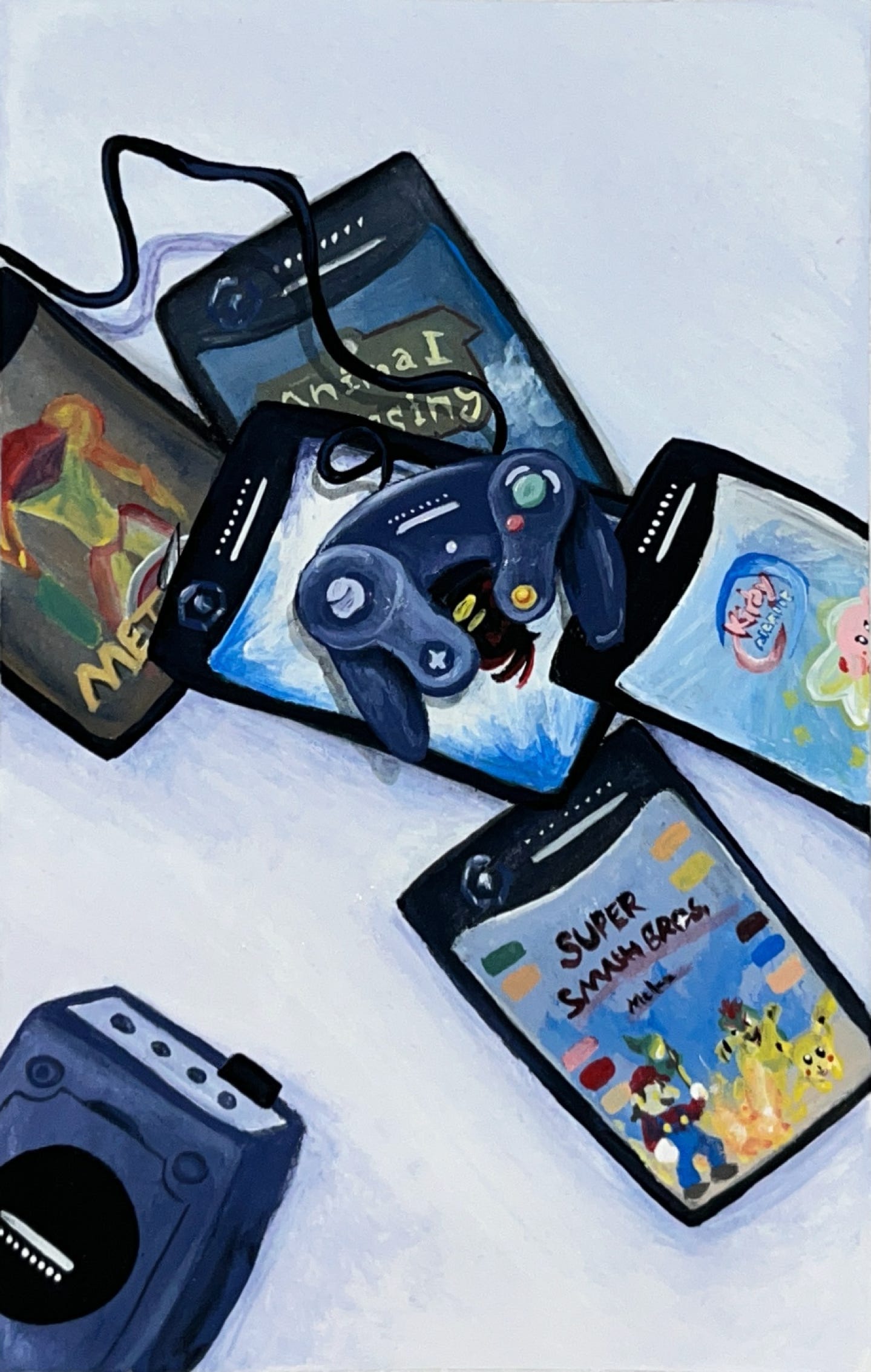
Anyway, the painting below (which I used as a cover for this post) is one I made many years ago:
Valete // χαίρετε! :)
This depends on the philosopher in question, e.g. Aquinas would certainly consider Natural Law as given by God, yet his idea of divine law is based upon salvation and revelation, not simply something we can discover through our natural capacity for reasoning.
“Truthfulness in statements that one cannot avoid is a human being’s duty to everyone, however great the disadvantage to him or to another that may result from it; and although I indeed do no wrong to him who unjustly compels me to make the statement if I falsify it, I nevertheless do wrong in the most essential part of duty in general by such falsification, which can therefore be called a lie (though not in a jurist’s sense),” Kant, Immanuel. “On a Supposed Right to Lie from Philanthropy.” Practical Philosophy. Translated and edited by Mary J. Gregor. Cambridge University Press. 1996. p. 611-615
Van Leeuwen, Neil. Religion as Make-Believe: a Theory of Belief, Imagination, and Group Identity. Harvard University Press. 2023. p. 2
Van Leeuwen, Neil. Religion as Make-Believe. p. 7
Van Leeuwen, Neil. Religion as Make-Believe. p. 4-5
Van Leeuwen, Neil. Religion as Make-Believe. p. 5
No posts
Comments
Nothing yet. Say the first thing.
Sign in to join the conversation.