
A man alone in the dark. A stranger who won’t let go. An all-night struggle that ends in a wounded hip, a new name, and a limp he’d carry forever.
For thousands of years, people have puzzled over this night.
Why would God wrestle a man? Why all night? Why a wound that never fully heals?
Because this passage isn’t ultimately about a fight — or even a name change. It's about something God had been working toward Jacob's whole life.
And it might be exactly what He’s waiting to do IN YOU.
Let me show you.
Upgrade so you don’t miss the DEEPER Bible Revelations hidden in plain sight.
A Lifetime of Running
Before we get to that night, we have to understand the man.
Because to understand why God wrestled Jacob, you first have to see how long Jacob had been running.
It started at birth.
As his brother came out, his hand grasped Esau’s heel; so his name was called Jacob.
— Genesis 25:26
He came into the world grabbing — already reaching, already striving, already grasping for something that wasn’t his.
His very name told the story. Jacob — heel-grabber. Supplanter. Deceiver.
And he lived up to it.
He manipulated his brother out of a birthright.
He deceived his blind father to steal a blessing.
And when Esau vowed to kill him for it — what did Jacob do?
HE RAN.
He fled to Haran, to his uncle Laban, hundreds of miles away.
And years later, when tension boiled over between him and Laban, did Jacob confront it head-on?
No. He slipped away quietly, in secret, and ran again!
Again and again, the pattern repeats. Jacob avoids. Jacob deceives. Jacob runs.
But look closer at what he’s running from. It isn’t only angry people. Behind Esau’s rage and Laban’s suspicion is something Jacob is even more desperate to outrun: the consequences of his own choices.
He deceived Isaac. He wronged Esau. And then he ran.
Because sometimes what we call running from people is really running from conviction. Running from consequences. Running from the conversation that would force us to admit what we’ve done. Running from repentance itself.
Does that sound like anyone you know?
Maybe it sounds like you.
And if it does — keep reading. Because this might be exactly the message God wants you to hear.
The Night Everything Changed
Then we come to Genesis 32.
And EVERYTHING changes.
After a lifetime of running, Jacob finds himself back where he started — facing the very brother he’d fled from all those years ago.
Esau is coming. And he’s bringing four hundred men.
So Jacob does what Jacob always does.
He sends his family ahead. He sends his servants ahead. He sends his flocks ahead — gift after gift, buffer after buffer, putting distance between himself and the thing he fears.
He sends them all across a stream called the Jabbok, and stays behind.
Now notice WHERE this is happening. Years earlier, when Jacob first fled the Promised Land with almost nothing, he had crossed the Jordan going out — a frightened runner with a stick in his hand.
He remembers it himself that very night:
With only my staff I crossed this Jordan, and now I have become two camps.
— Genesis 32:10
He crossed going out as Jacob, the runner. Now he’s coming back.
And before he can fully step back into the land tied to God’s promises, God meets him here — at the Jabbok, in the dark, on the threshold. Jacob is standing between his past and his future.
Now here’s something amazing.
Generations later, Jacob’s own descendants — now carrying his new name, Israel — would come to the Jordan themselves. In Joshua 3, the priests carried the Ark into the water, God held back the river, and Israel crossed into the Promised Land on dry ground.
Centuries after that, Jesus Himself would step into those same Jordan waters at His baptism — and the heavens opened, the Spirit descended, and the Father’s voice declared Him His beloved Son.
Again and again, God brings His people to a threshold — a water’s edge, a place between what was and what will be — and meets them there before what comes next.
Jacob crosses the Jordan leaving the land. Now, returning, he reaches the Jabbok — a stream that feeds into that same Jordan — and there, at the threshold, God stops him.
And one day his descendants, called Israel because of this very night, would retrace his steps — crossing back over that same water into the promise.
Feel the rhythm and beauty of God’s Word.
Think about that. An entire nation carries the name Israel because of what happened privately to one frightened man in the dark.
But all of that is still generations away.
Tonight, it’s just one man.
Left Alone
And Jacob was left alone. — Genesis 32:24
Alone. In the dark. On the wrong side of the river.
Think about how rare that word is for Jacob.
His whole life he has surrounded himself with buffers. A birthright bargain. Goat skins. His mother’s scheme. Servants. Flocks. Gifts. Family sent on ahead.
Layer after layer between himself and whatever he feared.
And now, one by one, all of it crosses to the other side. Until there is nothing left but the three things Jacob has spent a lifetime avoiding:
Jacob. God. And the darkness.
Scripture keeps showing us people meeting God in the quiet, stripped-down places. Because sometimes God removes the very things we’ve been hiding behind, until we finally have to face Him.
And ourselves.
And sometimes it isn’t only the things we hide behind — it’s the noise we fill the silence with, the busyness that keeps us from ever being still enough to hear Him.
Jacob had spent a lifetime surrounding himself with buffers—until an empty riverbank at midnight left him nowhere to turn but toward the God who had been pursuing him.
Alone. In the dark. Nowhere left to hide.
(Centuries later, another Man would cross the Kidron at night into a garden called Gethsemane, where He would agonize in prayer before facing the cross.)
You can almost hear the old instinct rising in Jacob:
I could still run. I could disappear before morning.
Because he hasn’t forgotten what’s waiting at sunrise — Esau, the brother he cheated, marching toward him with four hundred men.
Running was always easier than facing that. Never mind that his wives and children lie asleep on the far bank; escape had always meant leaving someone behind.
And that is exactly the moment God intervenes.
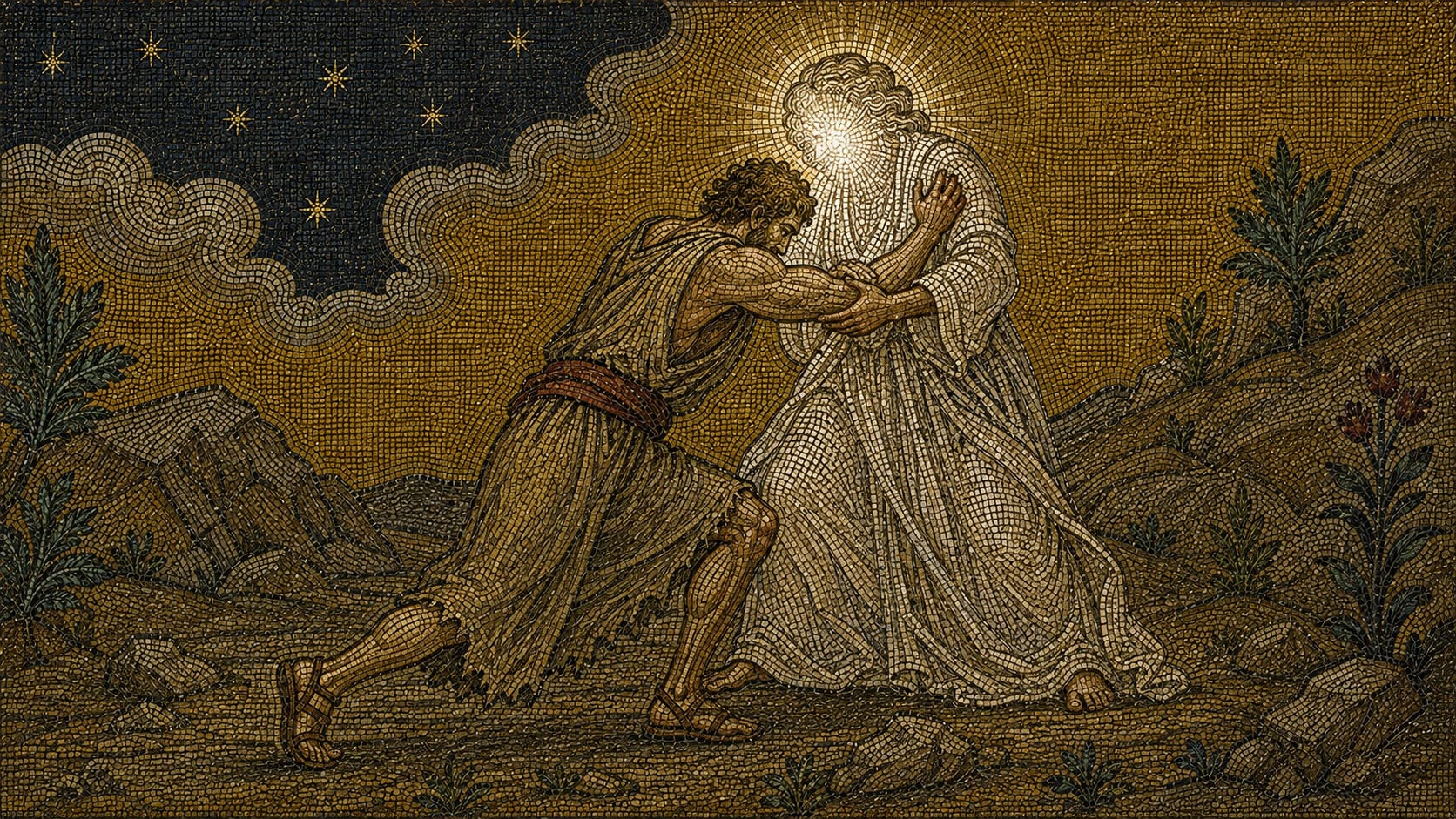
And a man wrestled with him until the breaking of the day. — Genesis 32:24
This was not random.
This was not God picking a fight.
This was God saying:
Jacob. That’s it.
NO MORE RUNNING!
Because before Jacob can step into his future, God deals with his past.
Before He changes Jacob’s circumstances, He changes his name.
Before Jacob faces Esau, he faces God.
He entered that night a runner.
He would leave it limping — but finally walking in the right direction.
Upgrade so you don’t miss the DEEPER Bible Revelations hidden in plain sight.
Why God Touched His Hip
Watch what happens when Jacob will not give up the struggle.
When the man saw that he did not prevail against Jacob, he touched his hip socket, and Jacob’s hip was put out of joint. — Genesis 32:25
Of everything God could have touched — think about where He aimed.
The hip. The socket.
God touched his hip, and suddenly Jacob couldn’t run the way he used to.
The legs that had carried him away from Esau, away from Laban, away from every hard thing he’d ever faced now carried a limp instead.
The very place that once carried him off now forces him to stop.
To stay.
To limp forward instead of sprinting away.
And that limp becomes a lasting reminder etched into his own body:
Do not escape your calling.
Face it — with Me.
There’s a striking echo of this centuries later. Paul, too, carried a weakness God chose not to remove — a “thorn in the flesh” he begged the Lord to take away three times.
And the answer he received wasn’t healing. It was this:
My grace is sufficient for you, for My power is made perfect in weakness.
— 2 Corinthians 12:9
Jacob spent his whole life leaning on his own cleverness, his own strength, his own ability to slip away. After that night, every single step tells him a different story:
I cannot walk the way I used to.
And maybe that’s exactly the point.
Sometimes the mark of a real encounter with God isn’t that we walk away more self-sufficient. It’s that we finally understand how dependent on Him we’ve been all along.
From Jacob to Israel
Only now… wounded, unable to flee, clinging instead of running… does Jacob finally do the one thing he’s NEVER done.
He holds on.
“I will not let You go unless You bless me.” — Genesis 32:26
For the first time in his life, Jacob isn’t grasping to take.
He’s clinging to receive.
Think about what that means.
Jacob spent his entire life trying to obtain blessing through people and schemes. He manipulated Esau for the birthright. He deceived Isaac for the blessing. He maneuvered, bargained, and disguised his way toward everything he wanted.
But here, at the Jabbok, he finally discovers what he’d missed for decades: the blessing he’d spent his whole life trying to steal from human hands could only ever truly come from God.
The deceiver has finally come to the Source.
And here’s the beautiful part. Jacob isn’t twisting God’s arm into blessing him. Years earlier, back at Bethel, God had already promised him the land, descendants, His presence, His protection, and that He would bring him home (Genesis 28:13–15).
The promise came before the wrestling.
Grace came before the wrestling.
Peniel wasn’t Jacob convincing God to finally bless him. No, God had been pursuing and blessing Jacob for years! The wrestling wasn’t about earning God’s promise—it was about God transforming the man who would walk in the promise He had already given.
That’s the whole shape of the Christian life.
We don’t obey to earn God’s grace.
Grace comes first and begins changing us.
Grace doesn't merely forgive us; it transforms us.
And then God asks Jacob a question.
“What is your name?” — Genesis 32:27
Slow down.
God knows his name. The question isn’t for God’s information—it’s for Jacob’s confession.
This isn’t the first time God has asked a question He already knew the answer to. After Adam sinned, God called into the garden,
“Where are you?” — Genesis 3:9
God wasn’t trying to locate Adam.
He was inviting Adam to come out of hiding.
God’s questions are often invitations, not investigations.
And now Jacob is being invited to do the same thing.
To stop hiding.
To stop pretending.
To finally tell the truth about who he is.
“Jacob.” — Genesis 32:27
Heel-grabber.
Supplanter.
Deceiver.
For the first time in his life, Jacob stops pretending to be someone else.
The moment he finally tells God who he has been...
God tells him who he is becoming.
“Your name shall no longer be called Jacob, but Israel, for you have striven with God and with men, and have prevailed.” — Genesis 32:28
The heel-grabber becomes the God-wrestler.
The deceiver becomes the one who prevails.
The runner becomes Israel—one who has striven with God.
And this is how God works. He takes a man at his lowest and gives him a new name for his future.
He did it here with Jacob becoming Israel. He did it again when Jesus looked at an impulsive fisherman and said, “You are Simon... you shall be called Cephas”—Peter, the rock (John 1:42).
And one day, He promises to do it for ALL who overcome, giving them a new name written on a white stone (Revelation 2:17).
The God who renamed Jacob in the dark is still giving people a new identity today.
Two Ways to Wrestle
And here is the distinction that changes everything.
Because there are two ways to wrestle:
Either we wrestle against God—fighting His will, running from His correction, pushing against the very hand that is trying to bless us.
Or we cling to God—refusing to let go of the One who is changing us, trusting Him as we face the battles before us.
The question was never whether Jacob would wrestle. He’d been wrestling his whole life — with Esau, with Laban, with his own fear.
The question was WHO he would wrestle with. And WHO would be standing next to him when it mattered.
That’s the question for you, too.
Because you are going to wrestle. That part isn’t up for debate.
The only question is whether you’ll wrestle alone — or whether you’ll wrestle with God right beside you.
The Fights We Refuse to Fight
Some of us are running right now.
Maybe not from an angry brother — but from a hard conversation. An act of obedience. A relationship that needs forgiveness.
A calling we keep pretending we didn’t hear.
We send everything ahead of us — busyness, distraction, excuses — putting buffer after buffer between ourselves and the thing God is asking us to face.
But my dear friend, listen to this:
The fights we refuse to fight today become the fights our children have to fight tomorrow.
Let me say that again.
The fights we refuse to fight today become the fights our children have to fight tomorrow.
The avoidance doesn’t disappear. It gets inherited. The patterns we refuse to confront today often become the patterns the next generation has to confront tomorrow.
God loved Jacob too much to let him keep running.
And He loves you too much to let you live in avoidance.
The Greatest Wrestler
And here’s the most beautiful part.
You have nothing to fear.
Because in Christ — the greatest Wrestler of them all — the fight has already been fought.
And won.
He faced His cross head-on.
He didn’t run. He didn’t avoid it. He didn’t send anything ahead of Him into the dark to buy Himself an escape.
He stayed. He struggled. He prevailed.
And because He conquered it, we are made more than conquerors through Him (Romans 8:37).
The wounds in His hands are where our deepest healing begins.
From Grasping to Clinging
Now let me show you what may be one of the deepest patterns hidden in Jacob’s story.
Remember how Jacob entered the world:
"As his brother came out, his hand grasped Esau's heel; so his name was called Jacob." — Genesis 25:26
From his very first breath, Jacob was grasping. And in many ways, he spent much of his life doing exactly that. He grasped for the birthright, for the blessing, for advantage, for control.
And honestly, Jacob’s story is our story.
Ever since humanity first reached for the forbidden fruit in the Garden, we’ve been trying to seize with our own hands what only God can truly give.
We grasp for significance, security, approval, success, control. We keep reaching for things as though our lives depend entirely on our ability to take hold of them.
But watch what happens at Peniel.
God doesn’t erase Jacob’s determination.
He redeems it.
He doesn’t destroy the way Jacob is wired. He redirects it.
The same hands that once grabbed a brother’s heel…
now cling to God.
Do you see it? The problem was never simply that Jacob knew how to hold on. The problem was what he was holding onto, and that he kept trying to seize through his own strength what only God could truly give.
Before Peniel, Jacob grasped in order to take.
At Peniel, he clings to God in order to receive.
And isn’t that often how God works?
He doesn’t always erase the gifts, desires, personalities, or strengths He has placed within us. He teaches us to surrender them back to the One who gave them.
A determined person can use that determination for selfish ambition or faithful perseverance. A persuasive person can use words to manipulate or to proclaim truth. A gifted leader can grasp for control or kneel down and serve. A storyteller can spend his life pursuing his own glory—or use that same gift to point people toward God’s.
Let me tell you why that last one isn’t hypothetical for me.
For years, I loved storytelling, and I chased it toward Hollywood. I wanted to tell stories more than almost anything. But no matter how much I pursued it, it never gave me the fulfillment I was actually looking for.
Then I encountered the Lord.
Over time, He took that same love of storytelling and turned it in a new direction—toward Him. The gift didn’t disappear. The direction changed.
And now that same gift brings a fulfillment chasing it never did. It helps provide for and bless my family, and by God’s grace, it blesses other people too. Not because storytelling suddenly became holy on its own, but because I began surrendering it back to the One who gave it to me in the first place.
That doesn’t mean giving your gift to God guarantees money, fame, success, or an easy road. The blessing is much deeper than that. It means the gift finally gets pointed in the right direction—toward serving others and glorifying God.
That is why Scripture says:
“Trust in the LORD with all your heart… in all your ways acknowledge Him, and He will make straight your paths.” — Proverbs 3:5–6
And Paul writes:
“Whatever you do, do all to the glory of God.” — 1 Corinthians 10:31
“Whatever you do, in word or deed, do everything in the name of the Lord Jesus.” — Colossians 3:17
Peter says the same thing about the gifts God gives us: use them to serve one another so that “in everything God may be glorified through Jesus Christ” (1 Peter 4:10–11).
So maybe God doesn’t want to destroy everything about the old you.
Maybe He wants to redeem what He placed in you and teach you how to use it for the purpose it was always meant for.
Jacob was always a clinger. He just had to learn WHO to cling to.
Upgrade so you don’t miss the DEEPER Bible Revelations hidden in plain sight.
Just for You
So let me ask you something.
Where have you been running?
What conversation have you been avoiding? What obedience have you been delaying? What fear have you been sending everyone else ahead to face for you?
God has been pursuing you far longer than you've been running from Him.
Maybe today, God is finally catching up to you in the dark — not to destroy you, but to change you. Not to end you, but to name you.
And here’s the promise hidden in the last line of the story:
The sun rose upon him as he passed Peniel, limping because of his hip. — Genesis 32:31
Notice when the sun rises.
After the wrestling. Not before.
God did His deepest work in the dark. The sunrise didn’t begin Jacob’s transformation — it revealed a man who had already been changed in the night.
He walked into that darkness a deceiver.
He walked out of it as Israel.
Weeping may last through the night, but joy comes with the morning. — Psalm 30:5
That doesn’t mean every sorrow vanishes by breakfast, or that the limp goes away.
Jacob still limped. But darkness doesn’t get the final word. God does.
Jacob walked into the night running. He walked into the morning limping. But he walked into it changed—because God had met him there.
And now watch where he walks next.
The very next thing this newly named, freshly limping man does is lift his eyes and see Esau coming (Genesis 33:1)—the brother he’d been running from for twenty years, the fractured relationship his own sin had helped create.
But this time Jacob doesn’t hide behind everyone else.
Genesis says Jacob himself went on ahead of them and approached Esau, bowing to the ground as he came near (Genesis 33:3).
The man who used to send everyone ahead of him now goes first.
The man who spent his life running away is finally walking toward the person he wronged.
Do you see it?
The night with God wasn’t meant to end as a private spiritual experience. The vertical encounter produces horizontal obedience. Jacob meets God in Genesis 32—and then walks toward Esau in Genesis 33.
God changed his name in the dark.
By morning, you could see the change in his walk.
He entered running on two good legs. He left with a limp. And strangely enough… the wounded man was finally walking straighter than the healthy one ever had.
So face it, my friend.
Limp, if you have to.
But. Don’t. Run.
Prayer
Father,
Thank You that You love us too much to let us keep running.
Thank You that even in the dark — even when we’re alone, exhausted, and ready to flee one more time — You come to us. You wrestle with us. You refuse to let us go.
Forgive us for the fights we’ve avoided. For the conversations we’ve dodged, the obedience we’ve delayed, the calling we’ve pretended not to hear. Forgive us for sending everything and everyone ahead of us to face what You’ve asked us to face.
Touch the places we’ve relied on to escape. Give us the courage to stop running and start clinging. To hold on to You and say, I will not let You go unless You bless me.
And thank You that in Christ, the greatest Wrestler, the victory is already won — that because He faced His cross and did not run, we are more than conquerors through Him.
Change our hearts.
Transform who we are.
Make us into people who face it with You.
In Jesus’ name,
Amen

You’re going to LOVE what’s coming NEXT!
If this article helped you stop running and see Scripture in a deeper way,
there’s much more waiting for you.
Unlock every Revelation the moment it drops.
Go DEEPER into Scripture than ever before.
Get full access to the complete archive.
Love you guys. 🙏
And if this BLESSED you, share it with someone
who may be running from something God is asking them to face.
Comments
Nothing yet. Say the first thing.
Sign in to join the conversation.