
Quick recap. In Part 1, we traced where the word “rapture” came from. In Part 2, we laid all five views side by side — and saw that the whole debate turns on one question: when does the “catching up” happen?
Part 3 builds on both. Because now we walk into the engine room.
If you have ever heard someone talk about a seven-year tribulation, the middle of the tribulation, a coming ruler and covenant, or a future temple in Jerusalem, much of that framework traces back to one incredibly important prophecy:
Daniel 9.
And here’s what makes it absolutely stunning:
This same prophecy also gives Christians a remarkable timeline pointing toward Jesus’ FIRST coming.
By the end, I want you to understand exactly where the seven-year framework comes from — and why Christians disagree about it.
Let me show you!
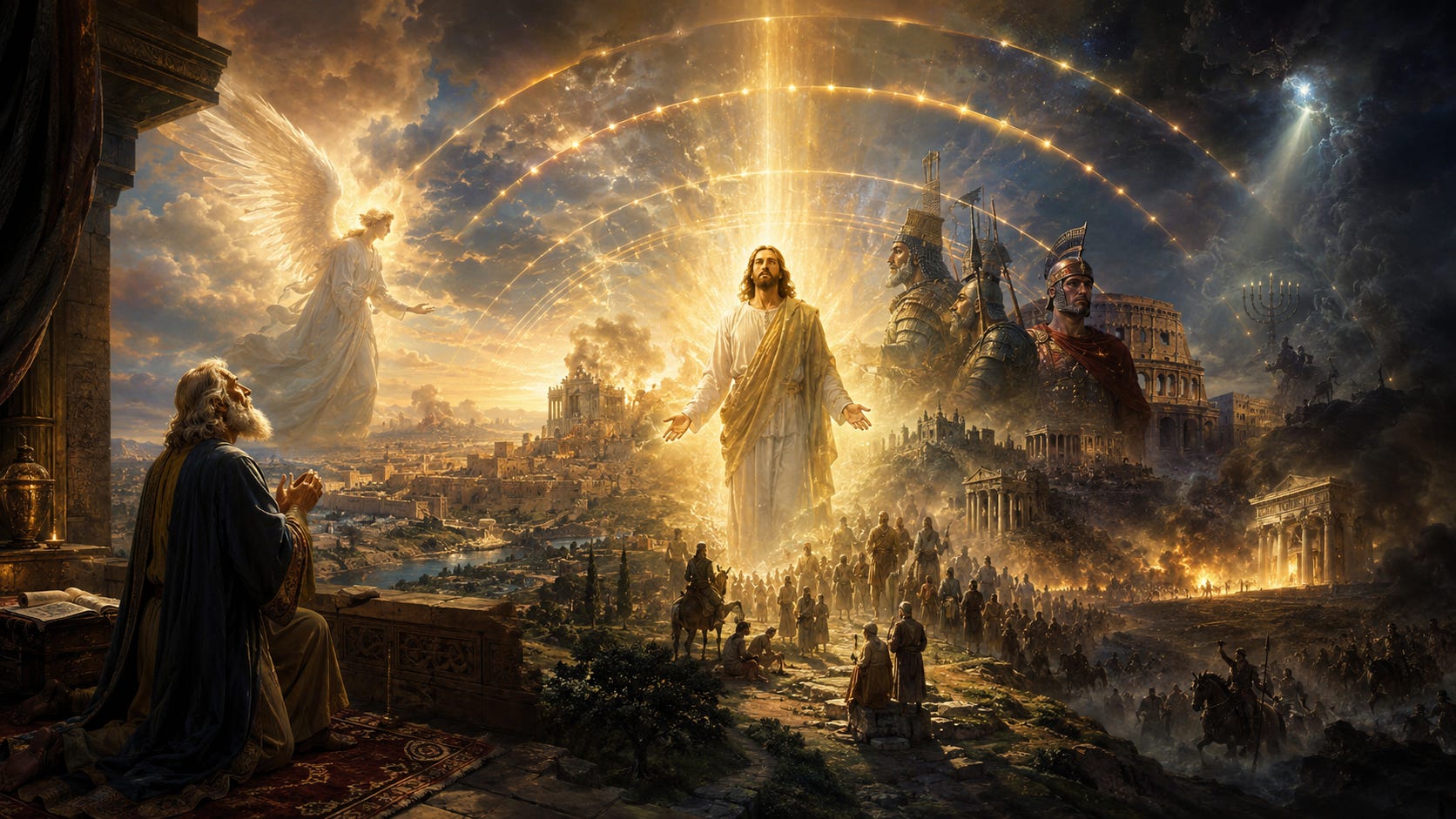
Picture the scene.
It’s around 539 BC. Daniel is an old man now. He has spent almost his entire life in exile, torn from his homeland as a young man.
Jerusalem is rubble.
The temple is gone.
And while reading Jeremiah, Daniel finds a promise:
The exile would last seventy years (Jeremiah 25:11).
Daniel realizes those seventy years are nearly over.
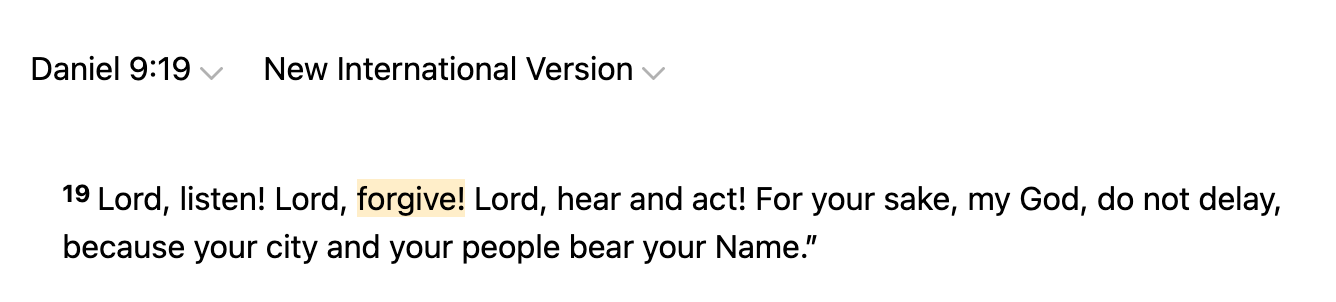
So he drops to his knees and pours himself out in one of the most gut-wrenching prayers in the whole Bible — confessing his people’s sin, begging God for mercy, pleading for Jerusalem. “O Lord, hear; O Lord, forgive... for Your city and Your people are called by Your name” (Daniel 9:19).
But there is a beautiful connection behind Daniel’s prayer.
More than 400 years earlier, when Solomon dedicated the temple, he imagined a future day when Israel would rebel against God and be carried into exile.
Solomon prayed that if they repented in that foreign land and prayed toward Jerusalem, God would hear them and forgive them (1 Kings 8:46–50).
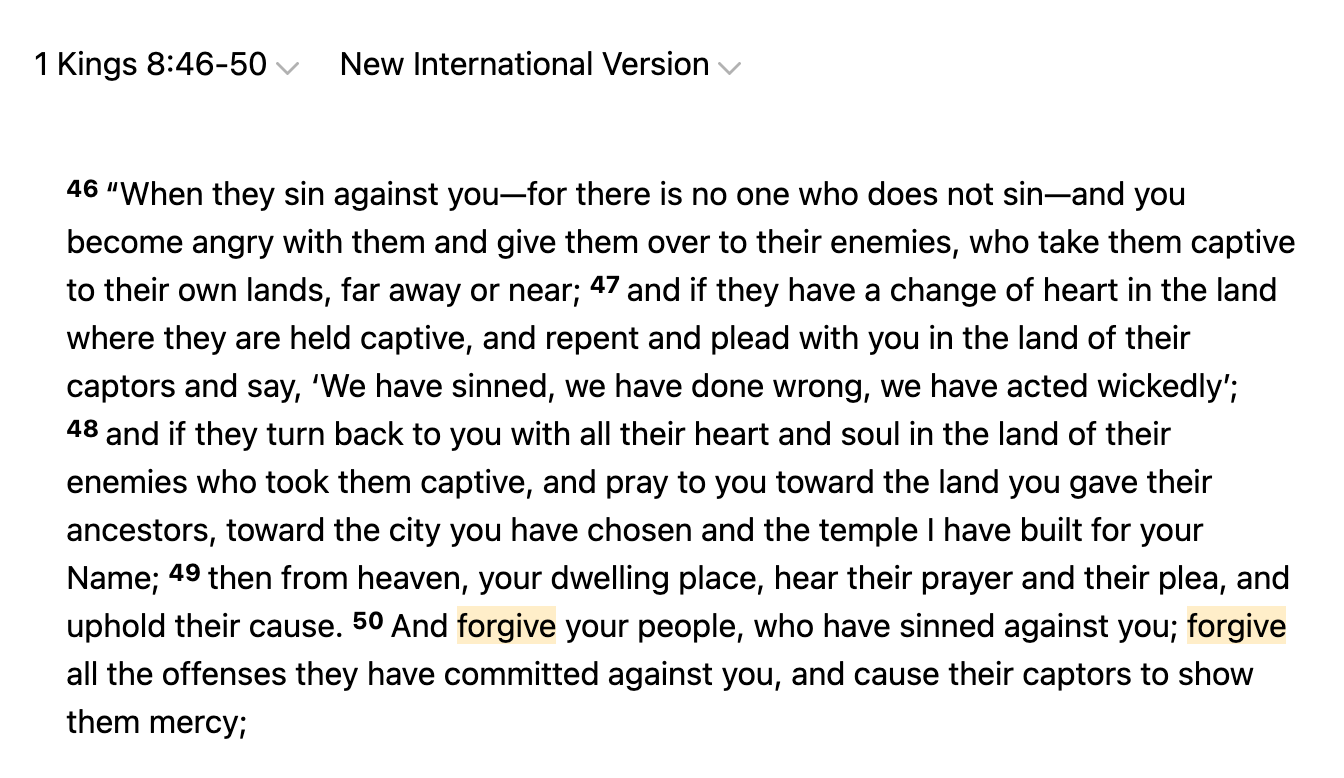
Solomon prayed for the exile before there was an exile.
And now Daniel is living in exactly the moment Solomon described.
Daniel 6 tells us that his windows opened toward Jerusalem and that he knelt to pray three times a day.
The temple Solomon dedicated when he prayed was now rubble.
But the God Solomon prayed to was still on His throne.
And while Daniel is still praying, something happens.
While I was speaking, praying, and confessing my sin... Gabriel... reached me about the time of the evening offering. — Daniel 9:20–21
While Daniel was still speaking.
Gabriel tells him:
At the beginning of your supplications the command went out, and I have come to tell you, for you are greatly beloved. — Daniel 9:23
Before Daniel finished praying, the answer was already on its way.
And notice when Gabriel arrives:
“About the time of the evening offering.”
But there was no evening offering.
There was no temple.
No altar.
No lamb burning in Jerusalem.
And yet Daniel was still measuring his day by the rhythm of worship.
Babylon could carry Daniel away from the temple. It could not carry the temple out of Daniel.
And at the hour when a sacrifice should have been offered, Gabriel arrives with a prophecy that will eventually speak of atonement — and of an Anointed One who will be cut off.
Daniel had prayed about seventy years.
Gabriel was about to answer him with seventy sevens.
And the answer would stretch all the way to the Messiah… and perhaps beyond.
Gabriel says:
Seventy weeks are determined for your people and for your holy city, to finish the transgression, to make an end of sins, to make reconciliation for iniquity, to bring in everlasting righteousness... — Daniel 9:24
“Seventy weeks” sounds strange in English, but the basic idea is pretty simple.
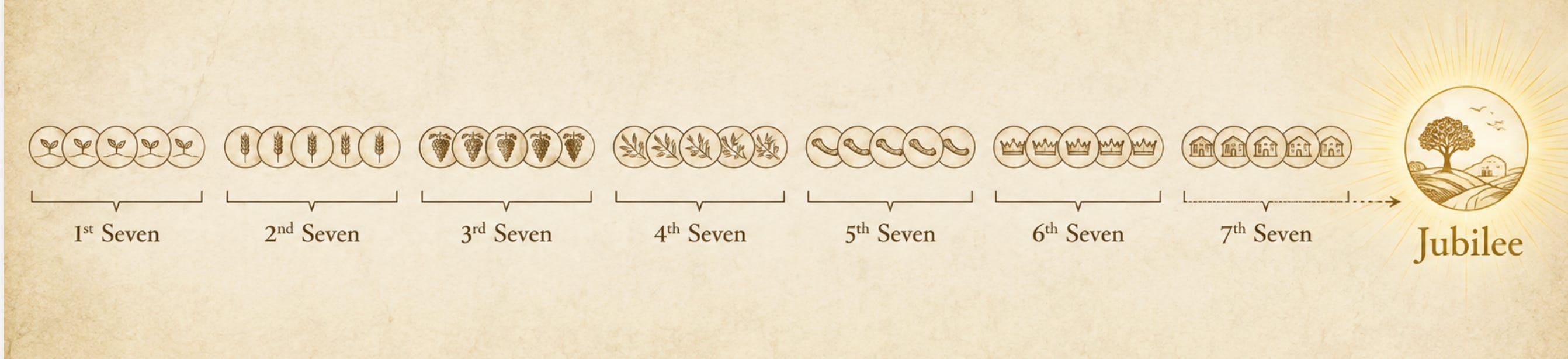
The Hebrew word translated weeks refers to units or groups of seven. Here, the context has traditionally been understood as referring to sevens of years.
So:
70 weeks = 70 sevens = 70 × 7 = 490 years.
That’s the basic math.
But the language of sevens also fits beautifully into Daniel’s world.
Daniel had been praying about Israel’s seventy years of exile, and 2 Chronicles later describes those years in terms of the land receiving its Sabbath rest (2 Chronicles 36:21).
Then in Leviticus 25, Israel was given another pattern built around sevens. After seven sets of seven years came the Jubilee — a time associated with release, restoration, and return.
Even the Jubilee was announced on the Day of Atonement.
Now listen again to what Gabriel says these seventy sevens will accomplish:
An end to sin.
Reconciliation for iniquity.
Everlasting righteousness.
Before Gabriel ever talks about a prince, a war, an abomination, or a desolation, he talks about sin being dealt with and righteousness being brought in.
Daniel 9 does not begin with Antichrist. It begins with redemption.
And for Christians, those themes of atonement, release, and restoration ultimately converge in Jesus.
Centuries later Jesus would stand in a synagogue and read:
...to proclaim liberty to the captives... to proclaim the acceptable year of the Lord.
— Luke 4:18–19
Then He said:
Today this Scripture is fulfilled in your hearing. — Luke 4:21
The great themes of Jubilee find their fulfillment in Jesus.
Now watch what Gabriel does with those 490 years.
Gabriel says:
Know therefore and understand, that from the going forth of the command to restore and build Jerusalem until Messiah the Prince, there shall be seven weeks and sixty-two weeks... — Daniel 9:25
Let’s count them:
7 weeks + 62 weeks = 69 weeks.
And if each “week” represents seven years:
69 × 7 = 483 years.
So Gabriel gives Daniel a starting point — a command to restore and rebuild Jerusalem — followed by a period of 483 years leading toward “Messiah the Prince.”
Which raises the obvious question:
Was there actually a command to rebuild Jerusalem?
Yes.
In the twentieth year of King Artaxerxes, Nehemiah tells the king that Jerusalem is still lying in ruins and asks permission to return:
Send me to Judah, to the city of my fathers’ tombs, that I may rebuild it. — Nehemiah 2:5
The king grants his request and even provides letters authorizing timber for the gates and the wall of Jerusalem (Nehemiah 2:7–8).
This happened around 445/444 BC.
And this is where one well-known Christian calculation begins.
Start with Artaxerxes’ authorization to Nehemiah. Then count Daniel’s 483 years using what some interpreters call a 360-day “prophetic year.”
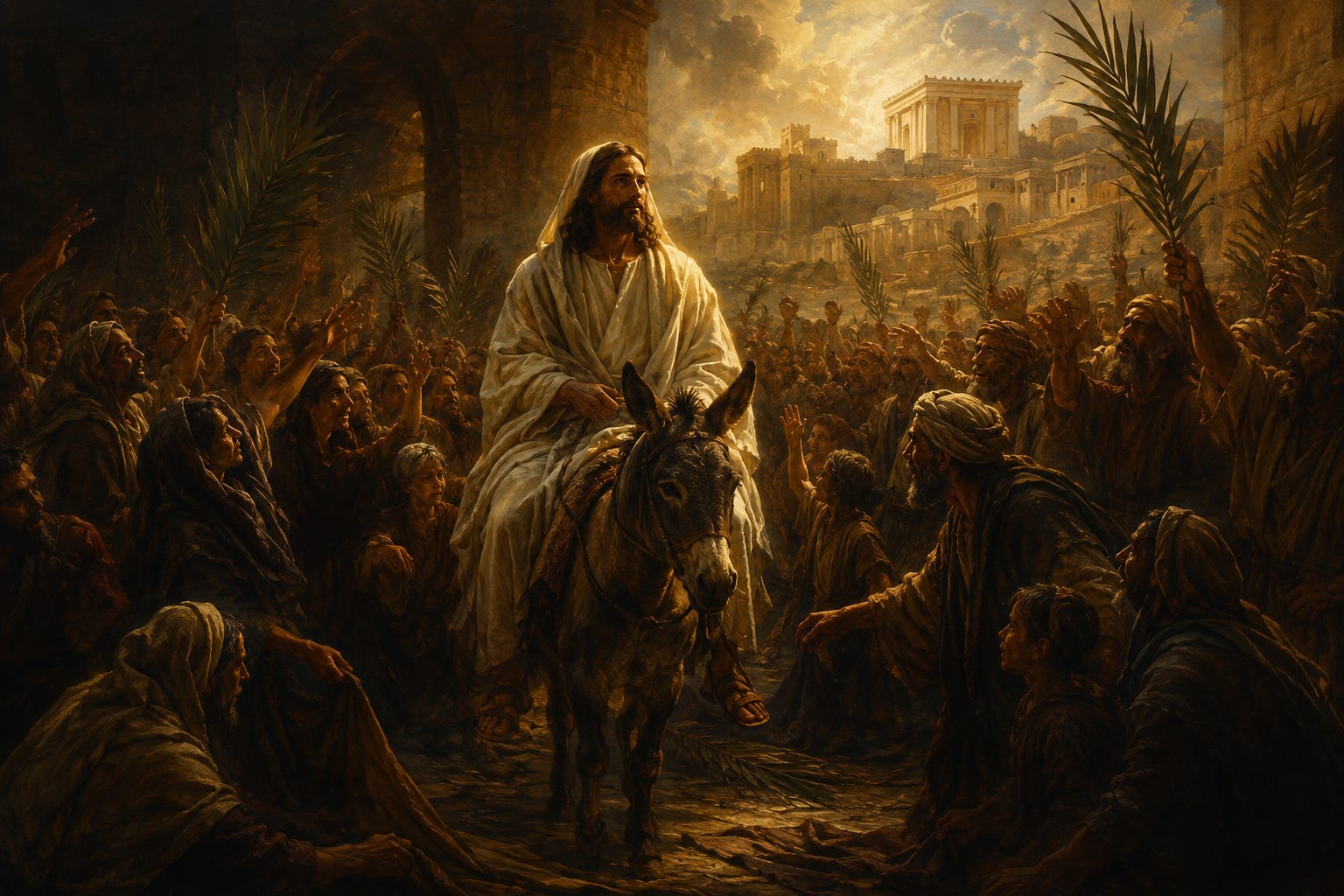
That calculation brings you to approximately AD 32–33 — the period surrounding Jesus’ triumphal entry and crucifixion.
(Other Christian calculations use a different decree and ordinary solar years, landing a few years earlier, around the start of Jesus’ ministry — so the exact chronology remains debated.)
Here’s the honest version, and it is still remarkable:
On the major Christian readings that take these 69 weeks as pointing to the Messiah, Daniel’s countdown lands right in the era of Jesus — His ministry, His presentation as Messiah, His death.
Gabriel said the countdown would begin with the restoration of Jerusalem and lead to “Messiah the Prince.”
And on these Christian readings, it does.
Then Gabriel says something even more striking:
And after the 62 weeks Messiah shall be cut off... — Daniel 9:26
Remember, Gabriel divided the timeline into two blocks:
7 weeks + 62 weeks = 69 weeks.
So when verse 26 says “after the 62 weeks,” it means after that second block has been completed — after the full 69 weeks.
And then the Messiah is:
“cut off.”
Killed.
Daniel’s prophecy doesn’t merely point toward when the Messiah would appear.
It says that after He comes, He will be cut off.
Centuries before Jesus was born, Daniel was already announcing the era of the Messiah’s coming — and that afterward, the Messiah would die.
But now we reach the question that affects almost every modern rapture chart.
Because Gabriel didn’t give Daniel 69 weeks.
He gave him 70.
So what happened to that final 70th week?
Gabriel gave Daniel 70 weeks — 490 years.
But so far, he has only accounted for:
7 weeks + 62 weeks = 69 weeks = 483 years.
Those 69 weeks lead to the Messiah, and afterward the Messiah is “cut off.”
Then Gabriel says:
...the people of the prince who is to come shall destroy the city and the sanctuary. — Daniel 9:26
And that happened about forty years after Jesus’ death, when Roman forces destroyed Jerusalem and the temple in AD 70.
So we have reached the question at the center of the debate:
What happens to Daniel’s final week — the remaining seven years?
There are two major ways Christians answer that question.
Many Christians believe Daniel’s prophetic clock pauses after the 69th week.
The Messiah is cut off. Jerusalem and the temple are later destroyed. Then there is a gap before Daniel’s final week begins.
On this reading:
The 70th week is still future.
And because one “week” represents 7 years:
Daniel’s 70th week = a future 7-year tribulation.
This is where the familiar 7-year tribulation framework comes from.
Other Christians believe the seventy weeks continue without a long pause.
On this reading, the final week was fulfilled in connection with Christ and the events surrounding His first coming and the first century.
And here is the key:
Daniel never explicitly says there is a gap between week 69 and week 70.
But he also does not explain the transition between them in enough detail to remove every question.
That is why faithful Christians have reached different conclusions.
So this is the source of the familiar seven-year framework:
Daniel’s 70th week.
The real debate is what happens to that final week.
Futurists believe it is still future, separated from the first 69 weeks by a gap.
Others believe it was fulfilled without a long gap, in connection with Christ and the events of the first century.
And that is the fork in the road:
Is Daniel’s 70th week still future — or has it already been fulfilled?
Let’s follow the futurist reading for a moment — the view that understands Daniel’s final week as still future and connected to the end times.
Gabriel says:
Then he shall confirm a covenant with many for one week; but in the middle of the week he shall bring an end to sacrifice and offering. And on the wing of abominations shall be one who makes desolate... — Daniel 9:27
On the futurist reading, the “he” refers back to the coming prince mentioned in the previous verse.
He confirms a covenant for 1 week — 7 years — and then, in the middle of the week, causes sacrifice and offering to cease.
That midpoint — 3.5 years into the 7 — is where the mid-tribulation view places the rapture, and where many futurists believe the most intense part of the tribulation begins.
But what exactly is the “abomination of desolation”?
Something very much like it had already happened before Jesus was born.
Around 167 BC, the Greek ruler Antiochus IV Epiphanes desecrated the temple in Jerusalem, stopped the sacrifices, and profaned the sanctuary.
And yet centuries later, Jesus still said:
Therefore when you see the “abomination of desolation,” spoken of by Daniel the prophet, standing in the holy place... then let those in Judea flee to the mountains. — Matthew 24:15–16
That’s significant.
Antiochus had already desecrated the temple centuries earlier. Yet Jesus still spoke of Daniel’s abomination as something His listeners would see in the future.
The question is what future event Jesus had in mind.
Some Christians believe His warning was fulfilled in AD 70, when Roman forces destroyed Jerusalem and the temple.
Others believe AD 70 was only a foreshadowing of a still-future end-times event.
And some see both — a near fulfillment in the first century and a greater final fulfillment still to come.

Before we go any further, let’s look at Daniel’s wording again.
In verse 26, Gabriel says:
…the people of the prince who is to come shall destroy the city and the sanctuary.
— Daniel 9:26
Then, in the very next verse, he says:
Then he shall confirm a covenant with many for one week… — Daniel 9:27
On the futurist reading, that “he” points back to “the prince who is to come.”
That’s why futurist interpreters understand Daniel to be describing a future ruler — and they identify this “one week” as the missing 70th week from Daniel’s original prophecy.
But here’s the important clarification:
Daniel never actually calls that ruler “the Antichrist.”
So why do so many Christians make that connection?
Because when you compare Daniel with other passages, the descriptions begin to overlap.
Paul describes a future figure he calls the “man of lawlessness”:
…the man of lawlessness is revealed, the son of destruction, who opposes and exalts himself above every so-called god or object of worship, so that he takes his seat in the temple of God, proclaiming himself to be God. — 2 Thessalonians 2:3–4
Then Revelation describes the beast, another ruler who blasphemes God and wages war against His people:
Then he opened his mouth in blasphemy against God… It was granted to him to make war with the saints and to overcome them… — Revelation 13:6–7
Put Daniel’s prince, Jesus’ coming desecration, Paul’s man of lawlessness, and Revelation’s beast together, and many Christians understand them as pieces of the same final end-times picture — the figure commonly called the Antichrist.
But here’s the fascinating part — the word antichrist never appears in any of those passages. Not in Daniel. Not in Paul. Not in Revelation.
It comes from John’s letters. And watch what John actually does with it:
…as you have heard that antichrist is coming, even now many antichrists have come…
— 1 John 2:18
John gives us the expectation of antichrist coming — and many antichrists already at work.
There’s something quietly beautiful in that contrast. John gives us an antichrist expected in the future, yet a spirit of antichrist already loose in the world. In a far greater way, Christ is coming again — yet Christ is already at work in the world, through His Spirit and His people. One dark kingdom is already leaking into the present. So is one glorious one.
So the familiar picture of one final, capital-A Antichrist is a synthesis — Christians connecting John’s word with Daniel’s prince, Paul’s man of lawlessness, and Revelation’s beast, and drawing them into a single portrait.
That may well be correct.
But it is worth being honest about the difference between what each passage explicitly says and what we conclude by connecting those passages together.
Here’s another question the futurist view has to answer:
What temple?
Daniel says sacrifices will be stopped.
Paul says the man of lawlessness will take his seat in the “temple of God.”
But today, there is no Jewish temple standing in Jerusalem.
So on a literal-futurist reading, the conclusion is pretty straightforward:
A temple would have to be rebuilt.
That’s why many prophecy teachers pay so much attention to the possibility of a third temple in Jerusalem.
But here’s where it gets interesting.
Remember the line from earlier — Babylon could carry Daniel away from the temple, but it couldn’t carry the temple out of Daniel? There I was speaking poetically. But Paul goes further than poetry. He actually calls God’s people the temple:
Do you not know that you are the temple of God and that the Spirit of God dwells in you? — 1 Corinthians 3:16
So some Christians wonder whether Paul’s “temple of God” has to mean a future building at all.
Could Paul instead be describing a lawless ruler or power trying to take the place that belongs to Christ among God’s people — corrupting worship, demanding allegiance, and setting itself up where only Jesus belongs?
Maybe.
Or Paul may be talking about an actual rebuilt temple in Jerusalem.
That’s the debate.
The important thing to remember is this:
The Bible never simply says, “A third temple will be rebuilt.”
That conclusion comes from reading Daniel and Paul through a literal-futurist lens.
And whichever way you lean, hold it with humility.
Prophecy should make us watchful — not speculative.
After all these weeks, numbers, calculations, princes, temples, and timelines, maybe the most amazing thing is not that we can figure some of it out.
Maybe it’s that God gave it to us at all.
Think about it.
We are trying to understand the plans of an eternal God. His ways are higher than ours. His view of history stretches farther than anything we could ever see.
And yet He reaches down.
He gave Daniel numbers.
He gave him weeks.
He gave him signs in history that people could actually watch for, count, study, and search out.
Because this is the kind of God He is.
He wants to be known.
And eventually, God did something infinitely greater than giving us a prophecy.
The Word became flesh and dwelt among us... — John 1:14
The God we could never climb high enough to reach came down to us.
He became flesh. People saw Him. Touched Him. Walked beside Him. Ate with Him.
He had a name.
Jesus.
And maybe that is the deepest point underneath all these charts and calculations. The numbers are not the goal. The timeline is not the goal. Even prophecy itself is not the goal.
Jesus is.
Daniel was given a timeline that pointed forward to Him.
And now we are living on the other side of that first coming, looking forward to another promise:
He is coming again.
For some of you, that is not merely interesting theology.
It is hope.
Maybe life hurts right now.
Maybe you are exhausted.
Maybe there are mornings when you wake up and think, Lord, how much longer?
Maybe when you hear that Jesus is returning, something inside you says:
Please come.
Scripture actually gives language to that longing.
Peter calls what we have in Christ a “living hope” (1 Peter 1:3).
Paul calls His appearing our “blessed hope” (Titus 2:13).
And Revelation ends with almost a cry:
Even so, come, Lord Jesus! — Revelation 22:20
That is what prophecy should ultimately produce in us.
Not panic.
Not obsession.
Not endless arguments over charts.
Hope.
Daniel looked at Jerusalem in ruins and wondered when God would fulfill His promise. And God answered him with a timeline that stretched all the way to the Messiah... and perhaps beyond.
Daniel could not see everything that was coming.
But God could.
And neither can we.
We may disagree about the gap. We may disagree about the temple. We may disagree about exactly when the rapture happens.
But Christians can stand together on something far greater:
Jesus came.
Jesus died.
Jesus rose.
Jesus reigns.
And Jesus is coming again.
So if you are hurting tonight, hold onto that.
If you are tired, hold onto that.
If this world feels darker than you know how to handle, hold onto that.
The God who reached down to Daniel...
The God who stepped down into our world...
is not finished reaching for us.
One day faith will become sight.
The waiting will end.
The King will come.
And when every chart has been folded up, every argument has gone silent, and every prophecy has reached its fulfillment…
We will not be staring at a timeline.
We will be staring at Jesus.
This is Part 3 of a four-part series on the rapture, tribulation, and end times. No hype. No date-setting. Just Scripture laid out as clearly as possible so you can search it out for yourself.
Part 1 — Where The Rapture Even Came From The word that isn’t in your Bible, the truth about John Nelson Darby, and the surprising history behind the doctrine.
Part 2 — The Five Views, Side By Side Pre-trib, mid-trib, pre-wrath, post-trib, and the view that sees no separate rapture at all — laid out so you can weigh them for yourself.
Part 3 — The 70 Weeks Of Daniel (You’re reading this) The 490-year prophecy, the mysterious gap, the abomination of desolation, and the temple question behind the seven-year tribulation.
Part 4 — So Should We Set Dates? What Jesus actually said about the day and hour, why date-setting keeps failing, what signs we are supposed to watch for, and how to stay ready without falling into hype.
Because Part 4 raises an important tension.
Jesus said:
Concerning that day and hour no one knows... but My Father only. — Matthew 24:36
So clearly, we are not supposed to pretend we know the exact date.
But in the very same breath, Jesus tells His followers to WATCH:
Watch therefore, for you do not know what hour your Lord is coming. — Matthew 24:42
So hold both of those together. Jesus says we don’t know when. And Jesus says watch.
And Scripture gives us the image of a watchman:
If the watchman sees the sword coming and does not blow the trumpet, and the people are not warned... — Ezekiel 33:6
Ezekiel was speaking specifically about the responsibility of Israel’s watchman, so I don’t want to turn that verse into permission to announce every end-times prediction we hear.
But put it all together and it raises a fascinating question:
If we are not supposed to set dates... what exactly are we supposed to be watching for?
That’s where we’re going next.
What are the signs? What did Jesus actually tell us to watch for? And how do we stay alert without becoming obsessed?
Part 4:
WATCHFUL — not fearful.
READY — not reckless.
HOPEFUL — not HYPED.
This is Part 3. Next, in the finale, we tackle the question everyone actually wants answered: can we know when He's coming? We'll look at what Jesus really said about the day and hour, why every date-setter in history has been wrong, and what we're actually supposed to be watching for — without the hype.
Unlock every part the moment it drops.
Go DEEPER into Scripture than ever before.
Get full access to the complete archive.
Love you guys. 🙏
If this BLESSED you, share it with a friend and bless them too!
No posts
Comments
Nothing yet. Say the first thing.
Sign in to join the conversation.