
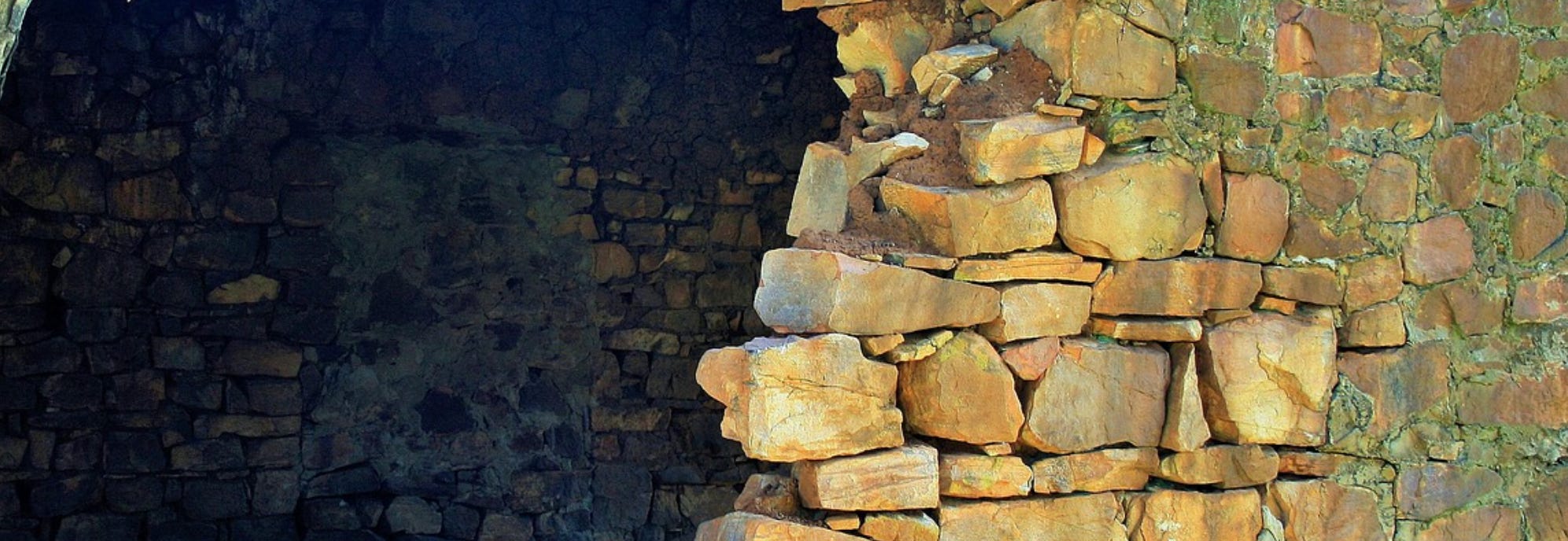
On the seventh day they rose early, at the dawn of day, and marched around the city in the same manner seven times... So the people shouted, and the trumpets were blown. As soon as the people heard the sound of the trumpet, the people shouted a great shout, and the wall fell down flat. — Joshua 6:15, 20
Six days of marching. Six days of circling a wall that did not move.
Every morning the priests lifted the ark. Every morning the seven trumpets sounded. Every morning the people fell into formation and walked the same path around the same walls and returned to camp. And the walls stood. Unchanged. Unmoved. As solid on the sixth day as they had been on the first.
If you had been watching from outside, you would have seen nothing happen six times in a row.
But something was happening. It just could not be seen yet.
Jericho was not an ordinary obstacle. The text tells us plainly: Jericho was shut up inside and outside because of the people of Israel. None went out, and none came in (Josh. 6:1). The gates were sealed. The city was locked. The people inside were not going anywhere, and neither, it seemed, was the wall.
By every military calculation, what God asked Israel to do made no sense. Walk around it. Do not shout. Do not let a single word leave your lips. Just walk, in formation, and go back to camp.
And do it again tomorrow. And the day after that.
God’s method of bringing down this heavily fortified city was not a siege engine or a strategy or a sudden overwhelming assault. It was six days of quiet, costly faithfulness. Six days of obedience that looked like nothing.
There is something important in what Joshua told the people before the first march: the people were silent. Do not shout or let your voice be heard, neither shall any word come out of your mouth (Josh. 6:10). Not a word. Not a complaint. Not a question about when something was going to happen.
This was not just a military tactic. It was a spiritual discipline. Six days of watching your own impulse to speak and choosing instead to trust. Six days of saying, by your presence and your movement and your obedience: we believe the word of God more than we believe what our eyes are telling us.
The walls looked the same on day six as they had on day one. But the people were not the same. Six days of faithful obedience had done something in them that the shout on day seven could not have done without it.
The sixth day of walking built the seventh day of victory.
The number seven runs through this passage like a river. Seven priests. Seven trumpets. Seven days. Seven circuits on the final day. In the world of Scripture, seven is the number of completion, of fullness, of what is done completely. God was not being arbitrary. He was building something.
Six days of obedience created a foundation that the seventh day could stand on. The shout on the final morning was not a sudden act of faith. It was the culmination of six days of faith that had been accumulating quietly, invisibly, in the bones of every person who had walked that circuit and said nothing and gone back to camp and risen the next morning to do it again.
The seventh day was loud. But the seventh day was built on six days of silence.
Most of us are somewhere in the middle of our six days.
We are doing what God has asked us to do. We are showing up. We are walking the circuit. We are being faithful with the ordinary, repetitive, unglamorous work of obedience. And the walls are still standing. Nothing seems to be changing. The situation looks exactly the same as it did last month, last year, the year before that.
And something in us wants to stop walking.
But the passage will not let us. Because what looks like the same walk is not the same walk. Day two is not day one. Day five is not day three. Each circuit adds something invisible, something that cannot be measured by looking at the wall but that is real and accumulating and building toward a moment we cannot yet see.
The walls of Jericho did not fall because of what happened on the seventh day. They fell because of what had been happening on days one through six. The shout was the release of everything that had been building in the silence.
Do not despise the six days. They are not delay. They are preparation.
Pay attention to what they carried. They did not walk in any order they chose. They marched in formation, with the ark of the covenant at the center, the word of God carried into the circuit with them on every pass. The trumpets sounding around it. The people arranged around it.
The wall did not fall because of the walking. It fell because of what was at the center of the walking. The ark. The presence. The word of God, carried around the obstacle, day after day, until the obstacle had no choice but to yield.
What we carry to our own walls determines what happens to them. Strategy and effort and persistence matter. But what is at the center of it matters more. If the word of God is at the center, if His presence is what we are carrying into the circuit, then what seems like unanswered walking is in fact the steady accumulation of something the wall cannot ultimately withstand.
The walls do not fall on the first day. They fall on the seventh. And the seventh day is only possible because of the six that came before it.
If you are in your sixth day, do not stop. If you are in your third day, do not stop. If you are in your first day, wondering whether this kind of faithfulness will ever produce anything visible, do not stop.
The shout is coming. But first, there is walking to do.
Keep walking. The walls know what is at the center of your circuit.
© 2026 Bible Portal. Share freely. Please keep the source and a link to Bible Portal intact. For other uses, contact us.
No posts
Comments
Nothing yet. Say the first thing.
Sign in to join the conversation.