
There’s a particular kind of exhaustion that comes from staying somewhere you’ve outgrown.
I’m talking about the weariness of pretending, shrinking and convincing yourself that “fine” is the same thing as “fulfilled.” Two decades ago, I sat in a conference room during yet another meeting that should have been an email. Chest tight. Wondering how I’d gotten so good at making myself small. Just saying ‘I am fine’ like a mantra that would bring me solace.
I know this feeling intimately.
My body was present. My ambition had already packed its bags and was waiting impatiently by the door, arms crossed and toe tapping. I knew something bigger was calling me. I also knew that walking toward it meant leaving behind a predictable paycheck, a title people understood, and a version of success that looked impressive on paper. I was terrified of what my family and friends might think if I traded security for uncertainty or if I failed. The fear of losing my salary and disappointing those who believed in my stability weighed heavily on my shoulders.
So I stayed. For a while.
Because here’s what nobody tells you about the familiar. It doesn’t have to be good to feel safe. It just has to be known.
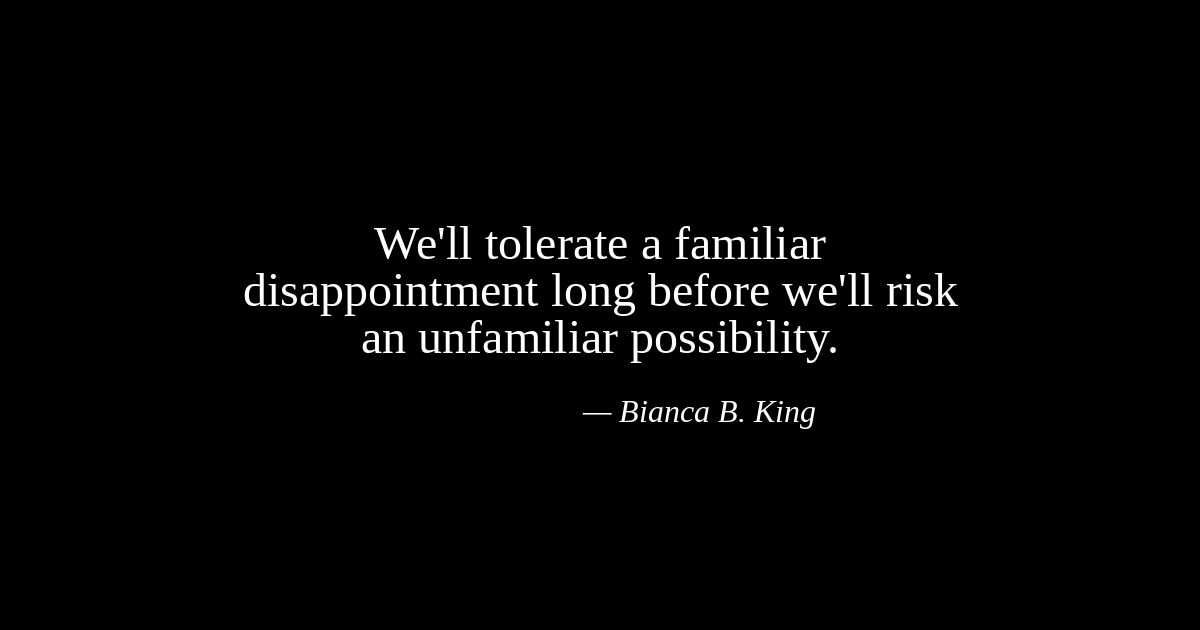
We’ll tolerate a familiar disappointment long before we’ll risk an unfamiliar possibility.
We cling to relationships that drain us, business models that bore us, and identities that no longer fit. We’ve memorized them. We know them like the route home when your mind is somewhere else. We arrive already knowing how much disappointment to expect. We’ve calibrated our hopes accordingly. These are the comfortable bars of our well-worn cages.
We all hold tight to the familiar like a battered orange life raft with a single oar, as if we’re adrift in the vast Indian Ocean. I still find spaces in my life where I’m gripping that old raft. When I let go, when I really let go, the universe sends a super yacht. Suddenly, I’m basking on the sundeck, cold drink in hand, instead of huddled in a life preserver, barely keeping my head above water.
Uncertainty, on the other hand, asks us to trust ourselves without proof. To bet on a version of our lives we can only imagine, never guarantee. Every courageous choice begins in the dark, a reminder that uncertainty is a shared human experience, not evidence of inadequacy. And that feels terrifying. What if we’re wrong? What if we let go of the good-enough and reach for something bigger, only to come up with nothing?
The fear of letting go is almost never about what we’re leaving.
It’s about who we’ll have to become on the other side. It’s becoming the woman who trusts herself enough to build what she actually wants.
Growth requires identity shifts. The woman who stays small and the woman who builds something remarkable cannot coexist. One of them has to go.
Grieving who you’ve been is real grief. Even the version of you that was struggling, settling, playing it safe. That version survived. She coped. She made it this far. Letting her go feels like betrayal, even when it’s actually evolution. To honor this transition, consider a ritual that acknowledges your journey. You might write a letter of gratitude to your former self, thanking her for the strength and wisdom she imparted. It sounds small. It isn’t.
First, we stop shaming ourselves for the hesitation. Fear of the unknown isn’t weakness; it’s human. Your nervous system is doing exactly what it was designed to do. Keep you alive by keeping you in familiar territory. In these moments, practice a simple self-soothing tool. Take a deep breath and name what you’re feeling. Acknowledge the fear, frustration, or doubt swirling inside. It won’t fix everything. It will buy you enough space to think.
Second, we get honest about the cost of staying. The obvious costs and the quiet ones. The dreams deferred. The energy spent managing disappointment instead of building something meaningful. The slow erosion of believing you’re capable of more.
Third, we take the next small step anyway. One decision that points you toward what you actually want, even if your hands shake while you make it.
What if letting go didn’t mean losing yourself? What if it meant finding the version of you that’s been waiting beneath the performance?
I started my business with $700 during the Great Recession. I didn’t have certainty. But what I had was a new marriage, a mortgage, student loans, a vision, and this unshakable knowing that staying where I was would cost me more than leaving ever could.
The uncertainty didn’t disappear. I just stopped letting it make my decisions for me.
What you want is on the other side of the familiar. I genuinely believe that. You don’t have to sprint toward it. You just have to stop walking in the opposite direction. And when you rise, you make it easier for the woman behind you to see what’s possible.
You don’t have to walk it alone. There are hands reaching back for you. But they can’t hold yours if you’re still gripping the raft.
The cage door is open, love. It always has been.
Let’s take the next step together.
What familiar thing are you holding onto that you’ve already outgrown? I’d love to hear from you in the comments.
Comments
Nothing yet. Say the first thing.
Sign in to join the conversation.